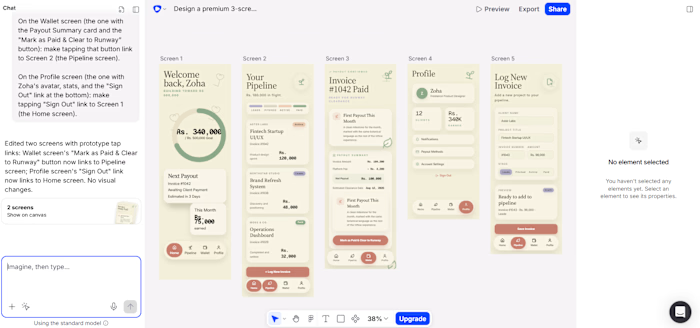
University Quest OS — Traceable Study-Abroad Planning

Zoha Ahmed


Self-initiated project. Built solo over a few weeks, for a problem I was having myself.
I'm in my second year of college in Karachi, and the moment I started seriously planning to apply abroad, the process fell apart in about an hour. Six tabs open. Three PDFs I couldn't verify were still accurate. No idea which deadline was actually real.
The thing is, applying abroad isn't a hard process. It's a well-documented one. The difficulty is that the documentation is scattered across a hundred sources, and not one of them tells you whether it's still true. Every guide is written with total confidence. Almost none of them are dated. You end up making decisions worth years of your life on advice that might be four admissions cycles stale.
So I built the thing I needed.
How it works
You upload your own research — official university PDFs, visa guides, scholarship documents, whatever you've actually collected — and University Quest OS turns them into a structured plan.
The part I care most about: every requirement traces back to the exact page it came from. Not a summary. Not a paraphrase. The page. If the planner tells you a deadline is a certain date, you can click through and read the source sentence that produced it.
That constraint drove most of the architecture. It's easy to build something that reads your documents and confidently tells you what to do. It's harder to build something that can always show its working — and for this problem, showing the working is the product. The whole reason the existing guides fail is that you can't check them.
The decision I'd defend
Each destination is its own separate world, not a reskinned dashboard with a country filter on top.
Building one generic pipeline would have been dramatically less work, and it's what I'd have done if I were optimising for shipping speed. I didn't, because applying to the UK and applying to Germany are not the same process wearing different flags. The requirements differ, the sequencing differs, the vocabulary differs. A single abstracted pipeline would have quietly flattened those differences — and reintroduced exactly the problem I built this to solve: confident information that doesn't quite apply to you.
The generic version would have looked more impressive and been less true.
Status
Working tool, built solo. Still refining it, and I use it for my own applications.
Like this project
Posted Aug 23, 2026
A study-abroad planner that turns your own uploaded documents — visa guides, scholarship PDFs, university brochures.