
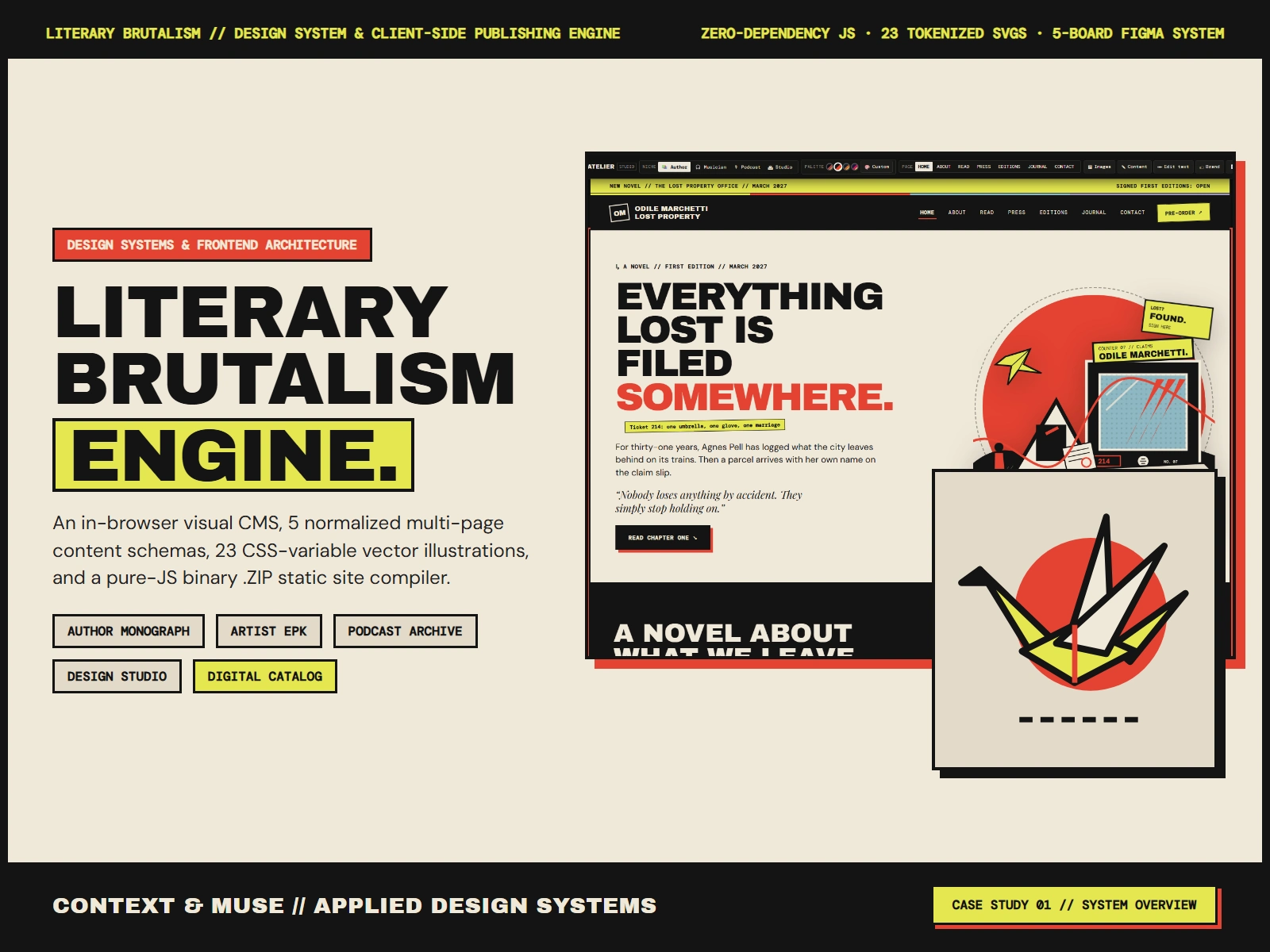
01 // SYSTEM OVERVIEW — Literary Brutalism is a zero-dependency client-side publishing engine and design system built at Context & Muse, combining an in-browser visual CMS, 23 CSS-tokenized vector illustrations, and a pure-JS static site compiler.
OVERVIEW & ARCHITECTURAL GOAL
Literary Brutalism is an internal design system and client-side publishing engine developed at Context & Muse. The goal was to explore how far a modern editorial web application can go using zero external frameworks, zero build dependencies, and zero server runtime—while still giving non-technical creators a full visual editing studio and static site compiler inside a single HTML document.
ROLE & SCOPE
• Design Systems & Typography Architecture (5-Board 1440px Figma System)
• Art Direction & Vector Illustration (23 CSS-Tokenized SVGs)
• Frontend Engineering (In-Browser Visual Editor, State History & Binary .ZIP Compiler)
• Automated Verification (34-Assertion Headless Browser & HTTP E2E Test Suite)
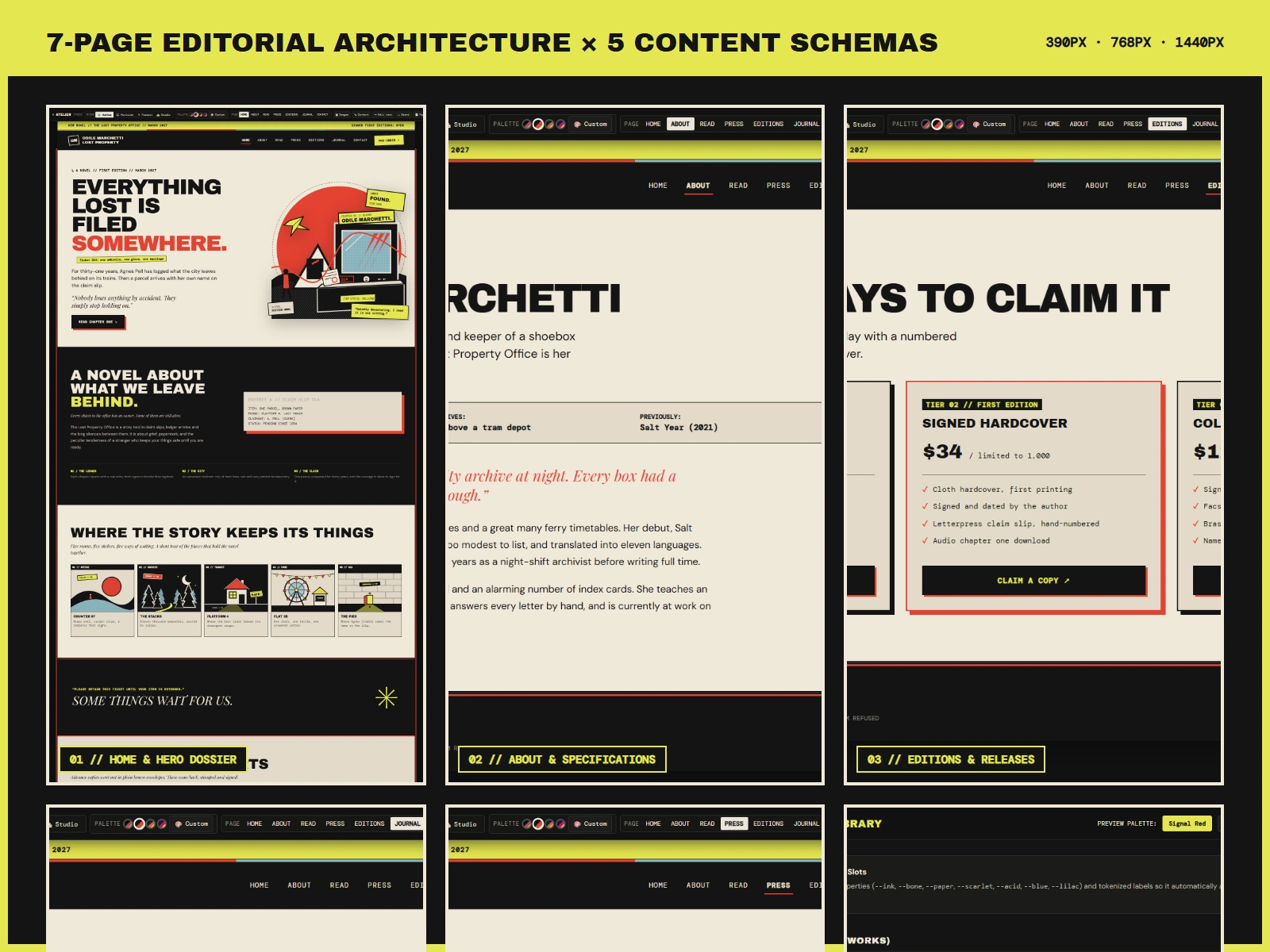
02 // 7-PAGE ARCHITECTURE × 5 CONTENT SCHEMAS — A single normalized JSON content schema drives 7 editorial page layouts (Home, About, Long-Form Reader + Audio Player, Press Kit, Editions, Tag-Filterable Journal, and Contact) across 5 distinct publishing presets.
MULTI-NICHE CONTENT SCHEMA & 7-PAGE ROUTING
Rather than hardcoding markup to a single vertical, the rendering engine decouples layout geometry from a normalized JSON content schema. A single 7-page editorial architecture (Home, About, Long-Form Reader + HTML5 Audio Player, Press Kit, Editions, Tag-Filterable Journal, and Contact) dynamically adapts across five distinct publishing models—literary monograph, recording artist EPK, narrative podcast archive, creative studio, and digital catalog.
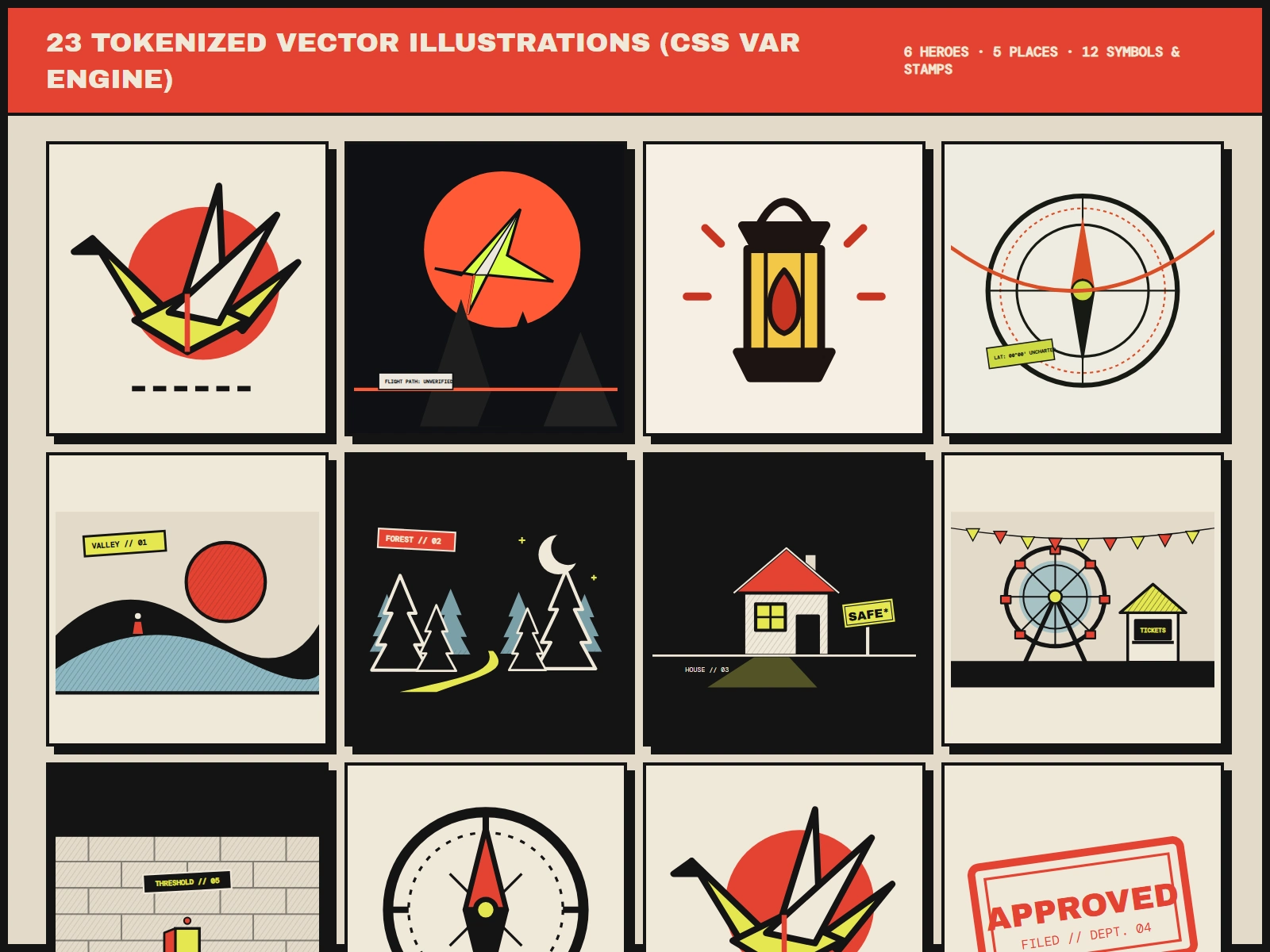
03 // 23 CSS-TOKENIZED VECTOR ILLUSTRATIONS — 6 hero compositions, 5 architectural place cards, and 12 technical stamps & symbols wired directly to 7 semantic CSS color variables and dynamic text tokens for real-time palette recoloring.
LIVE SVG COLOR & DOCKET TOKENIZATION
To replace generic stock photography with cohesive print-inspired artwork, I illustrated 23 modular vector compositions (6 hero scenes, 5 architectural places, and 12 technical stamps and symbols). Every SVG is bound directly to 7 semantic CSS custom properties (--ink, --bone, --paper, --scarlet, --acid, --blue, --lilac) and dynamic text nodes, allowing the entire illustration library to recolor and re-stamp metadata in real time when switching themes.
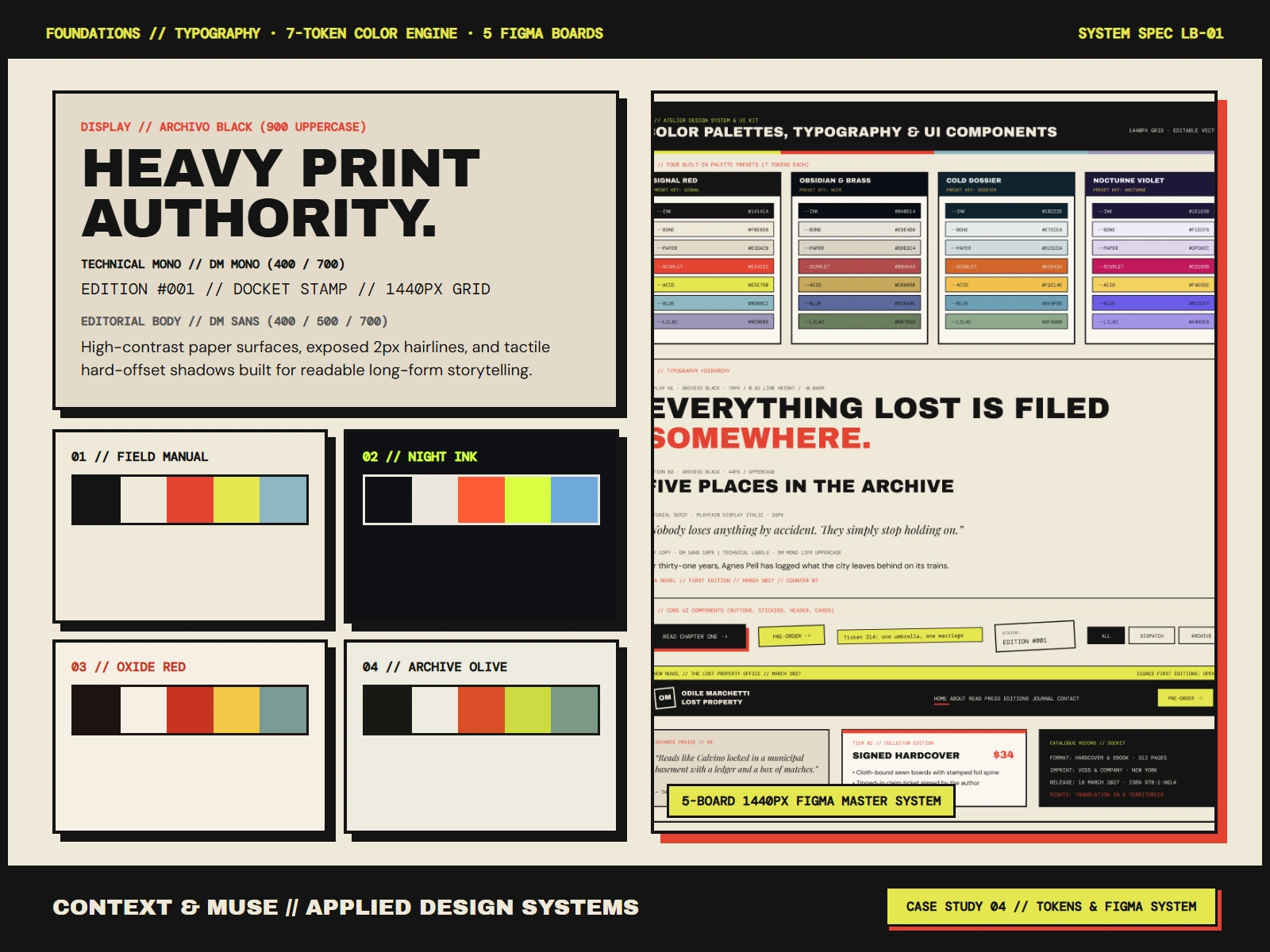
04 // TYPOGRAPHY, 4 ARCHIVAL PALETTES & 5-BOARD FIGMA SYSTEM — Built on Archivo Black, DM Mono, and DM Sans across 4 one-click color themes (Field Manual, Night Ink, Oxide Red, Archive Olive), paired with 5 consolidated 1440px Figma master sheets.
TYPOGRAPHIC HIERARCHY & 5-BOARD FIGMA MASTER SYSTEM
The visual language pairs heavy industrial display headlines (Archivo Black) with stamped technical indices (DM Mono) and high-contrast editorial body copy (DM Sans) across four archival palettes (Field Manual, Night Ink, Oxide Red, Archive Olive). The complete token matrix, responsive component anatomy, and vector specimen library were consolidated into five 1440px Figma master sheets.
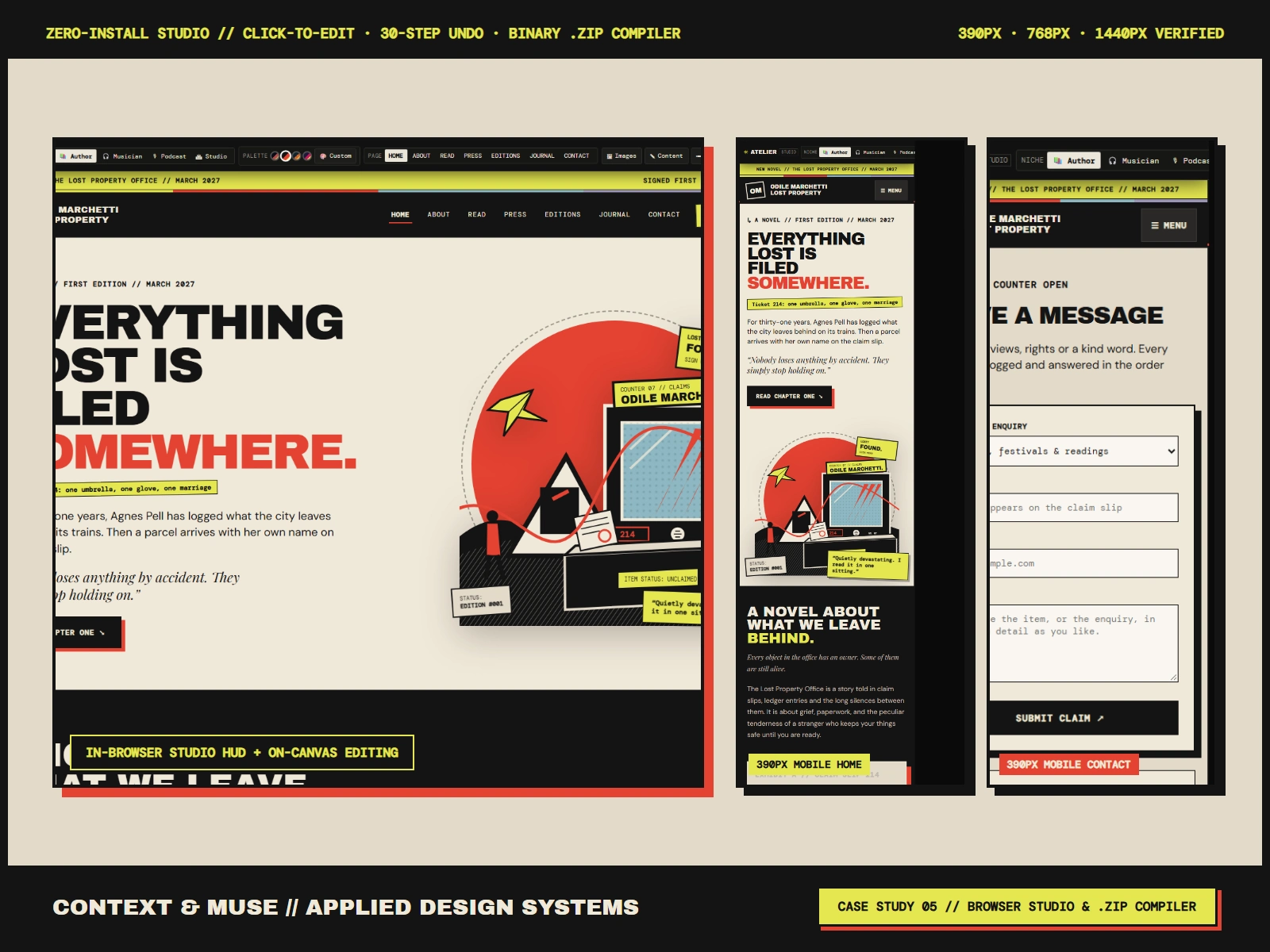
05 // IN-BROWSER STUDIO HUD & BINARY .ZIP COMPILER — Features direct on-canvas contenteditable authoring, repeatable array controls, a 30-step Undo/Redo history stack, automated 1200×630 Open Graph canvas generation, and an in-memory CRC32 binary .ZIP builder verified across 390px, 768px, and 1440px viewports.
CLIENT-SIDE VISUAL STUDIO & PURE-JS BINARY .ZIP COMPILER
The embedded Studio HUD provides direct on-canvas contenteditable authoring, repeatable array mutation controls, a 30-step Undo/Redo state stack with localStorage session recovery, and an HTML5 Canvas renderer that automatically generates a 1200×630 Open Graph card from the active palette. When publishing, a custom pure-JavaScript CRC32 binary .ZIP builder packages a clean, standalone static website directly in browser memory.
Live System Preview: https://blueprints.contextmuse.com/literarybrutalism
0 likes · 2 views · Nov 23, 2026
An in-house editorial design system and zero-dependency client-side publishing engine featuring an in-browser visual CMS, 23 CSS-tokenized vector illustrations,


