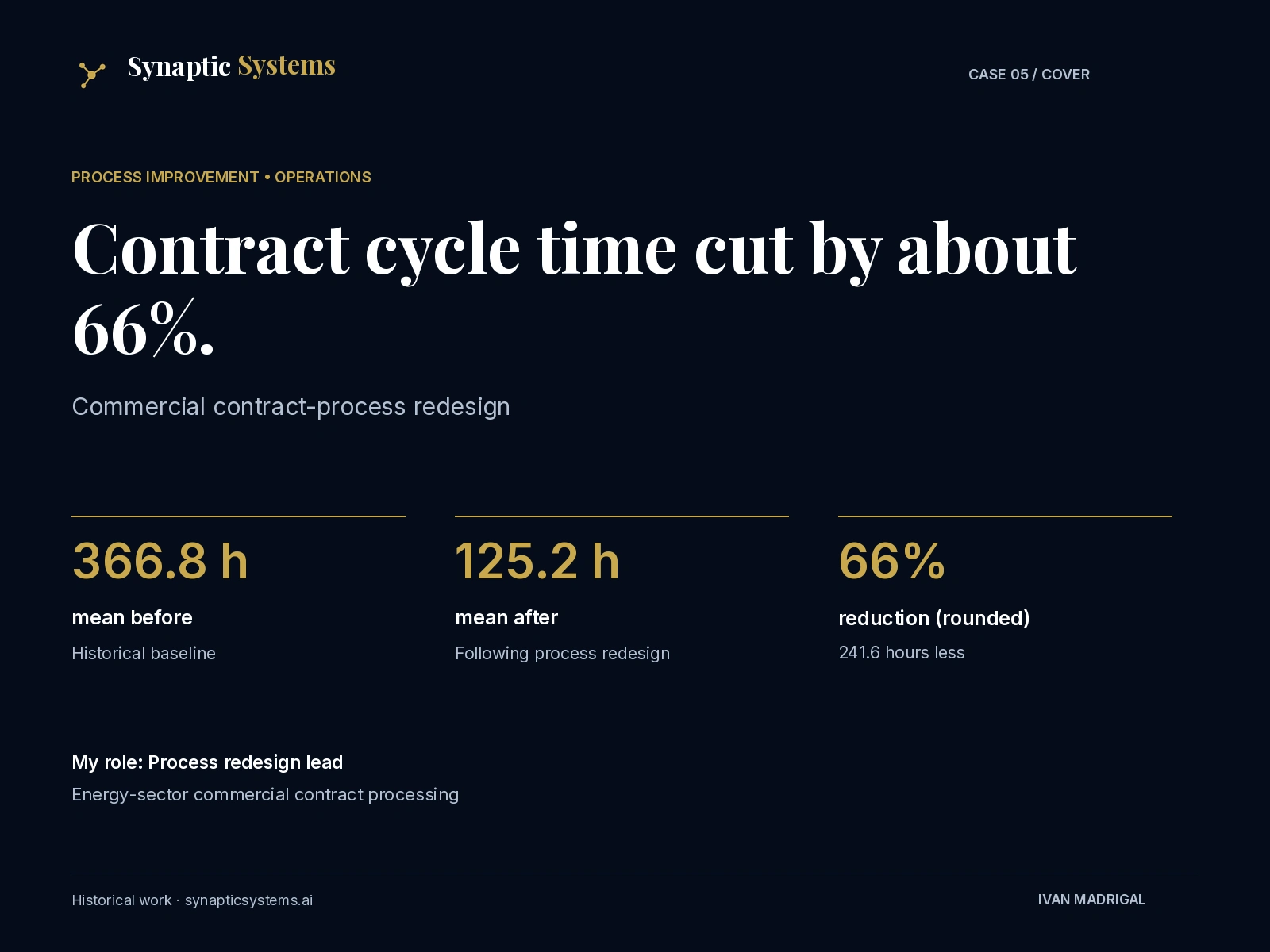
Contract cycle time cut by about 66%.

Ivan Madrigal

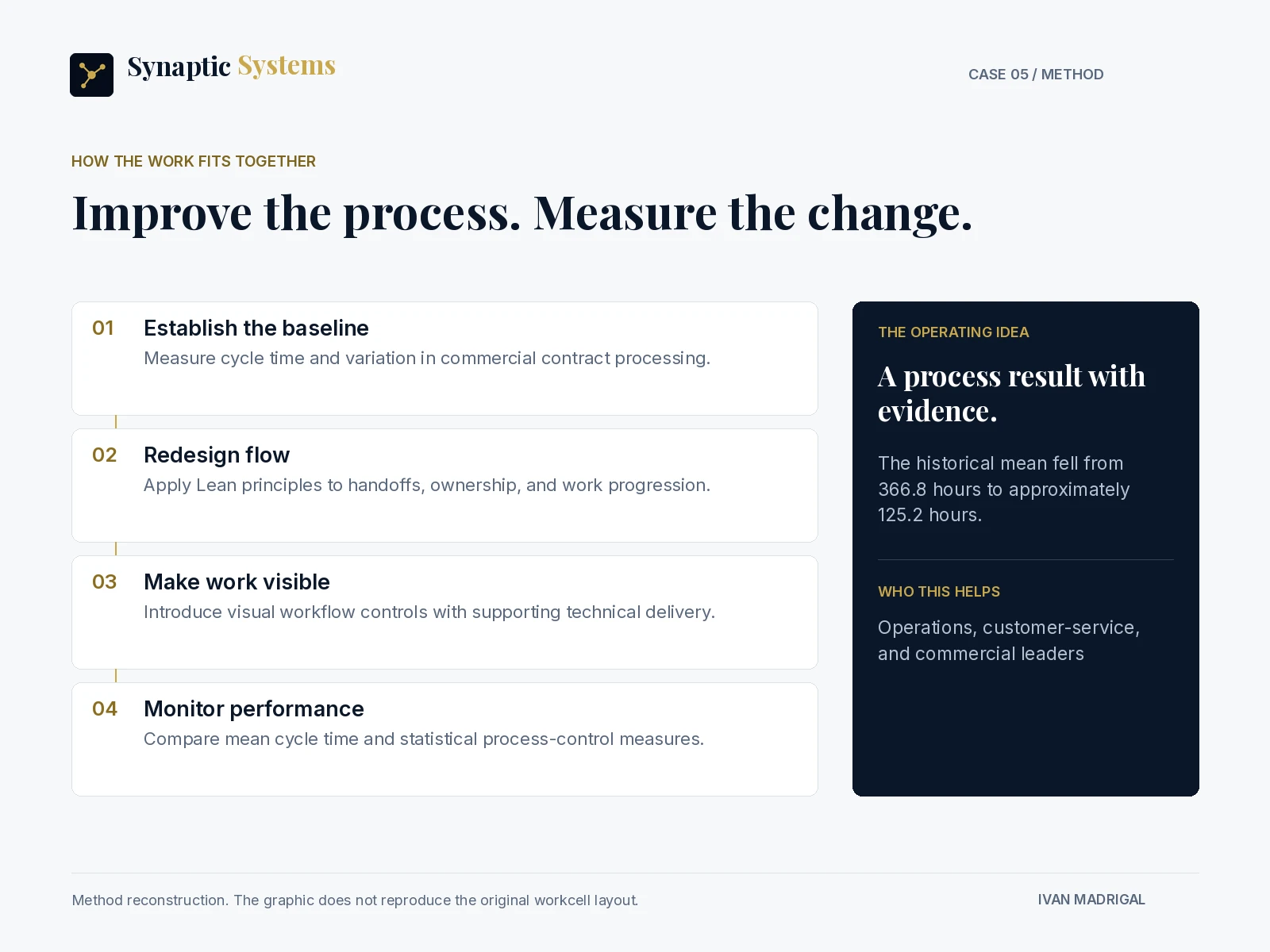
A reconstructed improvement method: establish the baseline, redesign flow and ownership, implement visual controls, and monitor performance.
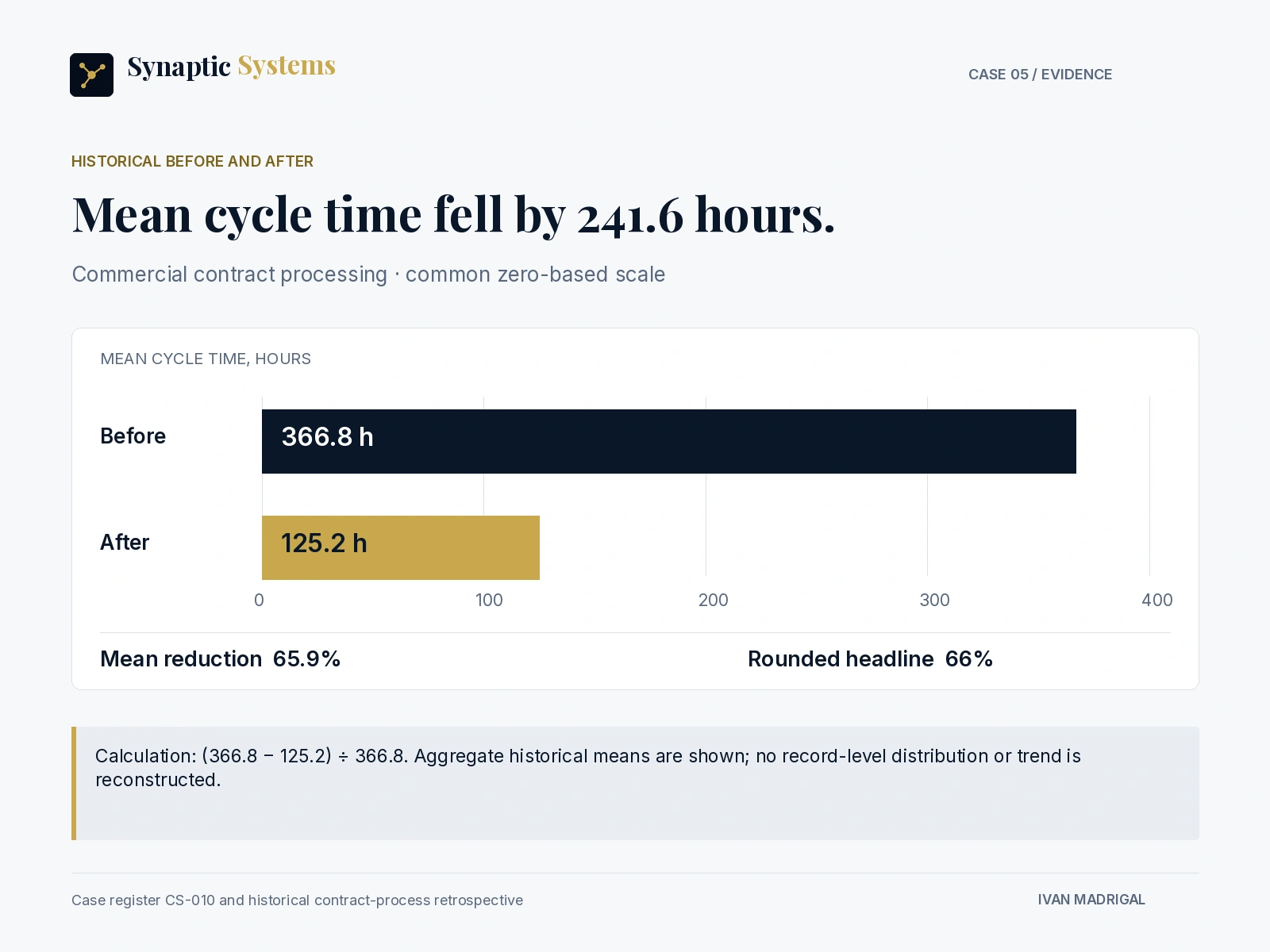
Before-and-after mean cycle time plotted on a common zero-based scale. These are aggregate historical means, not a time series or a paired record-level dataset.
The business problem
Commercial contract processing had long, variable cycle times. The historical baseline recorded a mean of 366.8 hours, creating delays and making performance difficult to manage.
My role and approach
I led process redesign using Lean principles, visual workflow management, and statistical process control. A technical colleague implemented supporting technology. The case emphasizes flow, ownership, and measurement rather than attributing the result to software alone.
The result
Mean cycle time fell from 366.8 hours to approximately 125.2 hours: a reduction of 241.6 hours, or 65.9%, rounded to about 66%. The reported upper control limit also fell from approximately 743 to 226 hours. A control limit is a statistical process measure, not the longest observed contract.
Why this case belongs in the portfolio
The result demonstrates operational improvement before the current AI wave. It shows the process and measurement discipline I bring to present-day automation: establish a baseline, redesign the work, and check whether the result actually changed.
Like this project
Posted Oct 20, 2026
Led process redesign that reduced mean commercial contract cycle time from 366.8 to 125.2 hours, supported by visual workflow controls.
Likes
0
Views
2