Transforming physical inventory into digital intelligence

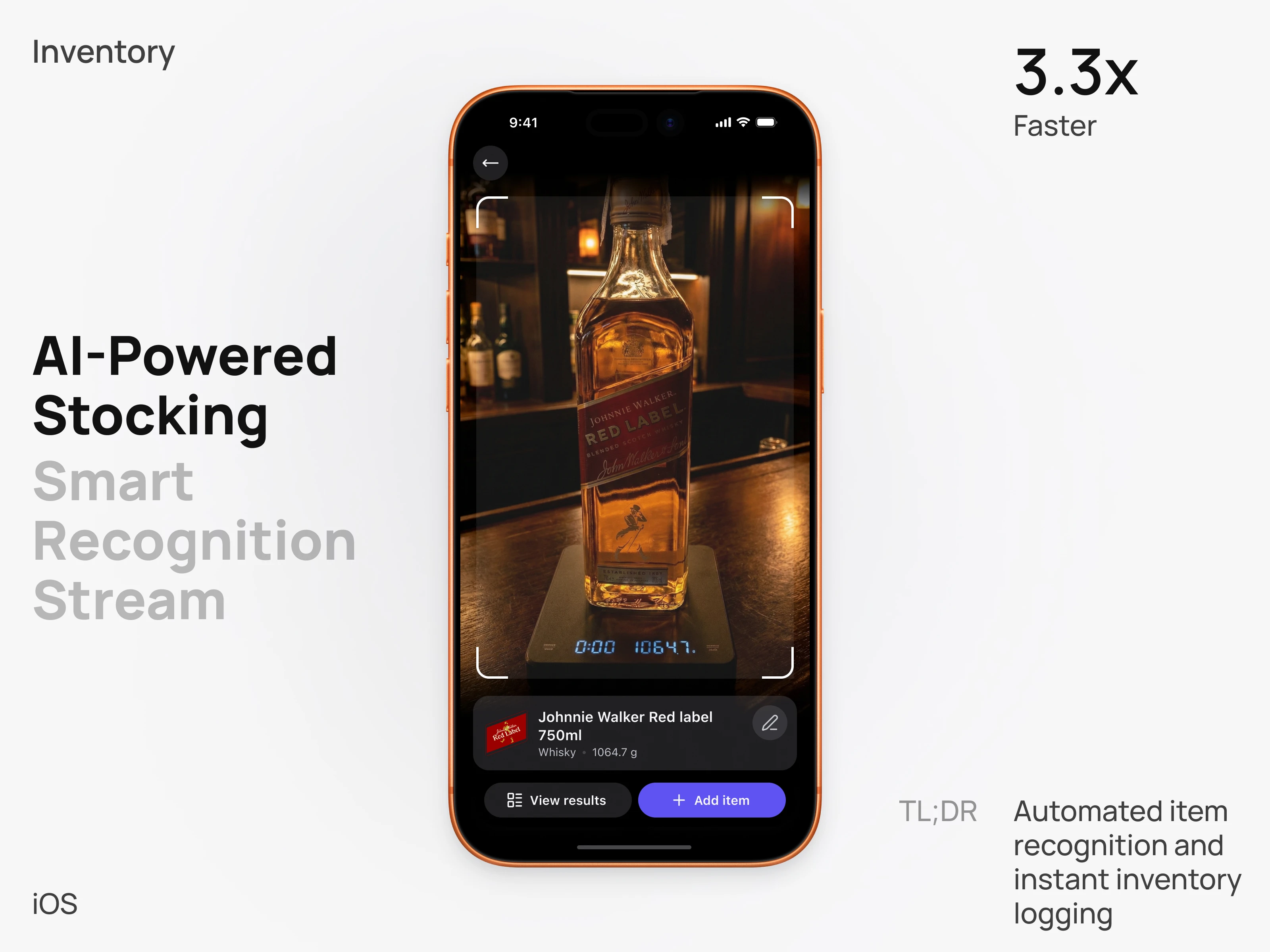
Transforming physical inventory into digital intelligence
Background
Inventory is the disconnect between the physical bar and the digital back-office. Traditionally, staff rely on visual estimation (using rulers) and tedious manual entry into legacy apps. This process is slow and prone to "fat-finger" errors. I led the design for the BarBuddy MVP, an iOS tool that automates this workflow. It connects directly to the venue's POS, allowing staff to conduct rapid audits and sync data instantly.
Challenges
Driving adoption of "invisible" tech
Staff preferred tangible tools over opaque algorithms. We had to design a workflow that felt controllable and transparent to ensure the feature didn't get abandoned on day one.
Objectives
Speed to market: Ship a stable, usable MVP in 3 months.
Smart automation: Replace manual typing with dual-AI vision (reading both bottle labels and scale displays).
Data integrity: Create a UI that handles high-density data without clutter.
Team
1 Designer, 2 Developers, 1 Product Manager, 2 Product Owners
Role
Product Designer
iOS App Design
User Research
Data Visualization
Duration
3 months
Strategy
Validating the "One-Handed" Workflow
Since this was an MVP, my strategy focused on validating the riskiest assumption: that a mobile-first flow could replace established manual habits in a high-stress environment.
01 . Usage under fatigue
Inventory happens at the end of a shift when staff are tired and focus is low. Complex flows will lead to abandonment.
Validation: I tested a linear, distraction-free camera interface. User testing confirmed that removing setup steps allowed staff to enter a rhythmic "flow state," scanning bottles 3x faster than typing.
02. Trust through verification
Users won't trust AI unless they can verify the data instantly.
Validation: I implemented a "Scan & Confirm" loop. Interviews showed that the ability to manually correct the AI increased trust. Users felt in control, treating the MVP as a helpful assistant.
03. Immediate feedback loop
Staff hate inventory because they never see the results of their labor.
Validation: I introduced an Instant overview panel that appears immediately after the session. We validated that positive reinforcement improved completion rates.
Design
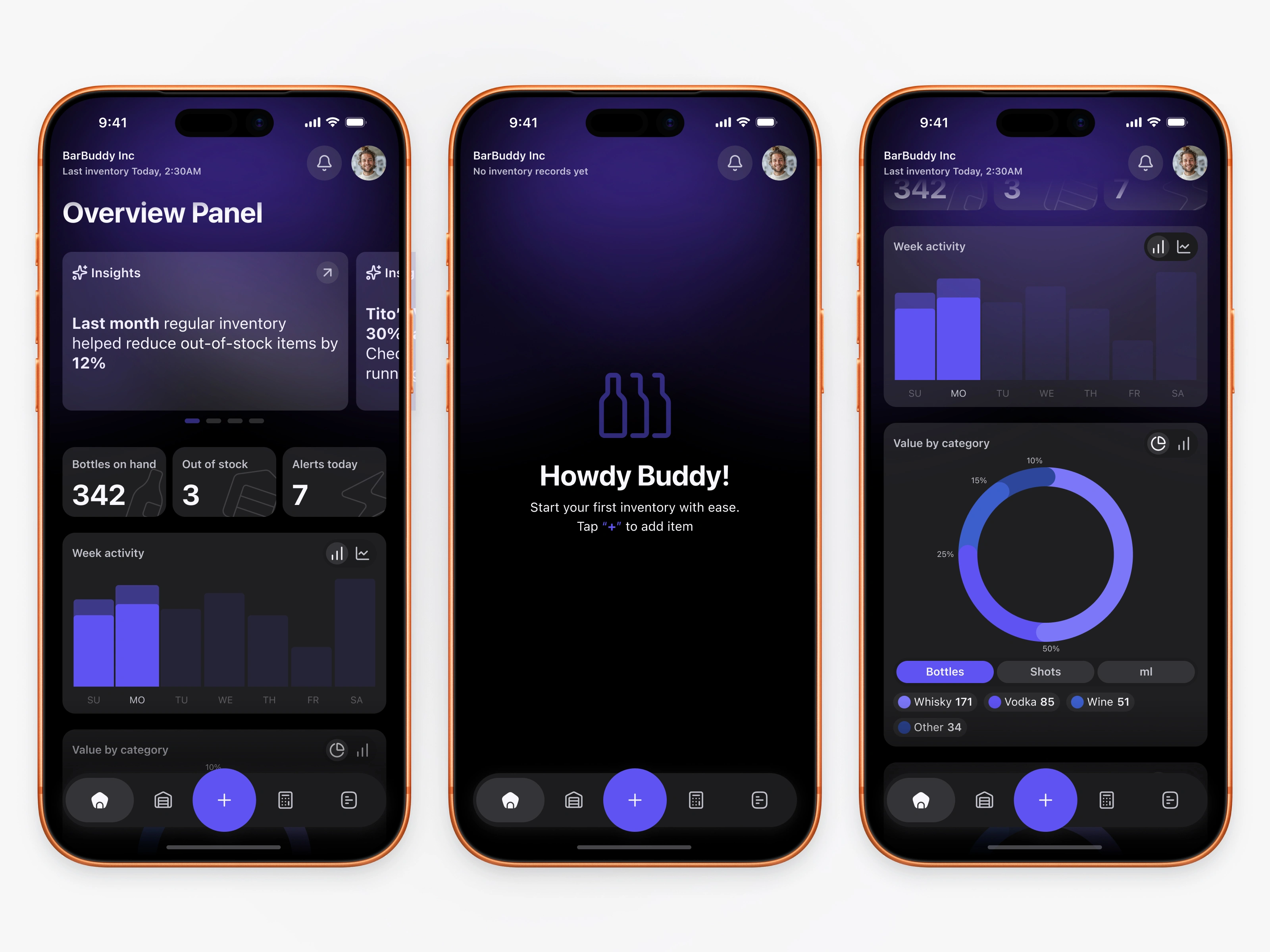
01. Dashboard & Operations
The home screen serves as a command center. It visualizes metrics like Bottles on hand and Week activity charts. A prominent "Add" button allows users to start an inventory session instantly. The "Insights" card acts as a nudge, showing the tangible value of regular audits.
02. Camera-integrated workflow
The scanning interface is optimized for low light. The camera simultaneously identifies the bottle brand and reads the digital number directly from the scale’s display. This allows the app to work with any existing hardware, removing the need for expensive Bluetooth equipment.
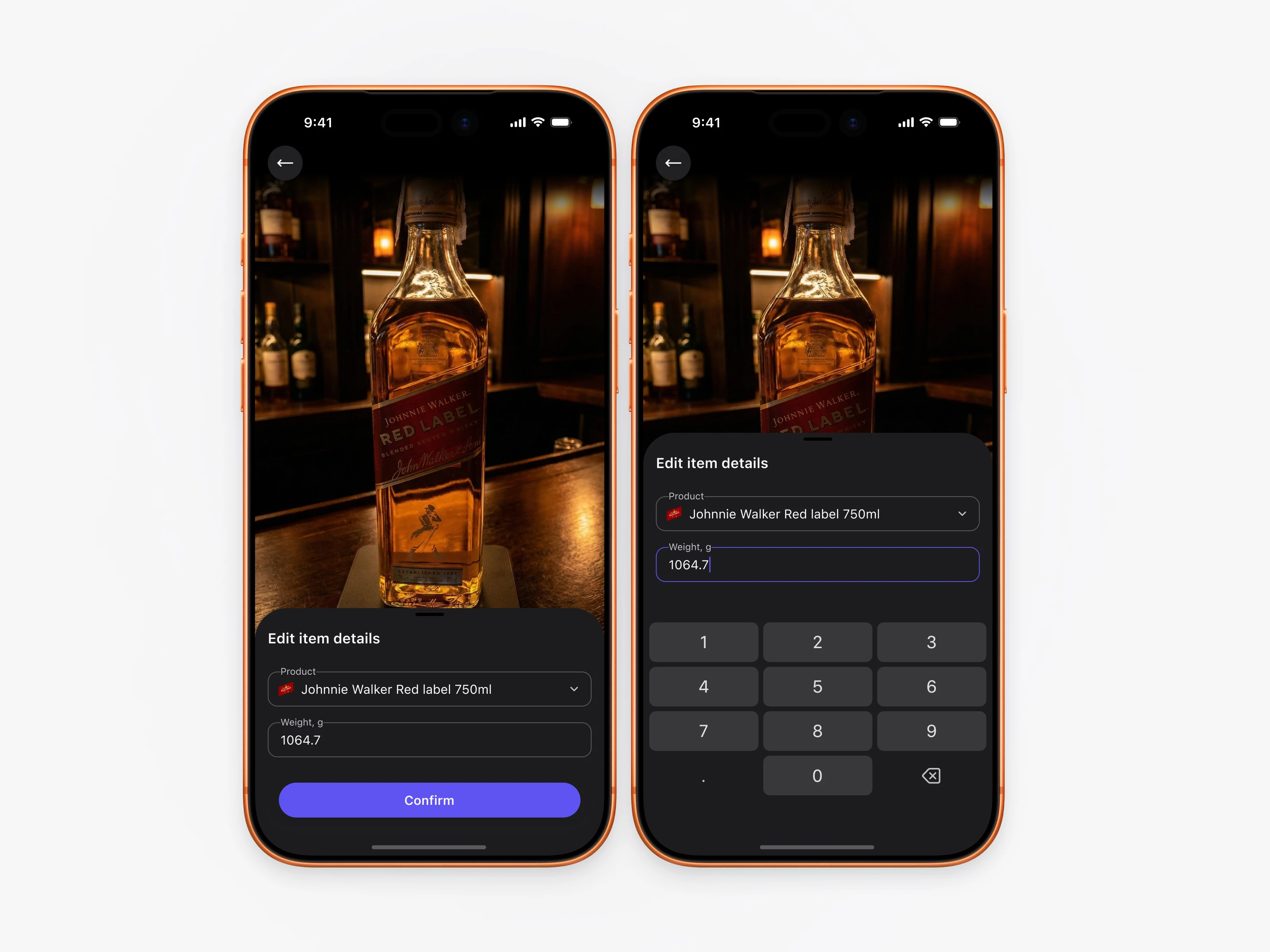
03.Frictionless editing
Trust is built through control. When a user needs to adjust a scan, I utilized a bottom-sheet modal with large touch targets, ensuring that corrections can be made in seconds and that only clean data reaches the back office.
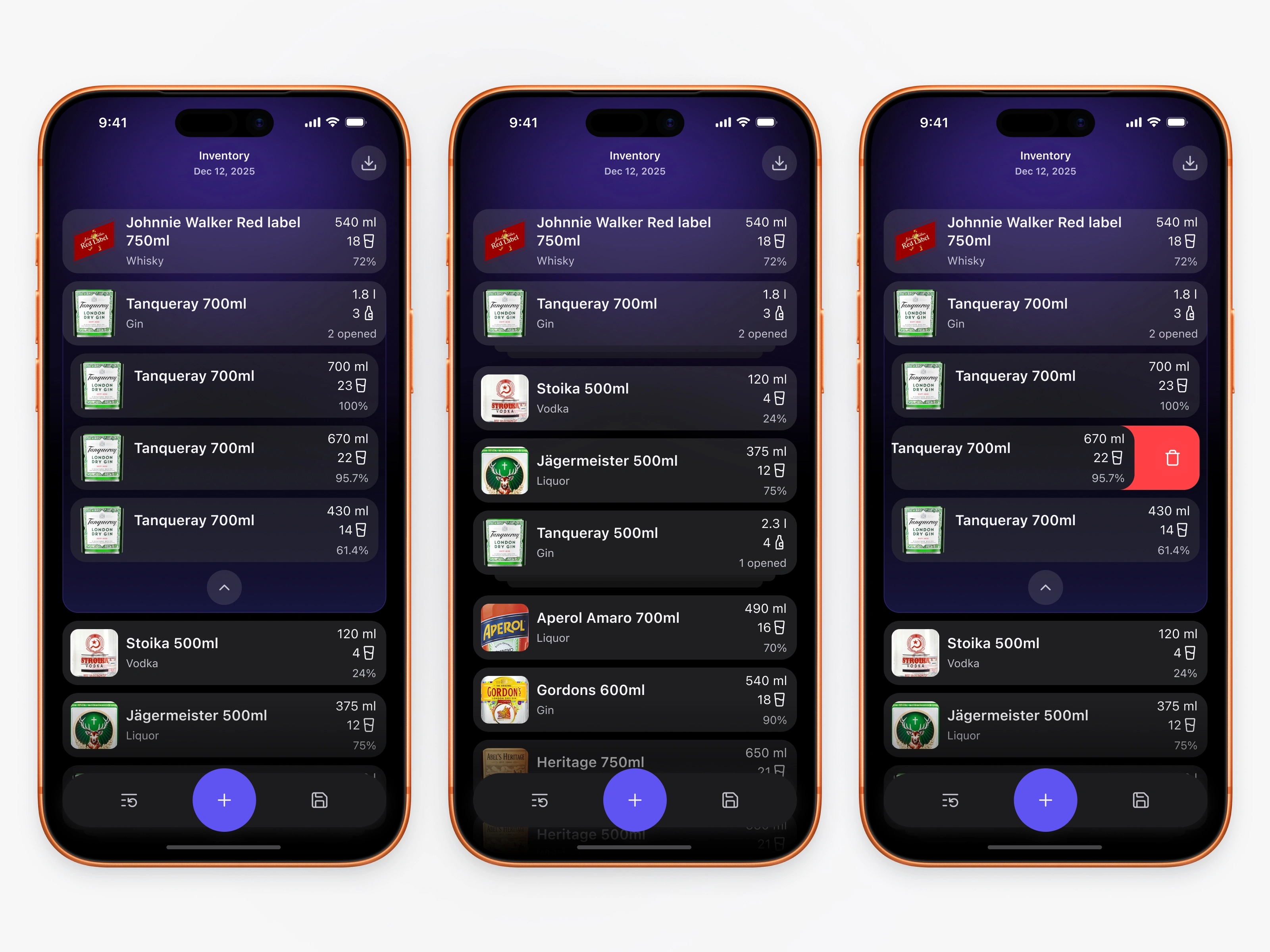
04. The smart inventory list
The final output prioritizes revenue-focused metrics. I implemented Smart Grouping to stack identical items, the interface translates abstract volume (ml) into usable shots—the currency of bar operations. Interactions allow users to inspect individual bottles or remove accidental scans, providing an immediate view of the total available stock rather than just abstract trends.
Outcomes
Trust via accuracy: The verification flow proved that AI was 98% accurate, eliminating the fear of errors.
Adoption via speed: Once trust was established, staff fully embraced the tool, reducing inventory time by 70% (from 2 hours to 40 mins).
Foundation for growth: The end-to-end product vision secured Pre-Seed funding for further development.
Takeaways
Context is King: Designing for a dark bar requires different contrast ratios and font sizes than a standard office app.
Trust requires control I learned that "seamless" doesn't always mean "automatic." Users were hesitant to trust the AI until I gave them the power to edit it. Adding the manual confirmation step paradoxically increased confidence in the automation. People trust algorithms more when they feel they can fire them.
MVP is about subtraction To ship in 3 months, we had to be ruthless. We cut "nice-to-have" analytics to focus entirely on the core scanning experience. This taught me that a polished core feature beats a half-baked comprehensive suite every time.
0 likes · 0 views · Oct 15, 2026
Led BarBuddy iOS MVP using dual-AI vision to scan bottles and scales, greatly improving accuracy and cutting inventory time.