Kingsmont Institutional Investment Website Design

Alexander Nevsky


Kingsmont — institutional investment website built in less than a day with AI
I designed and built the new website for Kingsmont, a Dubai-based investment company, in less than one working day using Google Antigravity and Gemini 3.8 Flash High (Fast) as my primary AI development environment.
The goal was to create an institutional website that felt serious and established without falling into the usual corporate-finance clichés. I worked from the company’s existing materials and real business information, defined the information architecture and visual direction, then moved directly from product and design decisions into production code.
The visual direction became “Quiet Institutional Power” — dark, restrained and editorial, with strong typography, structured information and subtle interactive elements. The production repository deliberately treats the company’s supplied corporate materials as the source of truth and avoids inventing portfolio companies, investment figures or other unsupported claims.
All of the visual imagery for the new site was AI-generated and art-directed as part of the same workflow. For the leadership section, I kept the real photographs of the team members, but integrated them into newly generated office environments so the imagery felt consistent with the new brand world rather than like a collection of unrelated headshots.
The site is live at kings-mont.com.
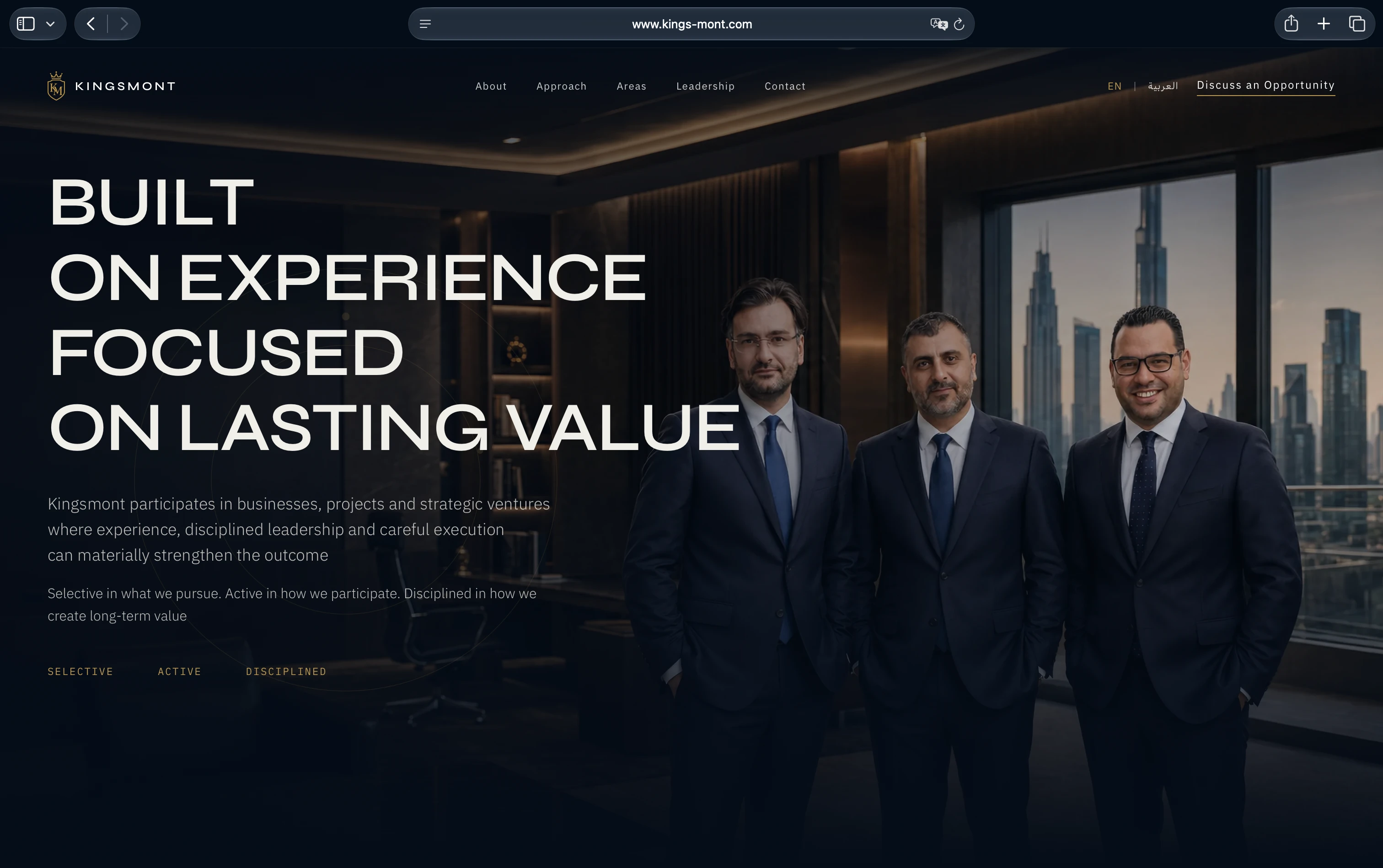
Home Page
Stack
Astro 7 · TypeScript · Tailwind CSS 4 · Three.js · Zod · Sharp · Cloudflare Pages
I chose Astro with static output because this is primarily a content-first institutional website. Most pages do not need a client-side application runtime, so Astro lets the site ship as clean static HTML and keeps JavaScript limited to the places where interaction actually adds value. Next.js was explicitly excluded because it would have introduced complexity without solving a real product requirement.
Tailwind CSS 4 sits on top of a dedicated design-token system, giving me enough speed to iterate with AI agents while keeping typography, spacing and visual rules controlled rather than letting generated UI drift from screen to screen. The typography system uses Syne for display, IBM Plex Sans for body/UI, and IBM Plex Mono for system labels.
For the interactive partnership visualization I used Three.js directly rather than bringing in a large animation framework. The production code includes a custom WebGL globe, while simpler motion stays in CSS and Intersection Observer. Framer Motion and GSAP were deliberately left out of v1.
Content is structured as JSON with Zod validation, imagery is processed with Sharp, and the site deploys as a static build to Cloudflare Pages. The repository also contains dedicated checks for leadership content, public claims and the contact form rather than relying only on whether the build compiles.
The interesting part for me is not that AI generated a lot of code quickly. It is that I could hold the entire loop myself:
research → product structure → visual direction → generated imagery → interface design → implementation → QA → production
That is increasingly how I work now: 15+ years of product design, with AI collapsing the distance between design and shipping.
Like this project
Posted Sep 15, 2026
Designed and built a website for Kingsmont using AI tools in less than a day.