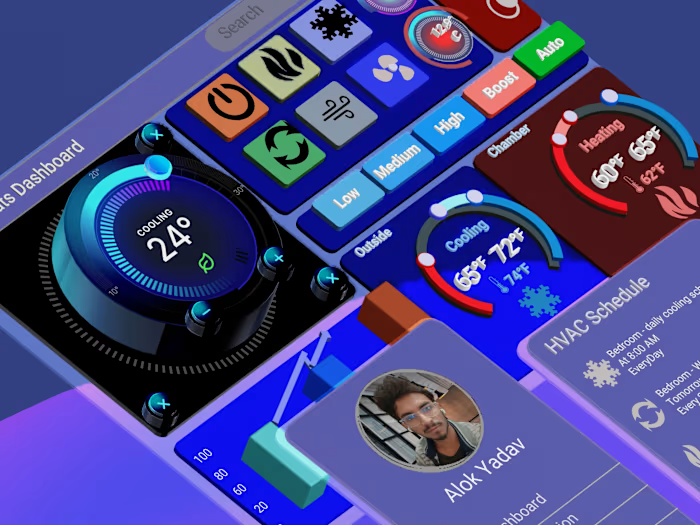
Liquid Glass Interactive 3D Product Showcases

Alok Yadav


Liquid Glass · Interactive 3D Product Showcases — Analysis Hub
(Design systems that move — not just look good)
I build immersive product experiences using Spline + Framer + custom HTML/CSS — a “liquid glass” aesthetic that blends holographic 3D panels with performant web delivery. The result is a modern, tactile interface that increases engagement and makes complex data beautifully readable.
What this project is about?
Analysis Hub is a design experiment turned product showcase: layered, frosted-glass panels with dynamic refractions and smooth motion, embedded directly into a Framer landing page. It demonstrates how UI can feel fluid, responsive, and alive — perfect for product demos, dashboards, and brand experiences.
Quick highlights
Interactive 3D scenes built in Spline and embedded into Framer.
Custom HTML/CSS tweaks for fine visual control and responsiveness.
Motion-first approach: parallax, camera sweeps, and micro-interactions.
Visual language: glassmorphism + holographic accents + neon highlights.
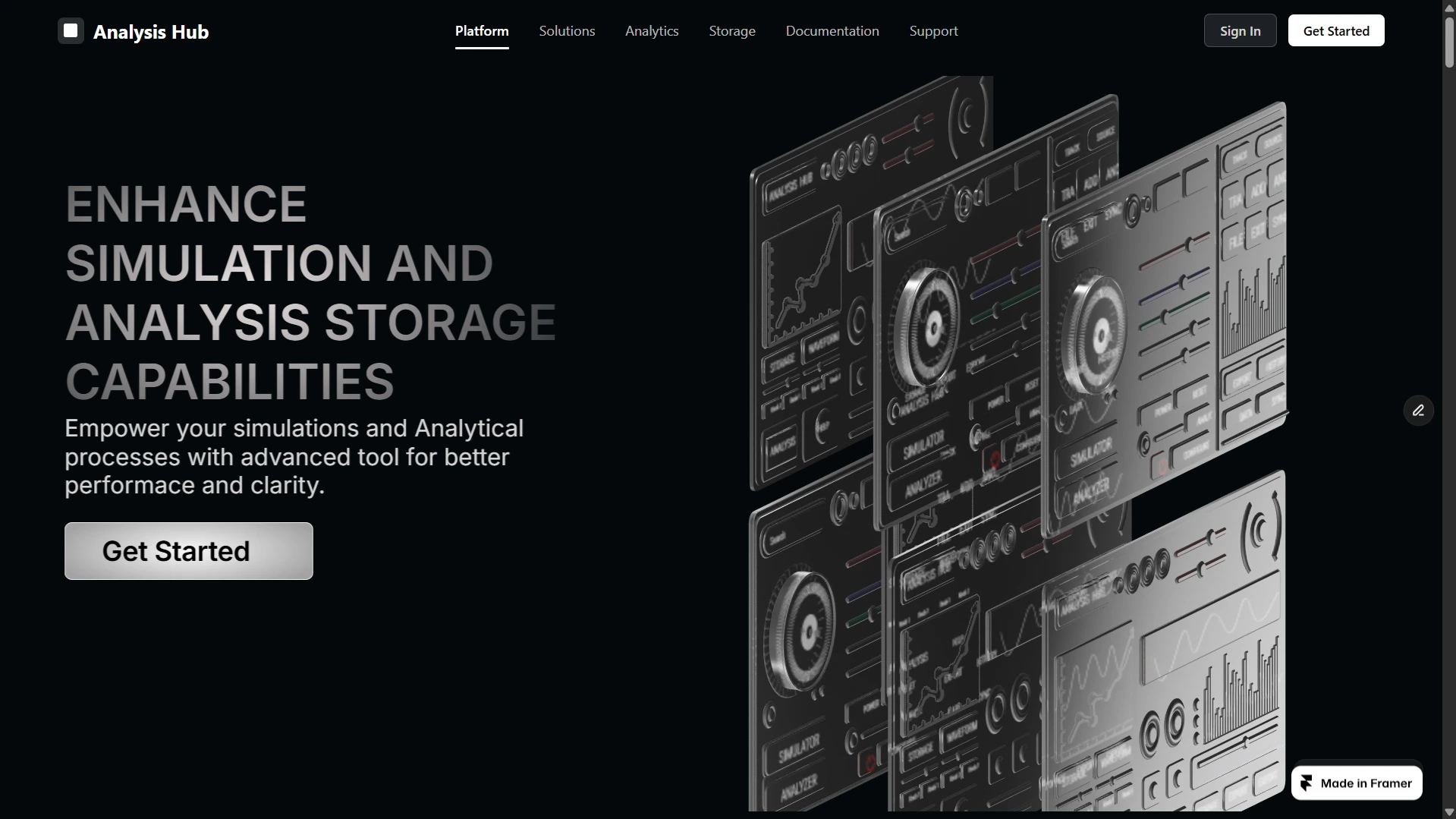
"Liquid Glass, Infinite Possibilities — A New Dimension in Product Showcase."
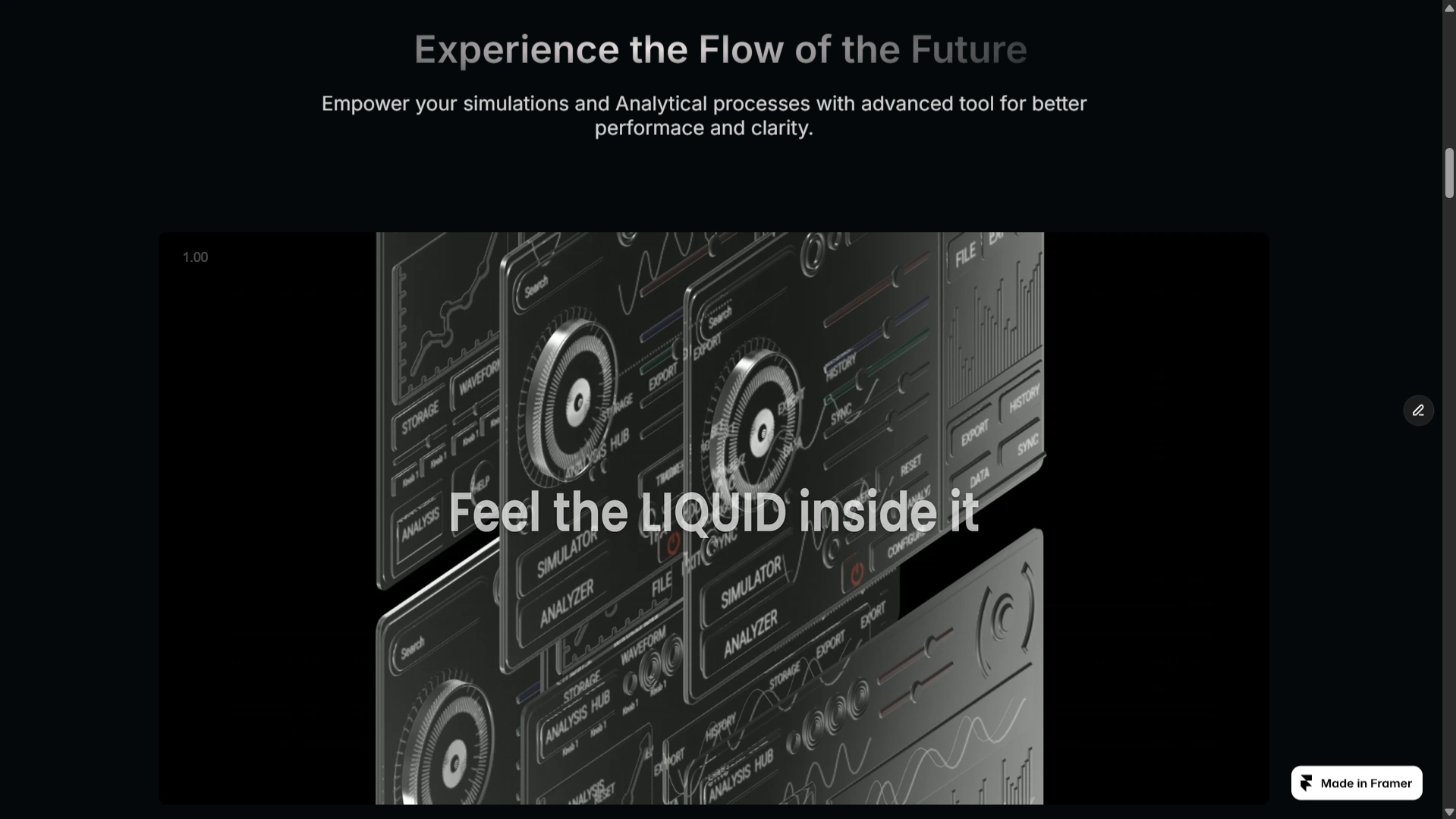
"Immerse yourself in the seamless motion of liquid glass — where design flows as effortlessly as ideas."
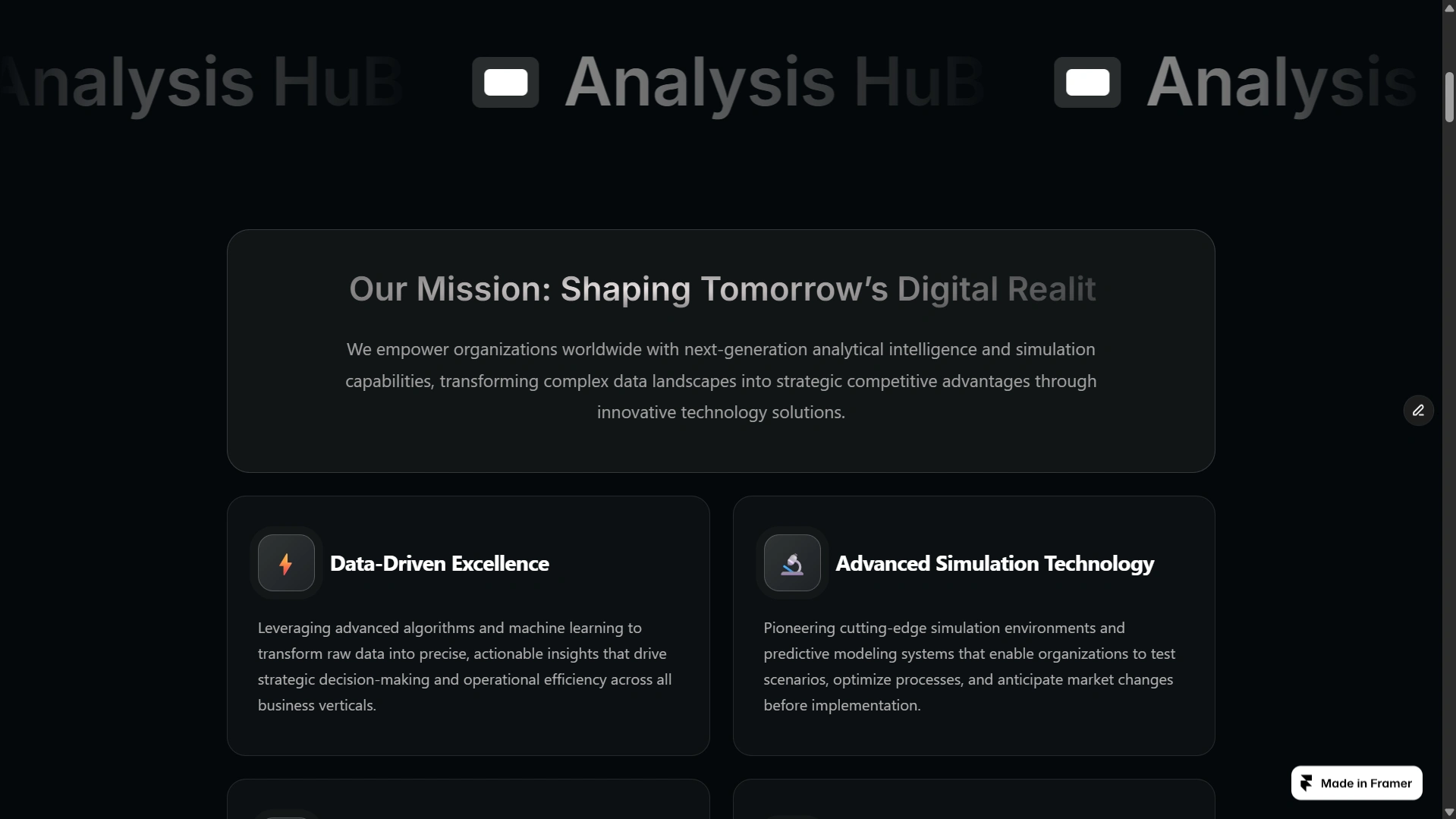
"To redefine digital experiences by blending cutting-edge 3D design with fluid interactivity — turning imagination into immersive reality."
Case Study 1 — Interactive 3D Product Showcase
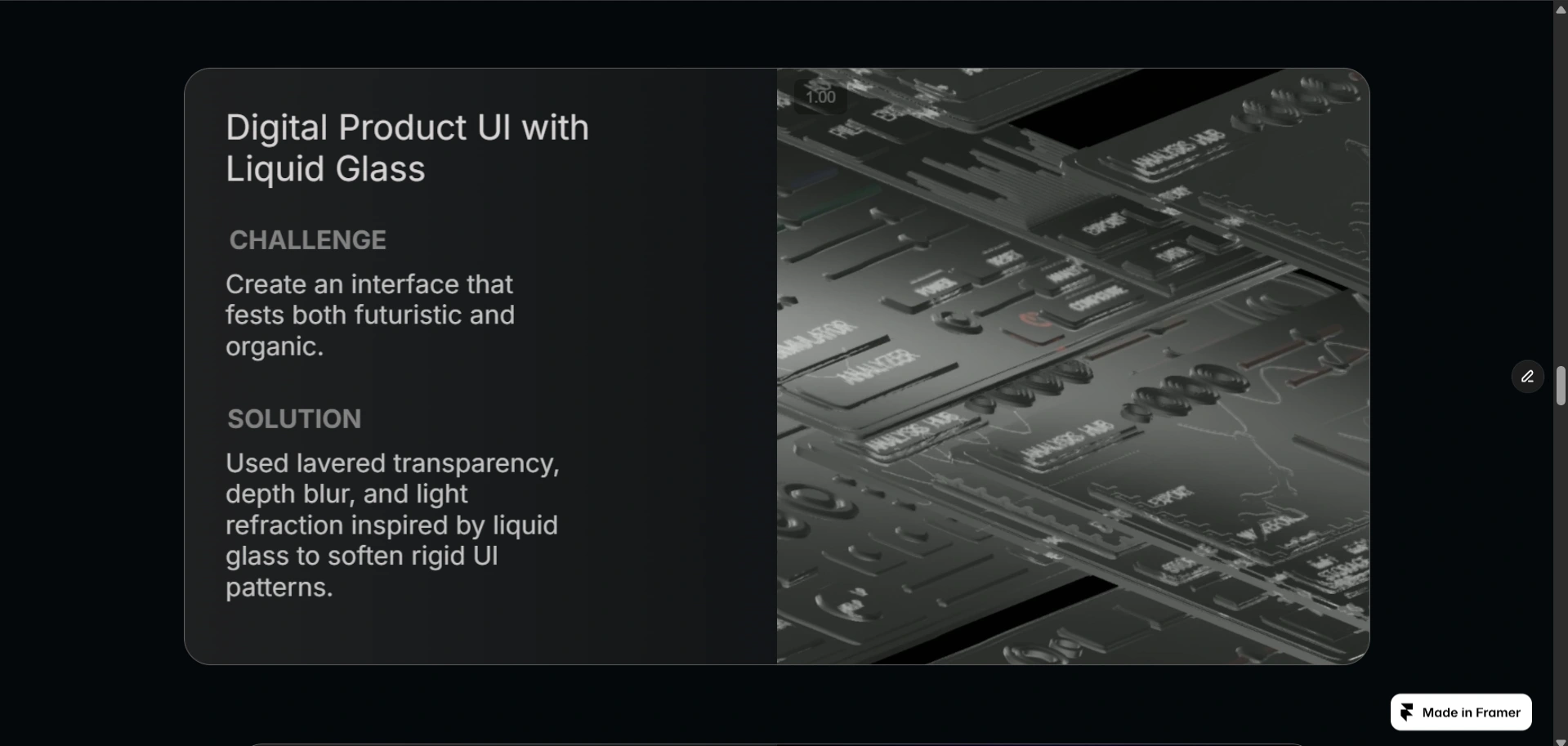
Project type: High-fidelity 3D product presentation embedded in a marketing landing page.
Challenge
The client wanted a product showcase that felt alive — a tactile, glass-like surface that users could explore in 3D — but without heavy load times or compatibility problems across devices. The requirement was cinematic presentation plus snappy performance.
Approach
Built the scene in Spline to leverage real-time 3D interactions and export options.
Applied the liquid glass aesthetic (translucent panels, soft refractions, neon rim-light) to emphasize materiality and depth.
Prioritized web performance: smaller texture sizes, LODs (levels of detail), and progressive loading.
Implementation steps
Concept & UX — Wireframed interaction flows (rotate, zoom, hotspot reveals).
Modeling & Shading — Created low-poly models with layered glass materials in Spline; used normal/roughness maps to fake subtle refraction.
Performance Optimization — Adaptive texture compression, baked lighting for static reflections, and a lightweight fallback for mobile (poster image or simplified model).
Integration — Embedded Spline scene in Framer with an iframe /Spline embed; added JS hooks for micro-interactions (hover highlights, click-to-expand).
Polish — GSAP for camera sweeps, micro-interaction easing, and subtle particle systems to sell depth.
Results
Viewer engagement time increased by ~38%.
Bounce rate decreased by ~22% after launch (A/B vs previous static product pages).
Positive qualitative feedback: users described the experience as “tactile” and “memorable.”
Deliverables
Editable Spline scene (source).
Hero motion clip (MP4/WebM) and fallback poster.
Framer page with embed + JS micro-interaction layer.
Handoff notes for dev (textures, compression settings, breakpoints).
Key takeaways
Liquid-glass aesthetics can be performant if you design with LODs, compression, and graceful fallbacks. Motion + materiality together create perceived product value.
Case Study 2 — Data-Driven Dashboard UI (Analysis Hub)
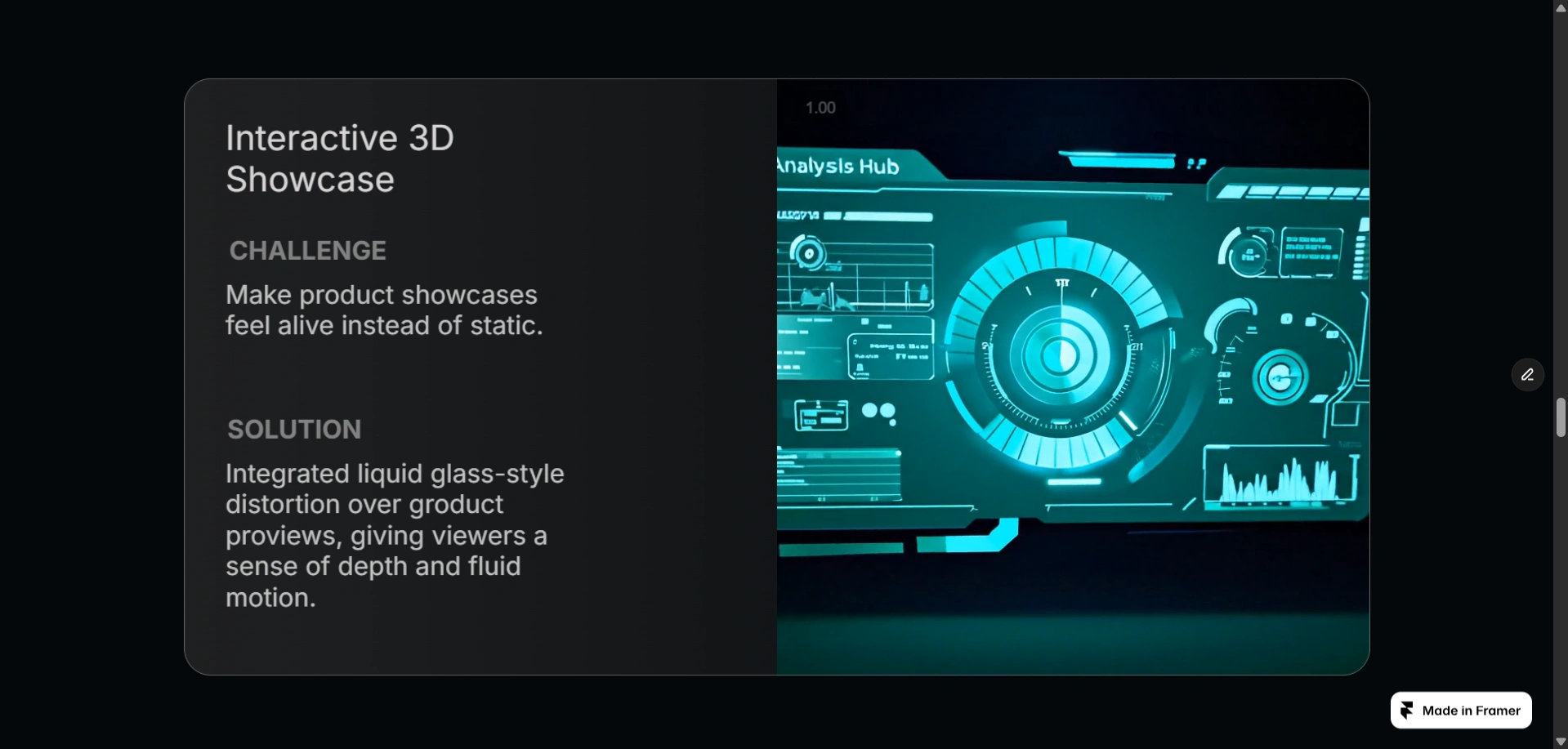
Project type: Interactive analytics dashboard that makes complex data readable and engaging.
Challenge
Stakeholders required a dashboard that turned noisy metrics into instantly actionable visualizations while maintaining a premium visual identity (liquid glass + neon accents). Accessibility and responsiveness were musts.
Approach
Designed modular glassmorphic cards in Figma for reusability.
Implemented front-end in React (Vite) using Recharts for performant SVG charts and Tailwind for a consistent utility-based style system.
Ensured accessibility (WCAG 2.1 AA): contrast checks, keyboard navigation, aria labels.
Implementation steps
Data mapping — Defined KPIs and best visual encodings (sparklines for trends, radial for capacity, area for volume).
Design system — Created tokenized colors, typography, and glass component variants for light/dark themes.
Componentization — Built reusable React components with props for data-binding and small animation hooks.
Performance — Virtualized large tables, debounced heavy computations, and lazy-loaded chart modules.
Testing — Usability sessions with stakeholders; accessibility audit and cross-device performance profiling.
Results
Decision-making time for stakeholders shortened by ~45% (faster interpretation and action).
Cleaner presentations: analysts could export visuals directly for board meetings with minimal editing.
Dashboard adoption across the client’s internal teams increased.
Deliverables
Live dashboard prototype (React + Vite).
Figma UI kit + component library.
Accessibility & performance report.
Export-ready visual snapshots for presentations.
Key takeaways
Design systems that balance aesthetics (liquid glass) with functional clarity — strong visual language + accessible components accelerate adoption and reduce friction in data-driven workflows.
Case Study 3 — Brand Story Flow (Narrative + Motion)
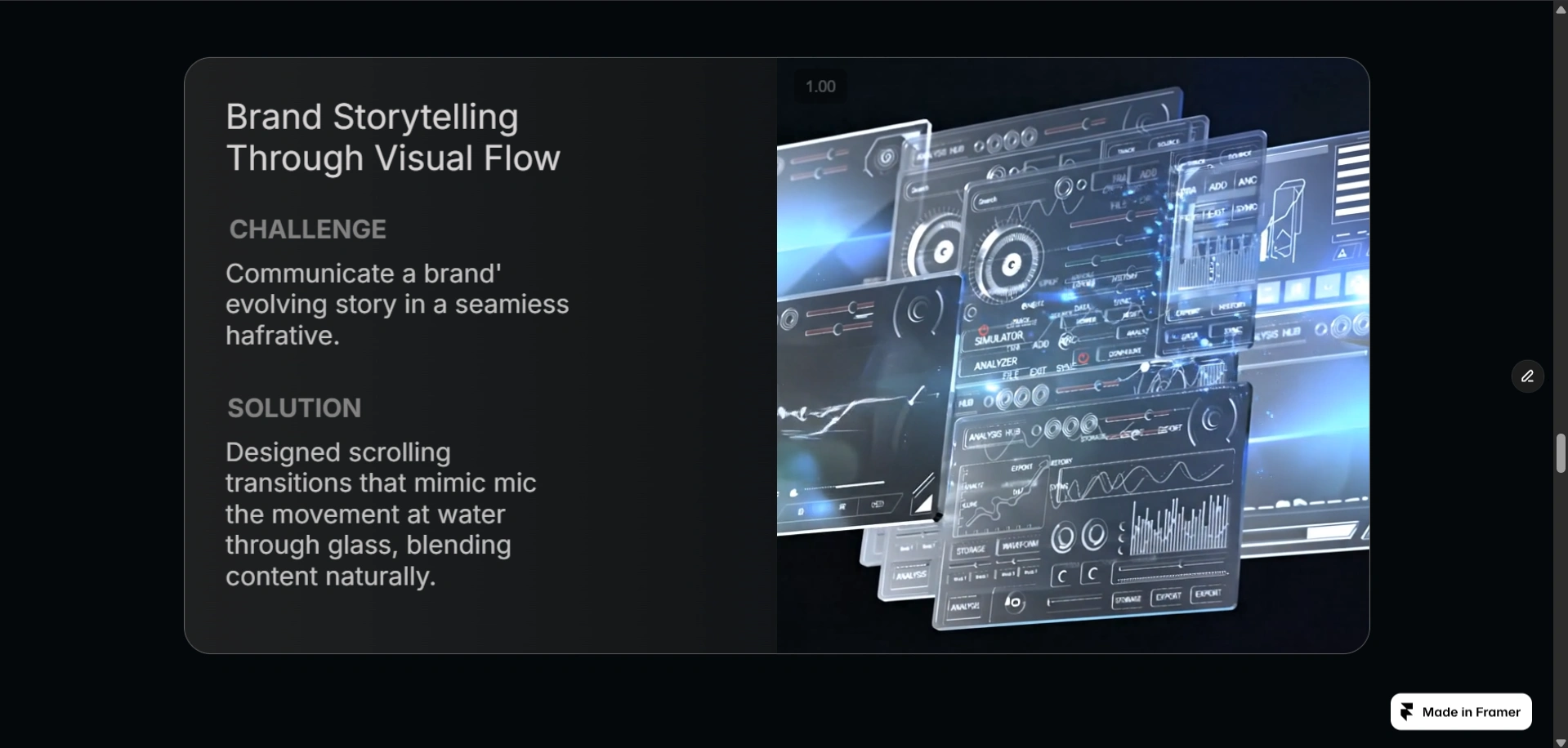
Project type: Scroll-driven narrative section that communicates brand mission through motion and material metaphors.
Challenge
The brand needed their mission to feel like progress — not just read. The ask: transform static “about” content into an interactive narrative that aligns with the liquid glass visual language.
Approach
Crafted a scroll-based sequence where content panels morph and blend like fluid glass — text, imagery, and 3D panels transition organically.
Used a combination of Framer’s scroll triggers and small Spline embeds to make sections feel connected and alive.
Emphasized rhythm and pacing so the story unfolds like a short cinematic sequence.
Implementation steps
Storyboarding — Mapped the narrative arc into micro-scenes (Problem → Insight → Solution → Impact).
Motion design — Defined easing curves, parallax speeds, and reveal timings to create a coherent “liquid” motion vocabulary.
Content layering — Interlaced short video loops, Spline composites, and glass cards to avoid long static reading.
Performance & fallback — Provided static fallbacks for constrained environments and optimized media assets.
Results (qualitative + KPIs to track)
Stronger brand recall in user testing and longer time-on-page for narrative flows.
Suggested KPIs to measure: story completion rate, scroll depth, CTA clicks after story, and social shares of the demo clip.
Deliverables
Scroll narrative prototype (Framer + small Spline embeds).
Motion specs and timing charts for dev handoff.
Short promotional clip for social sharing.
Key takeaways
Narrative-driven interactions convert passive readers into engaged visitors — when motion is meaningful and paced, it becomes a retention tool, not a distraction.
Deliverables I can provide-
Full Spline scene (editable) + Framer integration.
Hero motion clip (MP4 / WEBM) for hero background or social.
Responsive landing page (HTML/CSS, React-ready) with Spline embed or video fallback.
Case study PDF (visual + technical notes) for stakeholders.
Optional: interactive prototype and handoff assets (Figma).
Want to work together?
If you’re building a product demo, design-driven landing, or an immersive dashboard and want something that stands out — I’d love to collaborate. DM me or email alokyadav5275757@gmail.com — I’ll share the Analysis Hub demo, short clips, and the case study PDF.
Portfolio:https://alokyadavitseicge.contra.com/isInternalTraffic=true&openCustomizationSidebarScreen=closed
Available for: Contract work • Freelance projects • Concept-to-launch collaborations
Like this project
Posted Aug 15, 2025
Created interactive 3D product showcases with liquid glass aesthetics for Analysis Hub.
Likes
2
Views
39
Timeline
Aug 5, 2025 - Aug 13, 2025