AnswerTrace: An Evidence-First AI Visibility Command Center

Eric Moore


Project Type: Product strategy and UX concept (self-initiated)
Organization: Cedarline Advisory, a fictional demo workspace
Role: Product strategy, evidence model, UX architecture, interaction design, and visual design
Duration: July 26, 2026
Context
AI visibility tools can make a brand's presence inside model answers look measurable. The hard part is deciding what the measurement proves.
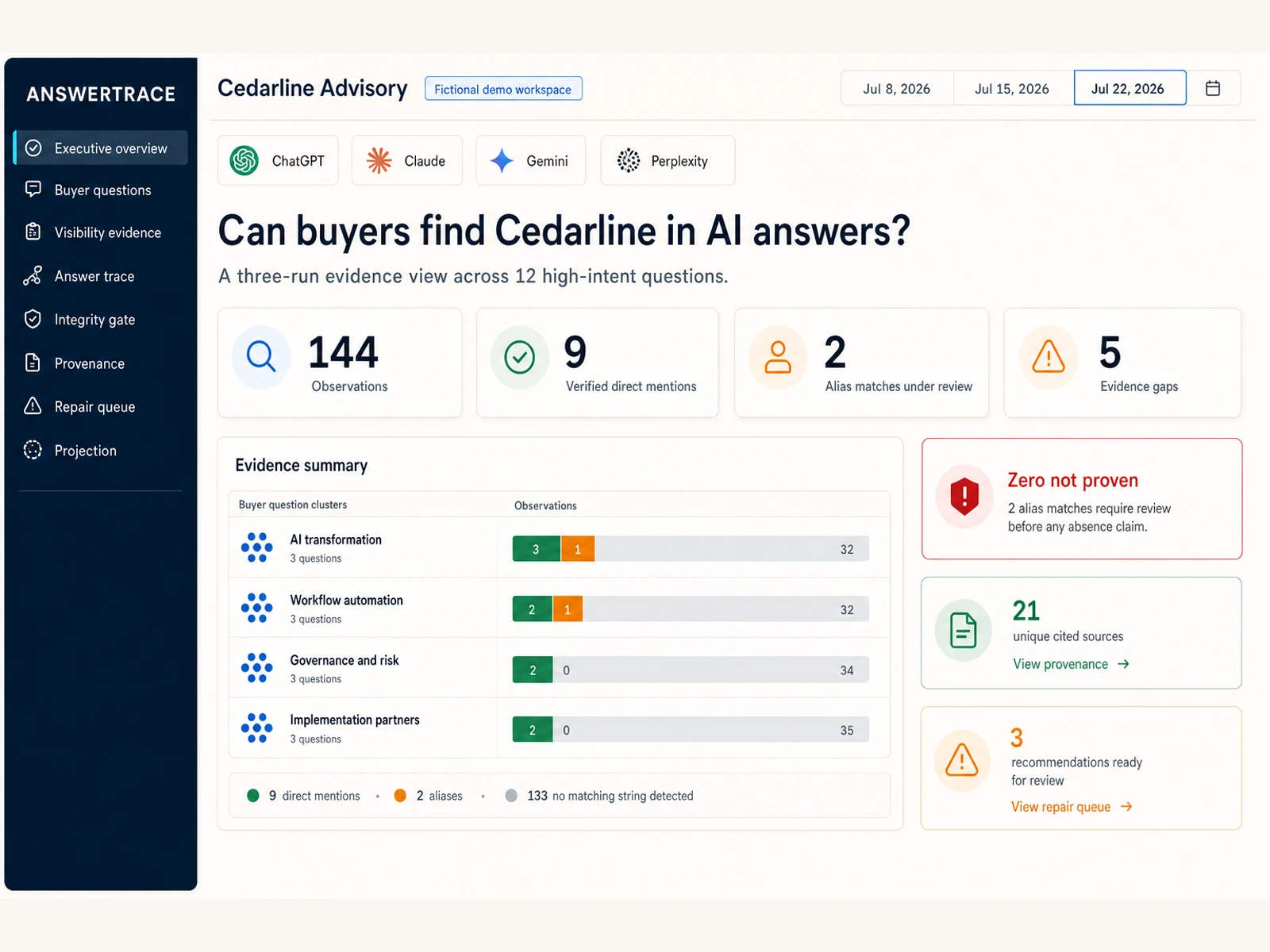
I designed AnswerTrace as a command-center concept for that harder job. It keeps every observation attached to the buyer question, engine, run, captured answer, matched entity, and cited source. Then it turns evidence gaps into reviewable content repairs without presenting a projection as a result.
The workspace shown here belongs to Cedarline Advisory, a fictional professional-services firm. The dataset is fixed across every screen: 12 buyer questions, 4 engines, 3 runs, and 144 observations. This is a self-initiated product concept, not a deployed SaaS product or client engagement.
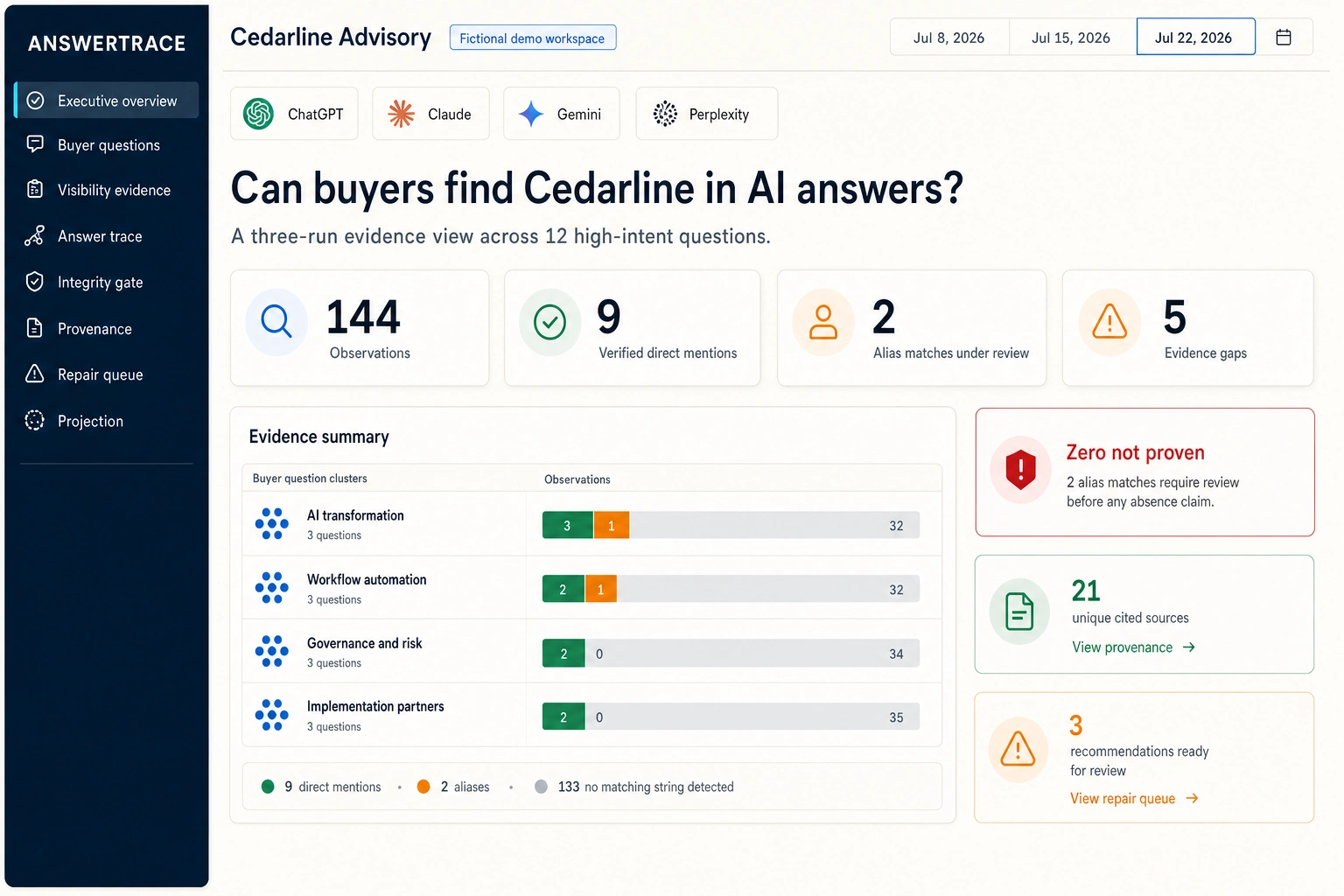
The executive view keeps the fixed corpus, source count, repair queue, and blocked integrity state visible at once. Cedarline Advisory is a fictional demo workspace.
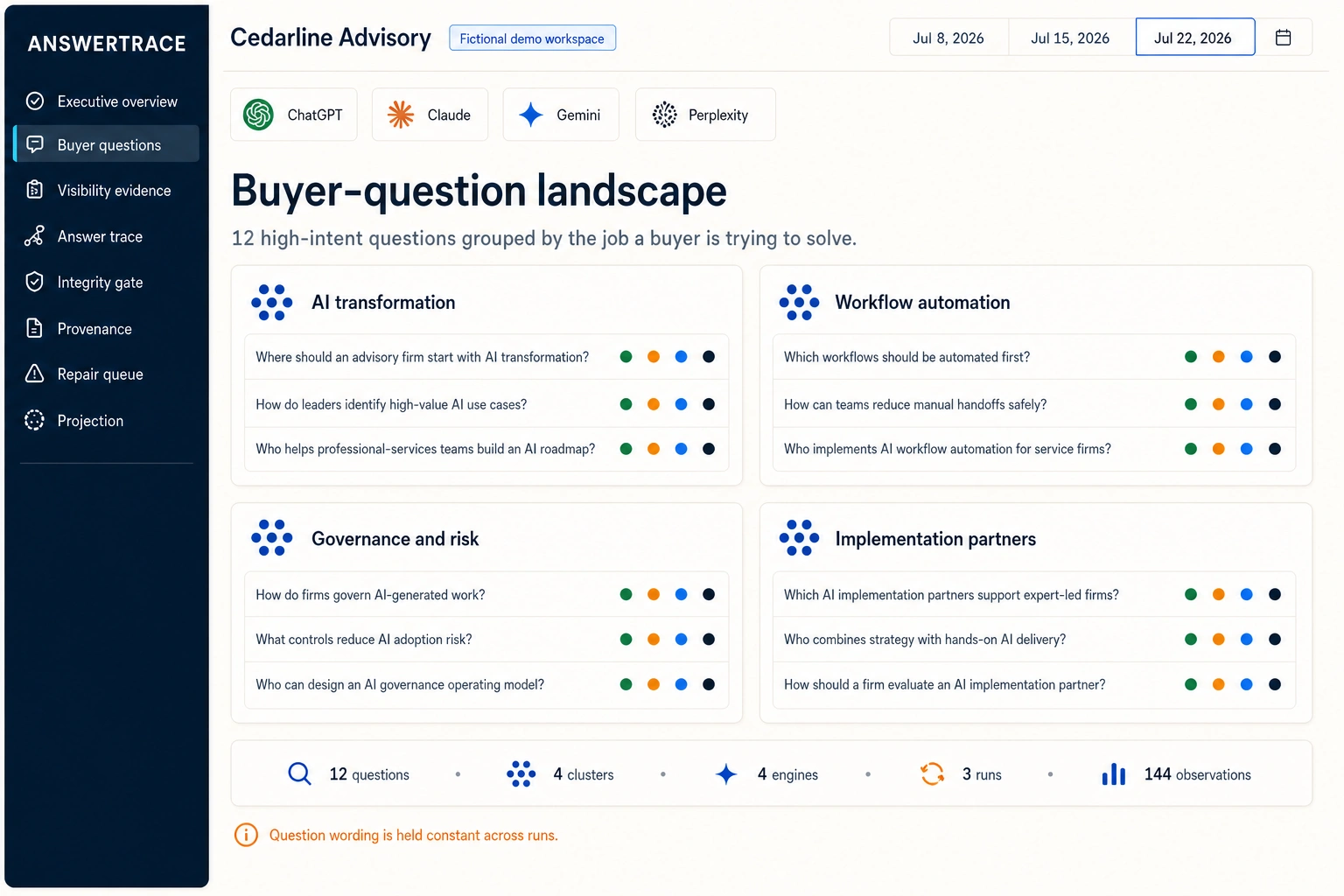
Twelve high-intent questions grouped by the job a buyer is trying to solve, then held constant across four engines and three runs.
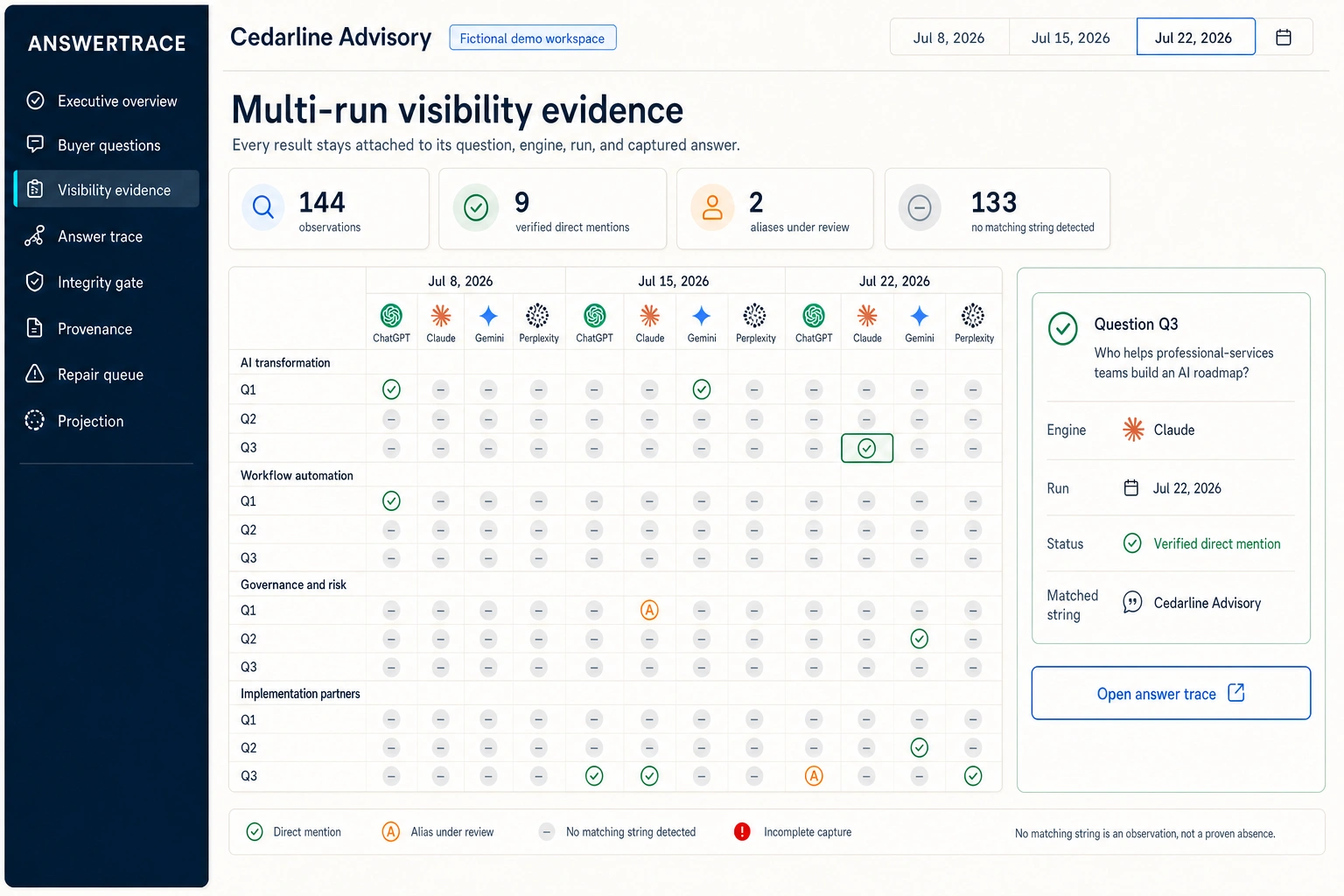
All 144 observations remain attached to their question, engine, and run. An unmatched string is recorded as an observation, not promoted to a proven absence.
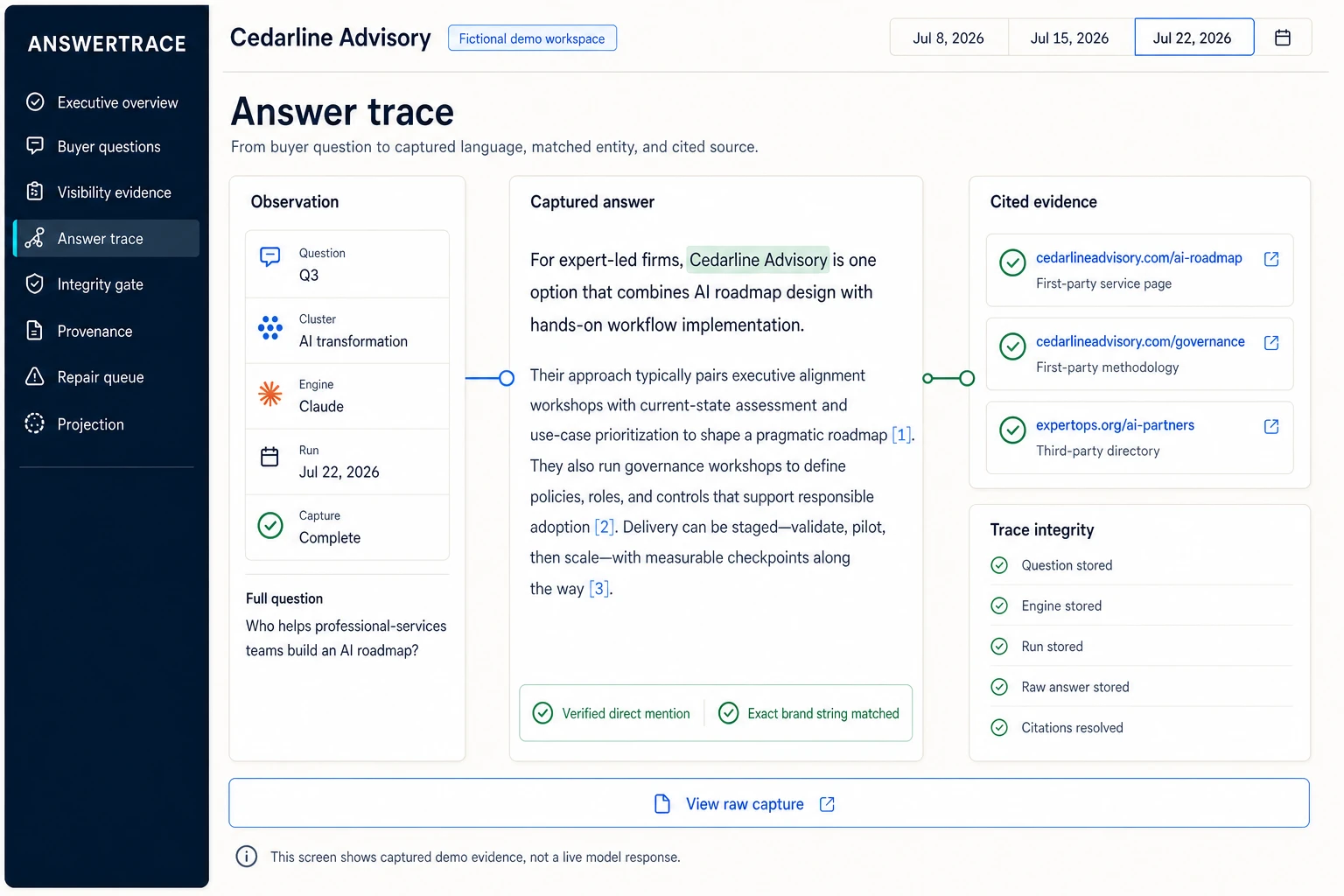
One verified mention traced from the buyer question to the captured language, exact entity match, and three cited sources.
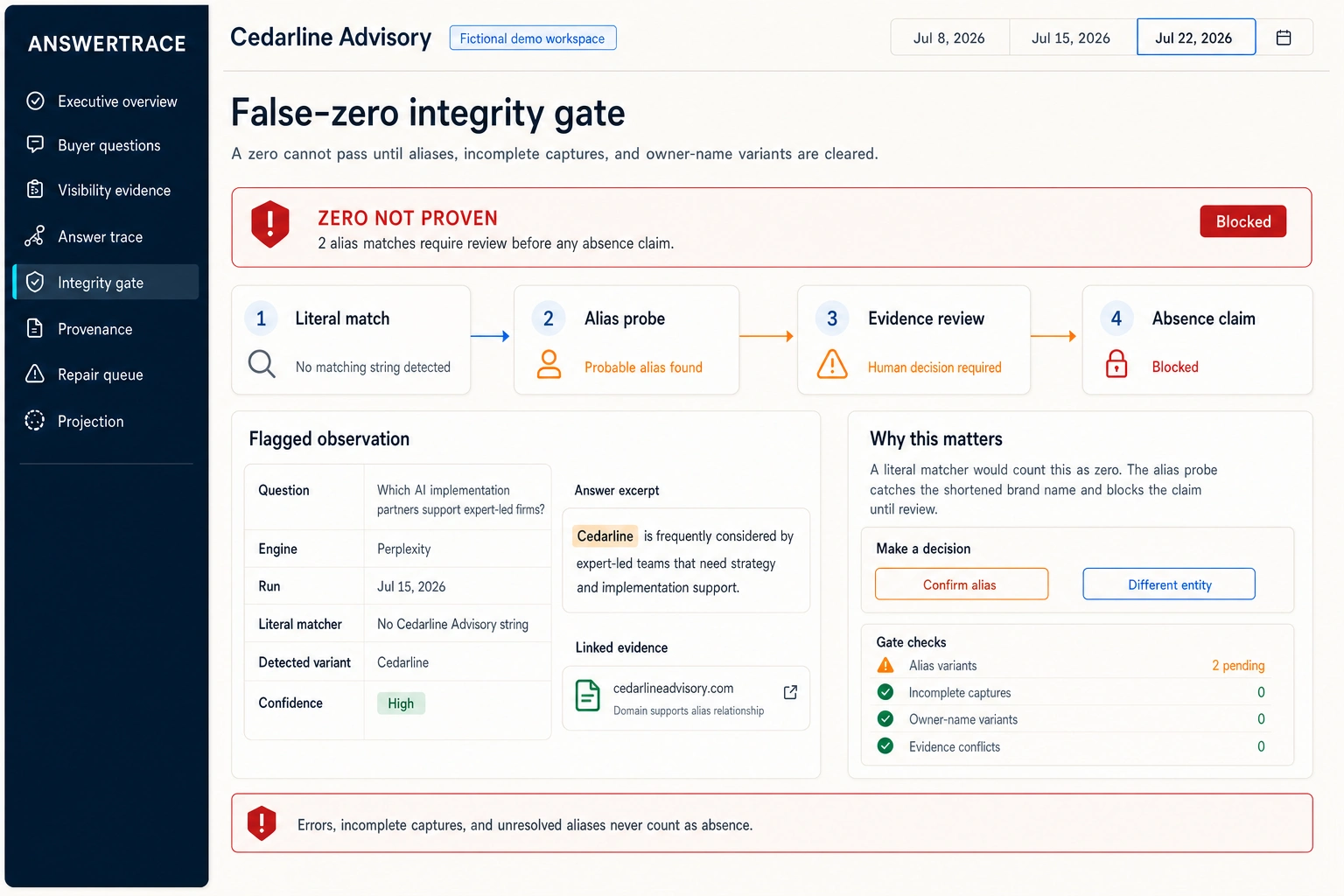
The shortened name Cedarline triggers an alias review and blocks the zero. Errors, incomplete captures, and unresolved aliases cannot become absence evidence.
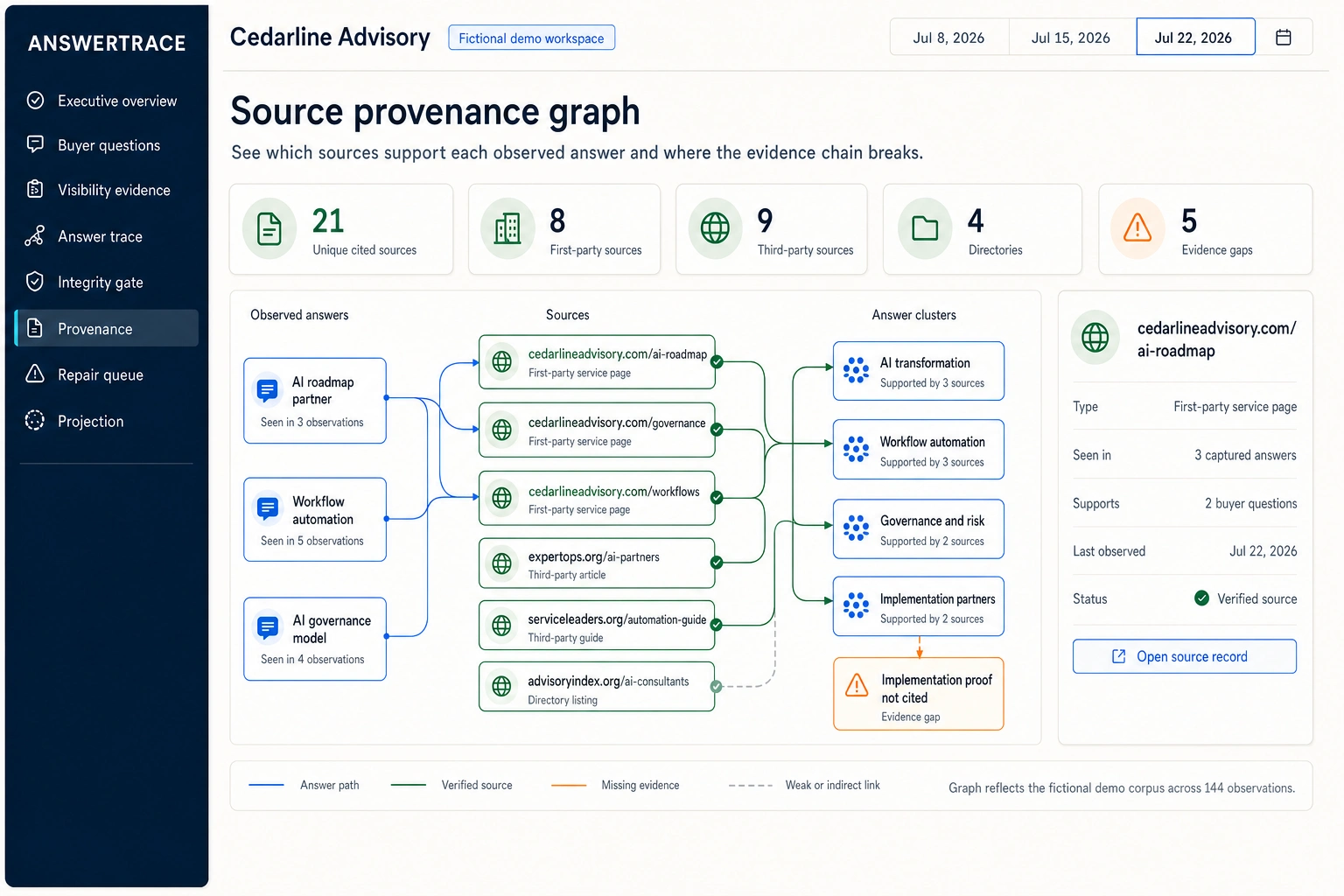
The provenance graph shows which sources support each answer cluster and where the chain ends in missing or indirect evidence.
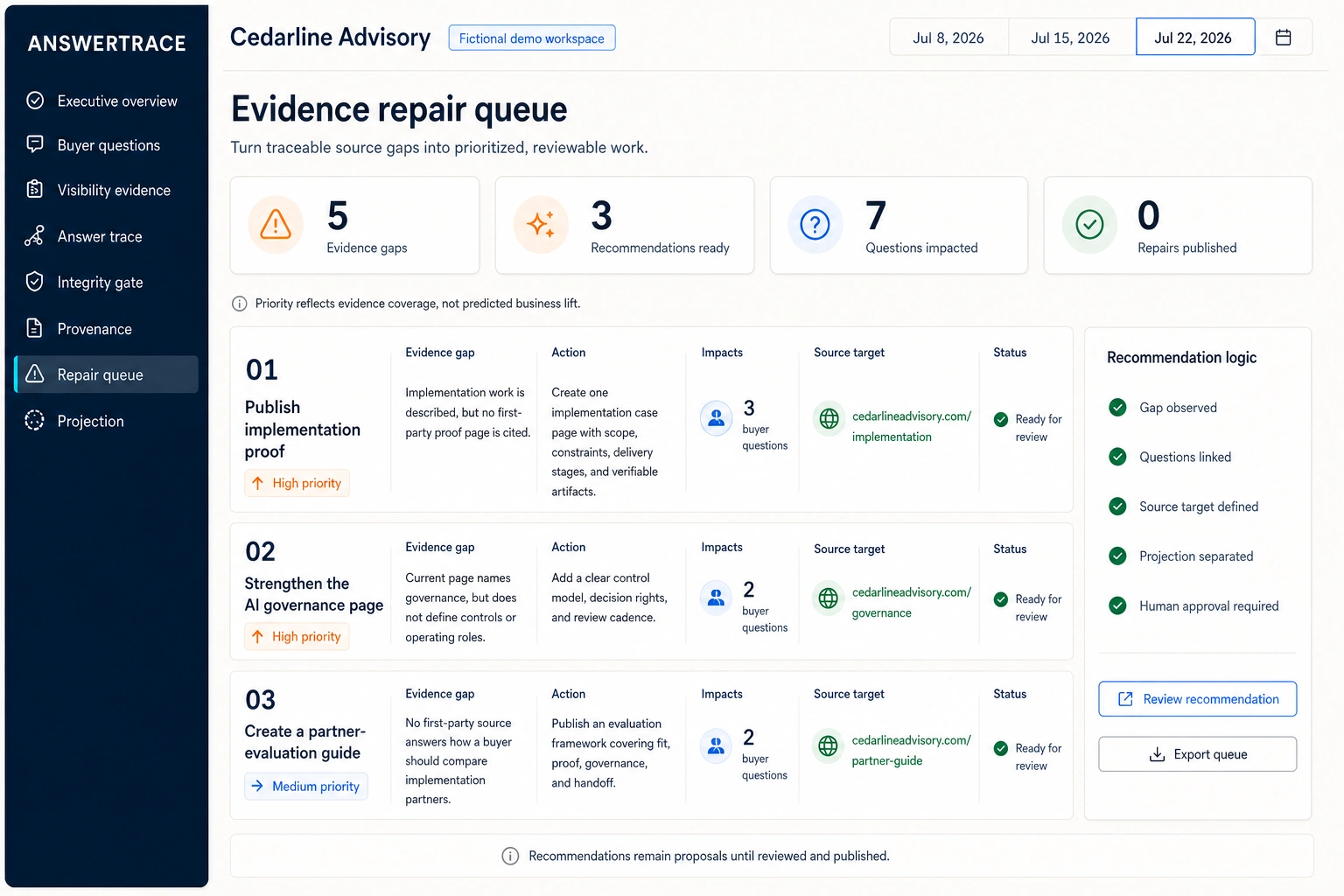
Five source gaps become three reviewable recommendations, each tied to affected questions and a proposed source target.
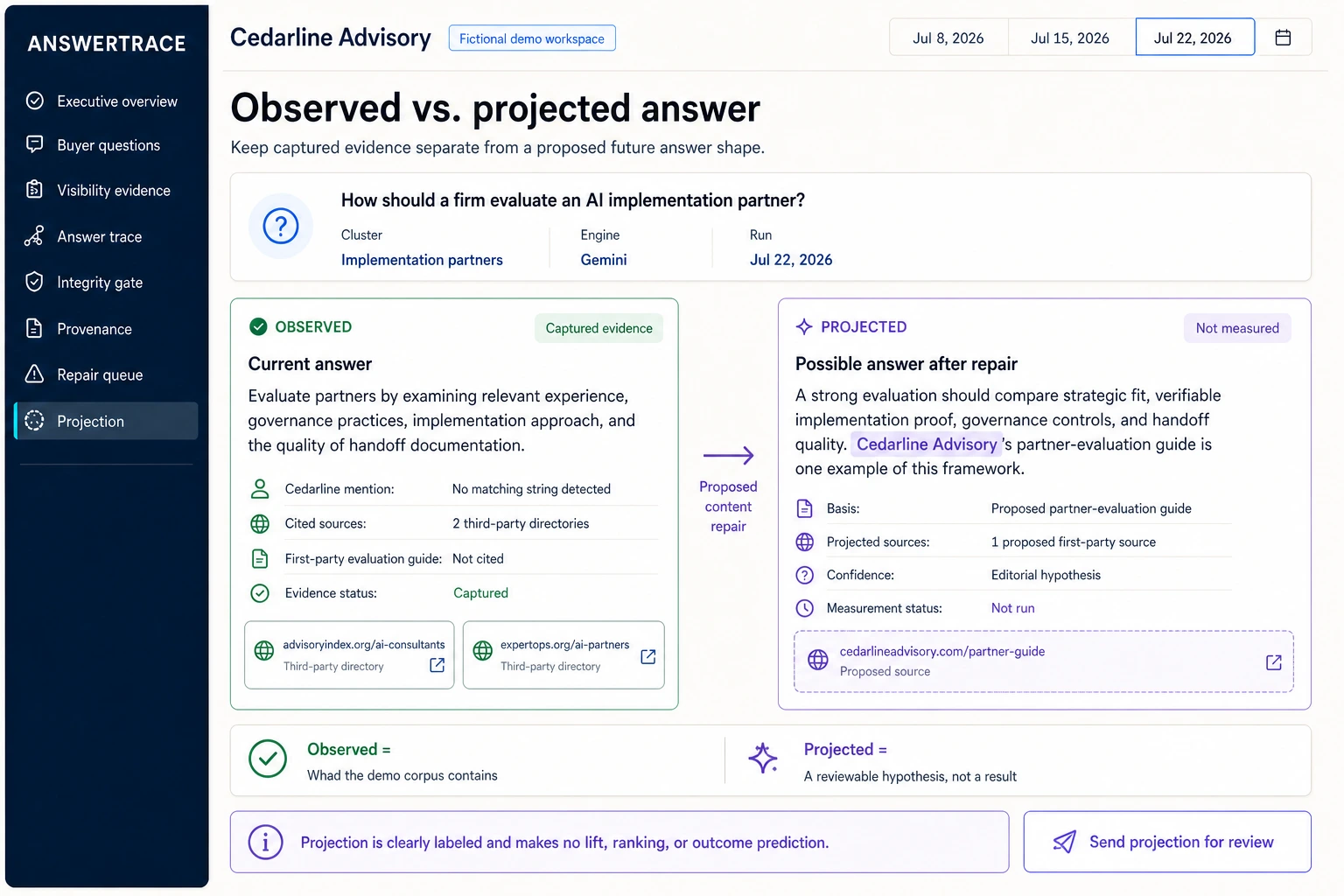
Captured evidence and a possible future answer share the screen without sharing a status. The projection is labeled unmeasured and makes no outcome prediction.
Problem
A clean zero can be the most dangerous number in an AI visibility report. The answer may use a shortened brand name, a founder's name, or another valid alias that a literal matcher misses.
A mention count without the raw answer, run, engine, and citations cannot be audited. It is a score without an evidence trail.
Source lists are usually separated from the questions they support. That makes it difficult to see which missing page or weak citation matters.
A proposed better answer can easily be mistaken for a measured result unless the interface keeps observed and projected evidence visibly separate.
Process
1. Define the observation before designing the dashboard
The atomic record is not a score. It is one buyer question, sent to one engine, in one dated run, with the complete answer and its citations stored beside it.
That model makes the totals inspectable. Twelve questions across ChatGPT, Claude, Gemini, and Perplexity, repeated on July 8, July 15, and July 22, produce 144 observations. The interface can always move from the summary back to the exact evidence underneath it.
2. Organize the work around buyer intent
The 12 questions sit inside four jobs a buyer is trying to solve: AI transformation, workflow automation, governance and risk, and implementation partners.
That structure keeps the product focused on decisions rather than vanity coverage. A user can see which questions expose a source gap, which answers cite first-party evidence, and which parts of the buyer's evaluation journey have no supporting material.
3. Put an integrity gate in front of every zero
The fictional corpus contains nine verified direct mentions and two possible aliases. One answer uses Cedarline without Advisory. A literal matcher would call that observation zero.
AnswerTrace does not. It flags the shorter string, links it to supporting evidence, and blocks the absence claim until a reviewer confirms whether both names refer to the same entity. Errors, incomplete captures, and unresolved aliases never count as absence.
4. Trace answers back to sources, then sources forward to repair work
The provenance graph connects an observed answer to the sources it cites and the buyer-question clusters those sources support. In the fictional dataset, 21 unique sources support the corpus and five evidence gaps remain.
The repair queue converts those gaps into three proposals: publish implementation proof, strengthen the governance page, and create a partner-evaluation guide. Each recommendation names the affected questions, missing evidence, proposed action, and source target. Priority reflects evidence coverage, not a predicted business lift.
5. Separate what was observed from what could be built next
The final screen places the captured answer beside a possible future answer after a proposed content repair. The projected side uses a different color, a dashed source state, and explicit labels: Not measured, Editorial hypothesis, and Not run.
That distinction is the product principle in miniature. The system can help a team reason about a better evidence footprint without pretending that the future answer has already happened.
Solution and outcome
An eight-screen command-center concept spanning executive overview, buyer questions, multi-run evidence, answer trace, false-zero validation, source provenance, evidence repair, and projection
One consistent evidence model across 144 fictional observations
An integrity gate that catches shortened brand aliases before an absence claim can pass
A source graph that connects cited evidence to the buyer questions it supports
A repair queue that turns five evidence gaps into three reviewable recommendations
A clear visual boundary between captured evidence and an unmeasured projection
The outcome is the product concept itself: a complete, inspectable UX system for making AI visibility claims more defensible. It demonstrates the product strategy, evidence rules, interaction model, and visual language. It does not claim that the software is live or that the fictional recommendations produced a business result.
Building an AI product where every answer needs an evidence trail? Let's map what the interface has to prove.
Like this project
Posted Jul 26, 2026
A self-initiated command-center concept for tracing AI answers, proving apparent zeros, and turning source gaps into reviewable repairs.