AI Companion Safety Platform: 200 Live Pages, One Trust System

Eric Moore


Project Type: AI Product Strategy + Safety Methodology + Platform Build
Role: Lead operator across product, methodology, build, and publishing operations
Team: Solo lead, with writers and designers brought in as the work required
Duration: March 2026 to present (ongoing)
Decision authority: I led analysis and recommendations; the client made the final call
Context
CompanionWise is a safety-first guide to AI companion apps, built as a client engagement. The category was moving quickly, but the information around it was fragmented across app stores, Reddit threads, thin affiliate lists, privacy policies, and sensational news coverage.
I took on the work because the category had attention but no trust system. The job was bigger than launching a content site. It needed a product model, an inspectable safety methodology, a publishing operation, and a business path that could grow without letting advertisers buy the answer.
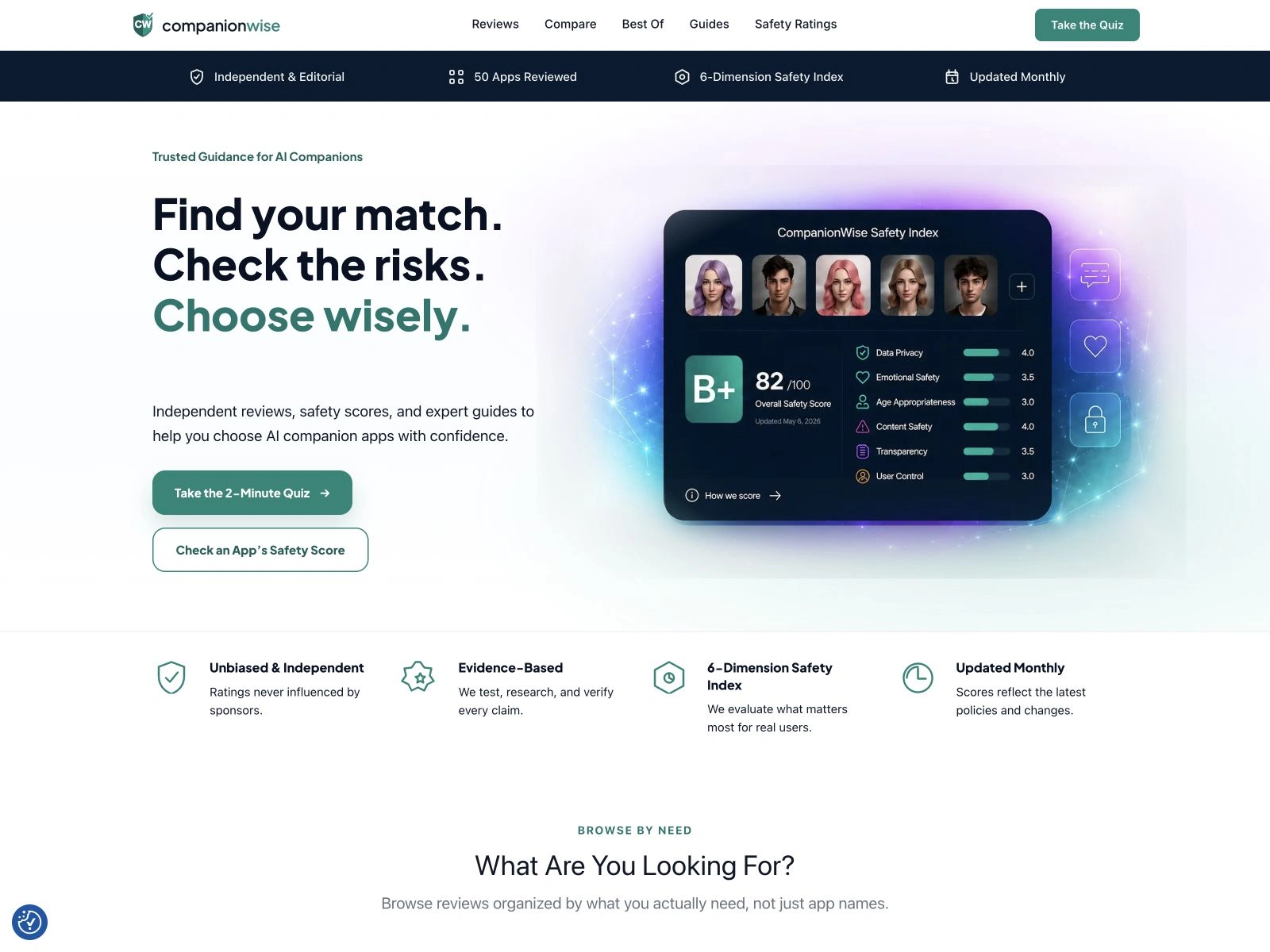
Caption: The live platform: 50 apps reviewed, direct paths into the Safety Index, and a two-minute recommendation quiz.
Problem
• Users could compare features, but they had no consistent way to evaluate privacy, emotional risk, age protections, content safety, transparency, or user control.
• A conventional affiliate site would create the wrong incentive. The commercial model had to sit behind the trust model, with independent scoring and clearly separated sponsorship paths.
• The content surface could not become a pile of disconnected articles. Reviews, safety ratings, comparisons, best-of lists, FAQs, guides, and quiz results had to work as one decision system.
• AI could accelerate research and production, but it could not be allowed to improvise a public safety grade or publish without editorial review.
Process
1. Define the product before building pages
The first deliverable was the operating model. I structured CompanionWise around three connected pillars: a companion-content taxonomy for discovery, a Matchmaker Quiz for conversion, and a Safety Index for trust.
That became seven recurring public content types, a strict internal-linking model, refresh cadences based on risk, and explicit gates. A review and its safety-rating page ship as a pair. A comparison or best-of page cannot feature an app until both exist. Trust pages explain the evidence standard, editorial policy, rating method, and corrections process before the site asks readers to accept a score.
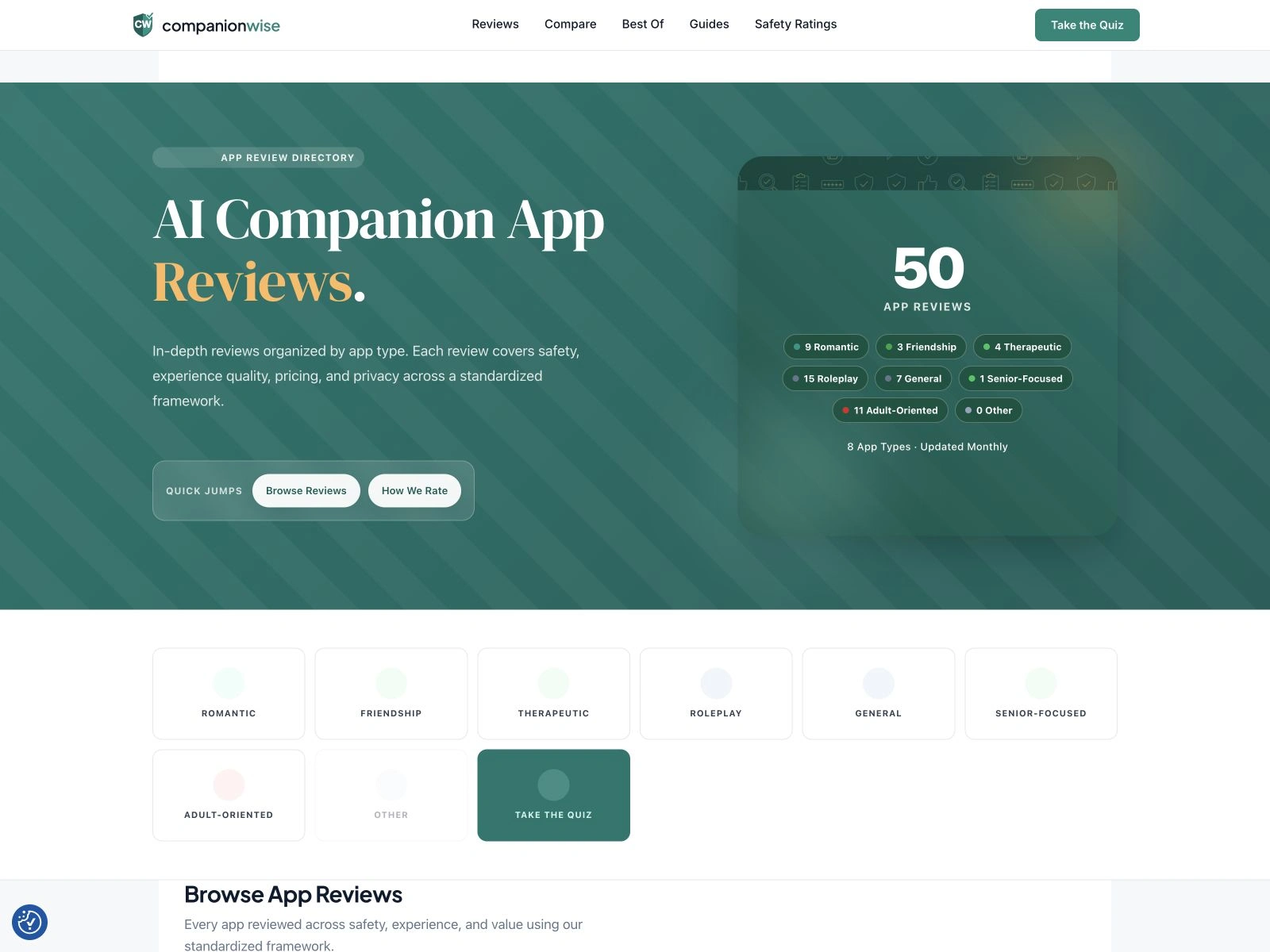
Caption: The content architecture in public: 50 app reviews connected to safety ratings, comparisons, best-of pages, FAQs, and guides.
2. Put AI in the proposal layer and keep the grade deterministic
Each app begins with evidence: privacy policies, terms of service, app-store data, safety documentation, regulatory sources, and credible incident reporting. AI-assisted workflows can organize that evidence and propose scores. They do not compute the published result.
The WordPress score engine requires all 23 sub-dimensions, rolls them into six weighted dimensions, and computes the public 0 to 100 score, letter grade, and Green / Yellow / Red tier. Critical failures trigger explicit caps or overrides. Every successful computation writes an audit-log entry, and a human editor reviews the evidence and score before publication.
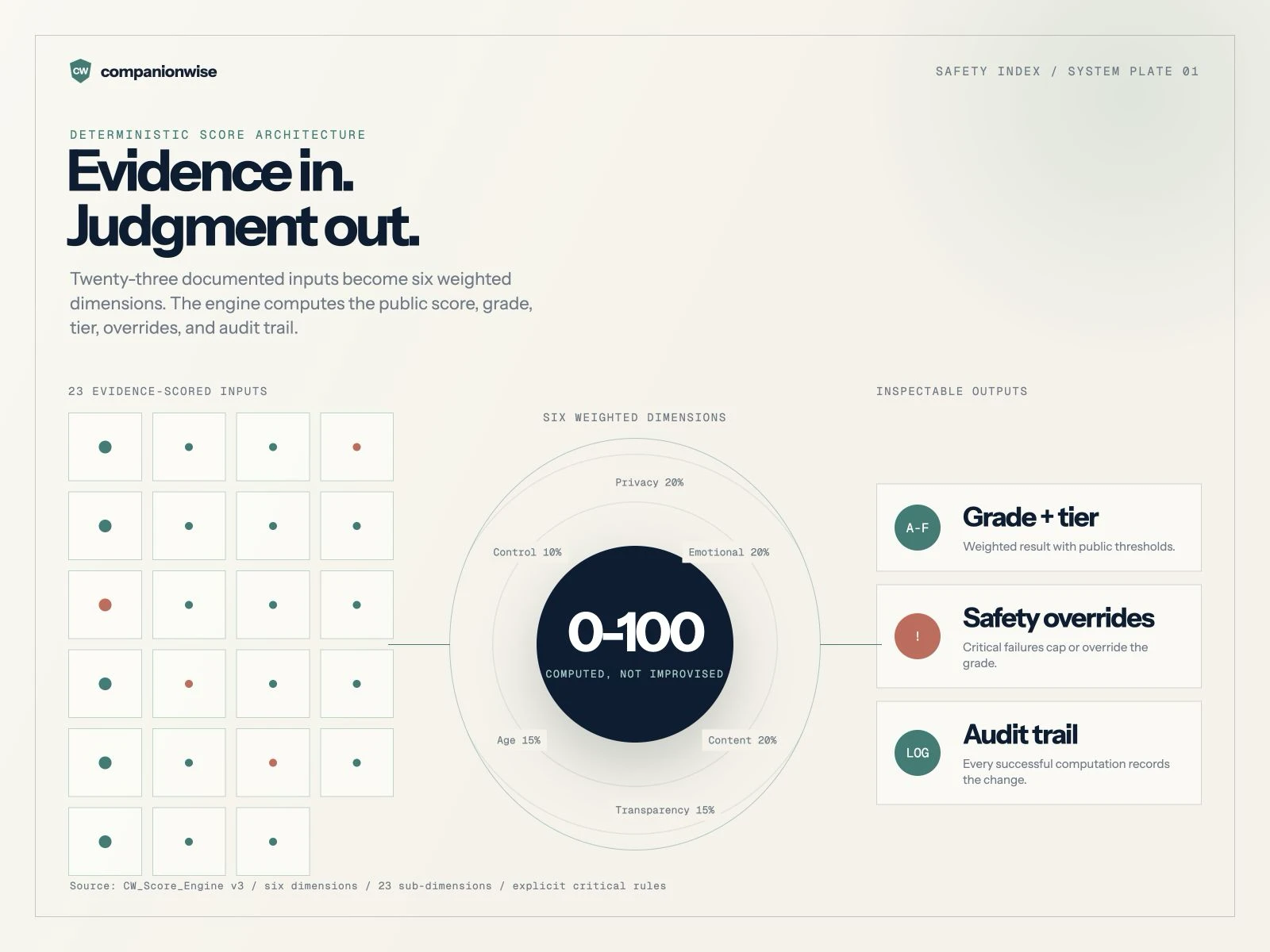
Caption: Twenty-three evidence-scored inputs become six weighted dimensions. The PHP engine computes the grade, tier, overrides, and audit trail.
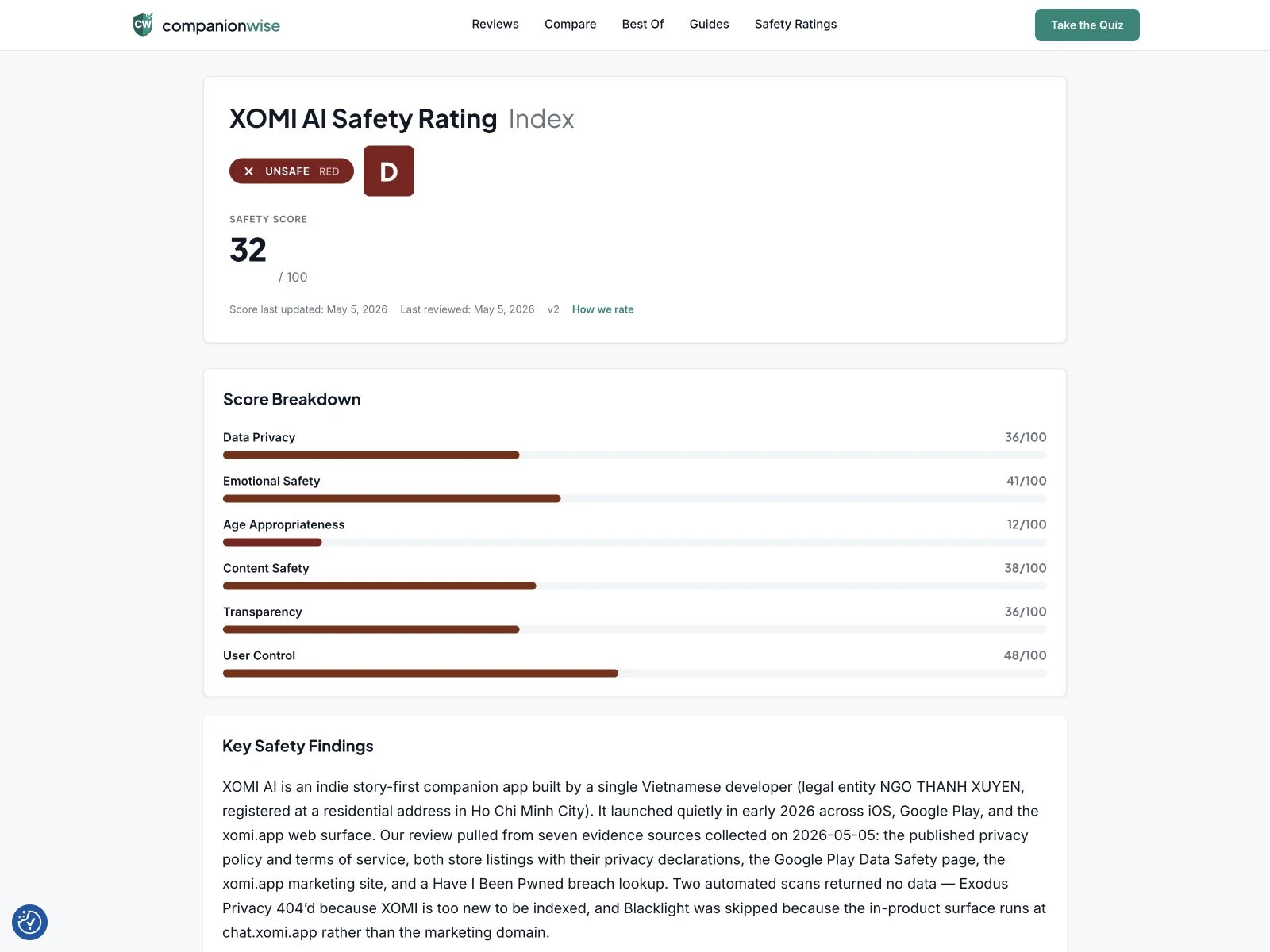
Caption: The result on a live app page: score breakdown, grade, tier, and the evidence behind the decision.
3. Build WordPress as a product platform
WordPress was the right base for a content-heavy authority product, but the implementation goes far beyond a theme and page builder. The platform runs on WP Engine with a GeneratePress child theme, custom post types, custom CompanionWise plugins and MU-plugins, structured ACF field groups, custom templates, schema output, correction workflows, and safety-alert distribution.
An authenticated REST endpoint at
/cw/v1/deploy-content handles the allowlisted post types in one call, preserves the finished HTML, and triggers the WordPress save hooks needed for sitemap and indexation updates. Trigger.dev handles background work. Custom scripts and dashboards monitor content completion, score freshness, indexation, and maintenance.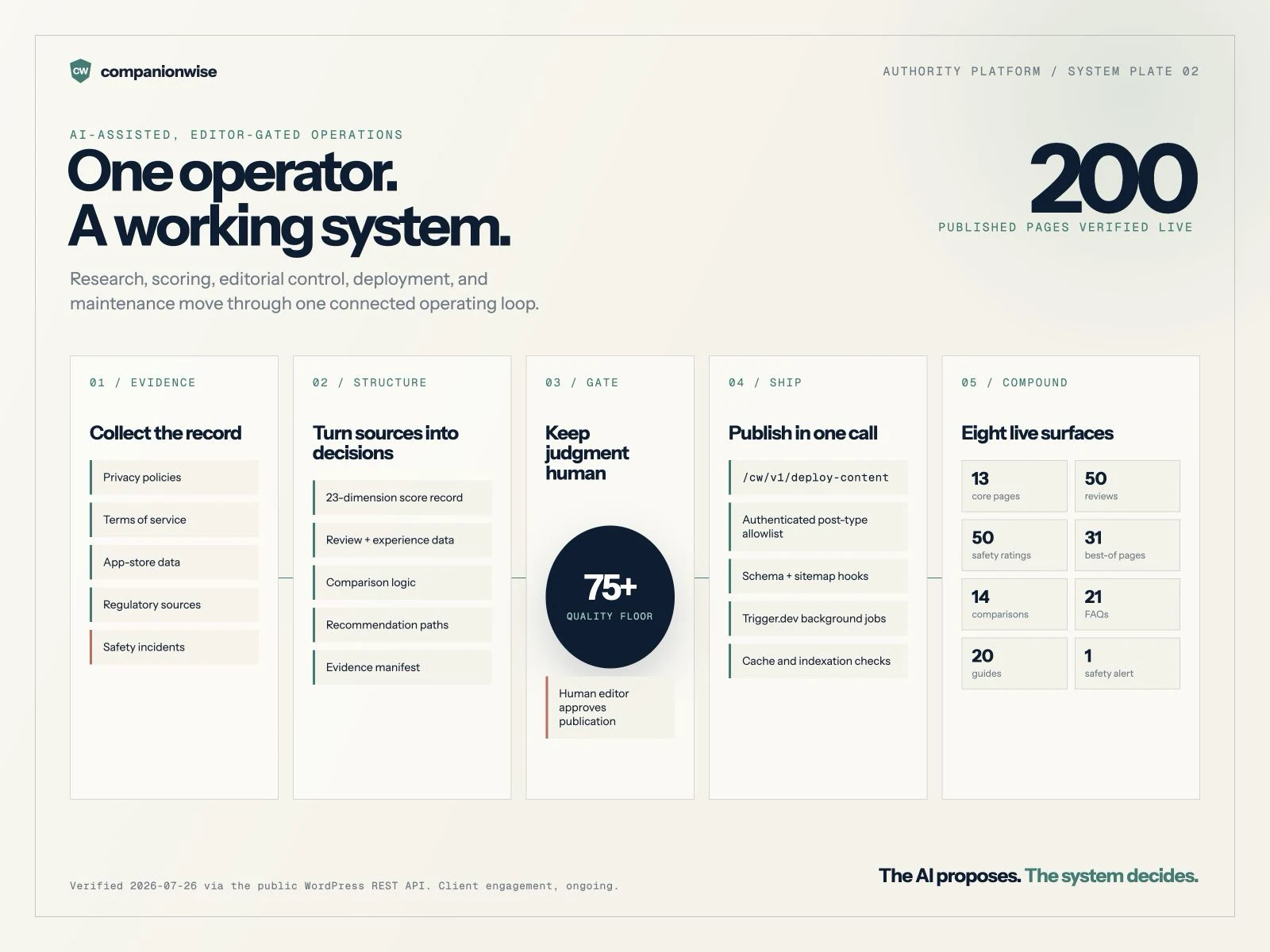
Caption: The operating loop: evidence, structured scoring, a 75-point quality floor, human approval, one-call deployment, and eight live surfaces.
4. Turn production into a gated operating system
The production flow is research, brief, draft, humanize, analyze, publish, and verify. AI agents can work in parallel on bounded tasks, while manifests and content-type-specific checks preserve the contract between stages.
Nothing goes live below the 75 out of 100 content-quality floor. Publication also checks evidence status, required companion pages, schema, sitemap inclusion, internal links, metadata, and the saved WordPress state. The goal is not maximum AI output. It is one operator moving at small-team speed without giving up an editorial gate.
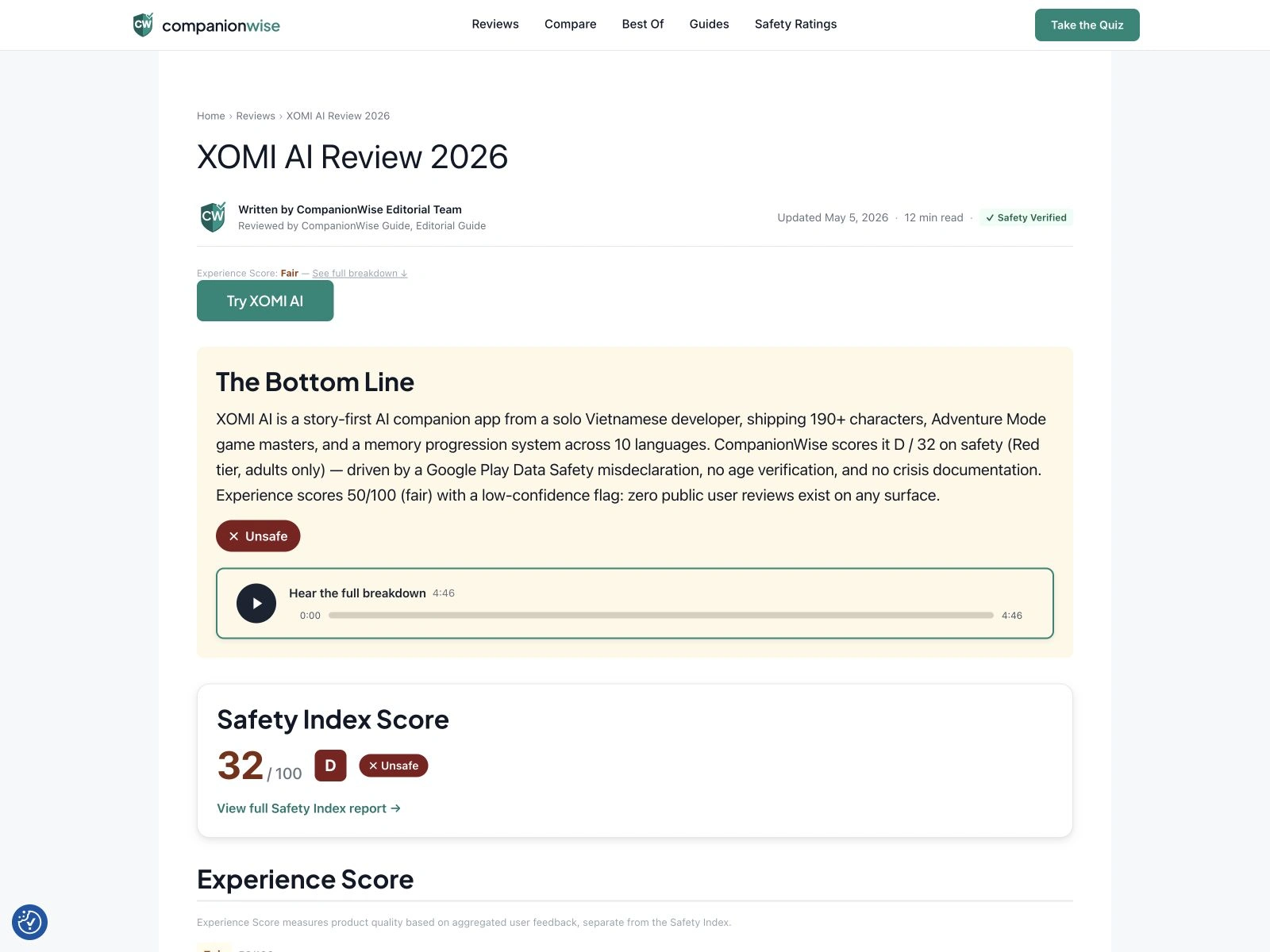
Caption: A live review surface with product identity, evidence-backed conclusions, Safety Index score, and experience score in one reader path.
5. Build the reader’s decision path, not just the page inventory
The public surfaces answer different questions. Reviews explain what an app is and who it fits. Safety ratings isolate risk. Comparisons make trade-offs visible. Best-of pages organize choices by need. The Matchmaker Quiz turns preferences into a recommendation path. Methodology pages show how the system reached its conclusions.
Those surfaces reinforce one another through structured data and deliberate links. A reader can move from a broad question to a shortlist, then into the safety evidence for a specific app without leaving the system.
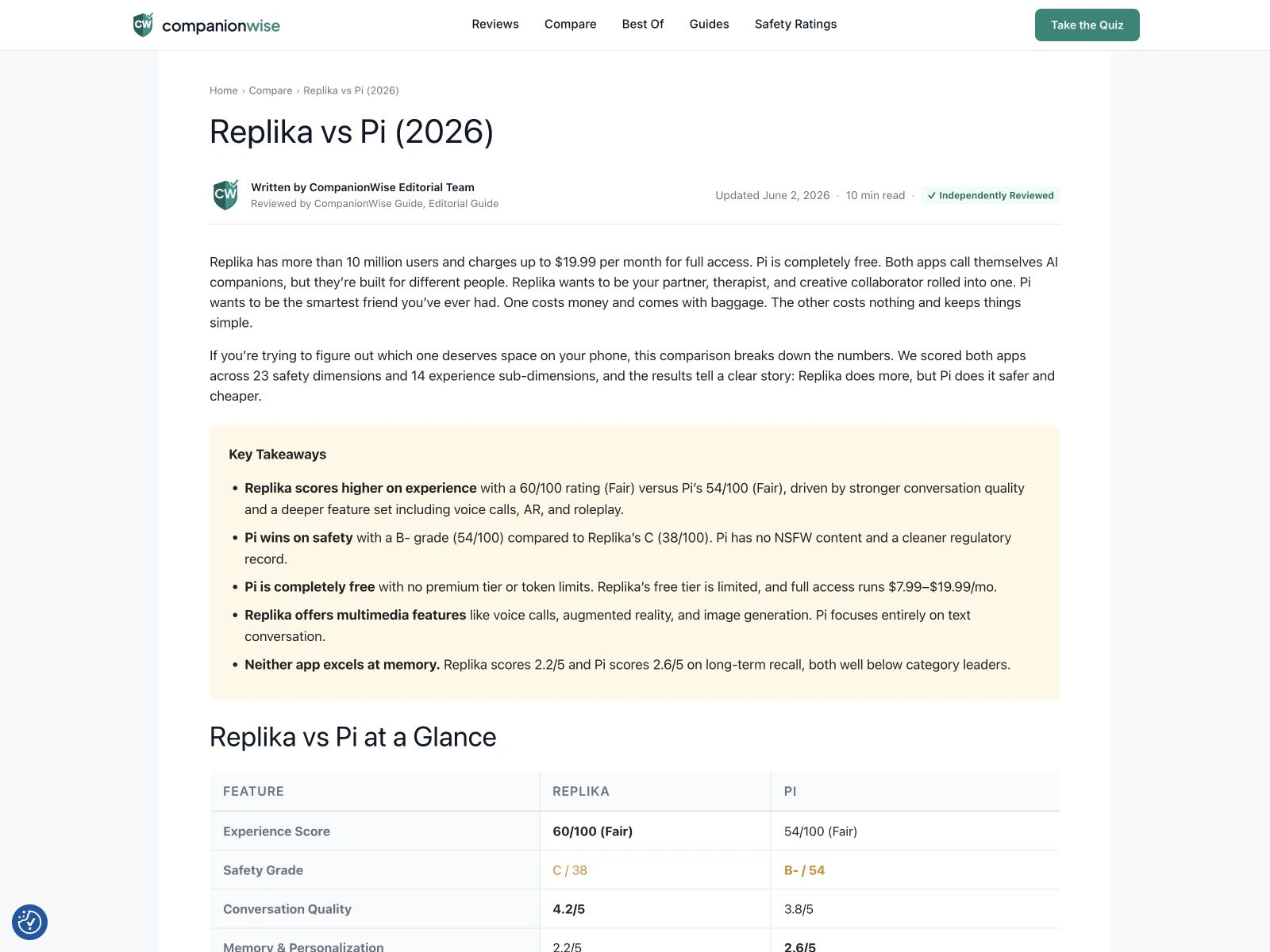
Caption: Comparison pages make the trade-off explicit instead of forcing one universal winner.
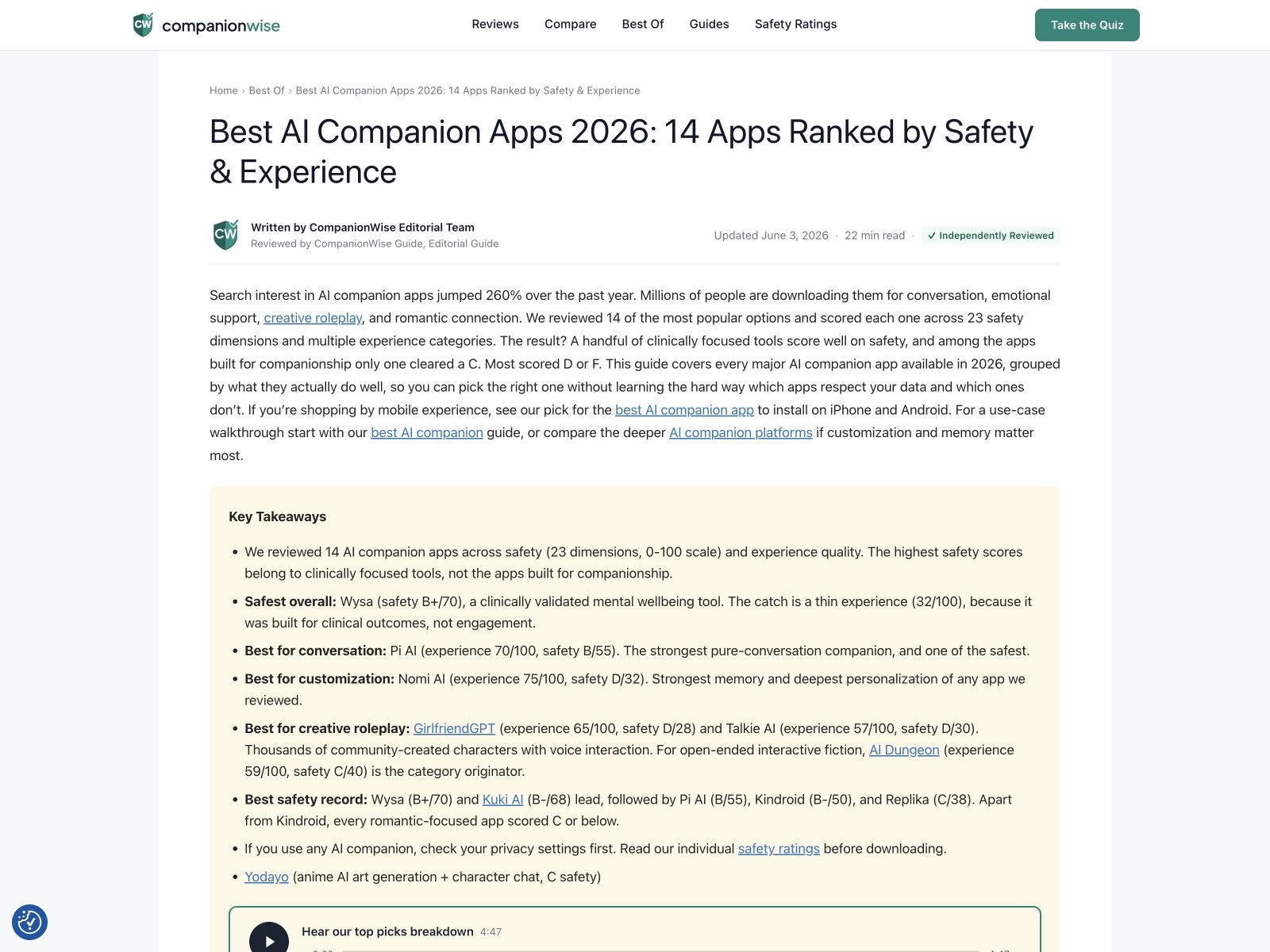
Caption: Best-of pages combine high-intent discovery with visible safety and experience criteria.
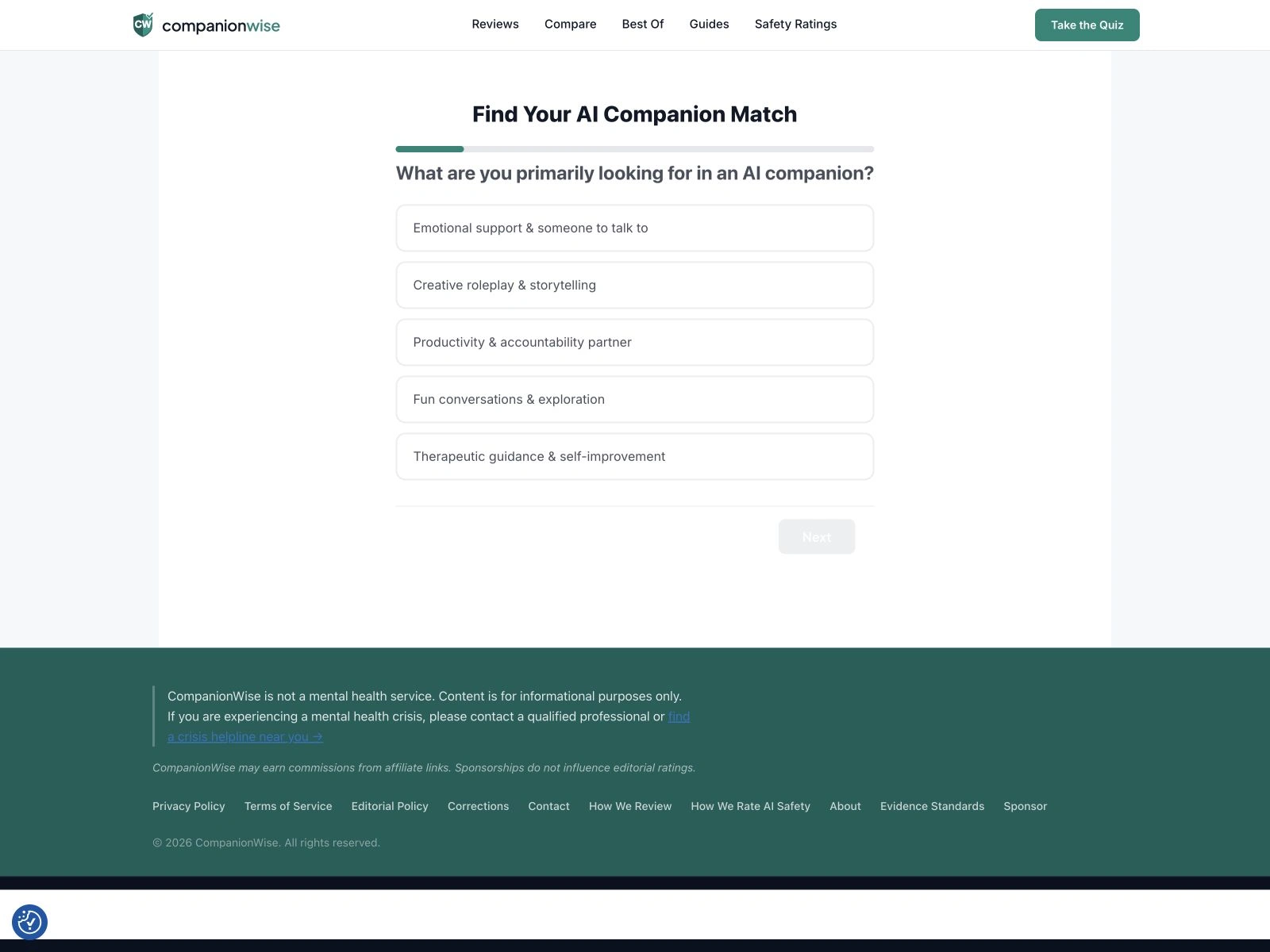
Caption: The Matchmaker Quiz turns user needs into a guided recommendation path instead of another generic ranking.
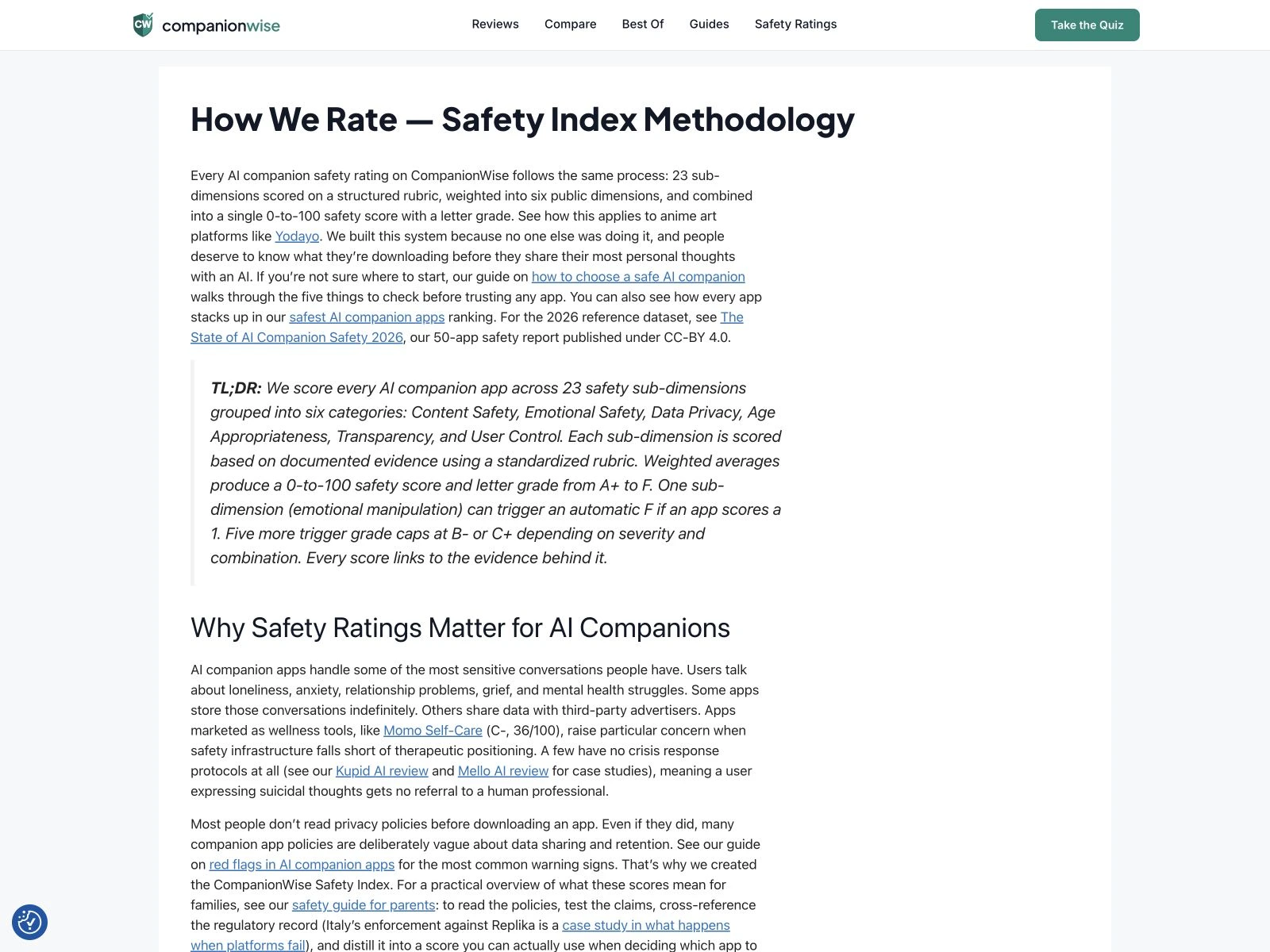
Caption: The public methodology explains the six dimensions, 23 inputs, evidence rules, grade logic, and correction process.
Solution & Outcome
• A live safety-first authority platform at companionwise.com, delivered as an ongoing client engagement.
• Exactly 200 published public pages verified through the WordPress REST API on July 26, 2026: 13 core pages, 50 reviews, 50 safety ratings, 31 best-of pages, 14 comparisons, 21 FAQs, 20 guides, and 1 safety alert.
• A 23-sub-dimension Safety Index that produces six weighted dimensions, a public score, letter grade, tier, critical overrides, and an audit trail through deterministic PHP.
• A recommendation quiz, paired review and safety surfaces, public evidence standards, editorial independence rules, and a correction path.
• A custom WordPress operating layer with authenticated REST deployment, Trigger.dev background work, content-completion gates, score-freshness checks, schema, and sitemap verification.
• A product architecture that keeps the commercial paths behind the trust system. Direct sponsorship, affiliate, email, and future data products were designed around editorial independence, not placed ahead of it.
The platform is live and still expanding. The AI proposes. The system decides. A human editor owns the publication call.
If your idea needs more than a website, it is worth defining the decisions, trust boundaries, and operating system before adding more pages.
Thanks for reading this far. If this is the kind of product and systems work you need, I would like to hear what you are building.
Like this project
Posted Jul 26, 2026
A client’s broad AI-companion idea turned into a 200-page safety-first platform with deterministic scoring, editorial gates, and automated publishing.
Likes
0
Views
11
Timeline
Mar 15, 2026 - Ongoing