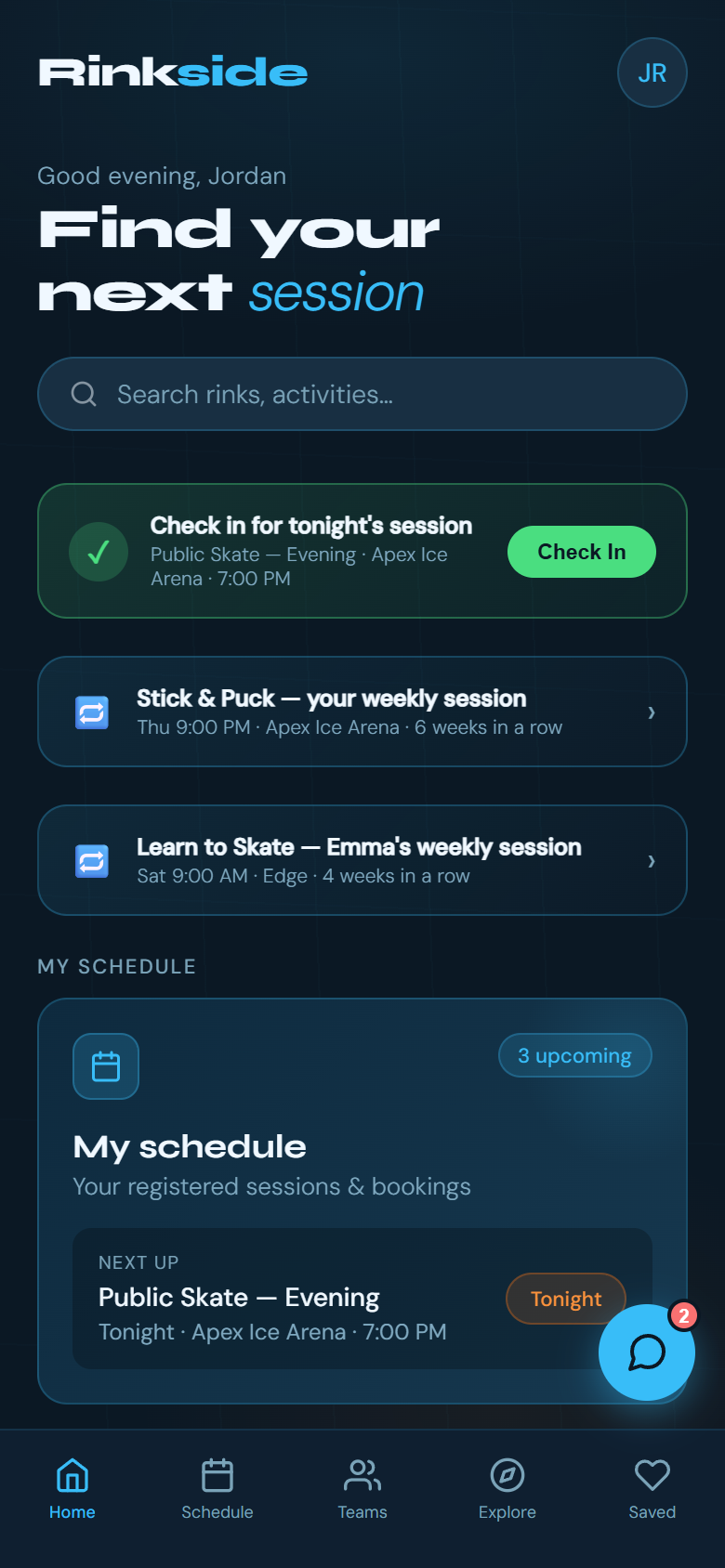
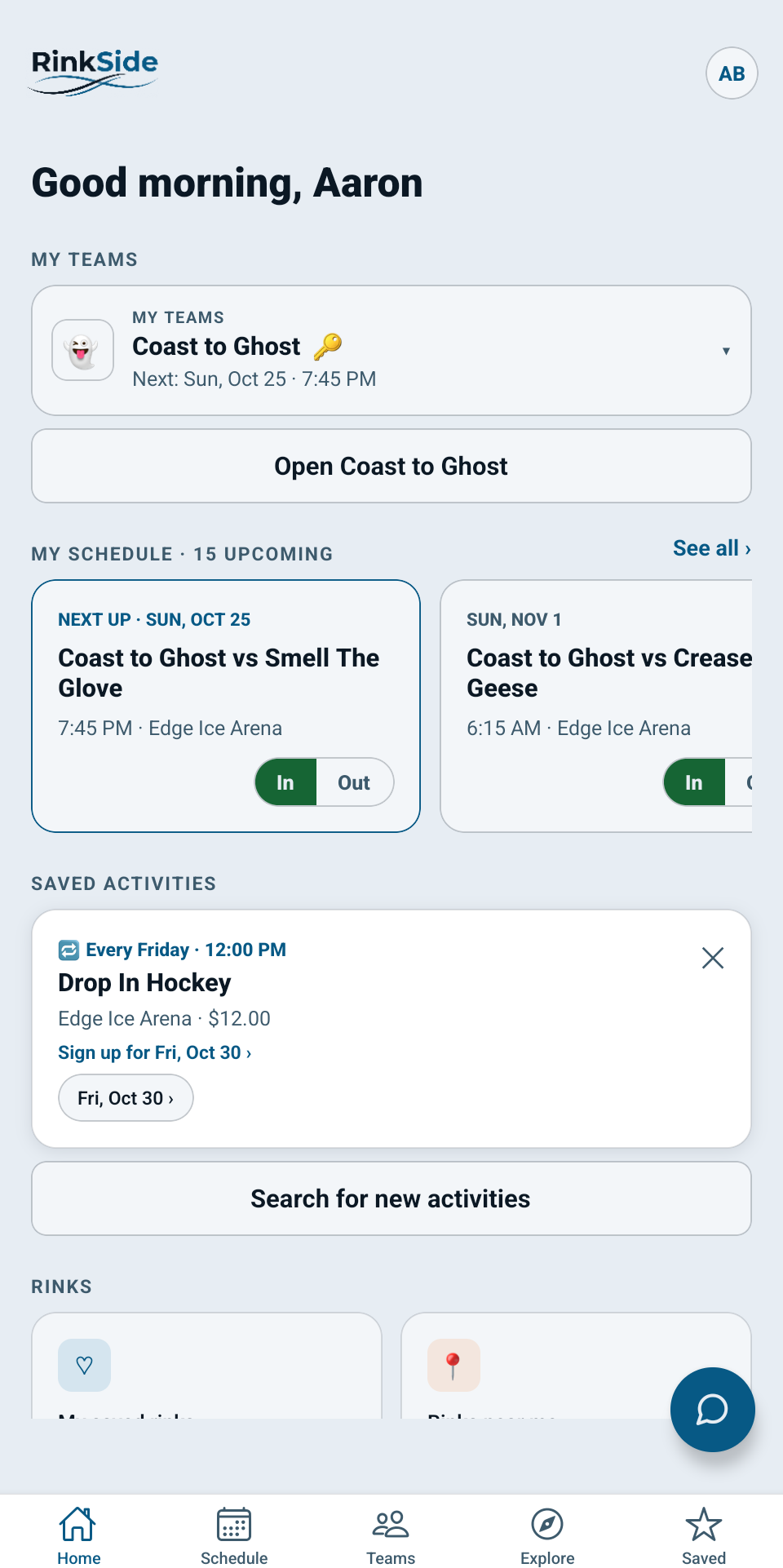
I couldn't book drop-in hockey on my phone at any of three Denver rinks, so I researched why and designed a fix: one app that shows every session you can actually book. Interviews, a survey, a competitive audit, journey maps, a service blueprint, and a working alpha now in testing with two teams. Full case study at aaronbeaudoin.com.
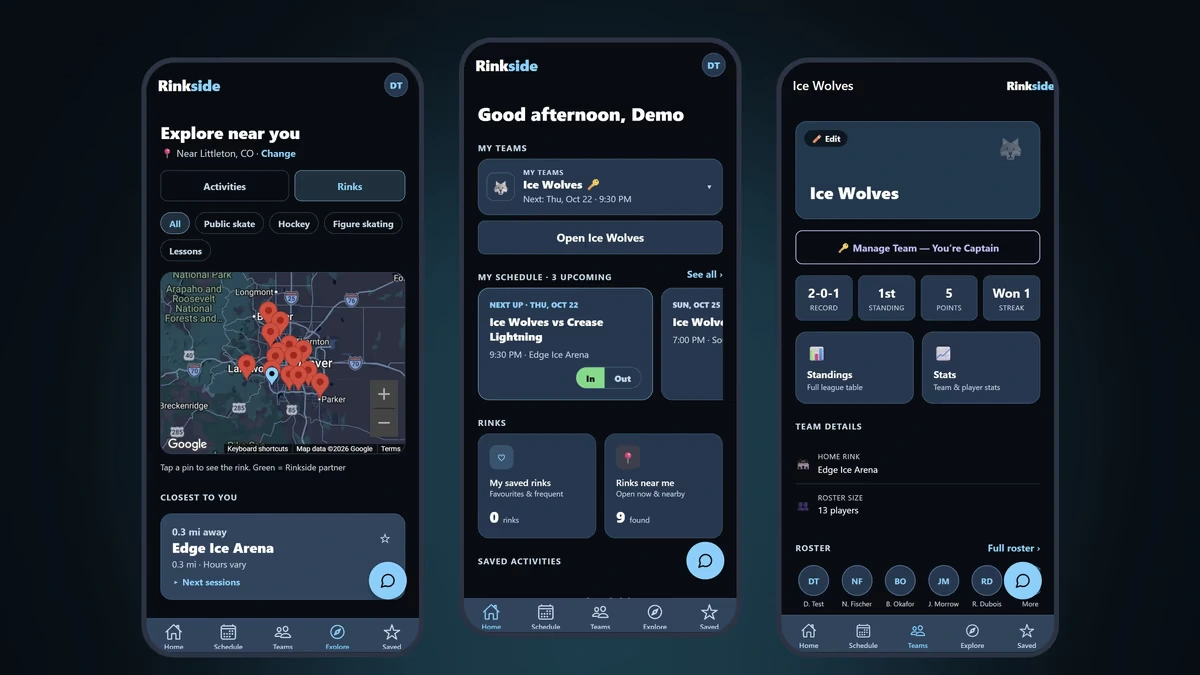
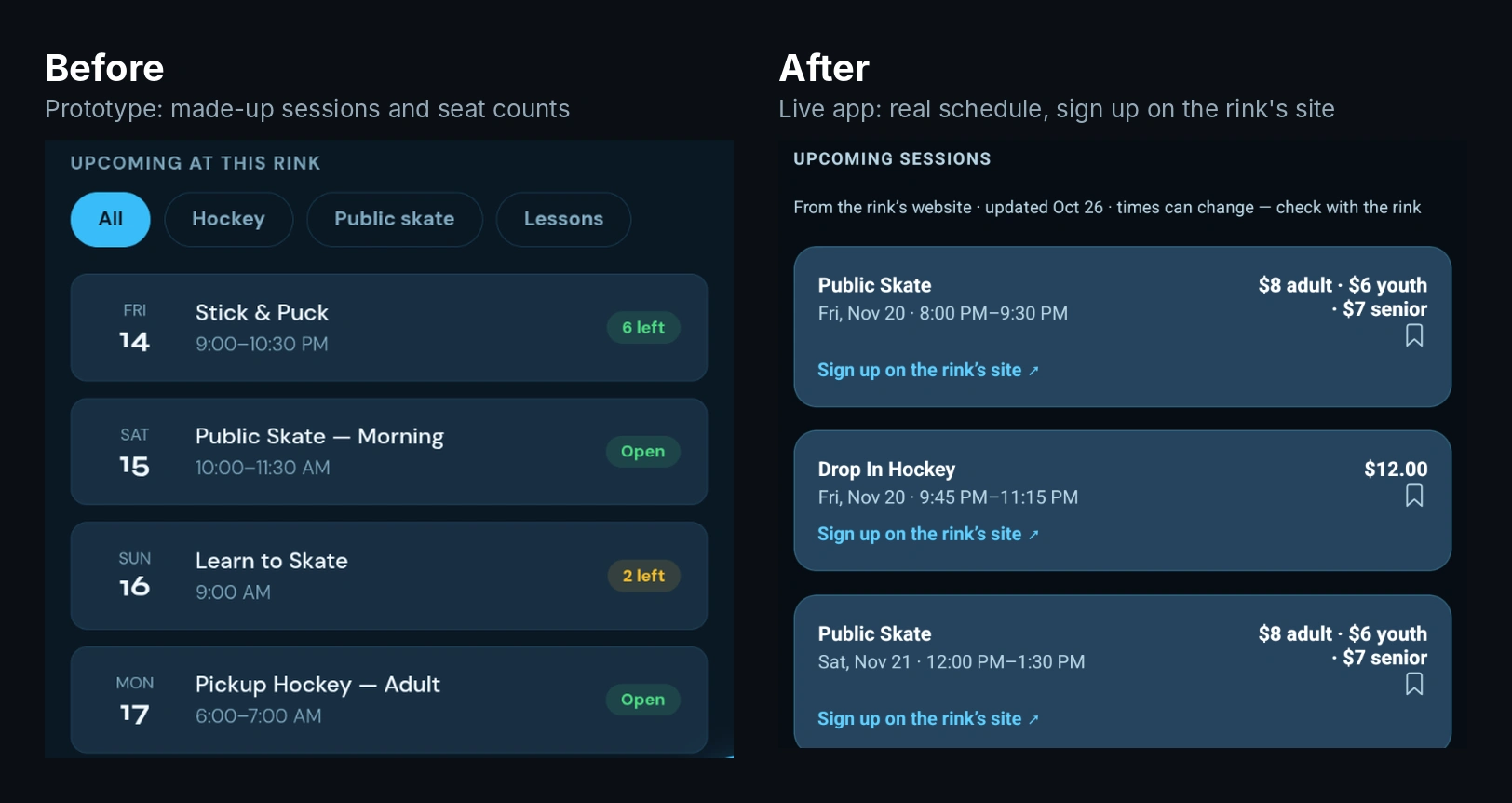
Prototype vs. live app. The prototype showed made-up sessions and seat counts. The live app shows each rink’s real schedule and sends you to the rink’s site to sign up, since no rinks are partners yet.
At a glance
The problem
Skaters can't tell which rink sessions they can actually book. Every rink uses different software, hides open spots behind a login, and still says to call.
What I did
Researched it at real rinks, with interviews, a survey, and a competitive audit. Then I designed and prototyped a one-app fix and built a working alpha with Claude Code.
Methods
Interviews · Survey · Competitive audit · Personas · Journey maps · Service blueprint · Prototype
Where it stands
Alpha on Android, iOS, and the web (step 1 of 4), being tested by two hockey teams. Results coming soon.
0 of 3 rinks let an adult book drop-in on a phone
13+ → 5 taps to book a session, in my prototype
73 rinks' sessions in one app
2 hockey teams testing the alpha
My role
Solo designer and founder. I did the research, UX, prototype, and product direction. I built the app with Claude Code.
Timeline
June 2026 – now
Platforms
Android app (alpha) · iOS app (TestFlight) · Web app (alpha)
Tools
Figma · FigJam · Google Forms · HTML/CSS/JS · Claude Code · Claude API · Expo / React Native · Next.js · Supabase · Clerk · GitHub · GitHub Pages · Vercel · Cloudflare
Status
Alpha (step 1 of 4). Testing with two hockey teams in progress.
01 · The problemFinding ice time shouldn't take five websites
I play adult league and drop-in hockey in Colorado. Finding ice time means checking a different website for every rink, logging in to see if there's room, and often still being told to call. I wanted one place where a skater can see every session they can actually book, right now.
The problems I set out to fix
You can't see what's available. Most rink systems hide open spots behind a login, or show them with no way to book.
There's no single source of truth. Rinks publish times that conflict with each other, then tell you to phone.
Casual skaters get left out. Drop-in is often members-only, and pricing assumes you're signing up for a season.
Team schedules depend on a volunteer. A captain retypes every ice time by hand, so games sit at "To be determined."
Problem statement
Adult recreational skaters need to see which sessions they can actually book right now, because every system I studied hides availability behind a login or shows it with no way to act on it.
Who it's for
Adult drop-in and league players, parents booking for kids, and casual skaters who just want to get on the ice.
Constraints
Solo project with no budget for paid tools or research participants.
A small research sample, from my own network.
No rink had signed on yet, so all rink data came from public listings.
Waivers and legal text need a lawyer, so the design leaves room for them instead of writing them.
02 · Research0 of 3 rinks let me book on a phone
What I wanted to learn
Is there a real need, and who has it?
How do people find out when they can skate, and how do they sign up?
Where does the booking journey break?
What do rinks need for this to work?
How I found out, and why
A hands-on study of real booking systems. I tried to book drop-in hockey on my phone at three Denver-area rinks, each on different software, and screenshotted every step. I wanted to see exactly where it breaks, not just hear about it.
Interviews with adult players, team captains, parents of youth skaters, and a casual skater, to hear the problem in their words.
A survey (8 responses) to check whether what I heard held up beyond the interviews.
I started with only my own experience as a player, and my early personas were guesses. I needed real data before designing anything. Everyone I interviewed or surveyed agreed to take part and answered voluntarily. Names and identifying details are left out here.
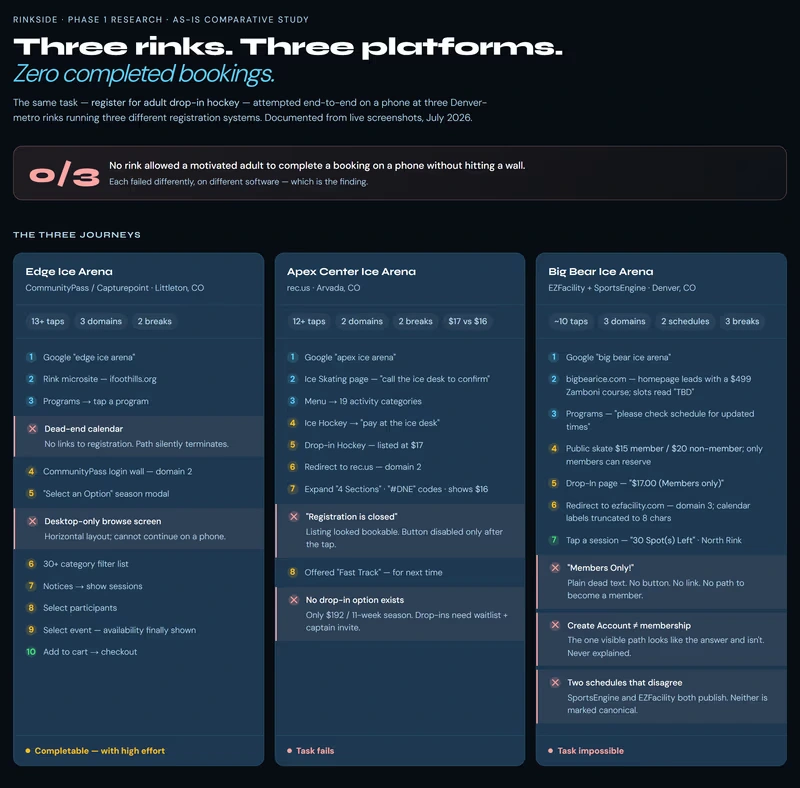
The as-is study: three rinks, three platforms, zero completed bookings on a phone.
What hurt the most
Availability is hidden or useless. Booking friction scored 3.1 out of 5 in the survey, the highest of anything I asked about. At one rink, booking a single session took at least 13 taps. Half the players I surveyed (4 of 8) had driven to a rink and found the session full, cancelled, or different from what they expected.
The schedule depends on a volunteer. Captains retype ice times by hand, so games show "To be determined."
Parents are already bridging apps by hand, copying schedules from the official platform into a team app.
In their words
Participant 2, adult league player
"It would be great if I could see all the availability for local rinks in one place, like when I want to get movie tickets."
Parent 1
"Convenience with registration would supersede commute time."
Parent 3
"Parents sometimes just copy all scheduling info into BenchApp for ease of use and common ground."
Casual skater
"Almost didn't go — the sessions were full."
How I made sense of it
I did the affinity work digitally instead of with sticky notes on a wall. Every interview and survey answer became a single observation, observations were grouped into themes, and a theme only counted as confirmed once two independent sources backed it. One anecdote wasn't enough.
People want "movie tickets for ice": one view of every rink
4 independent sources, unprompted: 2 survey answers, 2 player interviews
Manual schedule entry is where teams fall apart
2 captains, 2 players, 2 team apps
Booking is a real chore, but committed players push through it
Survey (3.1 of 5, the highest friction score) + 2 of 3 player interviews
Schedules go stale without warning
A player whose league time change never synced, and a captain who checks the league site by hand to catch changes
Switching away from BenchApp is easier than I assumed
2 captains, both independently
Themes I didn't see coming
Goalies play free, tracking team dues, and syncing to a phone calendar (that one came up 3 times)
What it changed
Friction is a first-timer problem more than a regular's problem. I assumed the booking hassle kept people from coming back. Every player I talked to still comes back; they're annoyed, not deterred. That made it a risk for winning new skaters rather than keeping current ones.
A scary number turned out to be a one-off. One team app screenshot showed 78% of players never answering. Both captains I interviewed said their teams answer far more often, so I stopped treating it as typical.
Competitive audit
I compared the booking platforms rinks use (CommunityPass, rec.us, EZFacility, SportsEngine, DaySmart Dash), BenchApp for team coordination, and similar apps like Volo Sports.
None of them show sessions from more than one rink.
Even the best one shows sessions you can't book, including ones that have already ended.
No ice-specific app combines the official schedule with team attendance. Volo does, but only at its own venues.
Feature matrix. Everyone builds for the rink. Nobody builds for the skater.
What it does
CommunityPass
rec.us
EZFacility
SportsEngine
BenchApp
Rinkside
Shows more than one rink
✕No
✓Yes
Availability before you log in
✕No
◐Partly
✕No
—Doesn't apply
✓Yes
Live spot count in the list
✕No
◐Partly
✕No
—Doesn't apply
✓Yes
Only shows sessions you can book
✕No
—Doesn't apply
✓Yes
Single session, no membership
◐Partly
✕No
—Doesn't apply
✓Yes
Built for phones, start to finish
✕No
✓Yes
◐Partly
✓Yes
One official schedule
✓Yes
◐Partly
✕No
✓Yes
One all-in price
✓Yes
◐Partly
—Doesn't apply
✓Yes
Push alert when something changes
✕No
◐Partly
✓Yes
Waitlist that moves people up
✕No
◐Partly
✕No
◐Partly
✓Yes
Team roster and attendance
✕No
✓Yes
Team schedule filled in from the rink
✕No
✓Yes
QR or digital check-in
✕No
◐Partly
✕No
✓Yes
Dashboard for rink staff
✓Yes
✕No
✓Yes
✓ works · ◐ partly · ✕ missing · — doesn't apply. The two highlighted rows are the ones nobody else does. I tested the five systems by trying to book on a phone, July 2026.
03 · Personas & journey mapPlayers and parents hit the same wall
Both personas are built from interviews. Their names and ages are made up. Their frustrations are real.
Easton, 31
Plays in a Tuesday-night adult league, plus drop-in stick & puck. Very comfortable with apps.
Goals
See his team's schedule and confirm he's coming, fast.
Find last-minute drop-in when he wants extra ice.
Not get surprised by a rink change or a Zamboni delay.
Frustrations
No way to know if a nearby drop-in has room without calling.
His captain types every game in by hand, so future games say "To be determined."
When the league changes a time, the team app still shows the old one.
Teammates don't say if they're in until the last minute.
In his words
"It would be great if I could see all the availability for local rinks in one place, like when I want to get movie tickets." (Participant 2)
Maria, 38
Works full time. Parent of one or two kids, ages 4–14, who skate at several rinks with different associations.
Goals
Sign the kids up without hunting across organizations.
Know right away if a session is full or cancelled.
Keep track of who's skating when.
Frustrations
Four or more separate organizations every season.
Registration sites crash when spots open.
Messages only reach one parent.
Entering the same info into multiple apps.
In her words
"Convenience with registration would supersede commute time."
The journey today
A Google search lands on a rink's homepage, not its schedule. Then a login wall, a dead end, and "call to confirm." Most people give up or pick up the phone.
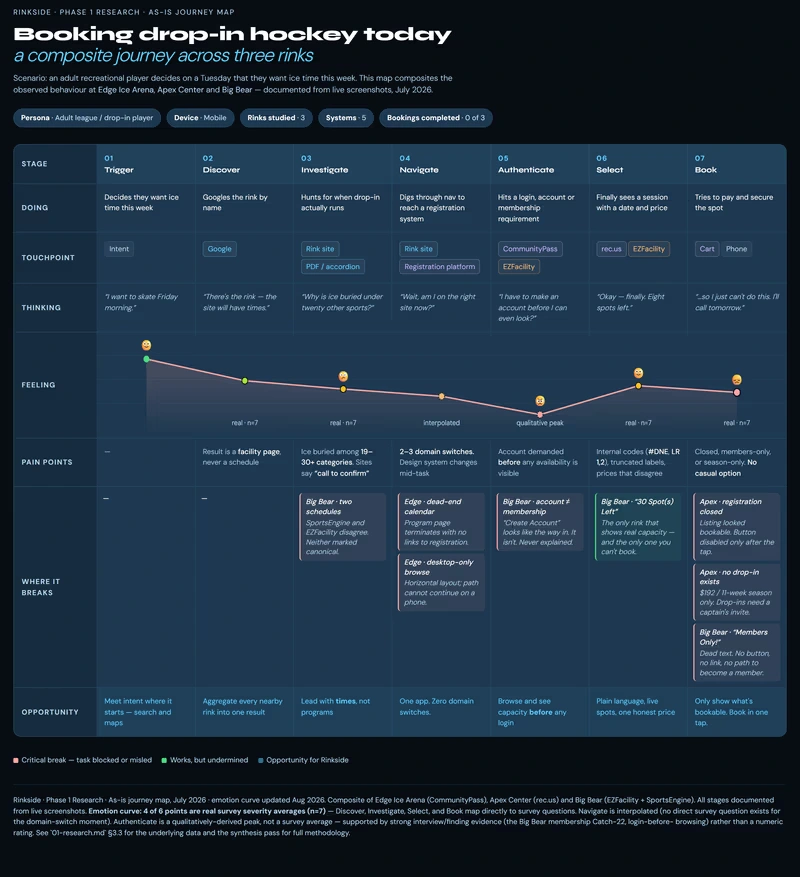
As-is journey: 13+ taps and three different websites, with the lowest point at the login wall.
The journey I designed for
Open the app and see every nearby session today in one list, with live spot counts. Book in a few taps, no membership needed.
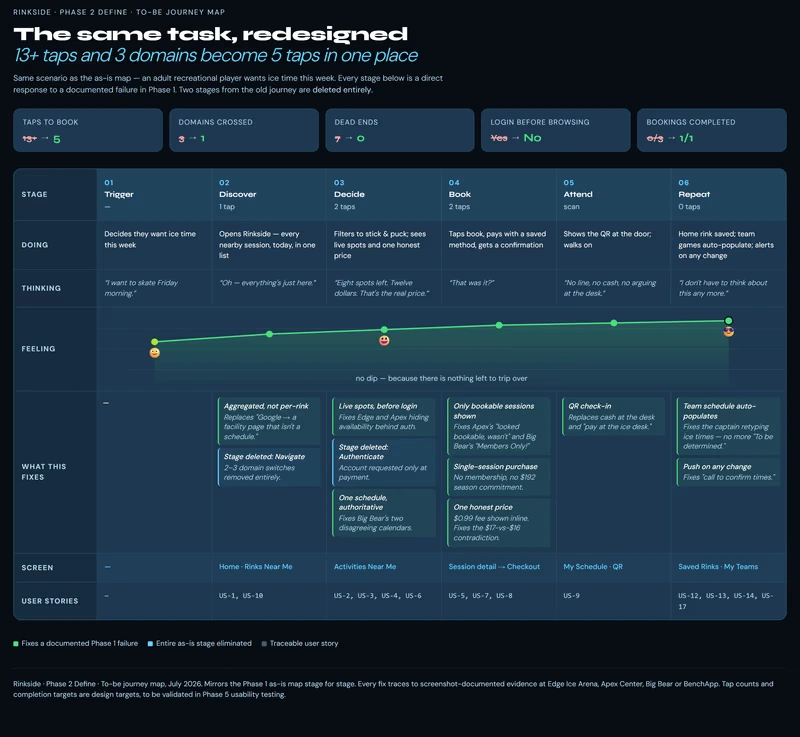
To-be journey: the same task in 5 taps, in one place.
Service blueprint: what happens behind the screen
The journey map only shows what the skater sees. A service blueprint adds what's underneath: what rink staff do, and the systems behind them. I made one for the same task, booking drop-in hockey, as it works today and as Rinkside is designed to work. It also adds a step the journey map left out: showing up at the rink.
I made it after the design, so it didn't shape the screens. It's a check on them. It's built from the survey (8 players), 3 player interviews, 3 operator interviews, and a screenshot audit of 4 rinks on 5 booking systems. Where it says "not researched," I have no data. That doesn't mean nothing happens there.
How to read it: each stage has five lanes. What the skater sees and does sits above the line of interaction. What the app or rink shows them sits above the line of visibility. Behind that is what staff do, and below the line of internal interaction are the systems. F marks a fail point, where the task is blocked or the skater is misled. P marks a pain point, where it works but badly.
Today, without Rinkside
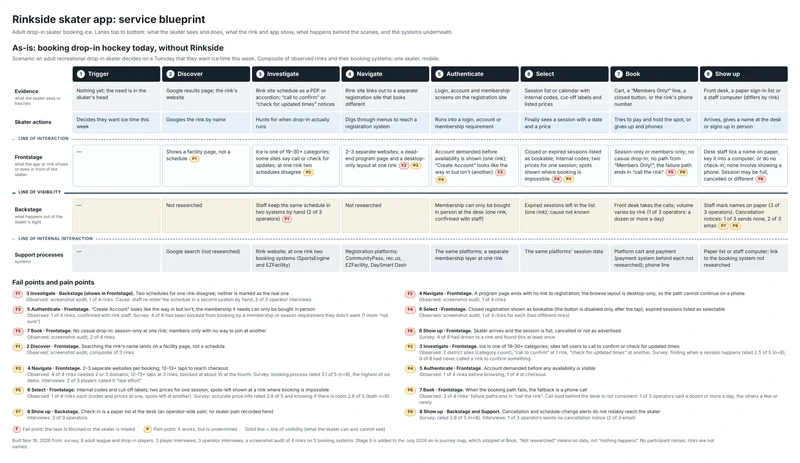
As-is. Six fail points and eight pain points, almost all of them where the skater can see them.
Read the as-is blueprint as text
1. Trigger
Evidence (what the skater sees or touches)
Nothing yet; the need is in the skater's head
Skater actions
Decides they want ice time this week
Frontstage (what the app or rink shows or does in front of the skater)
Backstage (what happens out of the skater's sight)
Support processes (systems)
2. Discover
Evidence (what the skater sees or touches)
Google results page; the rink's website
Skater actions
Googles the rink by name
Frontstage (what the app or rink shows or does in front of the skater)
Shows a facility page, not a schedule [P1]
Backstage (what happens out of the skater's sight)
Not researched
Support processes (systems)
Google search (not researched)
3. Investigate
Evidence (what the skater sees or touches)
Rink site schedule as a PDF or accordion; "call to confirm" or "check for updated times" notices
Skater actions
Hunts for when drop-in actually runs
Frontstage (what the app or rink shows or does in front of the skater)
Ice is one of 19–30+ categories; some sites say call or check for updates; at one rink two schedules disagree [P2]
Backstage (what happens out of the skater's sight)
Staff keep the same schedule in two systems by hand (2 of 3 operators) [F1]
Support processes (systems)
Rink website; at one rink two booking systems (SportsEngine and EZFacility)
4. Navigate
Evidence (what the skater sees or touches)
Rink site links out to a separate registration site that looks different
Skater actions
Digs through menus to reach a registration system
Frontstage (what the app or rink shows or does in front of the skater)
2–3 separate websites; a dead-end program page and a desktop-only layout at one rink [F2, P3]
Backstage (what happens out of the skater's sight)
Not researched
Support processes (systems)
Registration platforms: CommunityPass, rec.us, EZFacility, DaySmart Dash
5. Authenticate
Evidence (what the skater sees or touches)
Login, account and membership screens on the registration site
Skater actions
Runs into a login, account or membership requirement
Frontstage (what the app or rink shows or does in front of the skater)
Account demanded before availability is shown (one rink); "Create Account" looks like the way in but isn't (another) [F3, P4]
Backstage (what happens out of the skater's sight)
Membership can only be bought in person at the desk (one rink, confirmed with staff)
Support processes (systems)
The same platforms; a separate membership layer at one rink
6. Select
Evidence (what the skater sees or touches)
Session list or calendar with internal codes, cut-off labels and listed prices
Skater actions
Finally sees a session with a date and a price
Frontstage (what the app or rink shows or does in front of the skater)
Closed or expired sessions listed as bookable; internal codes; two prices for one session; spots shown where booking is impossible [F4, P5]
Backstage (what happens out of the skater's sight)
Expired sessions left in the list (one rink); cause not known
Support processes (systems)
The same platforms' session data
7. Book
Evidence (what the skater sees or touches)
Cart, a "Members Only!" line, a closed button, or the rink's phone number
Skater actions
Tries to pay and hold the spot, or gives up and phones
Frontstage (what the app or rink shows or does in front of the skater)
Season-only or members-only; no casual drop-in; no path from "Members Only!"; the failure path ends in "call the rink" [F5, P6]
Backstage (what happens out of the skater's sight)
Front desk takes the calls; volume varies by rink (1 of 3 operators: a dozen or more a day)
Support processes (systems)
Platform cart and payment (payment system behind each not researched); phone line
8. Show up
Evidence (what the skater sees or touches)
Front desk, a paper sign-in list or a staff computer (differs by rink)
Skater actions
Arrives, gives a name at the desk or signs up in person
Frontstage (what the app or rink shows or does in front of the skater)
Desk staff tick a name on paper, key it into a computer, or do no check-in; none involve showing a phone. Session may be full, cancelled or different [F6]
Backstage (what happens out of the skater's sight)
Staff mark names on paper (3 of 3 operators). Cancellation notices: 1 of 3 sends none, 2 of 3 email [P7, P8]
Support processes (systems)
Paper list or staff computer; link to the booking system not researched
Fail points and pain points
F1 · 3 Investigate · Backstage (shows in Frontstage). Two schedules for one rink disagree; neither is marked as the real one.
Observed: screenshot audit, 1 of 4 rinks. Cause: staff re-enter the schedule in a second system by hand, 2 of 3 operator interviews.
F2 · 4 Navigate · Frontstage. A program page ends with no link to registration; the browse layout is desktop-only, so the path cannot continue on a phone.
Observed: screenshot audit, 1 of 4 rinks.
F3 · 5 Authenticate · Frontstage. "Create Account" looks like the way in but isn't; the membership it needs can only be bought in person.
Observed: 1 of 4 rinks, confirmed with rink staff. Survey: 4 of 8 had been blocked from booking by a membership or season requirement they didn't want (1 more "not sure").
F4 · 6 Select · Frontstage. Closed registration shown as bookable (the button is disabled only after the tap); expired sessions listed as selectable.
Observed: screenshot audit, 1 of 4 rinks for each (two different rinks).
F5 · 7 Book · Frontstage. No casual drop-in: season-only at one rink; members-only with no way to join at another.
Observed: screenshot audit, 2 of 4 rinks.
F6 · 8 Show up · Frontstage. Skater arrives and the session is full, cancelled or not as advertised.
Survey: 4 of 8 had driven to a rink and found this at least once.
P1 · 2 Discover · Frontstage. Searching the rink's name lands on a facility page, not a schedule.
Observed: screenshot audit, composite of 3 rinks.
P2 · 3 Investigate · Frontstage. Ice is one of 19–30+ categories; sites tell users to call to confirm or check for updated times.
Observed: 2 district sites (category count); "call to confirm" at 1 rink, "check for updated times" at another. Survey: finding when a session happens rated 2.5 of 5 (n=8); 0 of 8 had never called a rink to confirm something.
P3 · 4 Navigate · Frontstage. 2–3 separate websites per booking; 12–13+ taps to reach checkout.
Observed: 4 of 4 rinks needed 2 or 3 domains; 12–13+ taps at 3 rinks, blocked at about 10 at the fourth. Survey: booking process rated 3.1 of 5 (n=8), the highest of six items. Interviews: 2 of 3 players called it "real effort".
P4 · 5 Authenticate · Frontstage. Account demanded before any availability is visible.
Observed: 1 of 4 rinks before browsing, 1 of 4 at checkout.
P5 · 6 Select · Frontstage. Internal codes and cut-off labels; two prices for one session; spots-left shown at a rink where booking is impossible.
Observed: 1 of 4 rinks each (codes and prices at one, spots-left at another). Survey: accurate price info rated 2.8 of 5 and knowing if there is room 2.6 of 5 (both n=8).
P6 · 7 Book · Frontstage. When the booking path fails, the fallback is a phone call.
Observed: 3 of 4 rinks' failure paths end in "call the rink". Call load behind the desk is not consistent: 1 of 3 operators said a dozen or more a day, the others a few or rarely.
P7 · 8 Show up · Backstage. Check-in is a paper list at the desk (an operator-side pain; no skater pain recorded here).
Interviews: 3 of 3 operators.
P8 · 8 Show up · Backstage and Support. Cancellation and schedule-change alerts do not reliably reach the skater.
Survey: rated 2.8 of 5 (n=8). Interviews: 1 of 3 operators sends no cancellation notice (2 of 3 email).
Most of the failures happen in front of the skater, but at least one starts behind the line. One rink showed two schedules that disagree (F1), and the operator interviews explain why: at 2 of 3 rinks, staff keep the same schedule in two systems by hand. The skater's problem comes from the rink's workflow. That's the link between this app and Rinkside for rinks .
The new last step mattered too. 4 of 8 survey respondents had driven to a rink and found the session full, cancelled, or not as advertised (F6), and 1 of 3 rinks sends no notice when it cancels.
With Rinkside
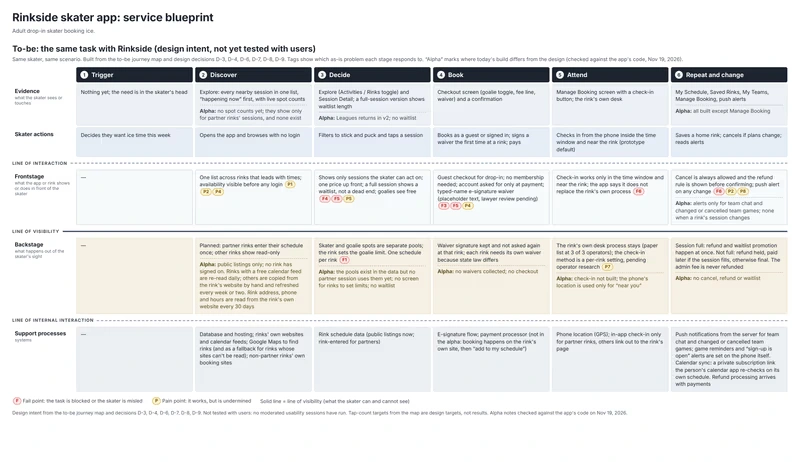
To-be. Design intent, not tested with users. Alpha notes show where today's build differs.
Read the to-be blueprint as text
1. Trigger
Evidence (what the skater sees or touches)
Nothing yet; the need is in the skater's head
Skater actions
Decides they want ice time this week
Frontstage (what the app or rink shows or does in front of the skater)
Backstage (what happens out of the skater's sight)
Support processes (systems)
2. Discover
Evidence (what the skater sees or touches)
Explore: every nearby session in one list, "happening now" first, with live spot counts
Alpha: no spot counts yet; they show only for partner rinks' sessions, and none exist
Skater actions
Opens the app and browses with no login
Frontstage (what the app or rink shows or does in front of the skater)
One list across rinks that leads with times; availability visible before any login [P1, P2, P4]
Backstage (what happens out of the skater's sight)
Planned: partner rinks enter their schedule once; other rinks show read-only
Alpha: public listings only; no rink has signed on. Rinks with a free calendar feed are re-read daily; others are copied from the rink's website by hand and refreshed every week or two. Rink address, phone and hours are read from the rink's own website every 30 days
Support processes (systems)
Database and hosting; rinks' own websites and calendar feeds; Google Maps to find rinks (and as a fallback for rinks whose sites can't be read); non-partner rinks' own booking sites
3. Decide
Evidence (what the skater sees or touches)
Explore (Activities / Rinks toggle) and Session Detail; a full-session version shows waitlist length
Alpha: Leagues returns in v2; no waitlist
Skater actions
Filters to stick and puck and taps a session
Frontstage (what the app or rink shows or does in front of the skater)
Shows only sessions the skater can act on; one price up front; a full session shows a waitlist, not a dead end; goalies see free [F4, F5, P5]
Backstage (what happens out of the skater's sight)
Skater and goalie spots are separate pools; the rink sets the goalie limit. One schedule per rink [F1]
Alpha: the pools exist in the data but no partner session uses them yet; no screen for rinks to set limits; no waitlist
Support processes (systems)
Rink schedule data (public listings now; rink-entered for partners)
4. Book
Evidence (what the skater sees or touches)
Checkout screen (goalie toggle, fee line, waiver) and a confirmation
Skater actions
Books as a guest or signed in; signs a waiver the first time at a rink; pays
Frontstage (what the app or rink shows or does in front of the skater)
Guest checkout for drop-in; no membership needed; account asked for only at payment; typed-name e-signature waiver (placeholder text, lawyer review pending) [F3, F5, P4]
Backstage (what happens out of the skater's sight)
Waiver signature kept and not asked again at that rink; each rink needs its own waiver because state law differs
Alpha: no waivers collected; no checkout
Support processes (systems)
E-signature flow; payment processor (not in the alpha: booking happens on the rink's own site, then "add to my schedule")
5. Attend
Evidence (what the skater sees or touches)
Manage Booking screen with a check-in button; the rink's own desk
Skater actions
Checks in from the phone inside the time window and near the rink (prototype default)
Frontstage (what the app or rink shows or does in front of the skater)
Check-in works only in the time window and near the rink; the app says it does not replace the rink's own process [F6]
Backstage (what happens out of the skater's sight)
The rink's own desk process stays (paper list at 3 of 3 operators); the check-in method is a per-rink setting, pending operator research [P7]
Alpha: check-in not built; the phone's location is used only for "near you"
Support processes (systems)
Phone location (GPS); in-app check-in only for partner rinks, others link out to the rink's page
6. Repeat and change
Evidence (what the skater sees or touches)
My Schedule, Saved Rinks, My Teams, Manage Booking, push alerts
Alpha: all built except Manage Booking
Skater actions
Saves a home rink; cancels if plans change; reads alerts
Frontstage (what the app or rink shows or does in front of the skater)
Cancel is always allowed and the refund rule is shown before confirming; push alert on any change [F6, P2, P8]
Alpha: alerts only for team chat and changed or cancelled team games; none when a rink's session changes
Backstage (what happens out of the skater's sight)
Session full: refund and waitlist promotion happen at once. Not full: refund held, paid later if the session fills, otherwise final. The admin fee is never refunded
Alpha: no cancel, refund or waitlist
Support processes (systems)
Push notifications from the server for team chat and changed or cancelled team games; game reminders and "sign-up is open" alerts are set on the phone itself. Calendar sync: a private subscription link the person's calendar app re-checks on its own schedule. Refund processing arrives with payments
I checked the to-be against the app's code. Wherever the alpha doesn't match the design, it says so. That check shows that most of what fixes the as-is fail points sits backstage, with the rink: one schedule per rink, spot counts, waitlists, and alerts when a rink's session changes. None of that is in the alpha, because no rink has signed on yet. Today the alpha only sends alerts for team chat and for changed or cancelled team games.
04 · IdeationEight ways to answer one question
How might we…
…show a skater, on one screen, every session they can actually book today?
…let someone try ice for the first time without a membership or a season commitment?
…turn a 13-tap, three-website task into a few taps in one place?
…make a team's schedule show up without anyone typing it in?
The sketches
I sketched eight different main screens, all answering "when can I skate, and is there room?"
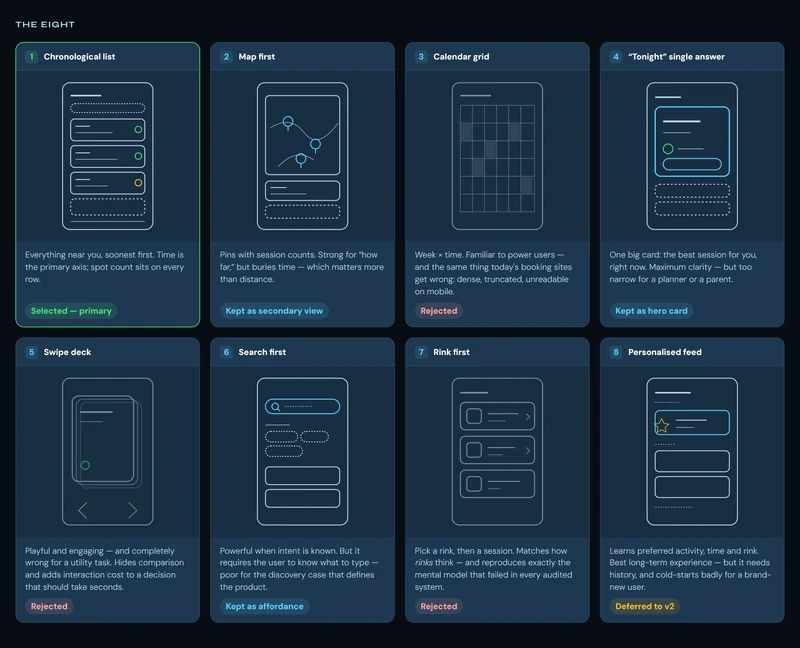
The eight concepts. The chronological list won.
What I picked, and why
A chronological list of sessions as the backbone, with a "Tonight" card on top, a map you can switch to, and search always within reach. It answers the question directly, it's the easiest to scan, and it still works when a rink has only a few sessions listed.
For teams, Rinkside replaces BenchApp instead of sitting next to it. It does what a team app does (schedule, In / Out RSVPs, team chat, stats), and the schedule fills in from the rink, so nobody retypes it. One app is easier to ask a whole roster to use than two.
What I dropped
Calendar grid. It's what the current systems do, and it's dense and hard to read on a phone.
Swipe deck. Fun, but wrong for a quick, practical task.
Rink first. It repeats the mental model that's already failing people.
05 · Wireframes & prototypeNothing more than three taps from Home
How the app is organized
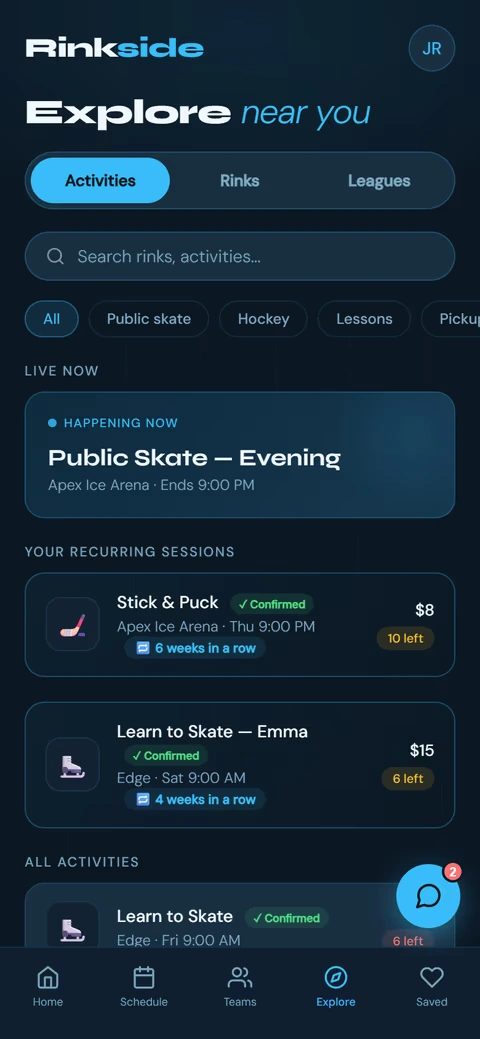
Six tabs: Home, My Schedule, My Teams, Explore, Saved, and Profile. Every screen follows the same order: one hero item, a scannable list, then filters. I merged "Rinks" and "Activities" into one Explore tab with a toggle, because research showed people getting lost between competing tabs.
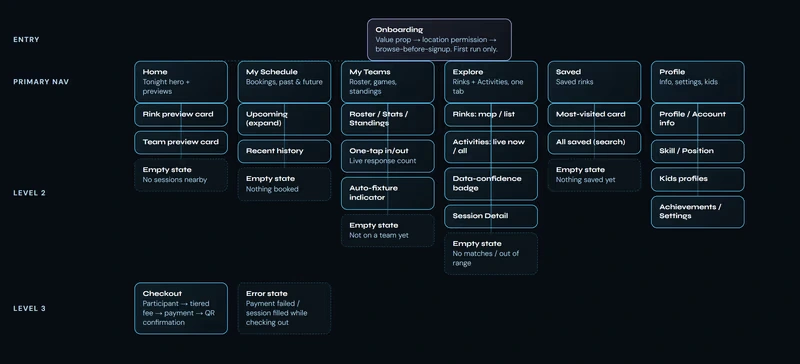
Sitemap. Nothing is more than three taps from Home.
The four key flows
Before the hi-fi screens, I mapped the four tasks that matter most in FigJam: finding and booking ice, a team game from schedule to rink, checkout, and canceling. They're redrawn here from my boards so they're easier to read.
Start: Open Rinkside
Home: hero and previews
Browse or search?
Search
Search results
↓ Continues below
Browse
Explore: rinks and activities
Sessions available nearby?
Yes
↓ Continues below
No
End: Empty state: no sessions nearby
↓ Continues below
Session list with live spot counts
Session detail
Proceed to checkout
End: Booking confirmed
Discover → book. Browsing and searching end up on the same list of sessions with live spot counts, so there's no separate path for each rink. If nothing's nearby, you get an empty state, not a dead end.
In the alpha, this flow ends by handing off to the rink's own site to pay, and then you add the session to your schedule. Paying in the app comes with step two of the launch plan.
More flows: team games, checkout, and canceling
Start: Rink publishes its schedule
The game fills in under My Teams
Push notification: new game scheduled
Player opens My Teams
Sees the game: date, time, venue
In or out?
In
Marked in, live count updates
↓ Continues below
Out
End: Marked out, live count updates
No answer by the deadline
Automated nudge
↺ Back to “In or out?”
Game day
QR check-in at the rink
End: On the ice
Team games. The rink's schedule fills in the team's games, so no captain retypes them. Players answer In or Out, and anyone who hasn't answered by the deadline gets a nudge. The board still ends with a QR check-in at the rink. After I watched four real check-ins and none involved showing a phone, I changed that step to a check-in button in the app (see Iterations).
Start: Enter from session detail
Pick who's going: you or a dependent
Price tier?
Under the threshold
Flat $0.99 fee
↓ Continues below
Over the threshold
Capped percentage fee
↓ Continues below
Show the all-in total before paying
Saved payment method?
Yes
↓ Continues below
No
Add one through Stripe
↓ Continues below
Pay
Payment result?
Success
End: Confirmation and QR credential
Failed
Error: payment failed
↺ Back to “Pay”
Session filled during checkout
Error: session filled
End: Waitlist offer
Checkout. Book for yourself or your kid, see the all-in total before you pay, and recover from the two ways it can fail: a declined card (try again) or the session filling up mid-checkout (join the waitlist).
Canceling: version 1 and version 2
Start: Tap Cancel booking
Is anyone on the waitlist right now?
Yes
Show: you'll be refunded, someone can take your spot
↓ Continues below
No
Show: you won't be refunded, the spot may go unfilled
↓ Continues below
Confirm the cancellation?
No
End: Booking kept
Yes, waitlist
Refund issued
Next person on the waitlist is promoted
They're charged and their spot is confirmed
End: Cancellation complete
Yes, no waitlist
Booking canceled, no refund
Spot opens, nobody to fill it
End: Cancellation complete
Version 1. You only got a refund if someone was already on the waitlist to take your spot.
Start: Tap Cancel booking
Is the session full right now?
Yes, with a waitlist
Show: you'll be refunded now, N people waiting
↓ Continues below
No
Show: not refunded now, but refunded if this fills before it starts
↓ Continues below
Confirm the cancellation?
No
End: Booking kept
Yes, full
Refund issued right away
Next person on the waitlist is promoted
They're charged and their spot is confirmed
End: Cancellation complete
Yes, not full
Booking canceled, spot opens, refund pending
Does it fill before it starts?
Yes
Refund paid
End: Cancellation complete
No
Pending closes: no refund
End: Cancellation complete
↓ Continues below
Version 2. If the session is full, you're refunded right away. If it isn't, your refund waits: if the spot fills before the session starts, you get your money back. You can always cancel, and the app tells you which case you're in before you confirm.
Checkout and canceling aren't in the alpha yet, because payments come with step two.
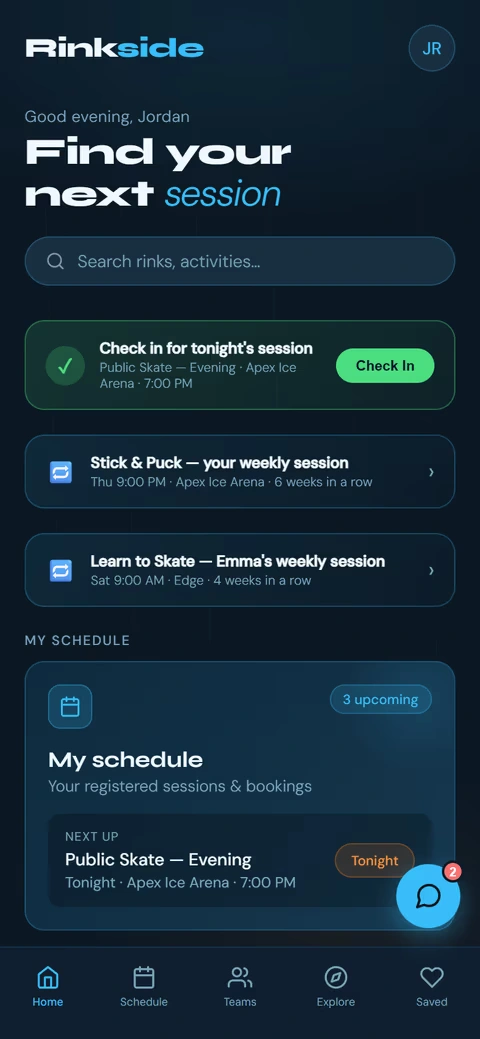
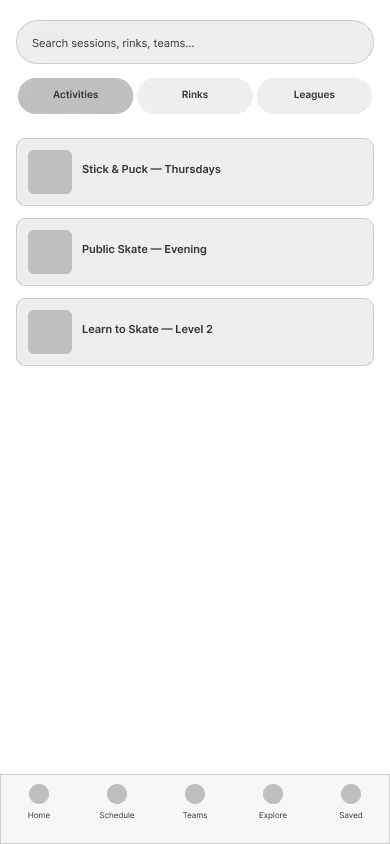
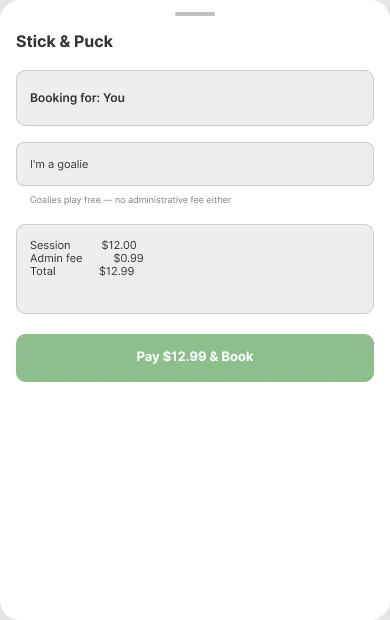
From lo-fi to hi-fi
I wireframed in Figma, then built the hi-fi prototype as clickable HTML so every screen could be wired together and tested on a real phone.
Home
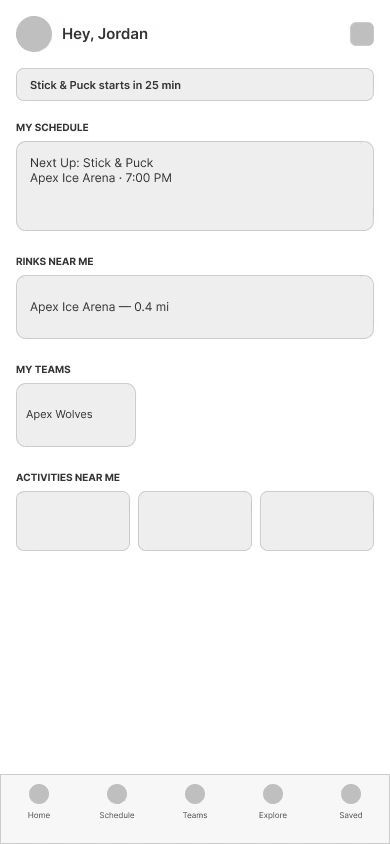
Lo-fi wireframe
Hi-fi prototype
Explore
Lo-fi wireframe
Hi-fi prototype
Checkout
Lo-fi wireframe
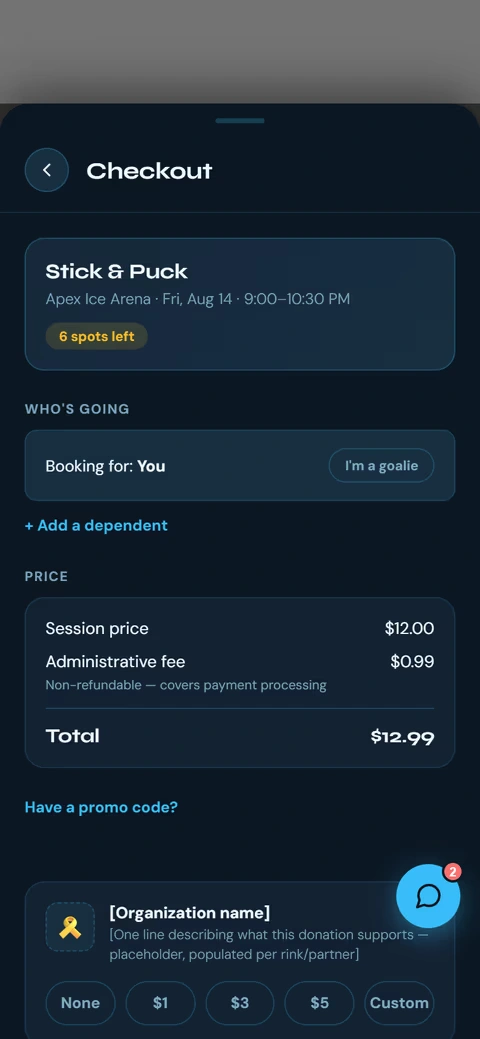
Hi-fi prototype
The built app, at phone and desktop size, is under Final design.
06 · Usability testingTesting with real teams, in a real app
In progress
I chose to build a working alpha first and test with the real app instead of a prototype. Two hockey teams are using it now, and I'm collecting their feedback over the next few weeks. I'll add the results here.
The test plan
Watching people use it (3–5 people, about 30 minutes each). I give someone a task, like "find out if there's an open session tonight and how many spots are left," and ask them to think out loud while I watch where they hesitate.
A follow-up survey (8–10 people) with a standard usability score, so I can compare rounds.
The tasks check whether the problems from research are actually solved: Can you tell if a session has room within 10 seconds? Do you hit any dead ends? Can you join your team from an invite and answer In or Out? Booking, cancelling, and the goalie fee come later. The alpha sends people to the rink's own sign-up page until rinks join (see Final design).
Feedback from the alpha comes in through the app's built-in feedback form.
Early signal
Before the alpha, two people tried the prototype informally. Both said, separately, that it was too dark. One also said it was "easy to use, very clear to navigate." Two people saying the same thing unprompted was enough for me to act on (see Iterations).
07 · IterationsWhat the evidence changed
So far, these changes came from research findings, an accessibility audit, and early feedback. Changes from the alpha testing will be added after it wraps up.
Checkout: goalies play free
The first checkout wireframe treated everyone the same. I rebuilt it with an "I'm a goalie" toggle that waives the fee, and separate spot counts for skaters and goalies.
Why: research showed rinks let goalies skate free and track them separately.
Check-in: from "show at the door" to self check-in
I planned a confirmation screen to show staff at the door. I changed it to a check-in button in the app.
Why: none of the four real check-in processes I observed involved showing a phone.
Notifications: let people choose
I planned text messages only. I changed it so each person picks how they hear from the app.
Why: my third parent interview split the preference: two wanted texts, one wanted email.
Theme: from dark-only to three themes
The prototype was dark-only. The alpha ships with Light, Dark, and Warm themes, and each one is checked against WCAG contrast.
Why: both informal testers said it was too dark. Rinks are also bright, and a dark screen is harder to read there.
Before: the prototype, dark only.
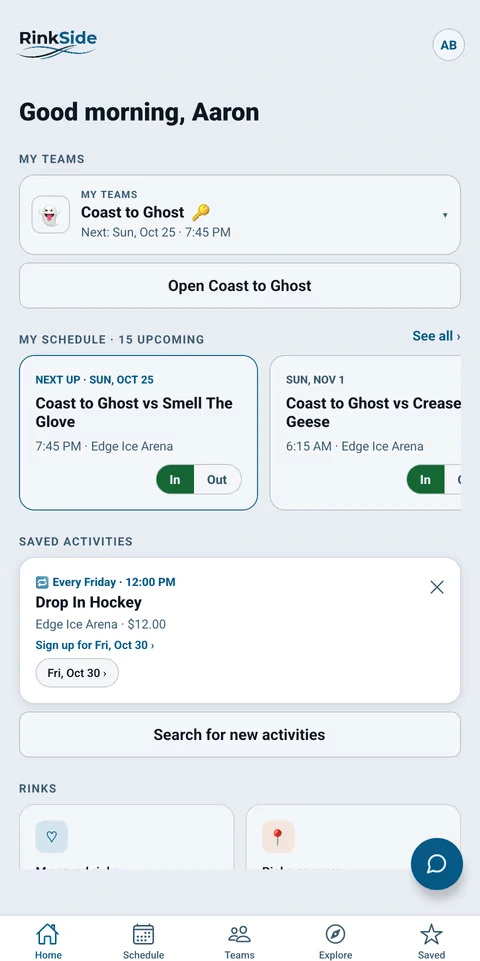
After: the alpha in Light.
0 likes · 2 views · Nov 20, 2026
Researched, designed, prototyped, and built an alpha app that brings rink sessions and team schedules into one place.