Explainable Decision Engine for Rule-Driven Systems

Crystal Zhu


Deterministic Rules-Based Scoring Engine (Explainable & Audit-Friendly)
Overview
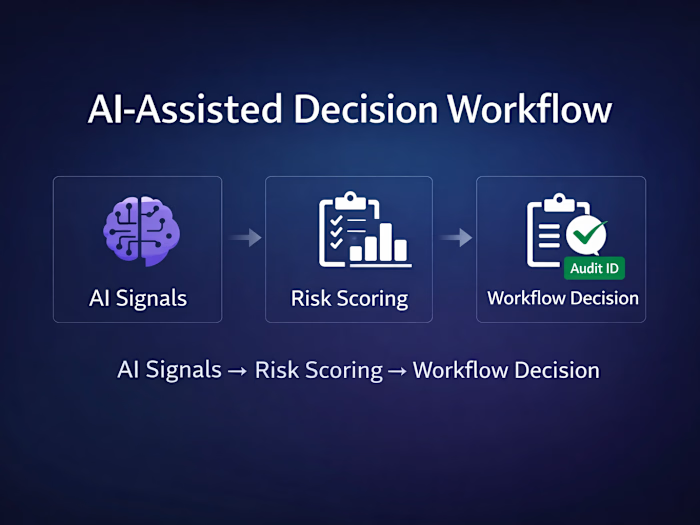
This project is a deterministic, rules-based scoring engine designed as a backend decision-support component.
It evaluates structured business events and produces:
• a numeric score
• a confidence level
• full explainability (reasons, applied rules, flags)
Unlike black-box scoring systems, every decision is transparent, traceable, and auditable.
This demo demonstrates how to build backend decision systems that prioritize correctness, reliability, and long-term maintainability.
Why This Matters
Many business systems require decisions that must be:
• explainable to stakeholders
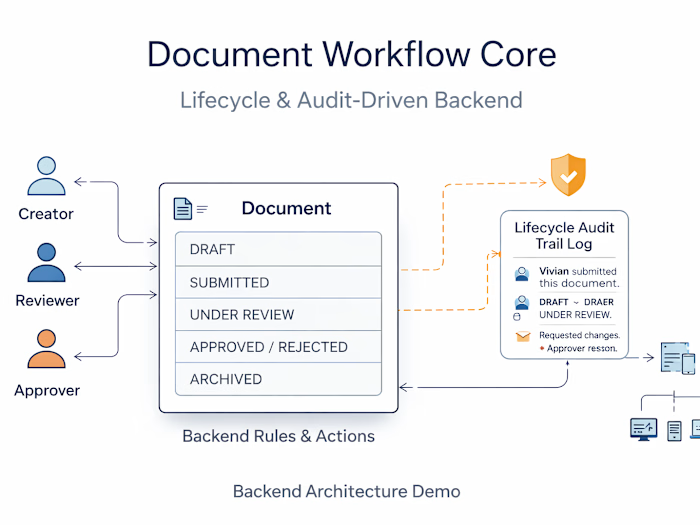
• auditable for compliance
• deterministic and repeatable
• safe to evolve over time
This engine models how real-world decision systems operate in:
• fintech & risk scoring
• eligibility & compliance workflows
• policy-based decision systems
• rule-driven automation platforms
Key Capabilities
Deterministic Scoring
The same input always produces the same result.
Explainability First
Every score includes:
• human-readable reasons
• applied rule details
• flags & warnings
This makes decisions understandable for both technical and non-technical stakeholders.
Confidence vs Score Separation
Confidence reflects evidence completeness, not score value — ensuring conservative and predictable outcomes.
Configuration over Code
Business rules are defined in versioned JSON rule sets instead of hard-coded logic.
This allows rule evolution without redeploying the application.
Backend Authority
All validation and rule enforcement happen on the backend to ensure correctness and prevent client-side bypass.
Rule Engine Design
Rules are stored as versioned JSON configurations.
Each rule includes:
• target field path
• operator (
EQUALS, IN, BETWEEN, etc.)• weight contribution
• human-readable reason
Determinism & Idempotency
To guarantee safe processing:
• events are uniquely identified per tenant
• payloads are canonicalized and hashed
• duplicate submissions are safely replayed
• conflicting replays are rejected
This ensures:
• no double scoring
• no silent data drift
• safe retries by upstream systems
Explainability Output
Each scoring result includes:
• reasons — why the score was produced
• flags — notable conditions or warnings
• appliedRules — rule contributions with weights
This enables:
• auditability
• debugging
• stakeholder transparency
Example Use Cases
This architecture can serve as a foundation for:
• risk or eligibility scoring
• compliance-adjacent workflows
• decision-support systems
• policy enforcement engines
• rule-driven evaluation services
Technology Stack
• Java
• Spring Boot
• PostgreSQL
• JSON-based rule configuration
Designed for Evolvability
This demo is intentionally scoped but structured to evolve into:
• multi-tenant rule sets
• rule lifecycle management
• historical rule replay & backtesting
• async ingestion pipelines
• rule authoring dashboards
• domain-specific scoring strategies
What This Demo Focuses On
✔ determinism
✔ explainability
✔ auditability
✔ rule modeling
✔ backend correctness
What This Demo Intentionally Avoids
❌ machine learning models
❌ opaque scoring logic
❌ UI-heavy implementation
❌ production-scale optimizations
The focus is clarity, correctness, and structure.
About This Work
This demo showcases backend decision-system design patterns that emphasize transparency, reliability, and long-term system correctness.
It reflects real-world experience building integration-heavy systems where business rules, compliance, and auditability are critical.
If you’re building systems where decisions must be explainable, reliable, and safe to evolve, this architecture provides a strong foundation.
Like this project
Posted Feb 25, 2026
Deterministic rule engine that evaluates events and produces explainable scores, confidence levels, and audit-ready reasoning for decision systems.