ClientFlow — Modern Client Portal

Adel Merabet


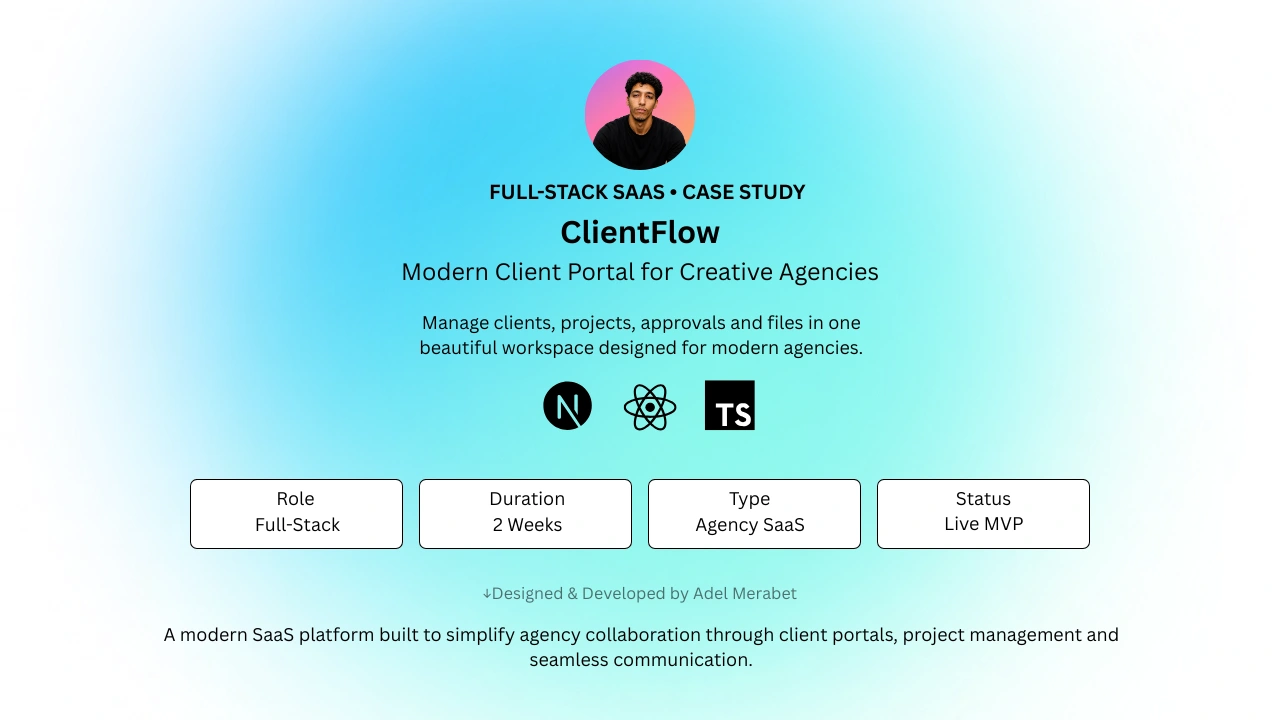
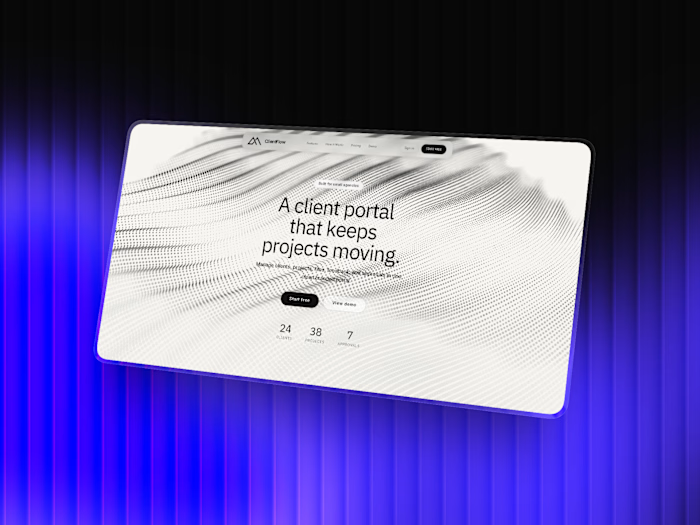
ClientFlow — Modern Client Portal for Agencies & Freelancers
Overview
ClientFlow is a purpose-built client portal for creative agencies and freelancers who are tired of managing projects across five different tools. It brings client communication, project tracking, file sharing, and approval workflows into a single, clean workspace — so teams can focus on the work instead of the coordination.
Built entirely from concept to deployment in July 2026, ClientFlow is a full-stack SaaS product designed with the same attention to detail you'd expect from a premium B2B tool.
The Problem
Creative agencies and freelancers operate in a fragmented environment. A typical project involves:
Email threads for communication
Google Drive or Dropbox for files
Notion or Trello for task tracking
Loom or Slack for feedback
DocuSign or PDF forms for approvals
Each tool adds friction. Clients get confused. Deliverables get lost. Approvals stall. The result is a slower, more stressful workflow — for both the agency and the client.
There was no single tool that felt native to the agency-client relationship. Most project management tools are built for internal teams, not for the external-facing, trust-sensitive dynamic of client work.
The Goal
Design and build a client portal that:
Gives clients a single, branded place to access everything related to their project
Reduces back-and-forth by centralizing communication and file sharing
Makes approvals fast and frictionless
Feels premium enough that agencies are proud to share it with clients
Is simple enough that non-technical clients can use it without onboarding
The north star was clarity. Every screen needed to answer one question: what do I need to do right now?
Research & Product Thinking
Before writing a single line of code, I mapped the core jobs-to-be-done for both sides of the relationship:
Agency side:
Share deliverables and get sign-off quickly
Keep clients informed without constant check-ins
Maintain a professional, branded experience
Client side:
Know where the project stands at a glance
Find files without digging through email
Give feedback and approvals without needing a new account or tool
I studied how existing tools like HoneyBook, Notion, and Basecamp handle client-facing workflows, and identified a consistent gap: they're either too complex for clients or too limited for agencies. ClientFlow was designed to sit precisely in that gap — powerful for the agency, effortless for the client.
Design Process
The design started with a clear constraint: the interface had to work for two very different users simultaneously — the agency managing the project and the client reviewing it.
Information architecture was the first priority. I mapped out the core navigation around four pillars: Projects, Messages, Files, and Approvals. Each section was designed to be self-contained, so a client could land on any page and immediately understand what it was for.
Visual language was intentional. I chose a clean, minimal aesthetic with strong typographic hierarchy and generous whitespace. The goal was to feel like a premium SaaS product — not a freelancer tool. Dark sidebar, light content area, subtle card-based layouts.
Component design followed a strict system: consistent spacing, a limited color palette, and reusable UI patterns across every screen. This made the interface feel cohesive and reduced cognitive load for users navigating between sections.
[Placeholder — add additional UI screenshots here]
Development
The entire product was built with a modern, type-safe stack chosen for developer experience, performance, and scalability.
Next.js served as the foundation — App Router for file-based routing, Server Components for fast initial loads, and API routes for backend logic.
TypeScript was used throughout to catch errors early and make the codebase maintainable as the product grew.
Tailwind CSS handled all styling. The utility-first approach made it fast to iterate on design decisions without context-switching between files.
Supabase powered the backend — PostgreSQL for the database, Row Level Security for multi-tenant data isolation, real-time subscriptions for live updates, and built-in auth for user management.
The architecture was designed around a multi-tenant model from day one, so each agency's workspace is fully isolated. File uploads are handled via Supabase Storage with signed URLs for secure, time-limited access.
Key Features
Project Dashboard
A real-time overview of every active project — status, progress, recent activity, and pending actions. Designed to answer "where does everything stand?" in under 5 seconds.
Client Communication Hub
A threaded messaging system scoped to each project. No more email chains. Conversations stay attached to the work they're about.
File Sharing & Organization
Structured file management with folder organization, version history, and direct download. Clients can find what they need without asking.
Approval Workflows
One-click approval and feedback on deliverables. Agencies can request sign-off on specific files or milestones, and clients can approve or leave comments directly in the portal.
Branded Client Experience
The portal is designed to feel like an extension of the agency's brand — clean, professional, and trustworthy. First impressions matter when you're asking a client to trust you with their project.
[Placeholder — add feature screenshots here]
Challenges
Multi-tenant data isolation was the most technically demanding aspect of the build. Ensuring that each agency's data was completely isolated from others — without sacrificing query performance — required careful schema design and thorough Row Level Security policies in Supabase.
Real-time updates added complexity to the state management layer. Keeping the UI in sync with live database changes across multiple users required careful handling of Supabase's real-time subscriptions alongside React's rendering model.
Designing for two user types in a single interface was the core UX challenge. The same screen needed to feel intuitive for a technical agency user and a non-technical client. The solution was progressive disclosure — showing only what each user needed at each stage, without hiding functionality that power users expected.
Results
ClientFlow was completed as a fully functional SaaS product in July 2026. The live demo is available at clientflow-one.vercel.app.
The product demonstrates a complete, production-ready implementation of a multi-tenant client portal — from database architecture and authentication to real-time UI and file management.
[Add specific outcomes, usage data, or client feedback here once available.]
My Role
I owned every layer of this product:
Product Strategy — defined the problem space, user personas, and core feature set
UX/UI Design — designed the full interface from information architecture to final visual polish
Front-End Development — built all UI components and page layouts in Next.js + Tailwind
Back-End Development — designed the database schema, authentication flows, and API logic in Supabase
Deployment — configured and deployed the production environment on Vercel
This was a solo build, which meant every decision — from schema design to button radius — was deliberate and considered.
Final Thoughts
ClientFlow started as a solution to a problem I've experienced firsthand as a freelancer: the constant friction of managing client relationships across too many tools.
The goal was never to build another project management app. It was to build the layer that sits between the agency and the client — a space that feels professional, reduces confusion, and makes the work speak for itself.
Every design decision was made with that in mind. Clean over clever. Clarity over features. Trust over complexity.
The product is live, the architecture is solid, and the foundation is built to scale. The next step is putting it in front of real agencies and letting the feedback shape what comes next.
Like this project
Posted Jul 19, 2026
Modern client portal for agencies to manage communication, projects, files, approvals, and client collaboration in one intuitive workspace.