AuditOS — AI-Powered Website Auditing

Adel Merabet


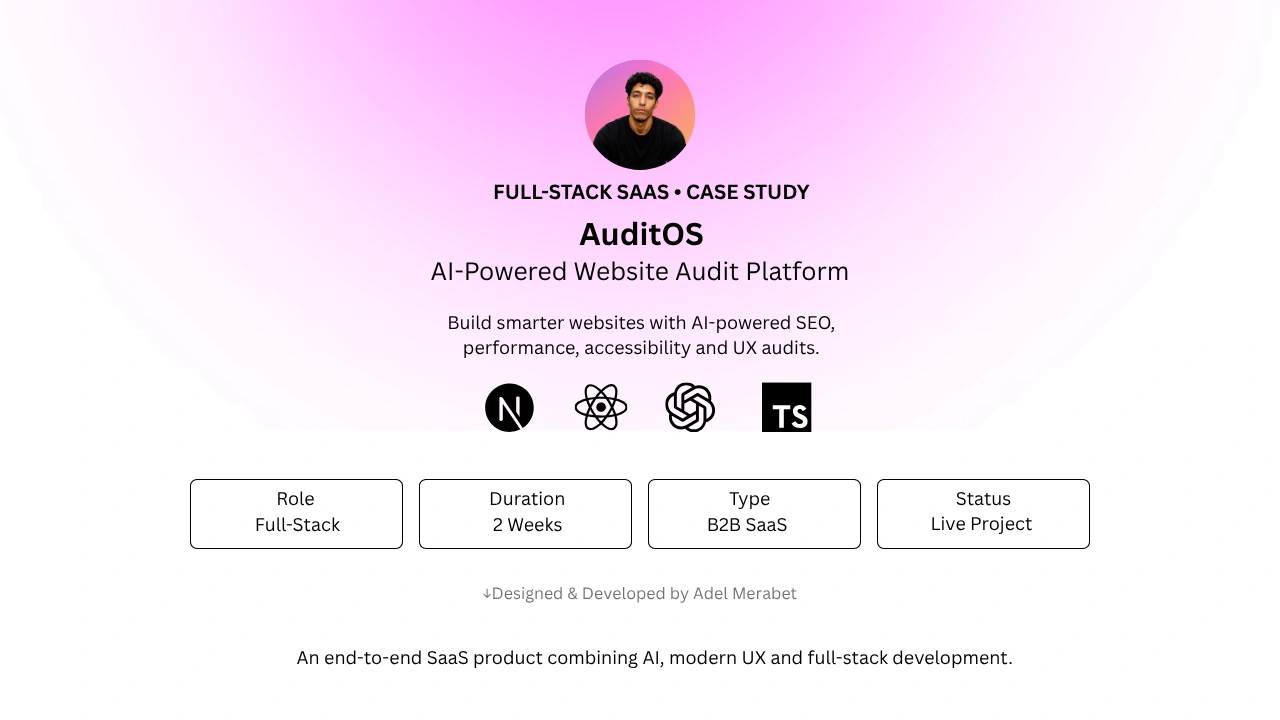
Complete product walkthrough showcasing the AuditOS experience—from landing page and website audit flow to AI-powered reports, dashboard, and pricing.
Project Overview
AuditOS is an AI-powered website auditing platform that helps businesses identify SEO, performance, accessibility, UX, and conversion issues in minutes. I designed and built the entire product — from the first screen to the deployed application — using a modern full-stack setup.
The Problem
Most website audit tools produce output that's either too raw for non-developers or too shallow to act on. Business owners and marketers know something is underperforming, but translating technical findings into clear next steps usually requires outside help.
AuditOS was built to make that translation automatic: submit a URL, get a structured, readable audit across the dimensions that matter most.
Product Goals
Cover five core audit dimensions: SEO, performance, accessibility, UX, and conversion
Use AI to present findings in plain language, not raw data
Keep the experience fast and the interface clean
Ship a complete, production-ready product
My Role
I owned the full build — product definition, UI/UX design, frontend development, AI integration, and deployment. Every decision, from layout to tech stack, was mine.
Design & UX
The interface is built around a single, clear entry point: submit a URL and get results. From there, audit findings are organized by category so users can scan what matters to them without wading through everything at once.
The visual design is clean and functional. Tailwind CSS kept the component styling consistent and the layout easy to maintain. The priority throughout was readability — the product is only useful if the findings are actually understood.
Development
The frontend is built with Next.js, React, and TypeScript. That combination gave me a strong typing foundation, fast rendering, and a clean structure for both the UI and the API layer.
OpenAI powers the AI layer, taking structured audit data and returning plain-language summaries and recommendations. Supabase handles backend services. The whole thing is deployed on Vercel.
Key Features
Five-dimension audit covering SEO, performance, accessibility, UX, and conversion
AI-generated output via OpenAI that makes findings readable without technical knowledge
Per-category results organized for easy scanning
Fast turnaround — results delivered in minutes
Responsive, clean UI built with Tailwind CSS
Challenges
The main challenge was making AI-generated output feel specific and useful rather than generic. Getting that right required careful thought about what data feeds into the AI layer and how results are structured before they reach the user.
Building the full product solo also meant making deliberate scope decisions. Keeping the feature set focused was what allowed the final product to feel complete and polished rather than stretched thin.
Outcome
AuditOS is a fully functional AI SaaS product, built and shipped independently from design through deployment. It demonstrates end-to-end product ownership across UI design, full-stack development, and AI integration — on a production-grade stack, without a team.
Like this project
Posted Jul 19, 2026
Designed and built an AI-powered website auditing platform that analyzes SEO, performance, accessibility, UX, and conversion issues in minutes.