Brand Positioning Audit: 7 Gaps Found, Revenue Up

Adelita Borges


Context
A growing e-commerce brand in a competitive market segment had been operating for 3 years but felt increasingly undifferentiated. Revenue growth had slowed, customer acquisition costs were rising, and the founding team suspected their brand positioning was part of the problem.
They had invested in visual branding (logo, packaging, website design) but had never done a strategic positioning audit. The question wasn't whether the brand looked good. It was whether the brand communicated the right things to the right people.
Challenge
The brand had 7 positioning gaps hiding in plain sight:
The value proposition was generic and interchangeable with at least 4 direct competitors
Messaging varied wildly across channels (website said one thing, social media said another, email said a third)
The target audience definition was based on demographics, not behavioral signals or buying triggers
Pricing was positioned as "premium" but the brand lacked the authority signals to justify it
Customer reviews and testimonials existed but weren't strategically deployed as social proof
The competitive landscape had shifted (2 new entrants in the past year) but positioning hadn't been updated
Content strategy was activity-driven (posting schedule) rather than positioning-driven (what perception are we building?)
Approach
Phase 1: Current State Audit (Week 1)
I conducted a comprehensive audit of how the brand currently appeared across every touchpoint: website, social media profiles, email sequences, paid ad creative, product descriptions, customer reviews, and press mentions. Documented the actual perception being created vs. the intended perception.
Phase 2: Competitive & Market Analysis (Week 2)
Mapped 6 direct competitors on positioning dimensions: price point, quality signals, audience targeting, channel strategy, and brand voice. Identified where the client was undifferentiated and where genuine whitespace existed.
Phase 3: Gap Analysis & Prioritization (Week 3)
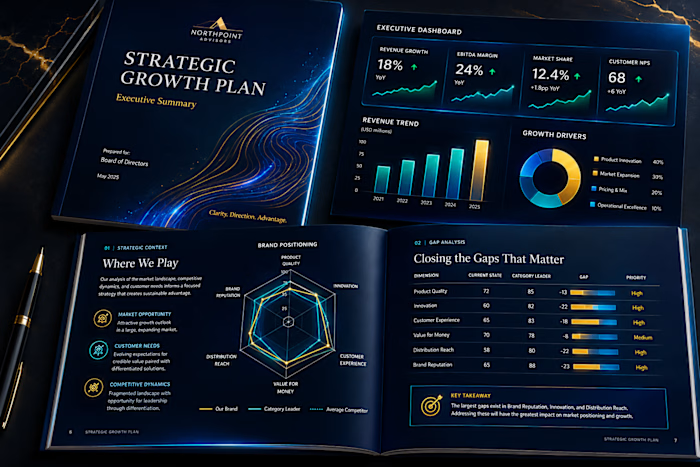
Cross-referenced the internal audit with the competitive analysis to identify the 7 specific gaps. Each gap was documented with:
What the current state was (with evidence)
What the desired state should be (with rationale)
The estimated revenue impact of closing the gap
Implementation difficulty and timeline
Phase 4: Repositioning Roadmap (Week 4)
Delivered a prioritized repositioning roadmap with 8 ranked initiatives. Each initiative included specific actions, responsible parties, success metrics, and a realistic timeline. The roadmap was designed to be executed over 90 days, with quick wins in the first 30 days to build momentum.
Results
7 critical positioning gaps identified with data evidence for each
Prioritized repositioning roadmap with 8 ranked initiatives delivered
Value proposition rewritten: moved from generic feature-listing to outcome-driven messaging
Channel messaging unified across website, social, email, and ads
Quick wins implemented in first 30 days: customer testimonial strategy and pricing page restructure
Measurable revenue growth reported within 60 days of implementing the first 3 initiatives
The audit document became the strategic brief for the brand's subsequent agency engagement
Tools Used
Google Analytics, Notion, Power BI, SEMrush
Like this project
Posted Jun 7, 2026
Strategic brand positioning audit that identified 7 critical gaps and delivered a prioritized repositioning roadmap, leading to measurable revenue growth.
Likes
0
Views
1
Timeline
Jan 1, 2025 - Mar 31, 2025