Concept Translator: Audience Framing

Amy Frank

Like this project
Posted Feb 8, 2026
A lightweight tool for framing the same idea for different audiences and making differences in emphasis visible.
Likes
0
Views
0




A brief walkthrough showing how a single idea is translated and compared across audiences.
Concept Translator
Concept Translator is a quiet workspace for restating the same idea for different audiences.
Many ideas fail not because they are wrong, but because they are explained in a way that does not match the listener’s assumptions, time constraints, or context. This tool is designed to surface that mismatch and make it visible.
Rather than refining an idea or judging its quality, Concept Translator focuses on how meaning shifts depending on who an explanation is for.
What this tool is for
Concept Translator is useful when an idea feels clear in your own head but repeatedly fails to land with others.
It helps answer questions like:
Why does this explanation work for one person but not another?
What assumptions am I making about the listener?
How can the same idea be framed differently without changing its core meaning?
The goal is not persuasion or optimization, but clarity across contexts.
How it shapes thinking
The tool asks users to slow down and consider the audience before rewriting an explanation.
Instead of starting with “how do I say this,” it starts with:
who the explanation is for
what that person likely already believes
what they care about or lack
This reframing shifts the task from writing better content to understanding perspective first.
Each translation exists as its own articulation of the same idea, not as a revision of the previous one.
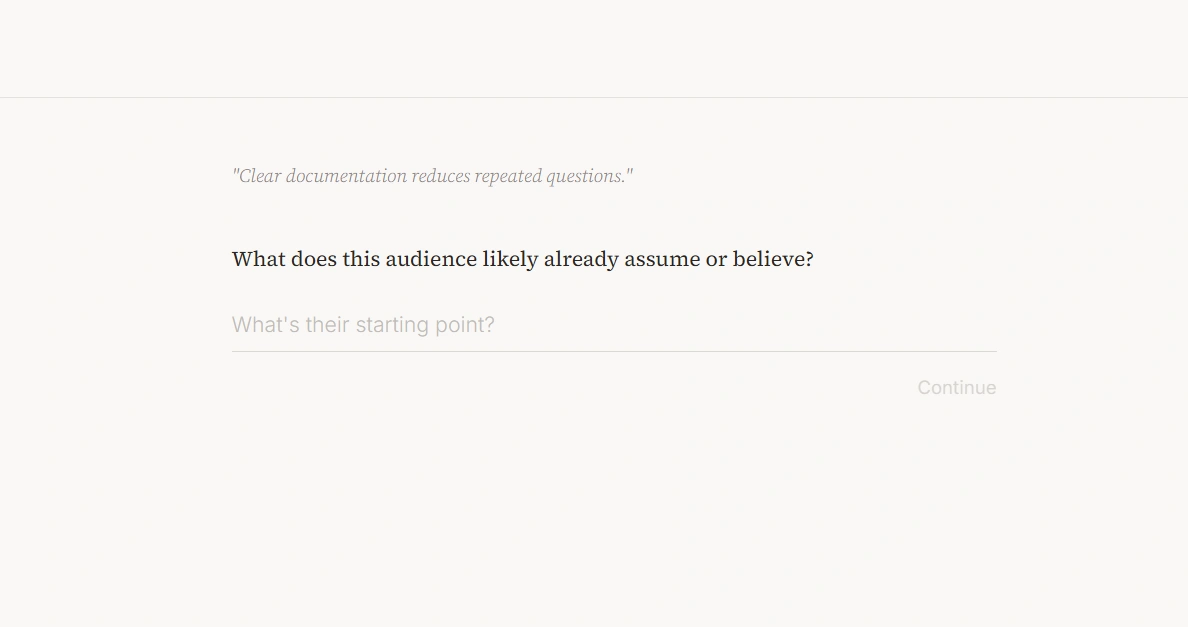
Considering what an audience likely assumes before explaining an idea.
Comparison as insight
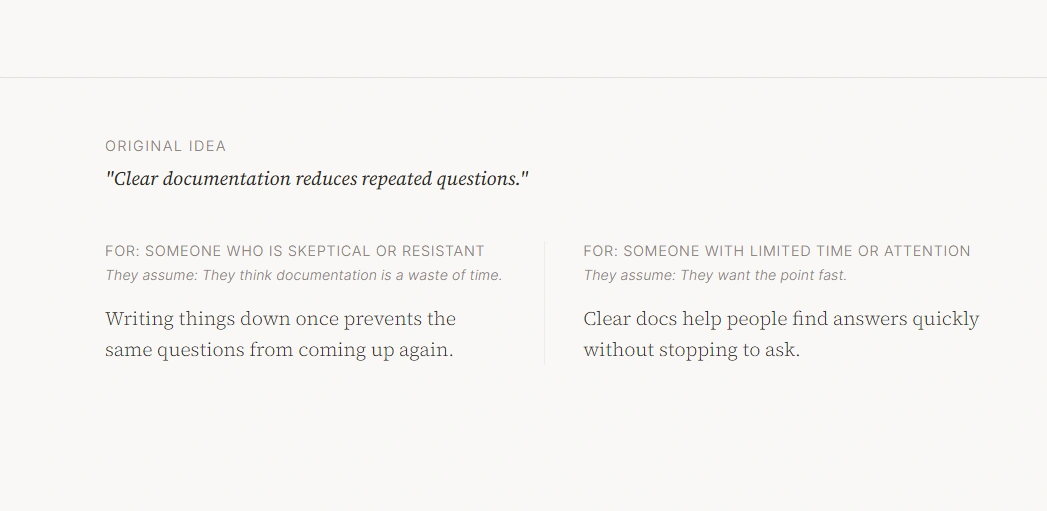
Once multiple translations exist, they can be viewed side by side.
Seeing explanations next to each other makes differences in tone, emphasis, and framing considers visible immediately. What is implicit in one version often becomes explicit in another.
The comparison view is not meant to rank explanations or select a “best” one. Its purpose is to reveal how audience context shapes meaning.
This moment of contrast is where most of the insight happens.
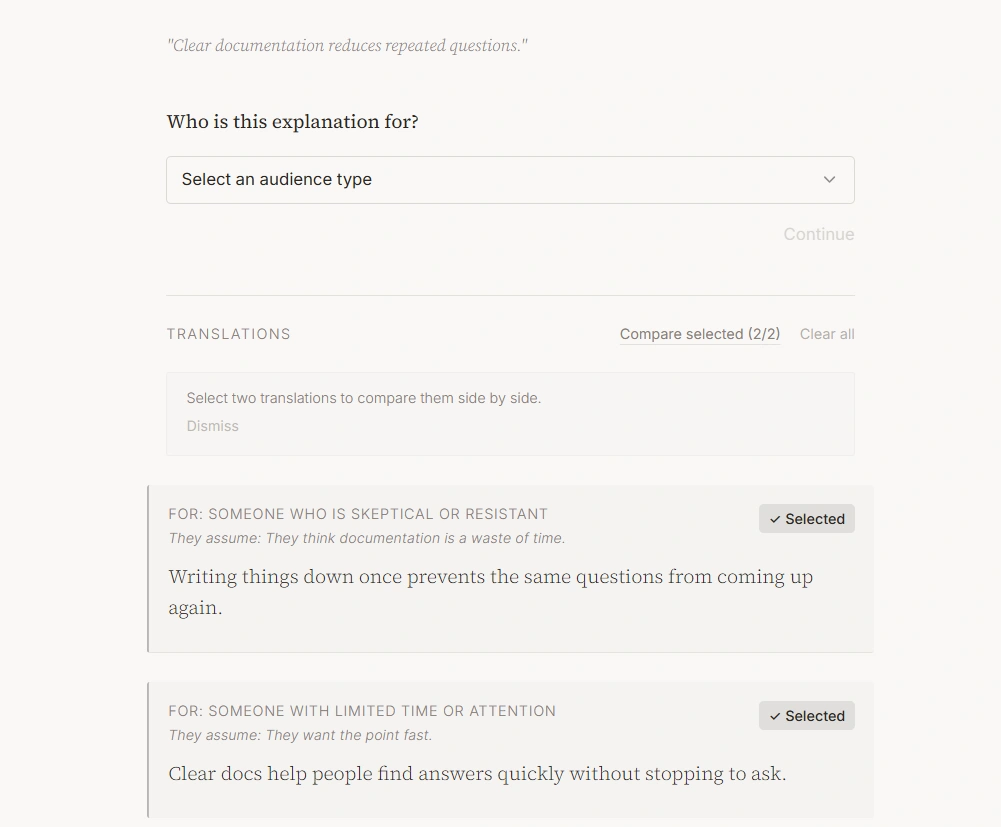
Viewing, selecting, and clearing explanations tied to one idea.
Design decisions
The interface is intentionally minimal and neutral.
The tool does not evaluate, score, or suggest improvements.
There are no templates, prompts, or AI-generated rewrites.
Content is not saved across ideas by default.
This restraint is deliberate. The absence of guidance keeps the focus on the user’s own understanding and language, rather than outsourcing thinking to the tool.
Starting a new idea clears the workspace entirely, reinforcing that each concept should be considered on its own terms.
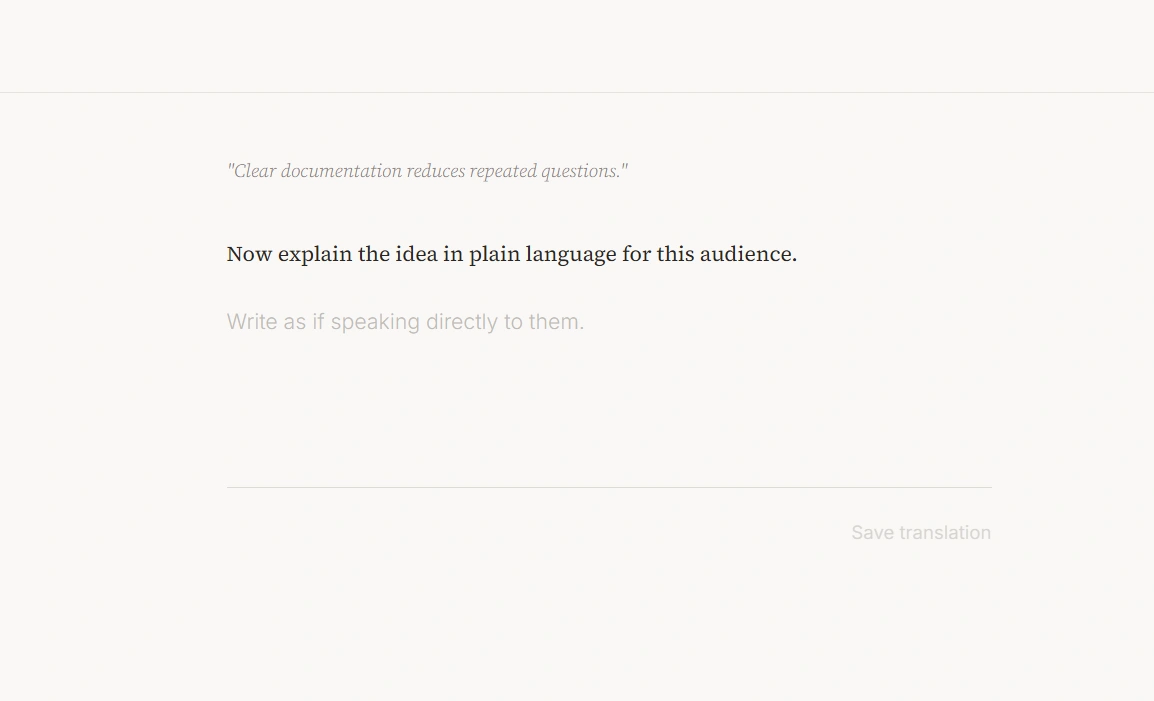
Writing an explanation of the idea for a specific audience.
Why this approach
Many tools aim to help people write faster, persuade better, or sound smarter.
Concept Translator is designed for a different moment: when someone wants to understand why communication breaks down in the first place.
By holding multiple interpretations of the same idea at once, the tool makes audience perspective concrete instead of abstract.
Built using Lovable.