AstroChakra Interactive Game Design

Varesh Mukhekar

AstroChakra: Designing a Question Wheel That Helps Users Start Conversations
Building my first interactive mini-game in Rive with 30+ timelines, state machines, and dynamic outcomes.
Press enter or click to view image in full size
TL;DR: AstroChakra started with a surprisingly simple product problem: users didn’t know what to ask. While working on SuperAstro, we discovered that many new users would open chat expecting guidance but quickly hit a wall. The problem wasn’t a lack of information, it was the lack of a starting point. To solve this, we designed AstroChakra, a gamified question-discovery experience that transforms a simple spin into a personalized astrology question. What began as a product experiment eventually became my first fully interactive mini-game built in Rive, involving more than 30 animation timelines, multiple state machines, dynamic outcomes, audio synchronization, and countless iterations to make a fortune wheel feel magical.
The Problem: A Powerful Chat Experience With One Friction Point
Press enter or click to view image in full size
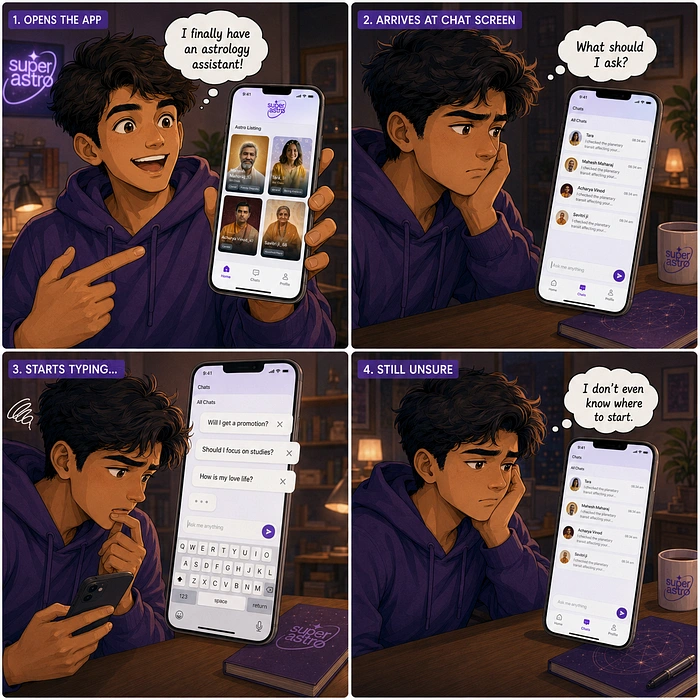
At SuperAstro, chat is the core product experience.
Everything eventually leads users back into a conversation.
Dashboards.
Reports.
Each feature exists to help users discover something interesting and then continue the journey through chat.
But while analyzing user behavior, we noticed a recurring pattern.
Many users wanted guidance but didn’t know how to begin.
They would open chat and wonder:
“What should I ask?”
The challenge wasn’t creating better answers.
The challenge was helping users discover better questions.
From Question Discovery to Game Design
Most products would solve this problem with a list.
A list of suggested prompts.
A list of recommended questions.
A list of trending topics.
But astrology is inherently emotional and curiosity-driven.
A static list felt functional.
We wanted something memorable.
Something that felt closer to discovering your fortune than selecting a menu item.
That’s when the idea of AstroChakra emerged.
Instead of choosing a question, users would spin for one.
Designing the Wheel
The concept was intentionally simple.
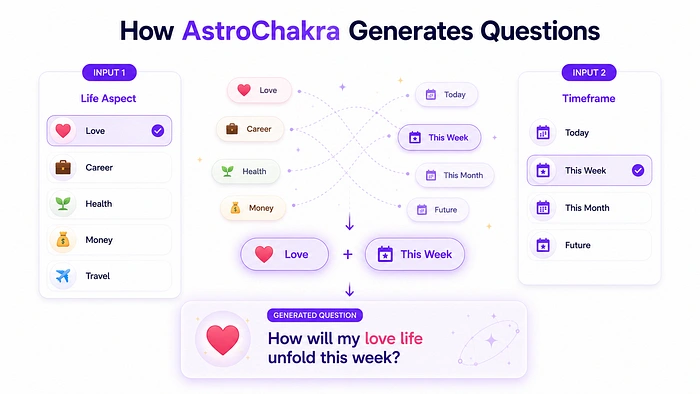
The wheel combines two dimensions:
Life Aspect
Love
Career
Health
Money
Education
Travel
Family
Timeframe
Today
This Week
This Month
Future
Press enter or click to view image in full size
Press enter or click to view image in full size
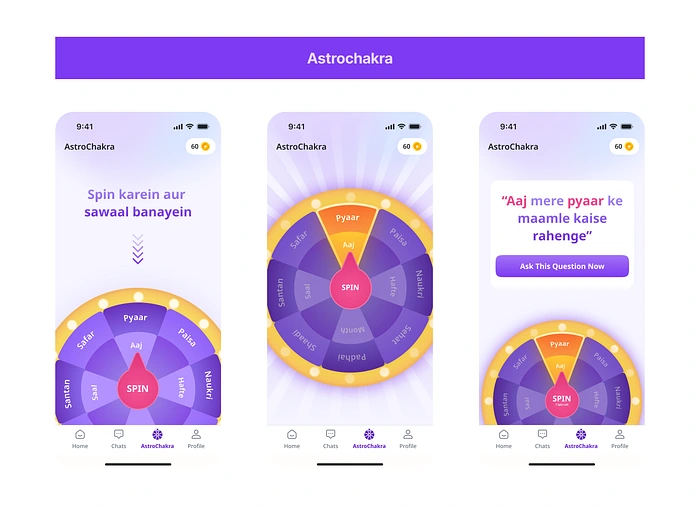
Screens from the app
Why Rive?
Initially, AstroChakra sounded like a straightforward animation project.
Create a wheel.
Make it spin.
Reveal a result.
Done.
But the deeper we explored the interaction, the more we realized this wasn’t an animation problem.
It was a systems problem.
The wheel wasn’t just spinning.
It needed to:
Respond to user interaction
Land on specific outcomes
Trigger result states
Coordinate multiple animations
Synchronize sound effects
Handle edge cases
Feel believable every single time
That’s when Rive became the obvious choice.
Get Varesh Mukhekar’s stories in your inbox
Join Medium for free to get updates from this writer.
Subscribe
Subscribe
Remember me for faster sign in
Its state-machine architecture allowed us to think beyond animation and build actual interaction logic.
Press enter or click to view image in full size
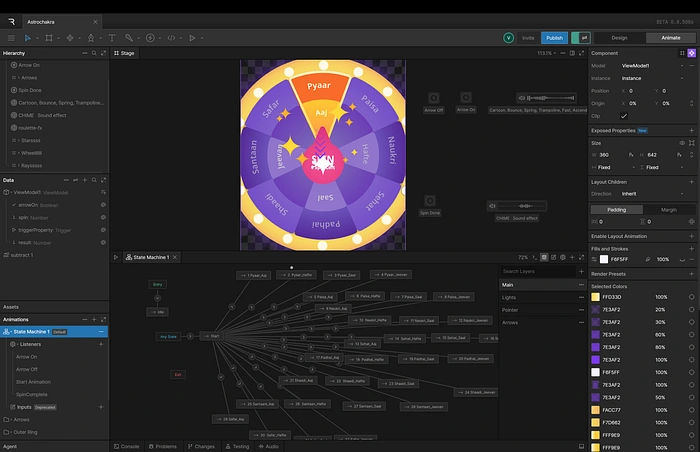
Thinking in States Instead of Screens
One of the biggest shifts during this project was learning to think differently about interaction design.
Traditional product design often focuses on screens.
Motion design focuses on transitions.
Interactive systems require thinking in states.
AstroChakra eventually evolved into a system containing:
Inputs
Spin trigger
Result values
Max Spin Limit
States
Idle
Start Spinning
Spin to Result
Every path had to feel intentional.
This was my first experience building something where the animation itself became the interface.
The Details That Made It Feel Alive
The most satisfying parts of AstroChakra weren’t the large animations.
They were the tiny moments.
The Pointer
A spinning wheel without resistance feels fake.
The pointer became an important character in the interaction.
Every segment passing underneath creates subtle feedback that makes the spin feel mechanical and believable.
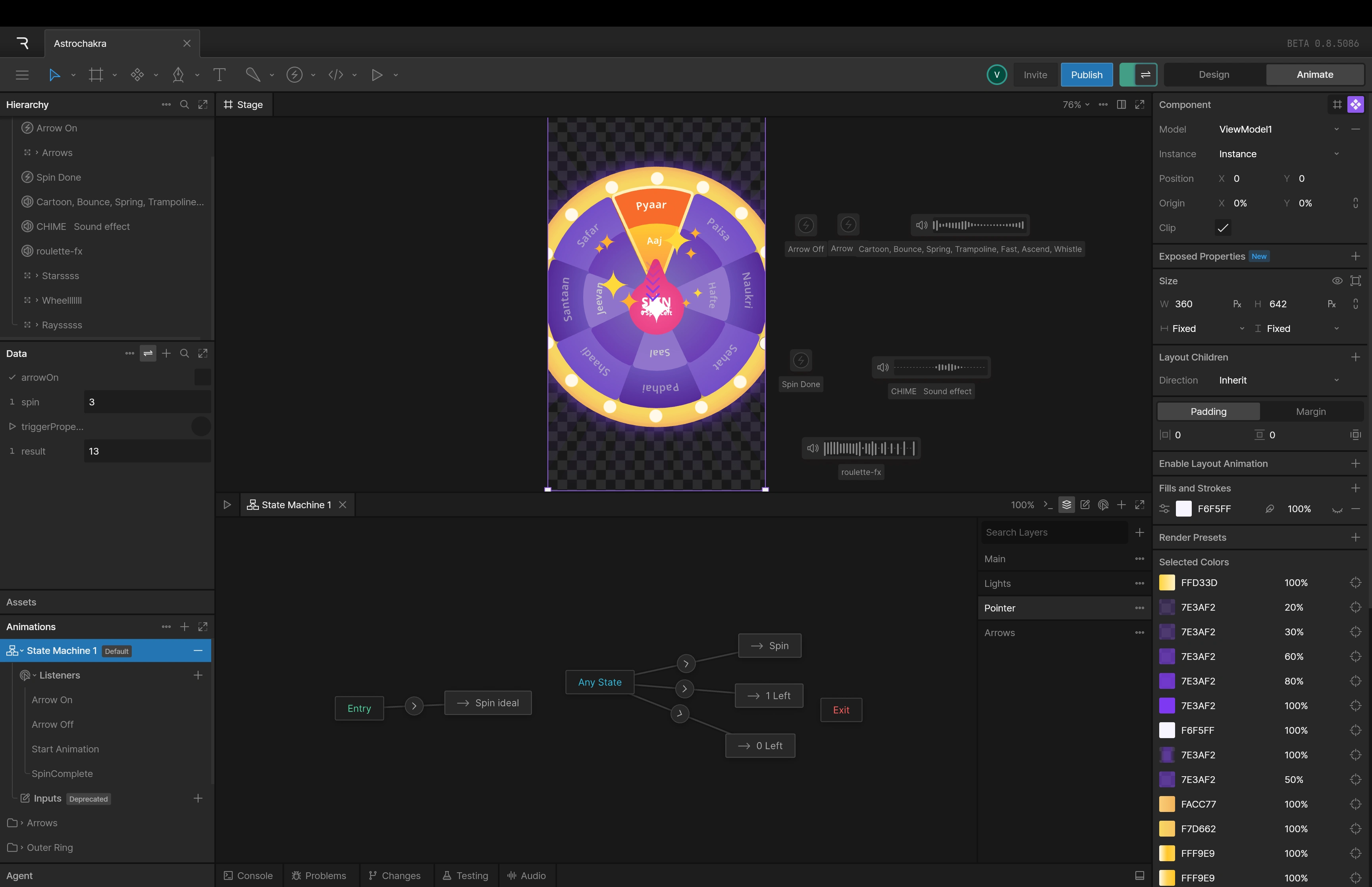
Pointer states as per the limit
Audio Feedback
The sound design reinforces momentum.
Fast when spinning.
Slower when approaching the result.
Tiny details that users rarely notice consciously — but immediately miss when they’re gone.
Press enter or click to view image in full size
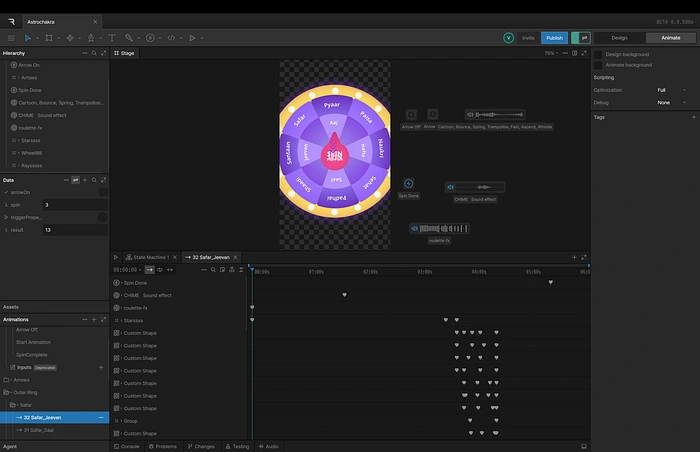
The Outcome
AstroChakra became more than a spinning wheel.
It became a bridge between curiosity and conversation.
Instead of asking users:
“What do you want to know?”
It helps them discover the question themselves.
And for me personally, it became my first shipped interactive experience built with:
30+ animation timelines
Multiple state machines
Dynamic result logic
Audio synchronization
Production-ready Rive implementation
Looking back, the most rewarding part wasn’t seeing the wheel spin.
It was watching a product problem transform into an experience that felt playful, intuitive, and useful.
Building a Playground for Testing
AstroChakra wasn’t a typical feature that could be reviewed through static screens. Its experience depended heavily on motion, timing, and state transitions.
To make collaboration easier, I built a lightweight testing website where product managers, developers, and designers could interact with the wheel directly. Instead of sharing recordings, I could simply share a link and let the team experience the interaction firsthand.
The playground helped us uncover timeline bugs, validate outcomes, and align on the intended behavior before implementation.
Sometimes the best way to review an interaction isn’t through a prototype, it’s by letting people play with it.
👉 Try it here: https://astrochakratest.netlify.app/
Press enter or click to view image in full size
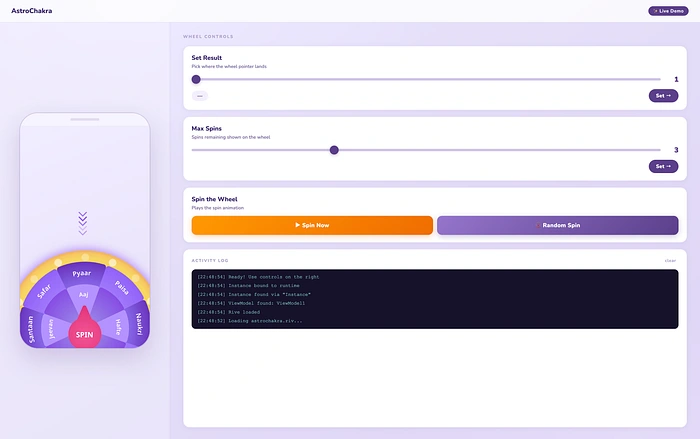
A custom testing playground built to validate interactions, collect feedback, and catch animation bugs before implementation.
Learnings
The animation wasn’t there to decorate the experience.
It was there to guide behavior.
To reduce hesitation.
To build confidence.
To create curiosity.
Most importantly, I learned that interactive motion sits somewhere between design and engineering.
It requires thinking not only about what users see, but about what the system does.
Final polished AstroChakra experience in production demo:
Like this project
Posted Jul 4, 2026
Designed AstroChakra, an interactive astrology question game using Rive.
Likes
0
Views
4