The Record Didn't Match the Story

Facthread Research
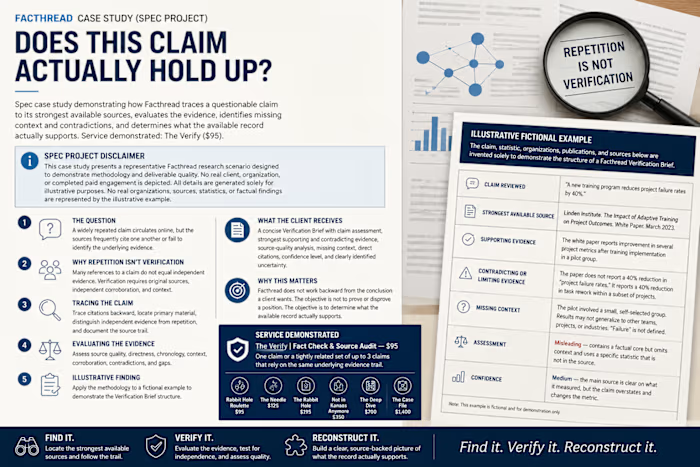
This is a spec/representative project created to demonstrate Facthread's Case File methodology. All names, organizations, publications, dates, quotations, statistics, records, and findings are fictional. No real research project is depicted. Nothing in this case study should be cited as a real source or mistaken for an actual historical record.
Service demonstrated: The Case File | Evidence Reconstruction & Analysis — $595, 21 business days.
The evidence problem
In this fictional scenario, a regional arts foundation is preparing to mark the 75th anniversary of the Hargrove Industrial Design Exhibition, a fictional 1951 design showcase organized by a fictional trade group called the Midlands Manufacturing Council. The foundation has inherited a disorganized collection of materials related to the exhibition: programs, newspaper clippings, photographs, correspondence, institutional records, and later retrospective accounts.
The problem: the materials don't agree with each other. The inherited collection contains conflicting dates for the exhibition itself, contradictory accounts of which firms participated, inconsistent descriptions of the exhibition's scale and purpose, and at least two different versions of why the Council stopped holding the event after 1953. Some of the later accounts appear to draw on each other rather than on primary sources. Several items are undated or have ambiguous provenance.
The representative evidence problem is not primarily about answering one specific question. The need is to assemble, catalog, cross-reference, and assess the evidentiary record so the fictional foundation could determine what the sources support before relying on them in an anniversary publication.
Why this required The Case File
The fictional foundation's problem isn't a research question. It's an evidence problem. The materials exist, but they are disorganized, contradictory, and unevaluated. No one has cataloged what is in the collection, mapped how the sources relate to each other, identified which accounts are independent and which are derivative, or documented where the record has gaps.
A Deep Dive investigates one defined research objective through up to 3 connected research threads. That structure works when the starting point is a question or objective. Here, the starting point was a body of scattered evidence that needed to be reconstructed into a coherent, cross-referenced record. The core challenge was building the structured record itself, not answering a single question.
That's a Case File: one evidence problem, up to 50 source items, up to 5 evidence categories, reconstructed as a structured evidentiary record.
Defining the evidence scope and categories
For this representative project, the defined evidence problem is the scattered and conflicting documentary record surrounding the fictional Hargrove Industrial Design Exhibition (1951-1953), including its organization, participants, chronology, and discontinuation.
Five evidence categories were established:
Institutional records — Council minutes, correspondence, and organizational filings (fictional)
Exhibition materials — Programs, catalogs, and promotional items from the collection (fictional)
News coverage — Contemporary newspaper and trade-press reporting (fictional)
Photographic record — Exhibition photographs with provenance assessment (fictional)
Later accounts — Retrospective histories, anniversary publications, and secondary sources (fictional)
The source-item ceiling was confirmed at 50. The inherited collection contained approximately 35 discrete items; the remaining capacity allowed for independently located sources to fill gaps or provide corroboration.
Building the Evidence Catalog
Each source item in the collection was cataloged with:
Item identifier (sequential, by evidence category)
Source type: Primary, secondary, or tertiary
Independence: Whether the source reported from its own evidence or derived from another cataloged item
Provenance: Origin, creator (where identifiable), date, and how it entered the collection
Condition/completeness: Whether the item was complete, fragmentary, or undated
Reliability assessment: Based on provenance, proximity to events, internal consistency, and corroboration
What the cataloging revealed
Of the 35 items in the inherited collection, 19 were primary sources (contemporary to the events), 11 were secondary (written after the fact, drawing on primary material), and 5 had ambiguous provenance that required further assessment.
Three items initially cataloged as independent secondary sources turned out to be derivative. A fictional 1986 article in the Midlands Arts Quarterly (fictional) and a fictional 2003 anniversary pamphlet both drew their factual claims from a single fictional 1978 retrospective by a former Council officer named Gerald Harwick (fictional). The 2003 pamphlet cited the 1986 article, which cited the 1978 retrospective, creating a citation chain that looked like three sources but was functionally one.
An additional 12 source items were independently located during reconstruction, bringing the total to 47 items against the 50-item ceiling.
Reconstructing the Master Timeline
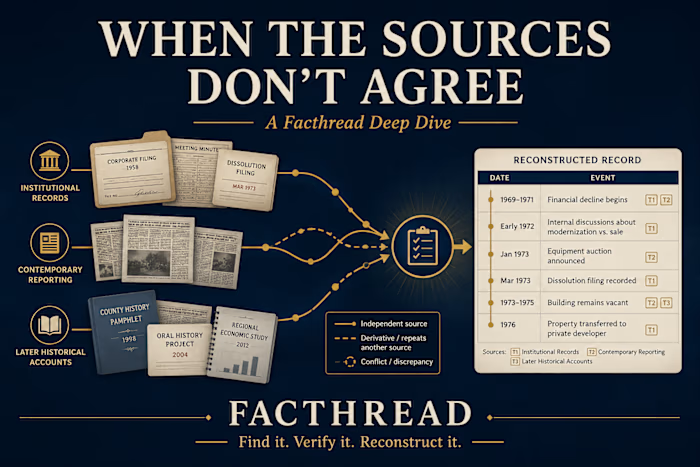
The Master Timeline integrated findings across all five evidence categories into a single chronology. Each entry was tied to its source item(s) and flagged where sources conflicted.
The following entries illustrate the Master Timeline's structure. All events, sources, and item identifiers are fictional.
Date | Event | Source(s) | Confidence | Notes |
|---|---|---|---|---|
Mar 1950 | Council votes to organize an industrial design exhibition | Council minutes, Item I-03 (fictional) | High | Primary institutional record; no conflicting source |
Sep 1950 | Planning committee formed; 6 members named | Council correspondence, Item I-07 (fictional) | High | Members listed by name in the letter |
Apr 1951 | Exhibition opens | Program, Item E-01 (fictional): April 14; Midlands Herald, Item N-02 (fictional): April 12 | Moderate | Two independent primary sources disagree on exact date (see Contradictions) |
1952 | Second exhibition held | Council minutes, Item I-11 (fictional): references "this year's exhibition"; 1978 Harwick retrospective, Item S-01 (fictional): "the second year" | Moderate | No surviving program, catalog, or direct news coverage located within scope; existence established by two sources but details are thin |
Late 1953 | Treasurer reports financial losses on third exhibition | Treasurer's note, Item I-16 (fictional) | High | Primary institutional record; references losses relative to prior years without providing earlier figures |
Late 1953 | Council discontinues the exhibition | Council minutes, Item I-14 (fictional); Treasurer's note, Item I-16 (fictional) | High (financial factor); Low (other explanations) | Three competing explanations in the record; only the financial explanation is corroborated by primary sources (see Contradictions) |
1978 | Harwick retrospective published; claims "nearly forty exhibitors" and attributes discontinuation to "loss of interest" | Item S-01 (fictional) | N/A (source assessment, not event) | Neither claim is supported by the primary record; this source becomes the basis for most later accounts (see Cross-referencing) |
The full Master Timeline contained 31 entries spanning 1950 to 2003.
Cross-referencing the record
The Cross-Reference Matrix mapped relationships across all 47 cataloged source items:
Corroboration: 14 pairs of source items independently confirmed the same facts
Contradiction: 6 pairs contained material conflicts (documented in the Contradiction & Discrepancy Register)
Dependency: 8 items were derivative of other cataloged items (drawing their claims from an identified earlier source rather than independent evidence)
Isolation: 5 items contained claims not corroborated or contradicted by any other cataloged source
The dependency mapping was critical. Without it, the inherited collection appeared to contain multiple independent accounts of the exhibition's discontinuation. With the dependencies mapped, it became clear that most later accounts traced back to a single source: the fictional 1978 Harwick retrospective.
Contradictions and discrepancies
The Contradiction & Discrepancy Register documented 6 material conflicts. Three illustrative examples:
Discrepancy 1: Exhibition opening date
Source | Date claimed | Source type | Independence |
|---|---|---|---|
Exhibition program, Item E-01 (fictional) | April 14, 1951 | Primary | Independent |
Midlands Herald, Item N-02 (fictional) | April 12, 1951 | Primary, contemporary | Independent |
1978 Harwick retrospective, Item S-01 (fictional) | "mid-April 1951" | Secondary | Independent (but imprecise) |
2003 anniversary pamphlet, Item S-05 (fictional) | April 12, 1951 | Tertiary | Derivative (cites 1986 article, which cites Herald) |
Assessment: The program (Item E-01) is the strongest source for the planned opening date. The Herald may have reported an advance date, a preview event, or made an error. The discrepancy is minor but documented because the 2003 pamphlet's apparent corroboration of the Herald date is not independent; it traces back to the Herald through a citation chain.
Discrepancy 2: Number of participating firms
Source | Firms claimed | Source type | Independence |
|---|---|---|---|
Exhibition program, Item E-01 (fictional) | 22 firms listed | Primary | Independent |
Midlands Herald, Item N-02 (fictional) | "more than thirty firms" | Primary, contemporary | Independent |
Council minutes, Item I-09 (fictional) | 18 confirmed participants as of Feb 1951 | Primary | Independent |
1978 Harwick retrospective, Item S-01 (fictional) | "nearly forty exhibitors" | Secondary | Independent |
Assessment: The program lists 22 specific firms by name. The Herald's "more than thirty" may include individual artisans or sub-exhibitors not listed as primary firms in the program. Harwick's "nearly forty" is the highest claim and is unsourced. The Council minutes' 18 likely reflects confirmed participants before the final roster. The program is the most reliable count of named exhibiting firms; the actual number of individual exhibitors may have been higher.
Discrepancy 3: Reason for discontinuation
Three competing explanations appeared in the record:
Explanation | Source(s) | Independence |
|---|---|---|
Financial losses on the 1953 exhibition | Council minutes, Item I-14 (fictional); Treasurer's note, Item I-16 (fictional) | Two independent primary sources |
Loss of interest from member firms | 1978 Harwick retrospective, Item S-01 (fictional) | Single secondary source |
Dispute between Council leadership and the exhibition committee | Oral account referenced in 1986 Midlands Arts Quarterly article, Item S-03 (fictional) | Single secondary source, citing an unidentified oral informant |
Assessment: The financial explanation has the strongest evidentiary support (two independent primary institutional records). The other explanations are not necessarily wrong; all three factors could have contributed. But only the financial explanation is corroborated by primary sources. The leadership-dispute account is the weakest: it traces to a single unnamed oral informant cited in a secondary source.
Findings and confidence assessments
The Findings & Confidence Summary assessed each key finding:
The Hargrove Industrial Design Exhibition was held three times: 1951, 1952, and 1953.
Confidence: High. Corroborated by Council minutes, exhibition materials, and contemporary news coverage across multiple evidence categories.
The first exhibition opened in April 1951 with 22 named exhibiting firms.
Confidence: High for the firm count (program is primary and specific). Moderate for the exact opening date (program says April 14; Herald says April 12; minor discrepancy unresolved).
The 1952 exhibition took place but left a thin documentary record.
Confidence: Moderate. Referenced in Council minutes and one later account, but no surviving program, catalog, or direct news coverage was located within scope. "Not located within scope" is not the same as "does not exist"; a program or coverage may survive in collections not examined.
Financial losses on the 1953 exhibition were a primary factor in discontinuation.
Confidence: High. Supported by two independent primary institutional records (Council minutes and Treasurer's note).
Most later accounts of the exhibition derive from a single 1978 retrospective.
Confidence: High. Dependency mapping confirmed that the 1986 article, the 2003 pamphlet, and at least two other secondary sources trace their factual claims to the Harwick retrospective. These are not independent corroboration.
Gerald Harwick's 1978 retrospective contains claims not supported by the primary record.
Confidence: High. Harwick's participant count ("nearly forty exhibitors") exceeds the program's named list by a significant margin with no sourcing. His characterization of the discontinuation omits the financial explanation documented in Council records and substitutes an unsourced "loss of interest" narrative.
Evidence gaps
The Evidence-Gap Map documented what the record did not contain:
1952 exhibition program or catalog. Referenced but not located within scope. May survive in private collections, the Council's successor organization (if any), or regional library special collections not examined.
1952 and 1953 news coverage. Only one brief 1953 Herald item was located. The Herald's archive for 1952 may be incomplete, or coverage may have appeared in trade publications not examined within scope.
Financial records for 1951 and 1952 exhibitions. The Treasurer's note (Item I-16) references 1953 losses but compares them to earlier years without providing figures. The earlier financial records were not located.
Exhibition photographs with reliable provenance. The collection contains 9 photographs, but only 3 have dates, captions, or other provenance markers. The remaining 6 are consistent with the exhibition's era and setting but cannot be definitively attributed to a specific year.
Identity of the oral informant cited in the 1986 article. The Midlands Arts Quarterly article references "a former committee member" without naming them. Without identification, the independence and reliability of this account cannot be fully assessed.
Each gap was documented with a note on what categories of source material might fill it and where that material might be found. "Not located within scope" was distinguished from "does not exist" throughout.
Source/Relationship Map
The Source/Relationship Map made three structural features of the evidence visible:
The Harwick dependency chain. The 1978 Harwick retrospective (Item S-01) was the origin point for most later accounts. The 1986 Midlands Arts Quarterly article (Item S-03) cited Harwick. The 2003 anniversary pamphlet (Item S-05) cited the 1986 article. At least two other secondary items paraphrased Harwick without citation. Five sources that appeared independent in the inherited collection were functionally one.
The primary-source cluster for 1951. The first exhibition had the richest primary record: program, Council minutes, correspondence, news coverage, and three provenance-confirmed photographs. Cross-referencing within this cluster produced the highest-confidence findings.
The 1952 gap. The second exhibition was a visible hole in the map. It appeared in Council minutes and one later reference, but had no surviving primary exhibition materials or contemporary coverage within scope. The map made the asymmetry between the 1951 and 1952 records immediately apparent.
Overflow and Next Leads
During reconstruction, 4 leads to potentially relevant material were identified but not pursued within the confirmed project scope. Some point to material that could become cataloged source items with further discovery work; others represent collections or archives whose contents are unknown.
A fictional regional trade publication, Industrial Design Midlands (fictional), may have covered the exhibitions. No issues from 1951-1953 were located during reconstruction, but the publication's archive may exist in a university library collection not examined within scope.
A fictional successor organization to the Midlands Manufacturing Council, the Midlands Design Alliance (fictional), was referenced in a 2001 web archive capture. If the Alliance inherited Council records, it may hold materials not in the foundation's collection. Whether those materials exist and what they contain is unknown.
Two additional photographs matching the exhibition's era were identified in a fictional regional library's digital collection. They were not examined or cataloged because the reconstruction prioritized completing cross-referencing and contradiction analysis across the 47 items already in the evidence set.
A fictional 1994 local-history newsletter contained a brief mention of the exhibition attributed to "a former exhibitor." The newsletter itself was cataloged (Item S-08), but the referenced exhibitor was not identified or pursued (outside the defined investigation).
These are leads, not source items. They were documented in the Overflow & Next Leads deliverable for reference. No findings are claimed from them, and investigating them was not part of this representative project.
What the Case File deliverable contains
The representative Case File deliverable would include:
Reconstructed Case File — The central evidentiary narrative: what the assembled record shows about the Hargrove Industrial Design Exhibition, organized by evidence category and synthesized into a coherent account of what the sources collectively support, where they conflict, and what remains unresolved
Evidence Catalog — 47 source items cataloged with source type, provenance, date, reliability assessment, independence status, and relationship to the evidence problem
Master Timeline — 31 entries integrating findings across all five evidence categories, with source conflicts flagged at each entry
Cross-Reference Matrix — Corroboration, contradiction, dependency, and isolation mapped across the full 47-item evidence set
Contradiction & Discrepancy Register — 6 material conflicts documented with competing accounts evaluated and (where possible) reconciled
Evidence-Gap Map — What the record does not contain, where evidence is missing, why, and what categories of source material might fill the gaps
Findings & Confidence Summary — Key findings with confidence levels (High, Moderate, Low, Unverified) and the evidentiary basis for each assessment
Source/Relationship Map — How sources, entities, and evidence threads connect: dependencies, corroboration chains, and structural features of the evidence set
Overflow & Next Leads — 4 leads to potentially relevant material discovered but not pursued within the confirmed project scope, documented for reference without investigation
Why this differs from The Deep Dive
A Deep Dive starts with a defined research objective and investigates it through up to 3 connected research threads. The fictional foundation's problem could have been narrowed into a Deep Dive objective (for example: "When and why did the Council stop holding the exhibition?"). But that would have addressed one question while leaving the rest of the scattered, contradictory collection unassessed.
In this scenario, the foundation doesn't need one question answered. It needs the full body of evidence cataloged, cross-referenced, and evaluated so it can see what the record actually supports before building an anniversary publication on top of it.
The representative Case File demonstrates that structure: 47 cataloged source items across 5 evidence categories, a reconstructed timeline, mapped dependencies, documented contradictions, honest confidence assessments, identified gaps, and overflow leads for further investigation.
The starting point was the evidence. The deliverable was the record.
All names, organizations, publications, dates, quotations, records, and findings in this case study are fictional. This is a spec/representative project demonstrating Facthread's Case File methodology. No real research project, client, or historical event is depicted.
Like this project
Posted Jul 29, 2026
Spec case study demonstrating evidence reconstruction across 47 cataloged fictional source items and 5 evidence categories, including provenance and dependency mapping, timeline reconstruction, cross-referencing, contradiction analysis, confidence assessments, and overflow leads.
Likes
0
Views
8