When the Sources Don't Agree

Facthread Research
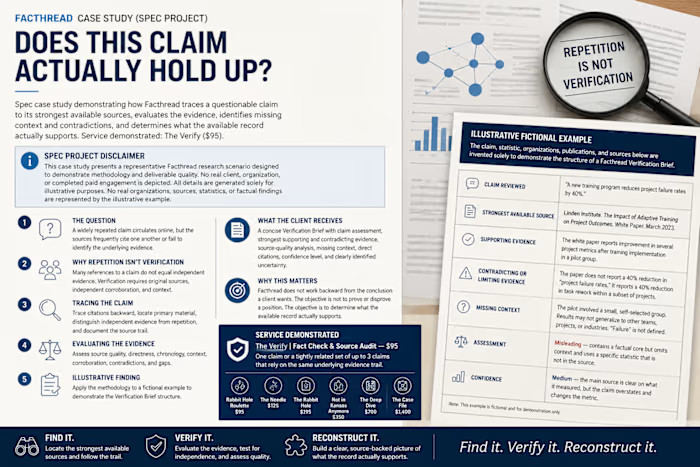
This is a spec/representative project created to demonstrate Facthread's Deep Dive methodology. All names, organizations, publications, dates, quotations, statistics, records, and findings are fictional. No real research engagement is depicted. Nothing in this case study should be cited as a real source or mistaken for an actual historical record.
Service demonstrated: The Deep Dive | Multi-Source Research & Evidence Analysis — $295, 14 business days.
The research objective
In this fictional scenario, a regional historical society is preparing an exhibit and encounters a straightforward-sounding question: When did the Bellhaven Textile Cooperative actually close, and why?
The Cooperative was a fictional mid-century worker-owned textile operation in a fictional mid-Atlantic mill town. It operated from roughly 1946 to the early 1970s. Three decades later, the historical society discovers that its own archival sources disagree about when the Cooperative closed, why it closed, and what happened to its assets.
The exhibit can't go forward with contradictory dates on the wall. The society needs the record reconstructed.
Why a single-source search wasn't enough
The apparent question was simple: When did the Cooperative close? But resolving it required more than verifying a date. The conflicting dates opened three distinct evidence trails: the Cooperative's institutional record, contemporary reporting, and later historical accounts. Determining what happened required investigating those trails independently and then reconciling them against one another. That moved the project beyond a single focused research trail and into Deep Dive territory.
The research problem required:
Following three connected but distinct evidence trails
Evaluating source quality and provenance across different record types
Determining which sources were independent and which were repeating each other
Reconstructing a timeline from conflicting accounts
Reconciling the conflicts or documenting why they couldn't be reconciled
The three connected research threads
Thread 1: The institutional record
What did the Cooperative's own surviving documents say? This thread investigated fictional corporate filings, meeting minutes referenced in later accounts, a dissolution filing, and the county recorder's office records. The goal: establish what the Cooperative's own paperwork showed about its final years and closure.
Thread 2: Contemporary reporting
What did local newspapers report at the time? This thread investigated fictional coverage in the Bellhaven Register (a fictional weekly newspaper) from 1969 to 1973, looking for reporting on the Cooperative's operations, financial difficulties, closure, or asset disposition.
Thread 3: Later historical accounts
What did subsequent histories, retrospectives, and institutional publications say happened? This thread investigated a fictional 1998 county history pamphlet, a fictional 2004 oral history project, and a fictional 2012 regional economic study, evaluating how the closure was described after the fact and whether those accounts were consistent with the contemporary record.
How the sources were evaluated
Each source was assessed for:
Provenance: Where did this document come from? Who created it, when, and for what purpose?
Independence: Is this source reporting from its own evidence, or repeating another source?
Proximity: How close in time and position was the source to the events it describes?
Internal consistency: Does the source contradict itself?
Corroboration: Do independent sources confirm the same facts?
What the evaluation revealed
The fictional 1998 county history pamphlet cited a closure date of 1971 and attributed the closure to "declining demand for domestic textiles." It provided no source citation. The fictional 2004 oral history project interviewed three former workers (fictional), two of whom recalled the closure as happening in "late 1972 or early 1973." The fictional 2012 regional economic study cited the 1998 pamphlet as its source for the 1971 date.
This meant the 2012 study was not an independent source. It was repeating the 1998 pamphlet. Two sources appearing to agree were actually one source cited twice.
Meanwhile, the fictional county recorder's office held a dissolution filing dated March 1973. And the fictional Bellhaven Register ran a brief item in January 1973 noting that the Cooperative's remaining equipment was being auctioned.
The contemporary sources (the filing and the newspaper) pointed to early 1973. The later accounts pointed to 1971. The oral histories split between the two.
Where the record conflicted
The Contradiction & Discrepancy Log documented three material conflicts:
Conflict 1: Closure date
Source | Date claimed | Source type | Independence |
|---|---|---|---|
1998 county pamphlet (fictional) | 1971 | Secondary, no citation | Independent but unsourced |
2012 economic study (fictional) | 1971 | Tertiary, cites pamphlet | Not independent (repeats pamphlet) |
Oral history, Worker A (fictional) | "Late 1972" | Primary, from memory | Independent |
Oral history, Worker B (fictional) | "Early 1973" | Primary, from memory | Independent |
Oral history, Worker C (fictional) | "1971 or so" | Primary, from memory | Independent |
County dissolution filing (fictional) | March 1973 | Primary, official record | Independent |
Bellhaven Register (fictional) | January 1973 | Primary, contemporary | Independent |
Conflict 2: Reason for closure
The 1998 pamphlet attributed the closure to "declining demand for domestic textiles." The oral histories described a dispute among the worker-owners over whether to modernize equipment or sell the building. The Bellhaven Register item mentioned the equipment auction but not the reason for closure. The dissolution filing was procedural and stated no cause.
No single source provided a complete account. The pamphlet's explanation was plausible but unsourced. The oral histories described an internal cause (governance dispute) rather than an external one (market decline). Both could be true simultaneously, but no source connected them.
Conflict 3: Asset disposition
The 1998 pamphlet stated the building "was sold to a private developer." The 2004 oral histories described the building sitting vacant "for years." County property records (fictional) showed a transfer in 1976, three years after dissolution. The pamphlet's account was technically accurate but misleading in its implied timing.
Reconstructing the timeline
The Reconstructed Timeline synthesized findings across all three threads into a single chronology, with each entry tied to its source(s) and flagged where sources conflicted:
Date | Event | Source(s) | Confidence | Notes |
|---|---|---|---|---|
1946 | Cooperative founded | County filing, pamphlet (fictional) | High | Sources agree |
1969-1970 | Internal disputes over modernization | Oral histories A, B (fictional) | Moderate | Two independent accounts; no documentary corroboration |
1971 | Pamphlet's claimed closure date | 1998 pamphlet (fictional) | Low | Unsourced; contradicted by later documentary evidence |
Late 1972 | Operations wind down | Oral history A (fictional) | Moderate | Single source, but consistent with 1973 filing |
Jan 1973 | Equipment auction reported | Bellhaven Register (fictional) | High | Contemporary primary source |
Mar 1973 | Dissolution filing recorded | County recorder (fictional) | High | Official primary record |
1976 | Building transferred to private buyer | County property records (fictional) | High | Official primary record |
The weight of evidence supported a 1973 closure (dissolution filing + contemporary newspaper), not 1971 (unsourced pamphlet repeated by one later study). The 1971 date likely reflected either a rounding error, a confusion between the start of decline and the formal closure, or an unsourced claim that propagated through repetition.
Illustrative findings and confidence assessments
The Findings & Confidence Matrix assessed each key finding:
The Cooperative formally dissolved in early 1973.
Confidence: High. Corroborated by the county dissolution filing (March 1973) and the Bellhaven Register equipment auction notice (January 1973). Two independent primary sources with consistent timing.
The commonly cited 1971 closure date is not supported by the primary record.
Confidence: High. The 1971 date traces to a single unsourced secondary account (the 1998 pamphlet). The 2012 study that appears to confirm it is not independent; it cites the pamphlet. No primary source supports 1971 as the closure date.
Internal governance disputes contributed to the closure.
Confidence: Moderate. Two independent oral history accounts describe disputes over modernization. No documentary corroboration was located, but the accounts are consistent with each other and with the timeline of decline.
"Declining demand for domestic textiles" as the sole cause of closure is an oversimplification.
Confidence: Moderate. The market explanation is plausible for the period but is unsourced in the pamphlet and not mentioned in any other source. The oral histories describe an internal cause that the pamphlet omits entirely. The actual closure likely involved both factors, but no source connects them.
The building was not immediately sold after closure.
Confidence: High. County property records show a 1976 transfer, three years after dissolution. The pamphlet's claim that the building "was sold to a private developer" is accurate but implies a timeline the records don't support.
What remained unresolved
The Open Questions & Next Leads section documented:
Where did the 1998 pamphlet get the 1971 date? No source was cited, and the author is not identified. If the pamphlet's research notes survive, they might clarify whether this was a typographical error, a misremembered date from an interview, or a confusion between the start of decline and formal dissolution.
What were the specific terms of the internal dispute? The oral histories describe disagreement over modernization but provide limited detail. If Cooperative meeting minutes survive in any private collection, they might document the dispute directly.
Were there other contemporary news accounts? Only one Bellhaven Register item was located. The newspaper's archive for this period may be incomplete. A regional newspaper or trade publication might have covered the closure.
What happened to the Cooperative's financial records? No financial documents were located. If they survive, they might clarify the relative weight of market decline versus internal governance failure.
These gaps were documented honestly rather than filled with speculation.
What the Deep Dive deliverable contains
The representative Deep Dive Research Package would include:
Deep Dive Research Dossier — The central narrative reconstructing what the evidence shows about the Cooperative's closure, organized by research thread and synthesized into an integrated account
Evidence & Source Matrix — Every source materially used, documented by thread, with source type, provenance, date, reliability assessment, and relationship to findings
Reconstructed Timeline — The chronology above, integrating findings across all three threads with source conflicts flagged
Contradiction & Discrepancy Log — The three material conflicts documented above, with competing accounts evaluated and (where possible) reconciled
Findings & Confidence Matrix — Each key finding with its confidence level and evidentiary basis
Open Questions & Next Leads — What could not be determined, why, and where further investigation might look
Source/Relationship Map — How the sources related to each other: which were independent, which were derivative, and how the evidence threads connected
The Source/Relationship Map was particularly useful here because it made visible the dependency chain between the 1998 pamphlet and the 2012 study. Without mapping that relationship, two sources appearing to agree on 1971 would have looked like corroboration. With the map, it was clear they were one source cited twice.
Why this required The Deep Dive
The project began with what looked like a single focused question: "When did the Cooperative close?" But verification immediately exposed a larger evidence problem. The commonly repeated 1971 date conflicted with contemporary records, and resolving that conflict required three connected source trails rather than one focused research path.
Getting to the right answer required following three independent evidence trails, evaluating source quality and independence across different record types, identifying where later accounts were repeating earlier ones rather than providing independent corroboration, reconstructing a timeline from conflicting sources, and documenting what the record supported, what it contradicted, and what it couldn't resolve.
That's the work The Deep Dive is built for: one defined research objective, investigated through multiple connected source trails, with cross-thread reconciliation and honest confidence assessment.
The question wasn't hard to ask. The evidence was hard to untangle.
All names, organizations, publications, dates, quotations, records, and findings in this case study are fictional. This is a spec/representative project demonstrating Facthread's Deep Dive methodology. No real research engagement, client, or historical event is depicted.
Like this project
Posted Jul 29, 2026
Spec case study demonstrating multi-source investigation for one defined objective: reconciling three conflicting evidence trails through source provenance evaluation, independence testing, timeline reconstruction, and cross-thread reconciliation.
Likes
0
Views
3