The Case File | Evidence Reconstruction & AnalysisFacthread Research
One evidence problem. Fifty source items. One reconstructed record.
The Case File is Facthread's evidence-driven research service. It's for the situation where the question isn't "what can you find out?" but "what does the full body of evidence actually show?"
You have a subject with a scattered, conflicting, or disorganized evidentiary record. Documents that don't agree with each other. Sources that tell different versions of the same events. A timeline that doesn't hold together. Material spread across different archives, record systems, or source types. You need someone to catalog it, cross-reference it, reconstruct the chronology, identify the contradictions, map the gaps, and deliver a coherent evidentiary record you can actually work from.
This is where Facthread's question-driven and objective-driven services hand off. The Needle, The Rabbit Hole, and The Deep Dive start with a question or objective and investigate it. The Case File starts with an evidence problem and builds the record.
What kinds of evidence problems fit here
A subject with a scattered evidentiary record spread across multiple source types and archives
Conflicting accounts, documents, or records that need to be cataloged and reconciled
A body of material that needs to be organized into a coherent, cross-referenced record
Historical, institutional, or event research where the primary need is evidence assembly and assessment rather than answering a specific question
Prior research that produced a pile of sources but no structured analysis of how they relate, where they conflict, and what they collectively support
A timeline that needs to be reconstructed from multiple independent source types
Research spanning different domains (e.g., public records + news archives + corporate filings + court records + web archives) that need to be integrated
Any evidence problem where the core challenge is building the structured record, not answering a single question
Scope
The Case File covers one defined evidence problem or subject, investigated across up to 50 discrete source items and up to 5 major evidence categories.
A source item is a discrete evidentiary unit: a document, article, record, archived page, filing, image/document set, or other identifiable piece of evidence. Large, unusually dense, or labor-intensive materials (e.g., a 200-page report or a large document set requiring individual analysis) may count as multiple source items. Source-item counting is confirmed during scoping so there are no surprises.
An evidence category is a major class of source material investigated (e.g., public records, news archives, corporate filings, court records, web archives). Up to 5 categories per engagement.
During scoping, I'll define the evidence problem with you, confirm the source-item and evidence-category ceilings, and establish what the engagement will and won't cover. If the subject exceeds the ceilings, we'll discuss custom scope before any work begins.
How it works
You submit your evidence problem. The subject or body of material you need reconstructed, along with any context, documents, links, prior research, or background you already have.
I scope and confirm. I review the evidence problem, estimate source-item count and evidence categories, and confirm the engagement fits The Case File's ceilings. If the subject exceeds them, I'll tell you before any work begins.
I reconstruct. Source cataloging, cross-referencing, timeline reconstruction, contradiction identification, evidence-gap mapping, confidence assessment, and relationship analysis using lawful, publicly accessible sources. Material you provide is integrated alongside independently located sources.
You receive your case file. A structured evidentiary record within 21 business days of confirmed scope.
What you receive
Reconstructed Case File — The central evidentiary narrative: what the assembled record shows, organized by evidence category and synthesized into a coherent account of what the sources collectively support, where they conflict, and what remains unresolved
Evidence Catalog — Up to 50 source items within the confirmed scope, cataloged with source type, provenance, date, reliability assessment, and relationship to the evidence problem
Master Timeline — A reconstructed chronology integrating findings across all evidence categories, with each entry tied to its source item(s) and flagged where sources conflict on timing or sequence
Cross-Reference Matrix — How source items relate to each other: corroboration, contradiction, dependency, and independence mapped across the evidence set
Contradiction & Discrepancy Register — Material contradictions and discrepancies identified across the analyzed evidence set, with competing accounts documented and evaluated
Evidence-Gap Map — What the record does not contain, where evidence is missing or incomplete, why, and what categories of source material might fill the gaps
Findings & Confidence Summary — Key findings with confidence levels (High, Moderate, Low, Unverified) and the evidentiary basis for each assessment
Source/Relationship Map — Visual or structured mapping of how sources, entities, events, and evidence threads connect, when useful
Overflow & Next Leads — Relevant sources and leads discovered beyond the confirmed 50-item ceiling, documented for reference without obligation to investigate them within this engagement
Methodology
Every finding is tied to its source item. Confidence levels are assigned based on corroboration strength across the evidence set. The case file clearly separates verified facts, reported claims, inferences, contradictions, and unresolved questions.
When sources conflict, the conflict is documented in the Contradiction & Discrepancy Register and evaluated rather than silently resolved. The register shows what each source says, how the sources relate to each other, and what the weight of evidence supports.
When the evidence runs out within the confirmed scope, I document where it stopped and why. The Evidence-Gap Map identifies what might fill the gaps, and the Overflow & Next Leads section captures promising leads beyond the 50-item ceiling.
Confidence levels:
High — Corroborated by multiple independent source items with consistent findings
Moderate — Supported by credible evidence but with limited corroboration or minor inconsistencies
Low — Based on a single source item, unverified accounts, or sources with significant limitations
Unverified — Reported but not corroborated; included for completeness with appropriate caveats
Foreign-language & historical-text research
The Case File is not limited to English-language sources. Facthread provides translation-assisted research and cross-language source analysis as part of the reconstruction. This is not certified, sworn, legal, medical, or professional translation. If a project requires that level of translation, an appropriately qualified human translator would need to be separately involved.
For ancient or difficult historical languages, the case file distinguishes between the original text, established scholarly translations, competing interpretations, and Facthread's research synthesis. Facthread does not claim independent linguistic expertise in ancient languages.
The difference between The Case File and other Facthread services
The Needle ($125) answers one focused question. The Rabbit Hole ($195) follows one tangled question with up to two sub-questions. The Deep Dive ($295) investigates one defined research objective through up to 3 connected research threads. Not in Kansas Anymore ($350) stress-tests one theory with up to 6 component claims. Those services are question-driven or objective-driven.
The Case File ($595) is evidence-driven: you bring an evidence problem, and I build a comprehensive evidentiary record within the confirmed scope and source/evidence-category ceilings. The deliverable is the structured record itself, not the answer to a single question.
What this service is not
Not a private investigation, surveillance, or law-enforcement service
Not access to private, sealed, classified, or nonpublic information
Not hacking, impersonation, doxxing, or social engineering
Not locating or contacting people who are intentionally avoiding contact
Not unsupported accusations or conclusions about identifiable people beyond what sources support
Not legal advice, medical conclusions, financial analysis, or academic work submitted as your own
Not guaranteed findings (some evidence problems have gaps that cannot be filled with available sources)
Not speculation presented as fact
Not certified, sworn, legal, medical, or professional translation
Not an exhaustive search or a promise to locate every available source; scope is bounded by the confirmed source-item and evidence-category ceilings
Revision policy
One round of clarification questions on the delivered case file is included, covering source items, confidence levels, methodology, cross-references, timeline entries, contradiction analysis, or anything unclear. It does not cover additional source items beyond the confirmed ceiling, new evidence categories, or expanded scope.
Broader Facthread services
Rabbit Hole Roulette — Weird questions welcome ($95)
The Verify — Fact check and source audit ($95)
The Needle — Focused research and verification ($125)
The Rabbit Hole — Strange, obscure, and hard-to-untangle ($195)
The Deep Dive — Multi-source research and evidence analysis ($295)
Not in Kansas Anymore — Conspiracy, legend, and extraordinary claim analysis ($350)
If your evidence problem exceeds The Case File's ceilings, I'll let you know before starting and we can discuss custom scope.
FAQs
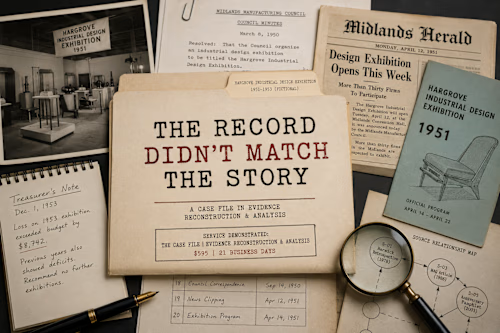
Example work
Facthread's other services


Starting at$595
Duration21 days
Tags
Online Research
OSINT
Public Records
Source Verification
Researcher
Archival Research
Competitive Intelligence
Fact-Checking
Service provided by
Facthread Research Lancaster, USA
- 1
- Followers
The Case File | Evidence Reconstruction & AnalysisFacthread Research
Starting at$595
Duration21 days
Tags
Online Research
OSINT
Public Records
Source Verification
Researcher
Archival Research
Competitive Intelligence
Fact-Checking
One evidence problem. Fifty source items. One reconstructed record.
The Case File is Facthread's evidence-driven research service. It's for the situation where the question isn't "what can you find out?" but "what does the full body of evidence actually show?"
You have a subject with a scattered, conflicting, or disorganized evidentiary record. Documents that don't agree with each other. Sources that tell different versions of the same events. A timeline that doesn't hold together. Material spread across different archives, record systems, or source types. You need someone to catalog it, cross-reference it, reconstruct the chronology, identify the contradictions, map the gaps, and deliver a coherent evidentiary record you can actually work from.
This is where Facthread's question-driven and objective-driven services hand off. The Needle, The Rabbit Hole, and The Deep Dive start with a question or objective and investigate it. The Case File starts with an evidence problem and builds the record.
What kinds of evidence problems fit here
A subject with a scattered evidentiary record spread across multiple source types and archives
Conflicting accounts, documents, or records that need to be cataloged and reconciled
A body of material that needs to be organized into a coherent, cross-referenced record
Historical, institutional, or event research where the primary need is evidence assembly and assessment rather than answering a specific question
Prior research that produced a pile of sources but no structured analysis of how they relate, where they conflict, and what they collectively support
A timeline that needs to be reconstructed from multiple independent source types
Research spanning different domains (e.g., public records + news archives + corporate filings + court records + web archives) that need to be integrated
Any evidence problem where the core challenge is building the structured record, not answering a single question
Scope
The Case File covers one defined evidence problem or subject, investigated across up to 50 discrete source items and up to 5 major evidence categories.
A source item is a discrete evidentiary unit: a document, article, record, archived page, filing, image/document set, or other identifiable piece of evidence. Large, unusually dense, or labor-intensive materials (e.g., a 200-page report or a large document set requiring individual analysis) may count as multiple source items. Source-item counting is confirmed during scoping so there are no surprises.
An evidence category is a major class of source material investigated (e.g., public records, news archives, corporate filings, court records, web archives). Up to 5 categories per engagement.
During scoping, I'll define the evidence problem with you, confirm the source-item and evidence-category ceilings, and establish what the engagement will and won't cover. If the subject exceeds the ceilings, we'll discuss custom scope before any work begins.
How it works
You submit your evidence problem. The subject or body of material you need reconstructed, along with any context, documents, links, prior research, or background you already have.
I scope and confirm. I review the evidence problem, estimate source-item count and evidence categories, and confirm the engagement fits The Case File's ceilings. If the subject exceeds them, I'll tell you before any work begins.
I reconstruct. Source cataloging, cross-referencing, timeline reconstruction, contradiction identification, evidence-gap mapping, confidence assessment, and relationship analysis using lawful, publicly accessible sources. Material you provide is integrated alongside independently located sources.
You receive your case file. A structured evidentiary record within 21 business days of confirmed scope.
What you receive
Reconstructed Case File — The central evidentiary narrative: what the assembled record shows, organized by evidence category and synthesized into a coherent account of what the sources collectively support, where they conflict, and what remains unresolved
Evidence Catalog — Up to 50 source items within the confirmed scope, cataloged with source type, provenance, date, reliability assessment, and relationship to the evidence problem
Master Timeline — A reconstructed chronology integrating findings across all evidence categories, with each entry tied to its source item(s) and flagged where sources conflict on timing or sequence
Cross-Reference Matrix — How source items relate to each other: corroboration, contradiction, dependency, and independence mapped across the evidence set
Contradiction & Discrepancy Register — Material contradictions and discrepancies identified across the analyzed evidence set, with competing accounts documented and evaluated
Evidence-Gap Map — What the record does not contain, where evidence is missing or incomplete, why, and what categories of source material might fill the gaps
Findings & Confidence Summary — Key findings with confidence levels (High, Moderate, Low, Unverified) and the evidentiary basis for each assessment
Source/Relationship Map — Visual or structured mapping of how sources, entities, events, and evidence threads connect, when useful
Overflow & Next Leads — Relevant sources and leads discovered beyond the confirmed 50-item ceiling, documented for reference without obligation to investigate them within this engagement
Methodology
Every finding is tied to its source item. Confidence levels are assigned based on corroboration strength across the evidence set. The case file clearly separates verified facts, reported claims, inferences, contradictions, and unresolved questions.
When sources conflict, the conflict is documented in the Contradiction & Discrepancy Register and evaluated rather than silently resolved. The register shows what each source says, how the sources relate to each other, and what the weight of evidence supports.
When the evidence runs out within the confirmed scope, I document where it stopped and why. The Evidence-Gap Map identifies what might fill the gaps, and the Overflow & Next Leads section captures promising leads beyond the 50-item ceiling.
Confidence levels:
High — Corroborated by multiple independent source items with consistent findings
Moderate — Supported by credible evidence but with limited corroboration or minor inconsistencies
Low — Based on a single source item, unverified accounts, or sources with significant limitations
Unverified — Reported but not corroborated; included for completeness with appropriate caveats
Foreign-language & historical-text research
The Case File is not limited to English-language sources. Facthread provides translation-assisted research and cross-language source analysis as part of the reconstruction. This is not certified, sworn, legal, medical, or professional translation. If a project requires that level of translation, an appropriately qualified human translator would need to be separately involved.
For ancient or difficult historical languages, the case file distinguishes between the original text, established scholarly translations, competing interpretations, and Facthread's research synthesis. Facthread does not claim independent linguistic expertise in ancient languages.
The difference between The Case File and other Facthread services
The Needle ($125) answers one focused question. The Rabbit Hole ($195) follows one tangled question with up to two sub-questions. The Deep Dive ($295) investigates one defined research objective through up to 3 connected research threads. Not in Kansas Anymore ($350) stress-tests one theory with up to 6 component claims. Those services are question-driven or objective-driven.
The Case File ($595) is evidence-driven: you bring an evidence problem, and I build a comprehensive evidentiary record within the confirmed scope and source/evidence-category ceilings. The deliverable is the structured record itself, not the answer to a single question.
What this service is not
Not a private investigation, surveillance, or law-enforcement service
Not access to private, sealed, classified, or nonpublic information
Not hacking, impersonation, doxxing, or social engineering
Not locating or contacting people who are intentionally avoiding contact
Not unsupported accusations or conclusions about identifiable people beyond what sources support
Not legal advice, medical conclusions, financial analysis, or academic work submitted as your own
Not guaranteed findings (some evidence problems have gaps that cannot be filled with available sources)
Not speculation presented as fact
Not certified, sworn, legal, medical, or professional translation
Not an exhaustive search or a promise to locate every available source; scope is bounded by the confirmed source-item and evidence-category ceilings
Revision policy
One round of clarification questions on the delivered case file is included, covering source items, confidence levels, methodology, cross-references, timeline entries, contradiction analysis, or anything unclear. It does not cover additional source items beyond the confirmed ceiling, new evidence categories, or expanded scope.
Broader Facthread services
Rabbit Hole Roulette — Weird questions welcome ($95)
The Verify — Fact check and source audit ($95)
The Needle — Focused research and verification ($125)
The Rabbit Hole — Strange, obscure, and hard-to-untangle ($195)
The Deep Dive — Multi-source research and evidence analysis ($295)
Not in Kansas Anymore — Conspiracy, legend, and extraordinary claim analysis ($350)
If your evidence problem exceeds The Case File's ceilings, I'll let you know before starting and we can discuss custom scope.
FAQs
Example work
Facthread's other services
$595