Useful FAQ Pages — Explanatory Writing Sample

Adam Pope

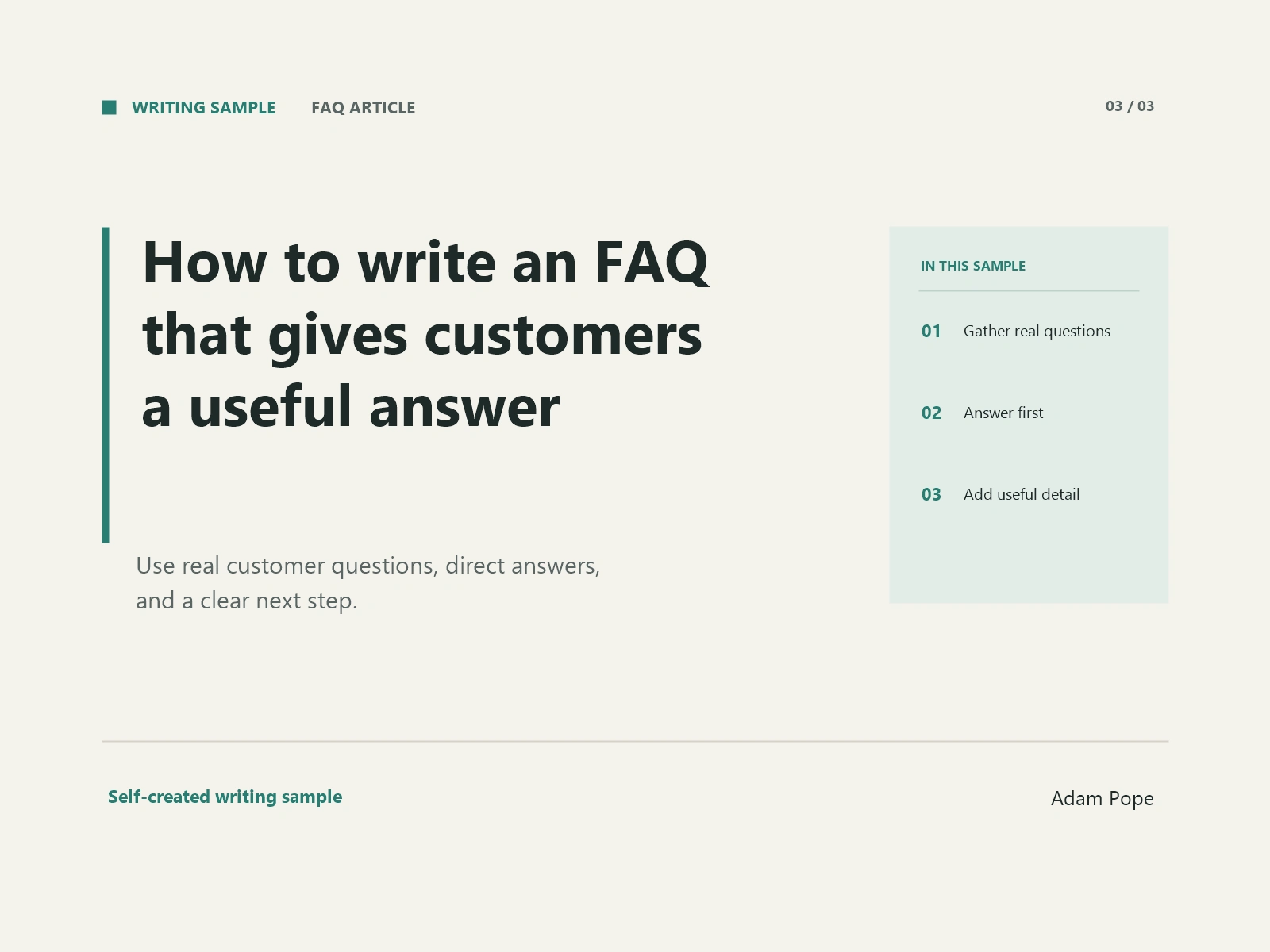
Self-created writing demonstration — general how-to article
Fictional brief: A small service business wants a practical blog post for owners who are writing their first customer FAQ page. This is a practice piece, not client work. No traffic, ranking, or conversion result is claimed.
How to write an FAQ page that gives customers a useful answer
A good FAQ page starts with a real question and ends with a clear next step. It should help a visitor decide what to do without reading three other pages first. If your business already answers the same questions by email or phone, you have a starting list. Turn those conversations into a page people can scan, understand, and use.
Start with the questions people actually ask
Collect questions from your inbox, contact form, sales conversations, and support notes. Write them down in the customer's words. “When will my order ship?” is more useful than an internal label such as “fulfillment policy.” If you have no customer questions yet, ask someone unfamiliar with the business to look at your site and say what they still need to know.
Choose a short first set. A page with six complete answers is more helpful than a page with twenty vague ones. Put urgent decisions first: price, timing, what is included, and how to get help. Add new questions when you see a repeated need.
Answer first, then add the detail
Open each answer with the information the reader came for. For example: “You can change your booking up to 24 hours before the appointment.” Then explain the steps, limits, and contact route. If the answer depends on location, product, or account type, say so at the start.
Keep one question focused on one issue. If a paragraph needs several “also” clauses, split it. Digital.gov recommends organizing information around the audience's needs and putting the most important information at the beginning. That approach helps you spot answers that are trying to cover too much at once.
Use headings that still make sense out of context
Group related questions under clear headings such as “Orders,” “Changes and cancellations,” and “Contact.” Avoid headings like “Other information.” A visitor who scans only the headings should still understand the shape of the page. The W3C's Web Accessibility Initiative explains that headings communicate page organization and can support navigation with assistive technology. That makes descriptive headings a useful editing choice, not just a visual one.
Check the promises before you publish
An FAQ is often read as a commitment. Compare every answer with your actual policy and process. Confirm dates, prices, eligibility, refund terms, and who handles exceptions. Do not copy an old answer into a new page just because it sounds polished. If a policy is still being decided, leave that answer unpublished until someone responsible confirms it.
Before the page goes live, ask a colleague to use it for three realistic tasks: find a price, find a deadline, and find a way to contact you. Watch where they hesitate. Move or rewrite the answer rather than adding another long explanation. Then give the page an owner who can review it when your process changes.
Keep a dated copy of approved answers somewhere your team can find it. That gives future updates a starting point.
An FAQ page is finished when a reader can find a relevant question, get a direct answer, and know what to do next. Start small, keep the language close to the customer's, and revise it as real questions come in.
Sources verified on October 3, 2026: Digital.gov plain-language organization guidance; Digital.gov guidance on writing for the reader; W3C WAI heading tutorial. The article's practical recommendations are editorial suggestions; the example booking policy is illustrative, not a statement about an actual business. Word count excludes title, section headings, fictional brief, and this source note.
Like this project
Posted Oct 3, 2026
Self-created 500-word article about writing clear FAQ answers from approved business facts. Fictional practice brief with primary source guidance.
Likes
0
Views
0