
Executive Program Architecture & Problem-Solving Frameworks
Overview: Designed to shift corporate and student cohorts from emotional reactivity to empirical, data-driven decision-making. This module trains professionals to dismantle cognitive biases, master logical reasoning, and build structural resilience in volatile environments.
🎯 Program Blueprint & Objectives
Target Audience: Mid-level professionals, management trainees, emerging leaders, and corporate teams navigating ambiguity.
Pedagogical Approach: Scenario-based red-teaming drills, behavioral science case studies, decision matrices, and weekly reflection journals.
Core Goal: Build rigorous analytical habits, emotional regulation, and structured problem-solving mechanisms under pressure.
⚙️ Proprietary Framework Architecture
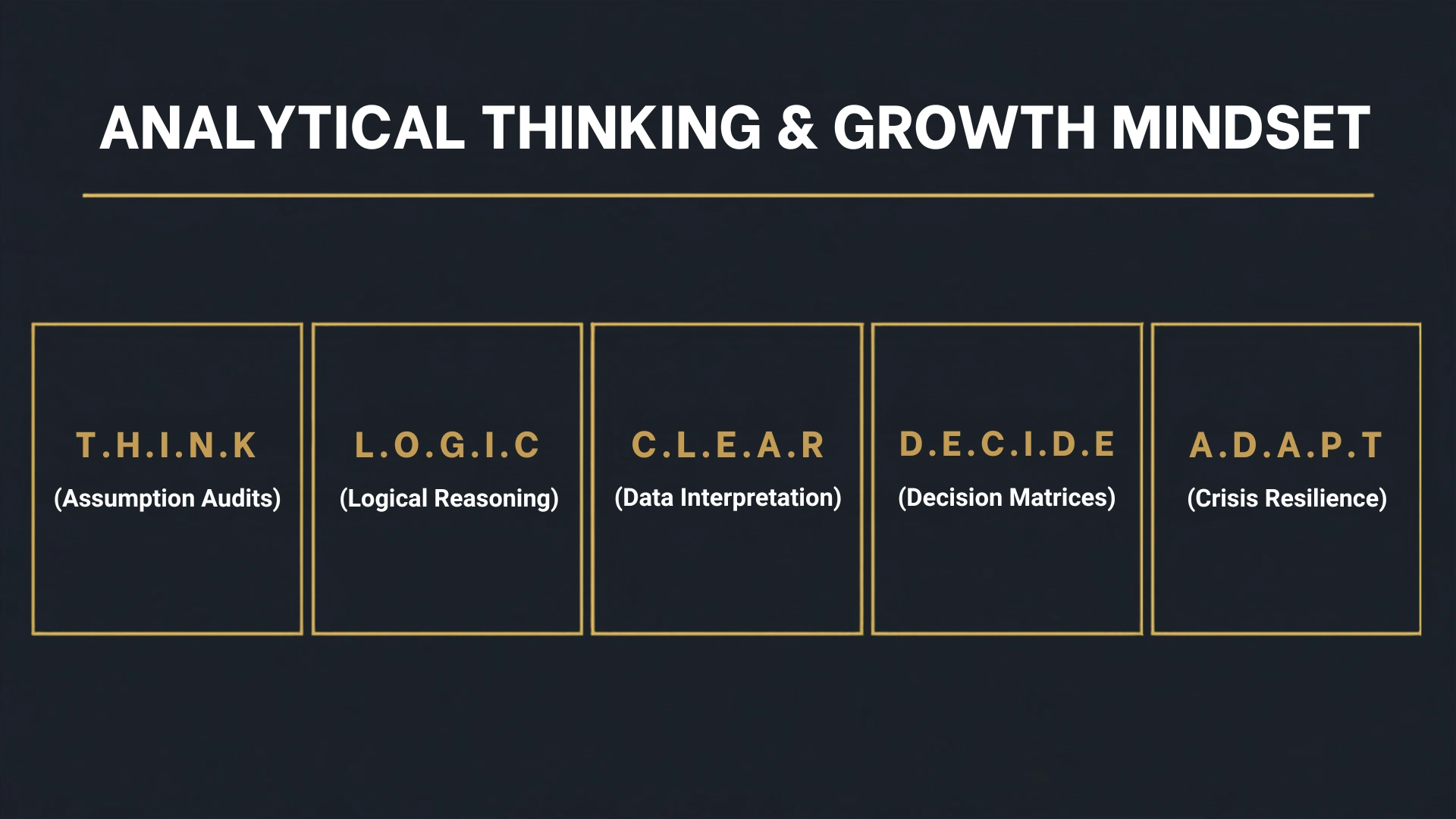
The module is anchored around 5 behavioral and analytical systems:
T.H.I.N.K — Take a pause, Hunt assumptions, Investigate evidence, Notice actualities, Know your conclusion. Used to separate objective facts from dangerous workplace assumptions.
L.O.G.I.C — List facts, Organise information, Generate explanations, Identify relationships, Choose strongest conclusion. A systematic logical reasoning model.
C.L.E.A.R — Conceive, Look for trends, Ask why/where/when, Evaluate sources, Report insights. A data interpretation framework that prevents gut-reaction errors.
D.E.C.I.D.E — Define, Examine, Consider alternatives, Identify risks, Decide, Evaluate. A quantitative and qualitative parameter toolkit for vendor selection, hiring, and high-stakes choices.
P.A.S.S — Pause, Acknowledge, Understand similarities, Engage empathetically. An emotional intelligence model to regulate high-stress workplace conflicts and boss pushback.
📊 Module-by-Module Breakdown
Module 1: Reality Check & Behavioral Science
Focus: Recognizing cognitive biases (Confirmation Bias, Anchoring) and overcoming the amygdala emotional hijack.
Key Exercise: The Fact vs. Assumption audit (e.g., decoding why an unlinked Excel sheet or panicked manager message triggers false conclusions).
Module 2: Logical Reasoning & Red Teaming
Focus: Structured problem-solving and data interpretation.
Key Exercise: Red Team vs. Blue Team Drills—splitting groups to defend a business decision versus actively challenging every underlying assumption.
Module 3: Decision Matrix & Strategic Choices
Focus: Cost-benefit analysis, opportunity cost, and objective-driven choices.
Key Exercise: Building multi-parameter decision matrices for real-world scenarios like software selection or crisis management.
Module 4: Growth Mindset & Cognitive Reframing
Focus: Moving from fixed-mindset panic to solution-seeking abundance.
Key Exercise: Rewriting failure loops using the G.R.O.W framework (Goals, Reflect, Open mistakes, Work consistently).
Module 5: Adaptability, Resilience & EQ
Focus: Managing sudden project cancellations, shifting deadlines, and client hostility.
Key Exercise: The A.D.A.P.T framework simulation (Accept change, Diagnose, Adjust, Persevere, Transform learning).
0 likes · 0 views · Sep 12, 2026
Executive Program Architecture & Problem-Solving Frameworks Overview: Designed to shift corporate and student cohorts from emotional reactivity to empirical,...


