
YASHASWINI TIWARI
Curriculum Architect & Leadership Consultant
- 1
- Followers


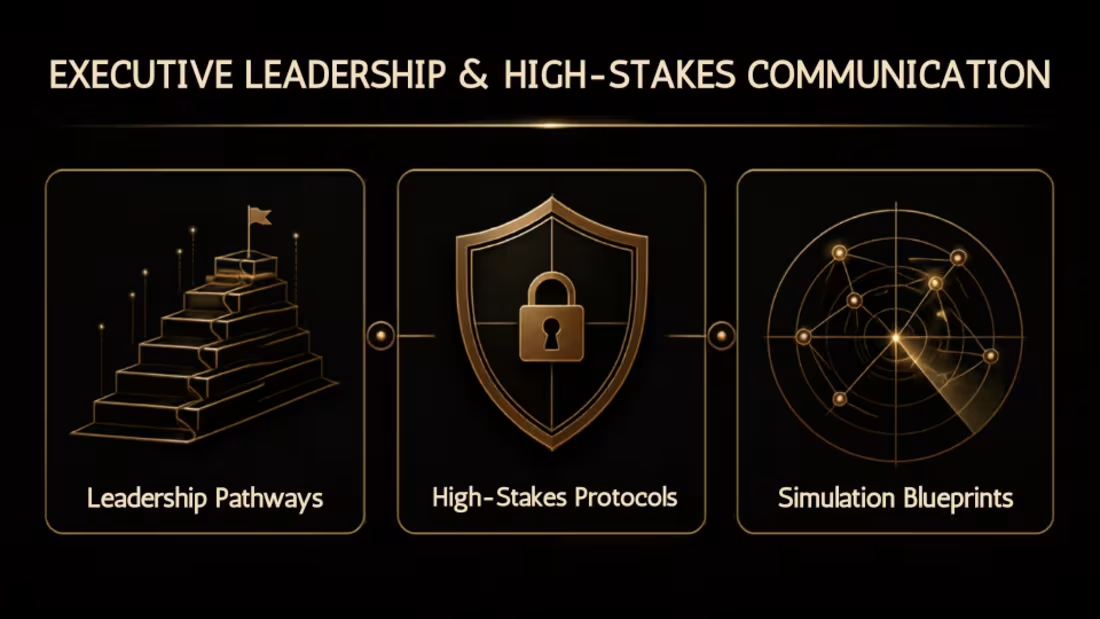
Project Title: Executive Leadership Development & High-Stakes Communication Framework
Project Role: Management Consultant & Facilitator
Project Overview :
Architected a multi-tiered leadership development framework tailored for emerging executives and managers. The module bridges human capital development with tactical decision-making under uncertainty, focusing on high-stakes executive presence, strategic narrative building, and cross-functional team alignment.
Designed to transition high-potential talent into authoritative leaders, this program equips organisations with the structural tools needed to navigate structural complexity, manage high-pressure team dynamics, and communicate vision with absolute clarity.
Key Deliverables / Scope:
Multi-Tiered Leadership Pathways: Structured progression models mapping foundational management skills to executive-level strategic capabilities.
High-Stakes Communication Protocols: Frameworks for managing crisis messaging, board-level updates, and organisational change management.
Interactive Simulation Blueprints: Rigorous role-play scenarios designed to test emotional intelligence, resilience, and real-time decision-making under pressure.
0
93
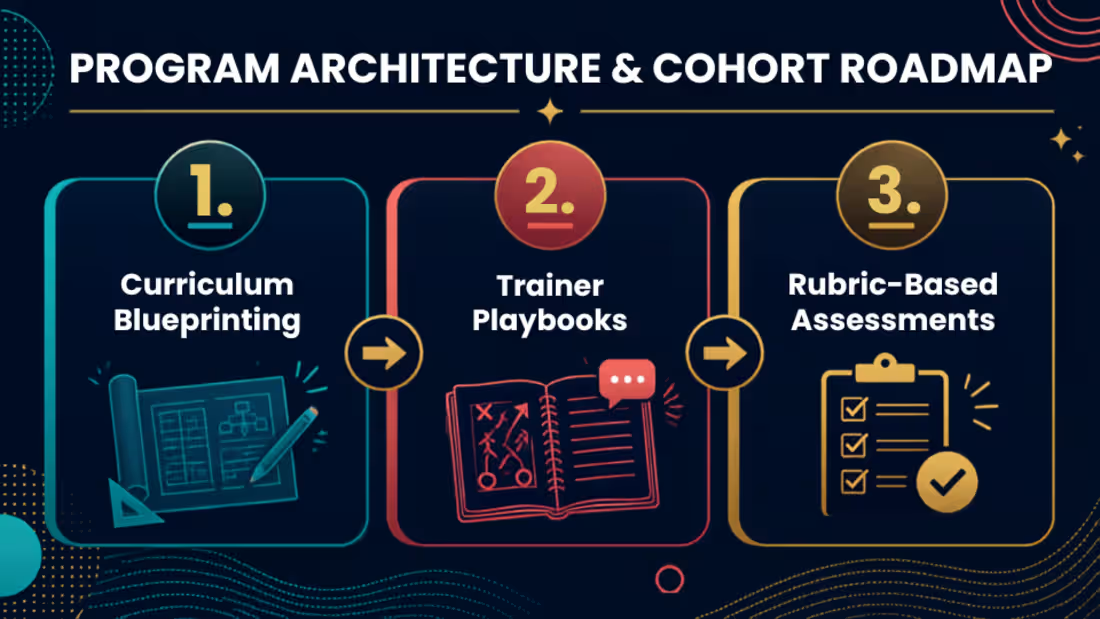
Project Title: End-to-End Upskilling Program Architecture & Cohort Roadmap
Project Role: Program Architect & Strategy Consultant
Project Overview:
Designed and launched an institutional upskilling program framework engineered to transition high-potential students and early-career talent into industry-ready professionals. This project focused on building structured cohort roadmaps, comprehensive trainer modules, and scalable evaluation metrics to ensure high cognitive retention and practical mastery.
Core Frameworks / Deliverables Highlight:
Curriculum Blueprinting: End-to-end mapping of modular learning pathways.
Trainer Playbooks: Standardized facilitator guides ensuring consistency across multi-instructor cohorts.
Rubric-Based Assessments: Built-in tracking mechanisms and reflection frameworks.
0
112
Executive Program Architecture & Problem-Solving Frameworks
Overview: Designed to shift corporate and student cohorts from emotional reactivity to empirical, data-driven decision-making. This module trains professionals to dismantle cognitive biases, master logical reasoning, and build structural resilience in volatile environments.
🎯 Program Blueprint & Objectives
Target Audience: Mid-level professionals, management trainees, emerging leaders, and corporate teams navigating ambiguity.
Pedagogical Approach: Scenario-based red-teaming drills, behavioral science case studies, decision matrices, and weekly reflection journals.
Core Goal: Build rigorous analytical habits, emotional regulation, and structured problem-solving mechanisms under pressure.
⚙️ Proprietary Framework Architecture
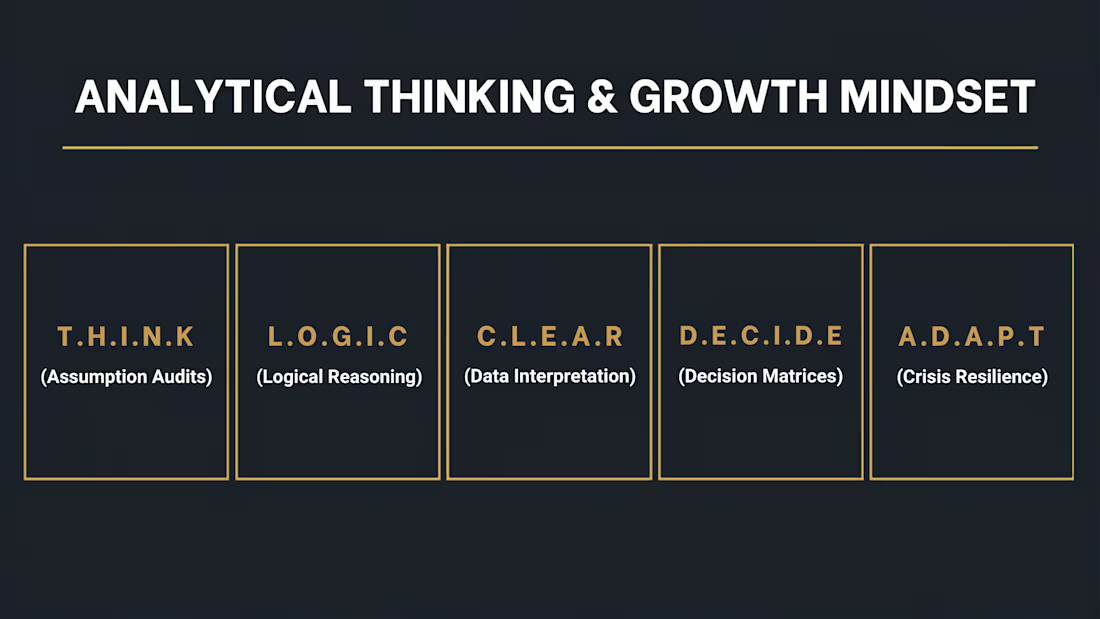
The module is anchored around 5 behavioral and analytical systems:
T.H.I.N.K — Take a pause, Hunt assumptions, Investigate evidence, Notice actualities, Know your conclusion. Used to separate objective facts from dangerous workplace assumptions.
L.O.G.I.C — List facts, Organise information, Generate explanations, Identify relationships, Choose strongest conclusion. A systematic logical reasoning model.
C.L.E.A.R — Conceive, Look for trends, Ask why/where/when, Evaluate sources, Report insights. A data interpretation framework that prevents gut-reaction errors.
D.E.C.I.D.E — Define, Examine, Consider alternatives, Identify risks, Decide, Evaluate. A quantitative and qualitative parameter toolkit for vendor selection, hiring, and high-stakes choices.
P.A.S.S — Pause, Acknowledge, Understand similarities, Engage empathetically. An emotional intelligence model to regulate high-stress workplace conflicts and boss pushback.
📊 Module-by-Module Breakdown
Module 1: Reality Check & Behavioral Science
Focus: Recognizing cognitive biases (Confirmation Bias, Anchoring) and overcoming the amygdala emotional hijack.
Key Exercise: The Fact vs. Assumption audit (e.g., decoding why an unlinked Excel sheet or panicked manager message triggers false conclusions).
Module 2: Logical Reasoning & Red Teaming
Focus: Structured problem-solving and data interpretation.
Key Exercise: Red Team vs. Blue Team Drills—splitting groups to defend a business decision versus actively challenging every underlying assumption.
Module 3: Decision Matrix & Strategic Choices
Focus: Cost-benefit analysis, opportunity cost, and objective-driven choices.
Key Exercise: Building multi-parameter decision matrices for real-world scenarios like software selection or crisis management.
Module 4: Growth Mindset & Cognitive Reframing
Focus: Moving from fixed-mindset panic to solution-seeking abundance.
Key Exercise: Rewriting failure loops using the G.R.O.W framework (Goals, Reflect, Open mistakes, Work consistently).
Module 5: Adaptability, Resilience & EQ
Focus: Managing sudden project cancellations, shifting deadlines, and client hostility.
Key Exercise: The A.D.A.P.T framework simulation (Accept change, Diagnose, Adjust, Persevere, Transform learning).
0
47
Business Communication & Professional Mastery
Executive Upskilling Curriculum & Program Architecture
Overview: An end-to-end, cohort-based curriculum designed to bridge technical competence with executive fluency, professional presence, and leadership communication.
🎯 Program Blueprint & Objectives
Target Audience: Final-year students, fresh graduates, interns, and first-job professionals.
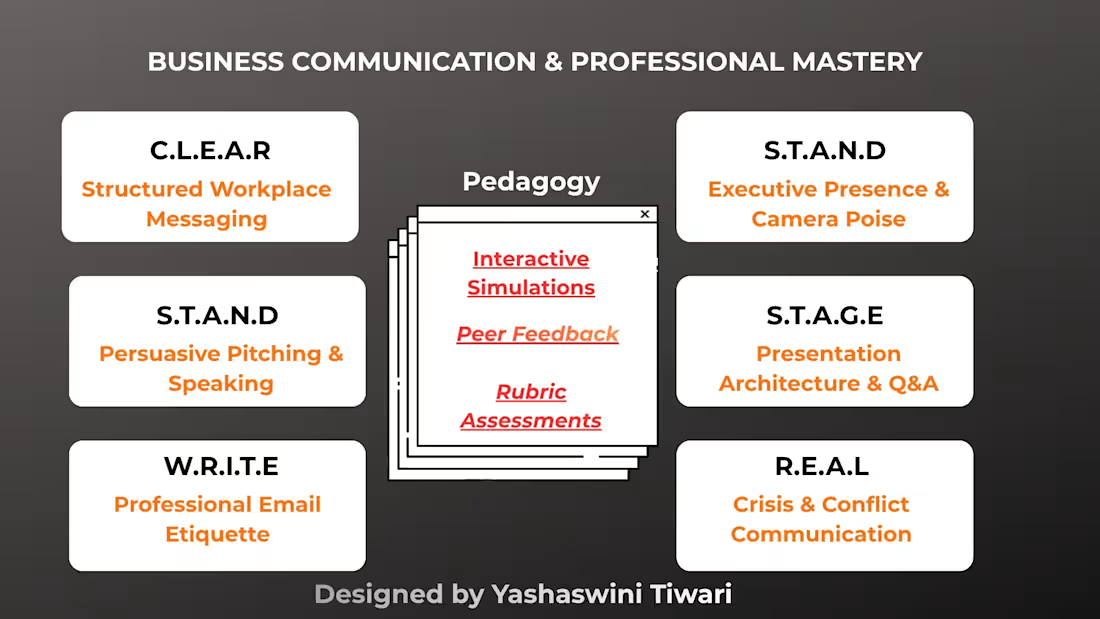
Pedagogical Approach: Immersive interactive workshops, trainer-led sessions, structured peer feedback loops, and real-world role-play simulations.
Core Goal: Transform technical potential into visible workplace readiness through systematic frameworks.
⚙️ Proprietary Framework Architecture
The curriculum is built on high-retention mnemonic frameworks designed for instant execution:
C.L.E.A.R — Structured, high-context workplace communication and messaging.
S.T.A.N.D — Posture, camera presence, and physical poise for virtual/in-person environments.
I.M.P.A.C.T — Persuasive speaking and high-stakes pitch structuring.
S.T.A.G.E — Presentation mastery, logical flow, and executive slide structuring.
W.R.I.T.E — Purpose-driven, professional email etiquette that eliminates friction.
R.E.A.L — Crisis communication, emotional intelligence, and high-pressure problem-solving.
📚 Module-by-Module Breakdown
Module 1: Foundations of Business Communication
Focus: Shifting from ambiguous messaging to structured clarity using the C.L.E.A.R framework.
Key Drill: The 60-Second Manager Briefing & message overhaul exercises.
Module 2: Executive Presence & Confidence
Focus: Commanding rooms and virtual spaces before speaking using S.T.A.N.D.
Key Drill: Camera presence audits and posture alignment.
Module 3: Smart Speaking & Pitching
Focus: Pitching ideas, innovations, and processes with I.M.P.A.C.T.
Key Drill: 90-second innovation rounds and object-pitching challenges.
Module 4: Presentation Architecture
Focus: Designing and delivering presentations that engage using S.T.A.G.E.
Key Drill: The 1-slide CEO pitch and heated Q&A defense simulations.
Module 5: Professional Email Etiquette
Focus: Writing correspondence that gets opened and acted upon instantly using W.R.I.T.E.
Key Drill: Subject-line optimisation and tone audits.
Module 6: Real-World Crisis Communication
Focus: Managing difficult clients, boss pushback, and team conflicts using R.E.A.L.
Key Drill: Dialectical communication drills (Thesis | Antithesis | Synthesis).
📊 Assessment & Certification Standards
Attendance Requirement: Minimum 80% active participation.
Scoring Metric: 60%+ overall score across rubric-based assessments and reflection journals for successful program completion.
0
99