RankVibe Product Leaderboard Development

Nagaraj M


RankVibe — Building a Public Product Leaderboard
Overview
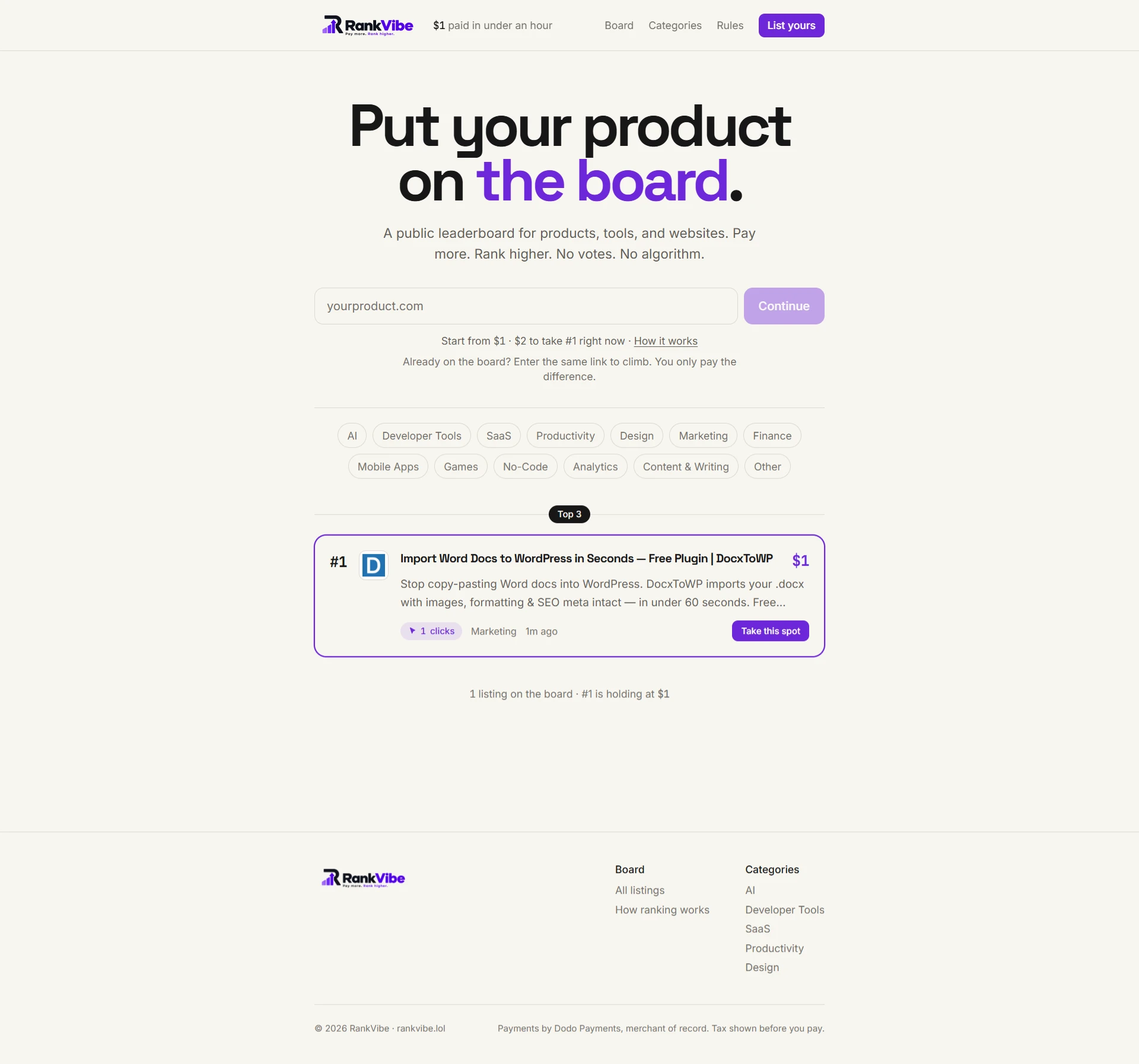
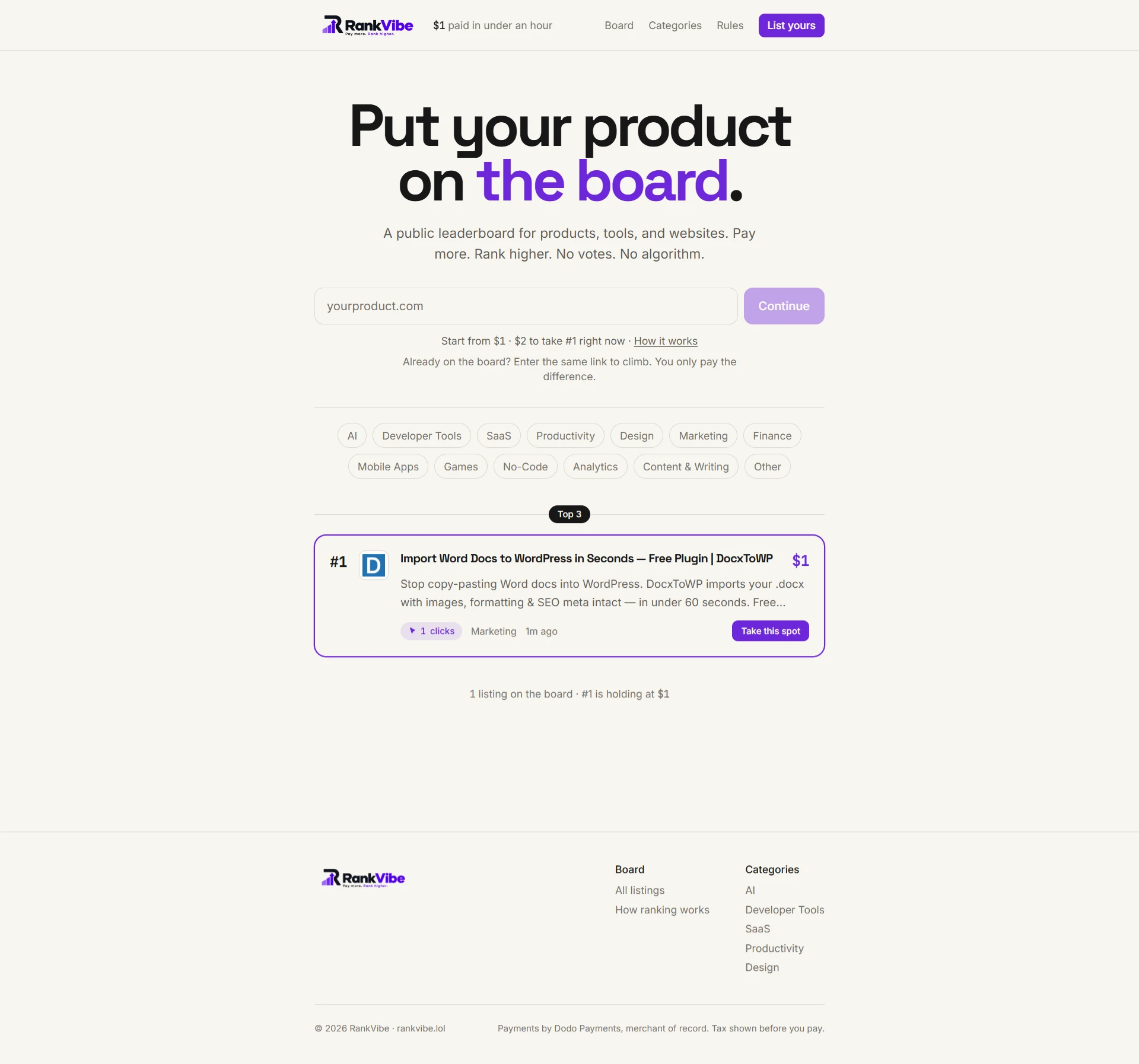
RankVibe is a public leaderboard for products, tools, and websites.
The concept is intentionally simple:
Pay more. Rank higher.
There are no votes, no recommendation algorithms, and no complicated scoring systems.
A product's position is determined by its cumulative total. Users can add more at any time to climb higher, while other products can also pass them.
The goal was to turn this simple idea into a polished, easy-to-understand product that people could use without needing to read a long explanation of how the ranking system works.
Live project: https://www.rankvibe.lol/
The Challenge
The biggest challenge was not simply building a leaderboard.
The ranking logic needed to be simple, fair, and easy for users to understand.
A few important questions had to be solved:
How should rankings be calculated?
What happens when two products have the same total?
How can an existing product climb without creating duplicate listings?
How much does a user need to pay to reach a specific position?
How can the system make the ranking outcome clear before payment?
How can the leaderboard also work as a place to discover interesting products?
The product also needed to avoid feeling like a complicated auction platform or a generic SaaS dashboard.
The Core Idea
RankVibe uses a cumulative ranking system.
Every completed payment adds to a product's lifetime total.
For example:
A product starts with:
$1
Later, the owner adds:
$10
The new lifetime total becomes:
$15
That total determines the product's position on the board.
If another product has a higher total, it ranks above it.
There are no permanent positions. Anyone can climb past another product at any time.
Ranking Logic
The ranking system follows a few simple rules:
Listings start from $1.
Payments are made in whole US dollars.
Rankings are based on the cumulative amount added to each listing.
Existing listings can use the same URL again to add more and climb.
Equal totals preserve the order in which they were reached.
Rankings only update after a completed payment is confirmed.
A rank is a live position, not a slot owned for a fixed period.
One important part of the experience was making this logic visible to users.
Instead of asking users to manually calculate how much they need to pay, the product helps them understand their possible position on the board.
For example:
Add $10
New total: $35
Estimated rank: #11
This makes the outcome clear before the user proceeds.
Product Discovery
I didn't want RankVibe to feel like a simple list of URLs and payment amounts.
The leaderboard also needed to be useful for visitors who were not planning to submit a product.
Each listing is designed to present the product clearly, including information such as:
Product name
Description
Website domain
Rank
Click count
Total amount
This turns the board into a lightweight product discovery experience rather than just a ranking table.
URL and Listing System
The submission flow handles both new and existing products.
When a user enters a website URL, the system identifies whether the URL is already listed.
If it is a new listing, the product can join the board.
If it already exists, the user can add to its existing total and climb higher.
URLs are also normalized to prevent unnecessary duplicates.
This includes handling things such as:
Query parameters
Tracking links
URL formatting
Consistent URL matching
Different paths can still exist as separate listings when appropriate.
For example:
example.comexample.com/productexample.com/pricingcan represent separate entries.
UX and UI Approach
The design direction focused on clarity.
The main question behind every screen was:
Can a first-time visitor understand how RankVibe works in a few seconds?
The homepage communicates the core concept immediately:
Put your product on the board.
The supporting message explains the ranking system without unnecessary technical language.
The interface uses:
Strong typography
A warm off-white background
Dark text for contrast
Purple as the main brand accent
Minimal UI elements
Clear ranking numbers
Generous spacing
The goal was to create something that feels modern and independent without looking like a typical SaaS dashboard.
Key Features
Public Leaderboard
A live ranking of products, tools, and websites based on their cumulative totals.
Product Submission
Users can submit a website and put their product on the board.
Climb Existing Listings
Existing products can add more to their total instead of creating duplicate entries.
Live Rank Estimation
Users can see the potential result of adding more before completing a payment.
Click Tracking
Outbound clicks are recorded and displayed publicly.
Product Metadata
Listings are presented with useful product information instead of just raw URLs.
Categories and Discovery
Visitors can browse and discover products without changing the global ranking logic.
Payment Integration
Completed payments trigger ranking updates.
Responsive Interface
The experience was designed to work across desktop and mobile devices.
The Result
RankVibe launched as a simple public experiment around one idea:
What if product visibility was not decided by votes or an algorithm?
Instead, the rules are visible and easy to understand.
There is no hidden scoring.
No popularity algorithm.
No voting system.
Just a live board where products can enter, climb, and compete for position.
What I Built
I handled the product from concept to launch, including:
Product concept
UX planning
UI design
Branding direction
Ranking system
URL submission flow
Product listing system
Payment flow
Click tracking
Responsive frontend
Backend and database logic
Metadata handling
Deployment
Project
RankVibe
A public leaderboard for products, tools, and websites.
Pay more. Rank higher.
No votes. No algorithm. Just the board.
Visit RankVibe: https://www.rankvibe.lol/
Like this project
Posted Aug 22, 2026
A product's position is determined by its cumulative total. Users can add more at any time to climb higher, while other products can also pass them.
Likes
0
Views
0
Timeline
Aug 22, 2026 - Aug 22, 2026