Automated Slack Reporting Pipeline with Apify & n8n

Muhammad Awais


Overview
Built an automated reporting pipeline that collects data from multiple web sources, processes and normalizes the results, applies business rules, and delivers a structured daily digest directly to Slack.
The system replaced a repetitive manual reporting process with a scheduled, reliable workflow that the client could run every day without manual data collection or formatting.
The Challenge
The client was manually collecting data from multiple web sources and preparing daily reports for their team. This process was time-consuming, repetitive, and prone to copy-paste and formatting errors.
As the number of data sources increased, the existing process became difficult to scale.
The Solution
I designed and implemented an automated pipeline using Apify, n8n, Make, Google Sheets, JavaScript, and Slack.
The workflow runs automatically every morning:
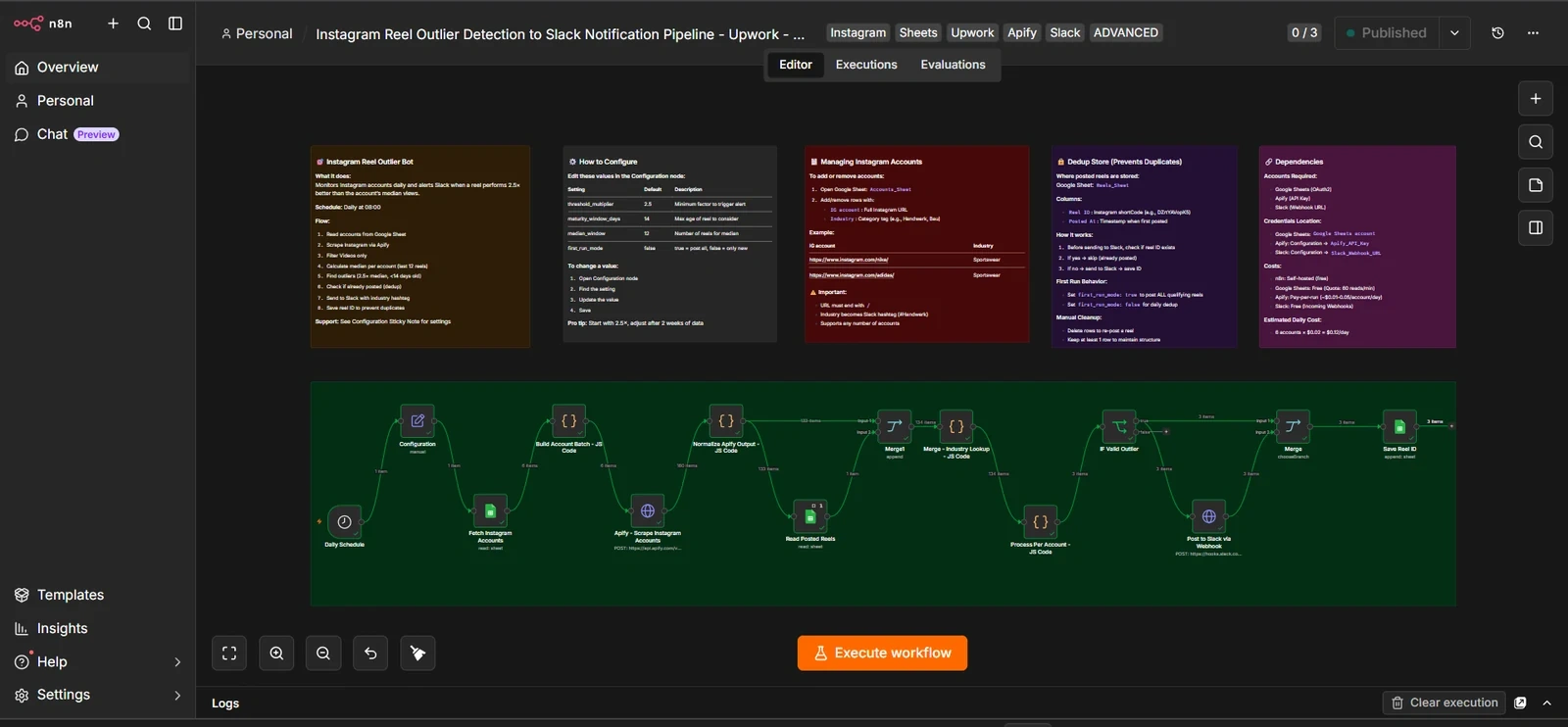
Scheduled Trigger → Apify → Data Processing → Business Rules → Slack Report
Workflow
A scheduled trigger starts the workflow at 9 AM.
Apify actors collect the required data from configured web sources.
The incoming data is normalized and mapped into a consistent structure.
Business rules filter, sort, and group the relevant metrics.
Conditional logic identifies on-track and off-track metrics.
A formatted digest is generated and posted directly to the client's Slack channel.
Automation Logic
The workflow includes threshold-based filtering, data transformation, grouping, sorting, and conditional formatting.
Only relevant metrics are included in the final report, making the Slack notification easy for the team to scan and act on.
Results
Saved 10+ hours of manual work per week
Eliminated repetitive copy-paste reporting
Delivered reports automatically every day at 9 AM
Improved consistency and reporting accuracy
Created a scalable structure for adding new data sources
Technical Stack
n8n · Make · Apify · Google Sheets · Slack · JavaScript
The system processes approximately 100–500 records per run and operates as a production reporting workflow.
Like this project
Posted Sep 28, 2026
Automated Apify + n8n reporting pipeline that scrapes, processes, and delivers structured daily data to Slack—saving 10+ hours per week.