Antes de maio (Before May)

Iria Iglesias


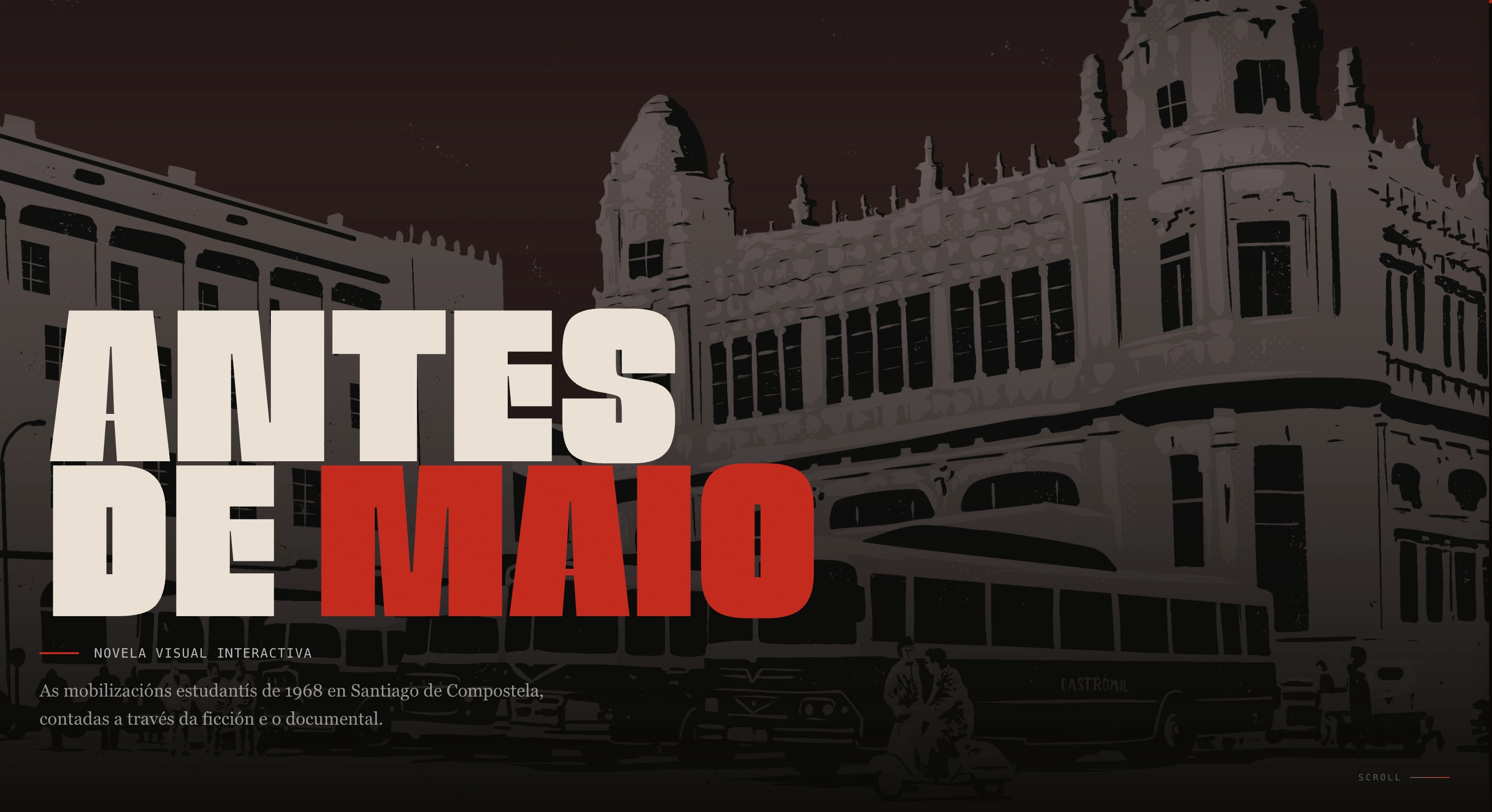
Antes de Maio — A documentary visual novel for live audiences
Role: Interaction design, UI, character illustration, narrative engine, frontend, live voting and sync system, production tech
Team: Irene Basanta (research, script · Aqueladas) · Iria Iglesias (digital design and engineering · Aqueladas) · Alex Rozados (background illustration) · MAOS Innovación Social (research)
Status: Premiered March 2026 at Teatro Principal de Santiago de Compostela · around 434 connected devices at peak · currently touring secondary schools across Galicia
Stack: Twine (narrative graph), custom parser from Twine to a React runtime, Node.js + Socket.IO for live voting and inventory sync
Context
Antes de Maio is a documentary visual novel about the 1968 student revolts at the University of Santiago de Compostela. You play María, a first-year student who arrives in 1967, and over the course of the piece you decide how politically involved she becomes — which professors she listens to, which assemblies she attends, who she trusts, and what she does the day everything breaks. The script is built on Irene's research: interviews with students from that period, archived bulletins, declarations and clandestine pamphlets that the audience can actually open and read inside María's inventory.
The format is unusual: a visual novel (backgrounds, character portraits, dialogue, choice nodes) designed to be played by a whole theatre at once. The novel is projected on the main screen; each audience member opens the same URL on their phone and votes on María's decisions. The inventory of scanned 1968 documents is on their phones too. The show advances as the room decides.
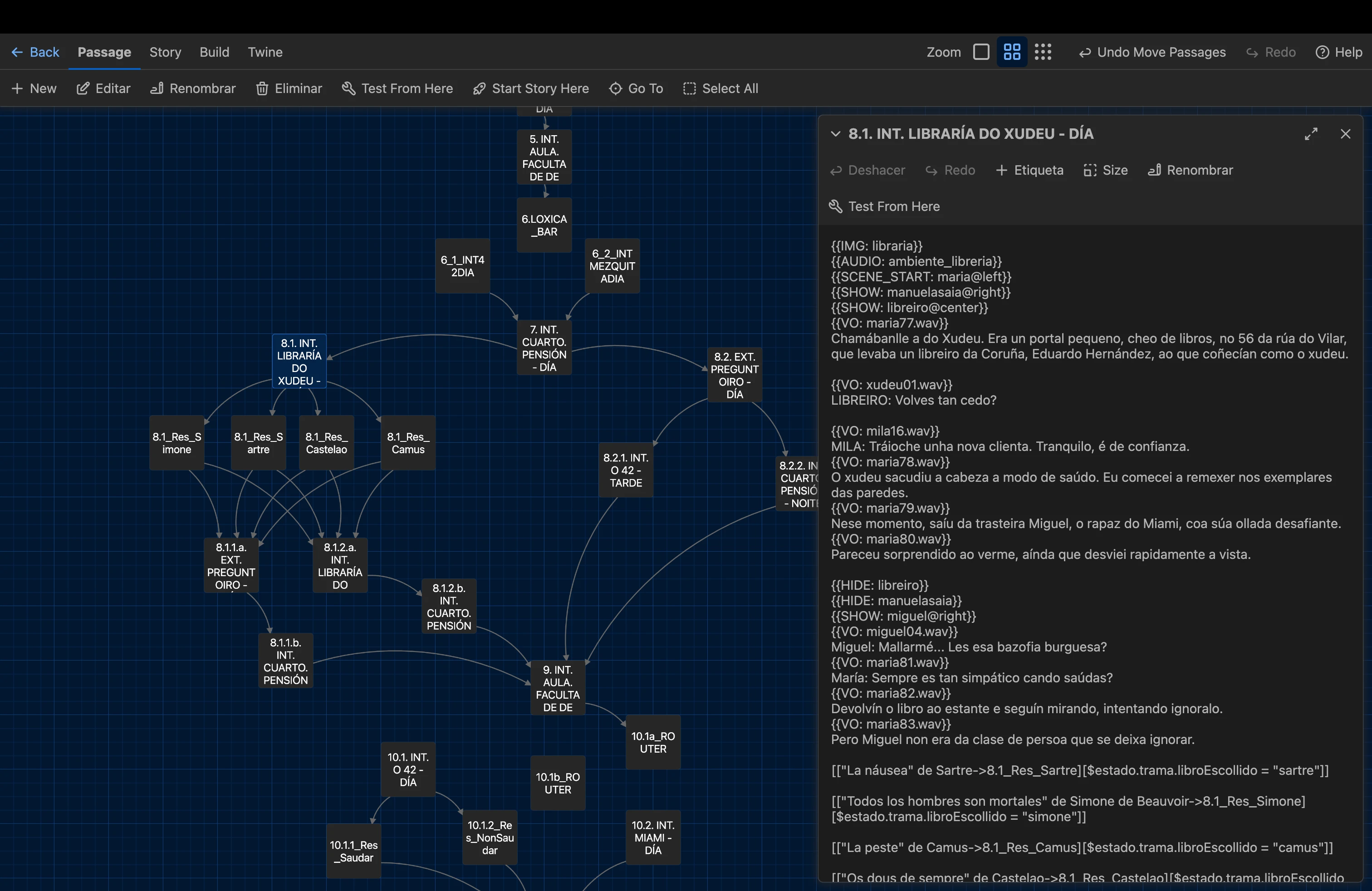
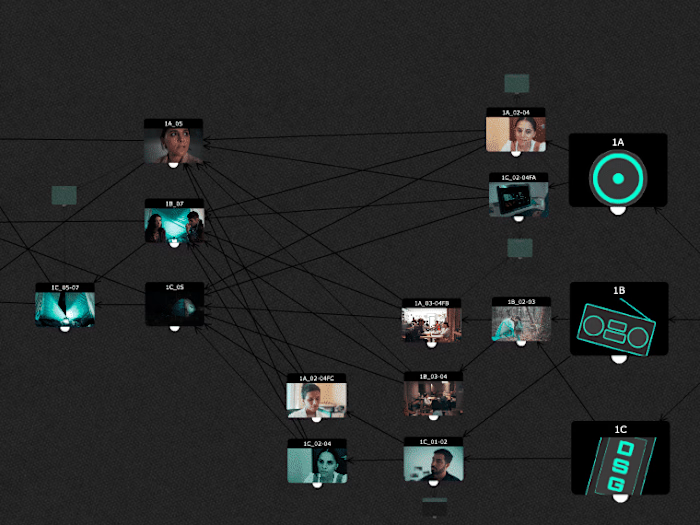
Twine doc with the interactive paths of the visual novel.
My role
Aqueladas is the audiovisual cooperative Irene and I co-founded. On Antes de Maio the division was clean: Irene led the research and wrote the script; I led everything that turned that script into a runnable, live, multi-device experience. That meant character illustration, the audience-facing interface, the narrative engine, the live voting and inventory sync system, and the production tech the night of the show. Alex illustrated the backgrounds.
The core design challenge
Visual novels are a single-player form. The whole genre assumes one reader making private decisions at their own pace. Antes de Maio had to keep what makes visual novels good: slow identification with a character, meaningful choices and layered documentation, while making it work for 200+ people deciding together, in real time, in the same room.
Most of the design decisions came from that tension.
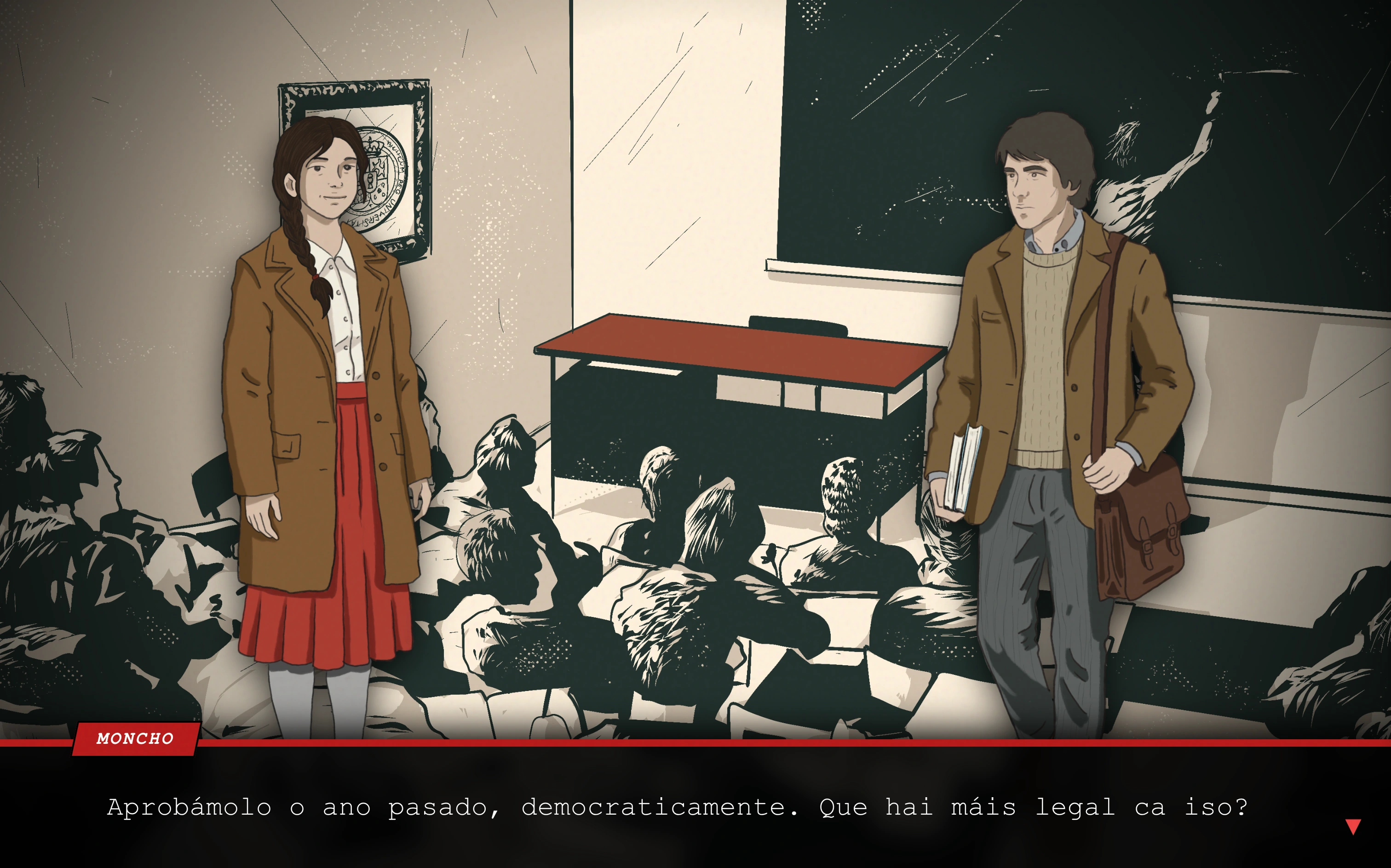
Dialogue part with two characters and background
A few decisions I'd point to
Two screens, two registers. The main screen, projected, runs the visual novel as a shared cinematic experience: dialogue, illustrated portraits, scenes. Each phone runs a quieter, more private surface: the voting interface and María's inventory of historical documents. The collective gets the story; the individual gets the archive. Both layers run on the same Socket.IO state, so opening a pamphlet on your phone never desyncs you from the room.
Translating a writer's flow document into a playable engine. Irene wrote the narrative as a flow document, sequencing, branching, adding the variables that needed to persist between scenes. I translated that into Twine to get a working narrative graph, then built a parser that turned the Twine output into the live React runtime: audience voting, vote-window timing, tie-breaking, reconnections mid-show. The 171 passages of the final piece moved through that pipeline. The slowest moments are deliberately untimed, while the audience reads bulletins together. The fastest are pressured, María has to react, and the vote closes in seconds.
Real documents, not props. The inventory items are scanned originals from various historical archives (actual bulletins, mimeographed declarations, university paperwork from 1968). We deliberately kept them legible-but-not-cleaned (folds, scan noise, period typewriter print). The point was for the audience to feel they were handling source material, not assets.
Character illustration with a documentary edge. I illustrated María and the cast on the line between visual-novel readability and historical document: limited palette, hand-drawn linework, faces specific enough to identify but still in the comic style. The backgrounds (Alex Rozado's work) are more atmospheric and painterly, so the cast reads forward against them.
Production tech (briefly)
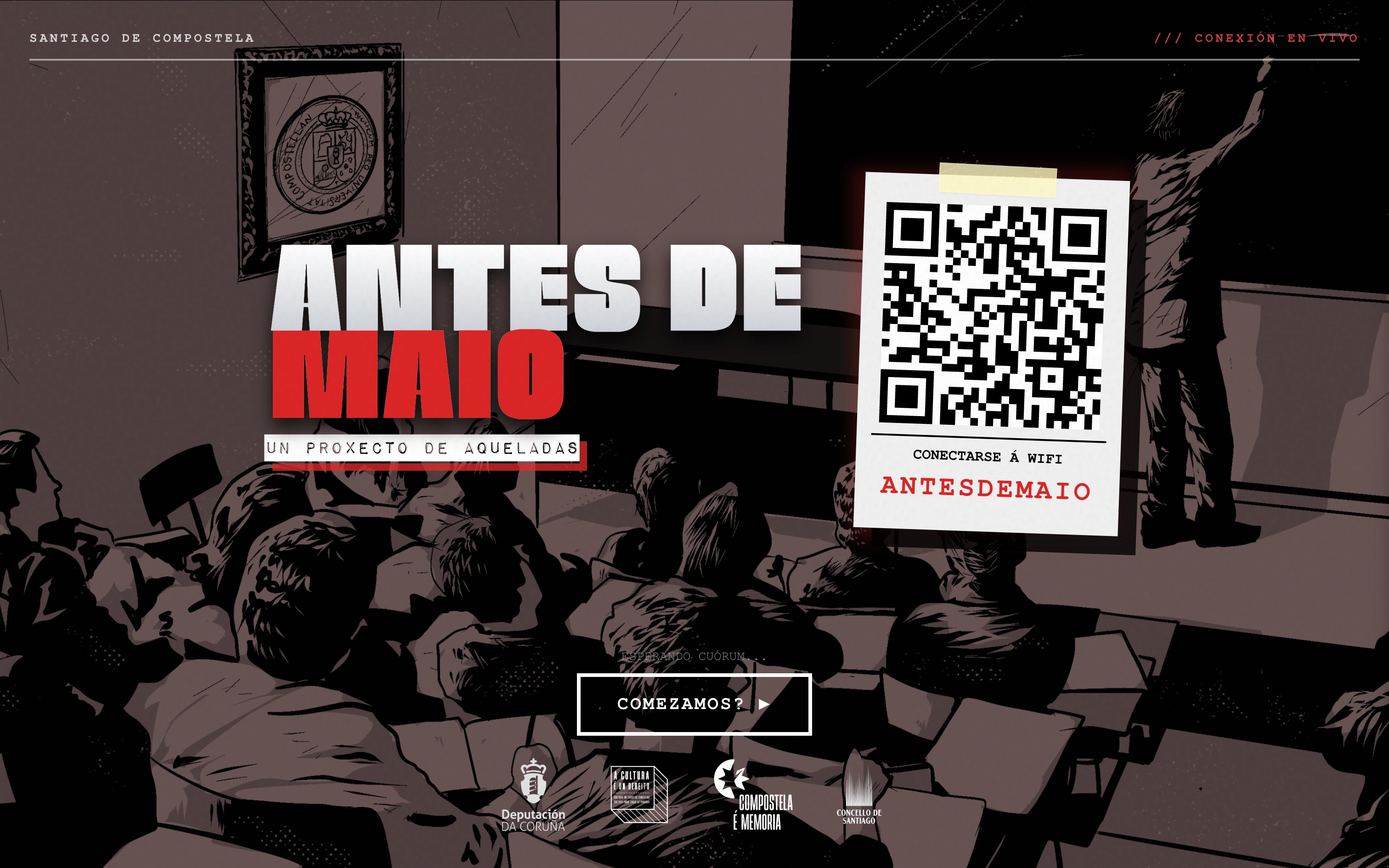
Running +200 simultaneous connections in a live theatre is its own problem. The premiere needed real engineering decisions: serving the production React build off a local machine on port 3001 rather than over public internet; isolating the venue's WiFi to stop Mac auto-join interference; hardening the IP routing so phones connected on first try; stress-testing at 400 concurrent clients before opening night; and writing day-of-event checklists for both macOS and Windows in case the operator on the night wasn't me. None of that is glamorous. All of it is what made the show actually happen and (fortunately) not fail.
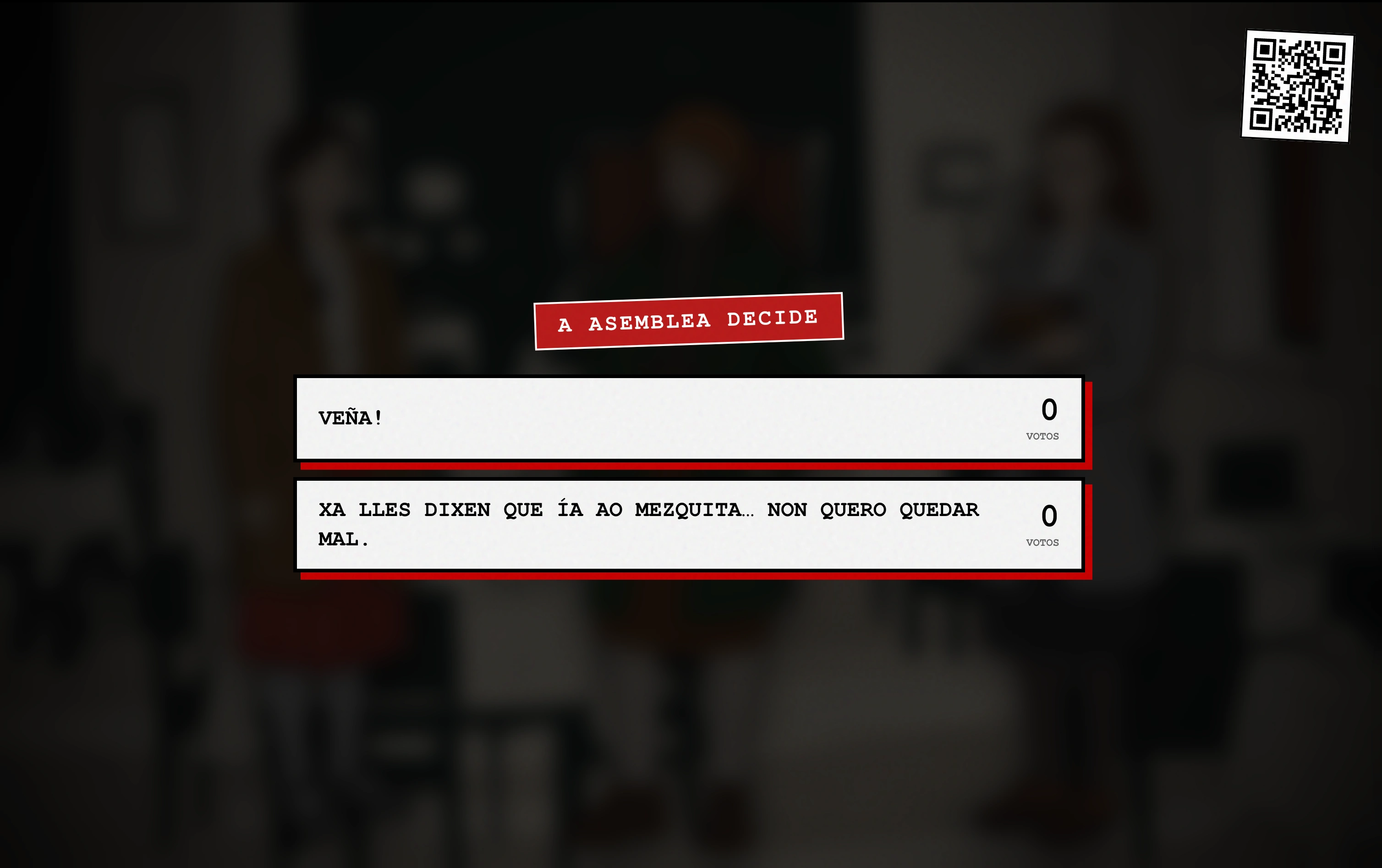
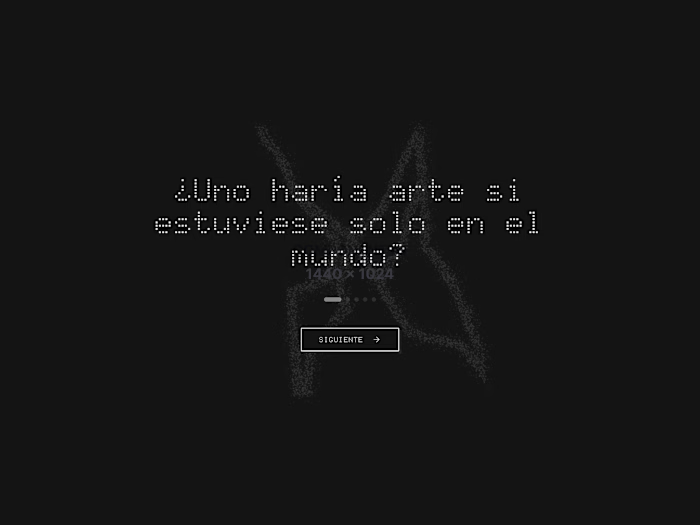
Decision point. The votes are updated in real time as the audience votes in the projections.
Where it lives now
Since the premiere we've been touring it through secondary schools across Galicia. The topic is dense and the period is half a century old, but it works there for a reason the design predicted: teenagers play with phones in their hands as a default state, so voting on María's decisions and pulling up a scanned 1968 pamphlet feels native to them, not like a school assignment. The form is doing work the content alone couldn't, making a piece of Galician political and historical memory live in the hands of the generation that comes next.
What this project did for me
Antes de Maio isn't a website, an app, or a game. It's an audiovisual piece with a software layer built specifically for it. Working on the seam between dramaturgy, historical research, illustration and live systems engineering is where I'm most useful, and it's the kind of brief I want more of.
Like this project
Posted May 19, 2026
An interactive visual novel for theaters, where the public votes in real time which path to follow and can access the inventory of the protagonist.
Likes
0
Views
17
Timeline
Sep 1, 2025 - Mar 17, 2026