
Mubeen Khan
B2B | SaaS - Website, Software Development and Marketing




Mesa, Arizona. A cleaner, I guess I’ll call her Rosa once drove 40 minutes to a house where nobody was home. The client had moved. Never told her. That was $0 for the day and $31 in gas.
She laughed about it. I didn’t. I asked her to scroll back through the last 30 days and mark every job she lost, skipped, or had to fix by hand.
She guessed 3. She found 11.
That’s the sneaky part. A lost job doesn’t send you a bill. It just isn’t there, like a sock in the dryer.
Seven of her 11 were texts that sat all night while the customer called the next company on Google. The other four were no-shows and one forgotten Friday. That last one was an every-other-week client she never typed into the calendar. The woman stood in her kitchen with her coffee, waiting.
Her friends said hire an office person, about $1,400 a month. Fair. But when she added up what the 11 cost her, the number was close to that, and the biggest chunk didn’t come from where anyone guessed.
I won’t say which piece it was yet. I’ll tell you in the comments.
So now I want the ugly stories. What’s the worst scheduling mess you’ve had? The “I drove all that way for nothing” kind. Drop it below and take a guess at Rosa’s biggest leak while you’re there. I’ll tell you who’s closest.
1
109
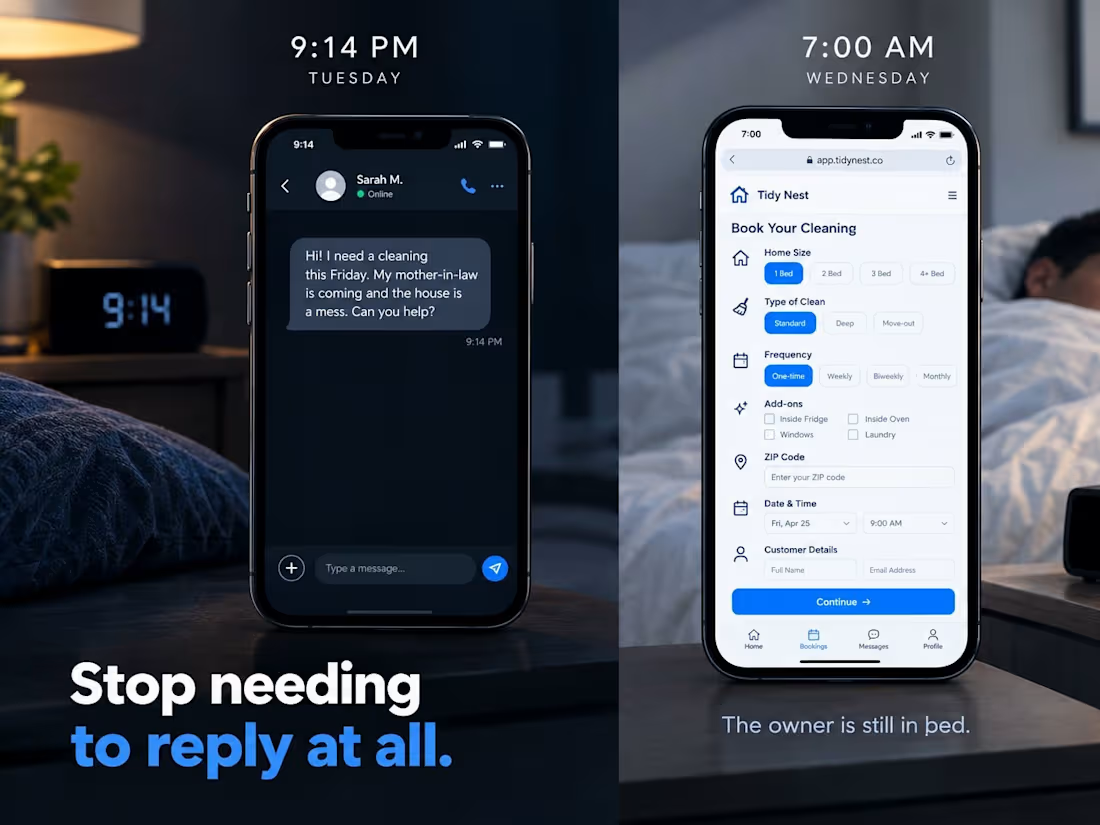
"A booking page for cleaning crews who lose jobs at 9pm"
A woman texted a cleaning company at 9:14 on a Tuesday night. Her mother-in-law was coming Friday and the house looked like a raccoon had thrown a party. Nobody wrote back. At 7am the owner replied, Hi! Sure, what day works? Too late. Shed already paid somebody else at 9:40
I did the math on it instead. About $180 a clean, every other week, for a year. Around $4,700 gone because a person was asleep. Which, fine, people sleep.
So here's the old way.
She texts. She waits. The owner tries to remember which days the crew is even on that side of town, sends back a few options, and the customer says ok let me check and is never heard from again.
Heres the new way.
She picks her home size, the kind of clean, how often, and extras like the inside of the oven. She types her ZIP code. She sees only the days you really drive to her area and only the hours that are really open. She pays a deposit. Booked. The owner is still in bed.
Everybody says reply faster. I think thats backwards. Stop needing to reply at all.
Other stuff it does weekly, biweekly or monthly repeat cleans, deposits through Stripe so fewer people ghost you, and if someone cancels, the next person on the waitlist gets offered that slot.
You can assign crews, keep customer notes, export to CSV, and the reminder emails go out by themselves.
I'm setting this up for cleaning businesses this month. If you run one, or know someone who does, Ill send you a demo. Or take a guess at the tiny feature in the comments. Ill tell you if you're close.
0
92

It was Tuesday, I remember... a guy named Dev sent me his demo page. He sells scheduling software to dental offices, mostly in his postal ranges. The whole page was three lines. I counted twice because I didn't believe it.
Line one said "Request a Demo." Line two said "Fill out the form and our team will be in touch." The button said "Submit."
"Be in touch" could mean a quick call. It could also mean nine emails from a guy named Kyle.
The visitor has to guess, and people don't fill out forms when they have to guess.
So we fixed it live, one small change at a time.
Change 1. say what happens
The headline became "See Chairtime work in your office." The subtext became "Book a 20-minute walkthrough with our team." Now you know what you get and how long it takes. But it still talks about the software. Nobody wakes up wanting to look at software.
Change 2. talk about the person
The new headline: "See how your front desk could stop losing 6 no-shows a week. Takes 20 minutes." The subtext: "We'll use your real schedule. No slideshow."
That last bit is on purpose. Everyone who books a demo is scared they'll get a scripted pitch from someone reading off a screen. Say the fear out loud and it shrinks.
Change 3. the button
"Submit" became "Book my walkthrough." Submit sounds like taxes. Book my walkthrough sounds like you're getting something.
Here's what I noticed after all that.
The old page was about what Dev wanted, which was a lead.
The new page is about what the visitor gets, which is 20 minutes that are actually about their office. Same form, same product.
There was a fourth change, and I've been thinking about it for a week.
Dev deleted one field from the form. Bookings went up. It was the field every sales book tells you to keep, and I still can't fully explain why it worked.
Which field do you think it was? I'll tell you if someone guesses right.
8
1
913

BIOIDENTICAL HORMONE THERAPY — LANDING PAGE COPY
HEADLINE
Something feels off. You know it. You just can't put it into words.
(Sub-line, smaller text below)
Your doctor called it stress. Or age. Or "normal." You didn't buy it then and you don't buy it now.
THE OPEN
Here's the thing nobody tells you at 42, or 51, or wherever your calendar happens to land on this.
Your hormones don't just quit one day. They fade the way a radio station fades when you drive too far from the tower. Static first. Then gaps. Then one morning you're wide awake at 3 a.m. staring at the ceiling fan, wondering when your own body became a stranger.
We're not going to spend six paragraphs describing your symptoms back to you like a horoscope. You already know them better than we do.
What we're going to tell you is the one thing most clinics won't: there is a name for what's happening, a reason it's happening, and a window (a real one, not a marketing one) where fixing it is easier than everyone lets on.
We'll get to that window in a minute. Hold that thought.
THE SPLIT: TWO ROADS, NOT ONE QUIZ
Most sites hand you one generic checklist. Hot flashes, mood swings, low libido, the usual suspects, copy-pasted from a pamphlet in 2009.
We didn't do that. Because a woman whose periods are still showing up (just weird now, unpredictable, sometimes twice in three weeks) is not living the same year as a woman who hasn't had a period in fourteen months.
Path One- Perimenopause
This is the messy middle. Nothing has fully stopped, but nothing feels reliable either.
Periods that have basically stopped making sense
Sleep that used to be automatic and now has to be negotiated
A short fuse you didn't used to have, the kind that surprises even you
Brain fog that makes you stand in a doorway forgetting why you walked in
Path Two- Postmenopause
The bleeding has stopped. The rest of it hasn't.
A sex drive that went quiet and just never came back
Joints that ache in ways that feel oddly specific, like your body is filing individual complaints
Skin and hair that changed texture almost overnight
A version of tired that sleep doesn't seem to touch
Pick the one that sounds like your Tuesday. Not your worst day, your Tuesday. That's the more honest measure.
THE QUESTION EVERYONE'S AFRAID TO ASK OUT LOUD
"I've heard hormones can cause cancer. Is this safe?"
Good. Ask it. We'd be more worried if you didn't.
Here's what actually happened. In 2002, a large study (the Women's Health Initiative) got published, and the headlines that followed it scared a full generation of women off hormone therapy overnight. Prescriptions dropped by more than half within a few years.
What most of those headlines left out, the study used older, synthetic hormone formulas, mostly on women well past 60, many of them a decade or more past menopause when they started. That is a very different situation from a 46 year old with declining estrogen starting bioidentical hormones, matched to what her body already makes, closer to when the drop-off actually begins.
Later reviews of the same data (including a 2017 follow-up from some of the original researchers) walked a lot of that panic back. Timing mattered. Formula mattered. Age at start mattered.
None of that makes hormone therapy risk-free. Nothing worth doing is. It means the blanket fear a lot of us grew up hearing wasn't the full picture, and you deserve the full picture before you decide anything.
That's a conversation for you and the prescribing provider on your intake, not a paragraph on a landing page. We just didn't want to dodge the question to get you to scroll further.
WHAT THIS ACTUALLY LOOKS LIKE
No waiting room. No six week referral chain. No doctor glancing at the clock while you try to describe a feeling that doesn't fit into a ten minute slot.
You fill out an intake. A licensed provider, an actual person with a medical license, reviews it and your labs. If bioidentical hormone therapy fits your case, they prescribe it. It ships to you.
If it doesn't fit, they tell you that too. That's not a sales pitch failing. That's the system working the way it's supposed to.
THE PART WE REPEAT ON PURPOSE
Every button on this page says close to the same thing, and that's not an accident.
No card required to start your intake.
No commitment once you see your options.
A real person reviews your case, not an algorithm.
On something this personal, the thing standing between you and clicking a button usually isn't the price tag. It's the quiet fear of getting steamrolled into a decision you didn't fully agree to. So we say the same three reassurances again and again, in slightly different words, because trust isn't built with one clever line. It's built with the same door staying open every time you check it.
CLOSE
You didn't imagine any of this. The fatigue, the fog, the sense that your own thermostat broke and nobody else can feel it.
Start with the intake. Fifteen minutes. See what a provider actually says about your case before you decide anything else.
[Start My Free Intake — No Card Required]
0
100