
AI Automation Engineer | Full-Stack Apps & Integrations


AI Automation Engineer | Full-Stack Apps & Integrations




Power BI Data Analyst + ML AI Automation Expert
- 5.0
- Rating
- 113
- Followers
Power BI Data Analyst + ML AI Automation Expert
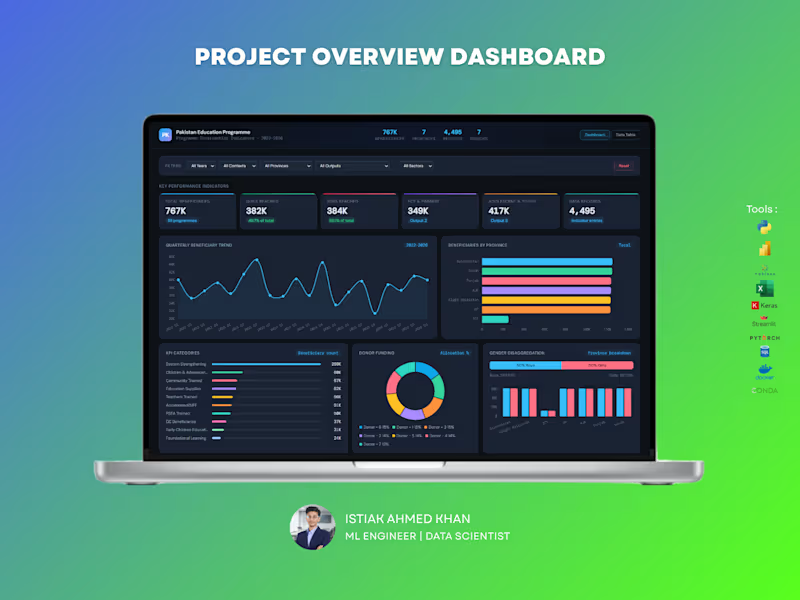
Education Program Analytics Dashboard – Data Analytics Solution
Handling large-scale program data without clear visibility can make impact measurement difficult. This dashboard is designed to give organizations a complete, real-time view of program performance, reach, and funding — all in one place.
What You Get :
A powerful, interactive dashboard that helps track beneficiaries, program outputs, regional performance, and donor contributions with clarity and precision.
Key Capabilities:
Monitor total beneficiaries and gender distribution
Track program reach across provinces and sectors
Analyze quarterly trends and growth patterns
Evaluate donor funding allocation and impact
Identify top-performing program categories and outputs
Explore education level distribution and engagement
For NGOs and large programs, data is critical for decision-making and reporting. This dashboard helps you measure impact, improve transparency, and optimize resource allocation — making your data meaningful and actionable.
Perfect For :
NGOs and non-profit organizations
Government programs
International development agencies
Research and policy teams
If you want a professional, insight-driven dashboard that clearly communicates impact and performance, I can create a customized solution tailored to your organization.
1
451
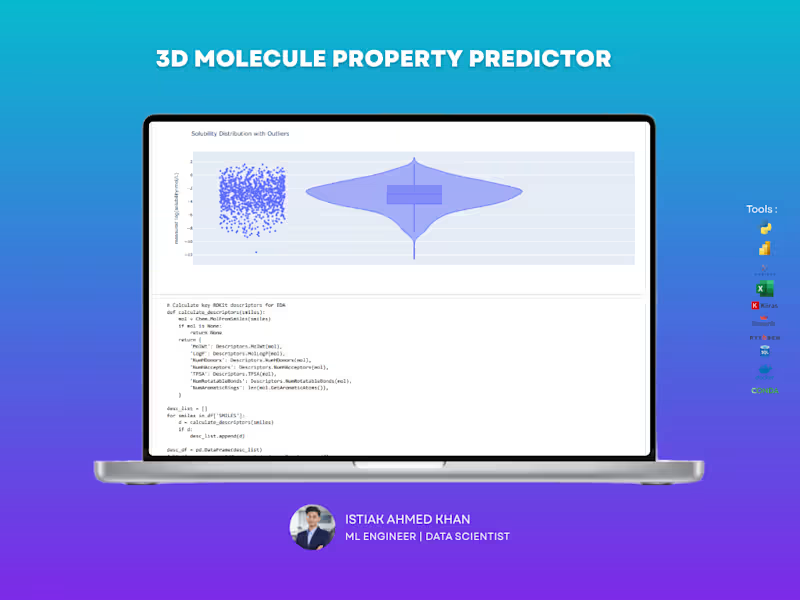
3D Molecular Intelligence: Accelerating Drug Discovery through Predictive Analytics
The Impact: This project addresses a critical bottleneck in pharmaceutical research: determining molecular solubility (logS). By replacing slow, expensive lab tests with high-precision machine learning, this system enables scientists to screen thousands of compounds in seconds, significantly reducing the cost and time required to bring new life-saving drugs to market.
Drastic Cost Reduction: The predictive pipeline reduces early-stage experimental screening costs by 70–90%, allowing research teams to focus resources on the most promising drug candidates.
High-Precision Forecasting: Utilizing a hybrid 3D feature engineering approach, the system achieves a remarkable 91.3% accuracy (R² score) in predicting solubility, providing a highly reliable alternative to physical testing.
Accelerated R&D Cycles: By automating the identification of viable molecules, the tool dramatically shortens the "hit-to-lead" time in pharma and materials science, getting products to market faster.
Empowering Researchers: I deployed a professional Streamlit dashboard featuring an interactive 3D molecular viewer. This allows non-technical chemists to visualize complex structures and make data-driven decisions without needing to write a single line of code
3
365
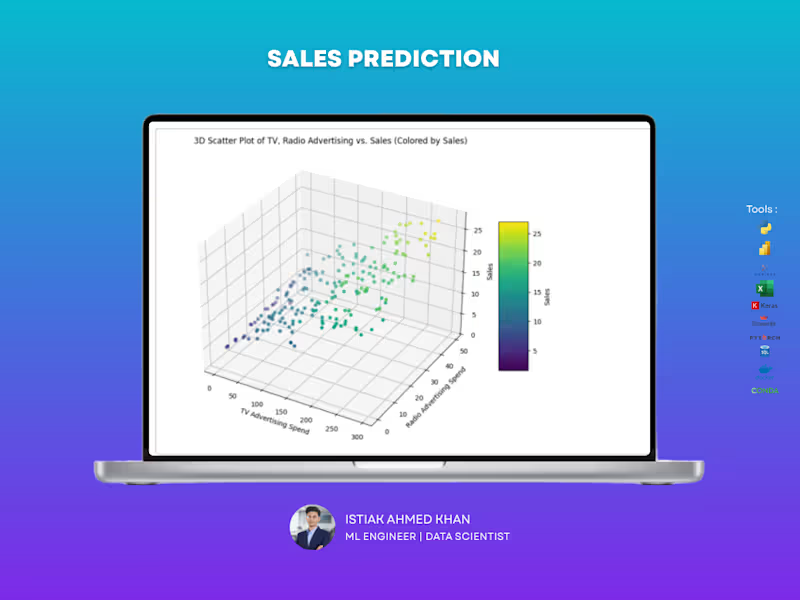
Predictive Marketing Analytics: Optimizing Advertising ROI
1. The Business Problem
Companies often struggle to determine which marketing channels actually drive revenue. Without a data-driven approach, advertising budgets are often misallocated across platforms like TV, Radio, and Newspapers, leading to inefficient spending and missed sales targets. This project aimed to build a predictive model to quantify the relationship between multi-channel marketing spend and total sales.
2. Strategic Insights & Market Analysis
Through a rigorous analysis of historical advertising data, I identified the specific drivers of revenue growth:
Dominant Revenue Driver: TV advertising emerged as the most critical factor, showing a massive 0.9 correlation with sales.
Efficiency Analysis: While Radio and Newspaper spending contributed to the marketing mix, their direct impact on sales was significantly lower (0.35 and 0.16 correlation, respectively), suggesting a need for budget reallocation.
Predictive Power: My analysis revealed that 81.6% of the variance in sales can be explained by TV advertising spend alone, providing a highly reliable foundation for future budget forecasting.
3. Data-Driven Solution
I developed a Linear Regression model to provide leadership with a mathematical framework for sales forecasting.
Reliability: The model was validated using a 70/30 train-test split, ensuring it performs accurately on new, unseen market data.
Accuracy: The system achieved a strong R-squared value of 0.79 on the test set, meaning it can accurately predict nearly 80% of sales fluctuations based on planned marketing spend.
Error Management: I performed a detailed residual analysis to confirm that the model’s error terms were normally distributed, ensuring the reliability of the forecasted figures.
4. Business Impact
Budget Optimization: Provided a clear mathematical equation (Sales=6.948+0.054×TV) that allows the marketing team to calculate the expected return on every dollar spent on TV advertising.
Strategic Planning: Enabled the transition from "gut-feeling" marketing to precision budgeting, allowing the company to maximize ROI by prioritizing high-impact channels.
Risk Mitigation: By identifying the variance that the model couldn't explain, I helped the business identify where external market factors might still influence sales, allowing for more conservative and realistic financial planning.
Technical Stack
Modeling: Simple Linear Regression, Statsmodels (OLS), Scikit-learn.
Analytics: Python, Pandas, NumPy.
Visualization: Seaborn, Matplotlib, 3D Scatter Plots
4
5
764
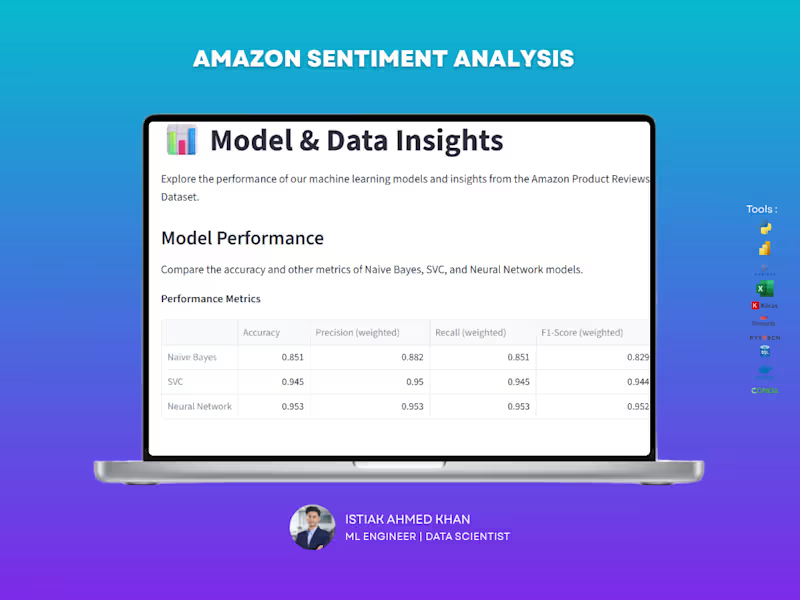
Sentiment-Driven E-commerce Optimization: Amazon Review Analysis & Rating Prediction.
Project Overview ✅
This project serves as a machine learning proof of concept designed to transform raw Amazon product reviews into actionable business insights. By automating the prediction of review ratings and analyzing customer sentiment, the system enables brands to optimize product listings, proactively address customer pain points, and drive higher conversion rates.
Process ✅
I developed an end-to-end pipeline covering data acquisition, complex text processing, and model deployment. Automated Data Scraping, Integrated the Apify API to extract real-time customer feedback directly from Amazon product URLs. I configured the scraper to handle up to 100 reviews per run, capturing critical metadata including rating scores, review descriptions, and verified purchase status.
Data Refinement & Feature Engineering:
Cleaned a dataset of approximately 1,944 reviews by removing noise (punctuation/symbols) and stop words using NLTK. I implemented TF-IDF Vectorization to convert text into numerical features and applied SMOTE (Synthetic Minority Over-sampling Technique) to address class imbalance, ensuring the model could accurately predict rare negative reviews.
Model Benchmarking ✅
Developed and compared three distinct architectures to identify the most robust predictor:
Naive Bayes: High-speed probabilistic classification.
Support Vector Classifier (SVC): Optimized for high-dimensional text data.
Neural Network (MLPClassifier): To capture complex semantic patterns.
Web App Deployment: Built a dedicated Streamlit dashboard that allows non-technical stakeholders to input raw review text and receive instant rating predictions with confidence scores.
Technical Stack✅
Languages & Tools: Python, Apify Client.
ML & NLP Libraries: Scikit-learn (SVC, Naive Bayes, MLP), NLTK (Tokenization, Stopwords), Imbalanced-learn (SMOTE).
Deployment: Streamlit, Joblib (Model Serialization).
Visualization: Plotly, WordCloud, Matplotlib.
Key Results ✅
Achieved a peak accuracy of 95.27% using the Neural Network model, with the SVC model following closely at 94.46%.
Developed sentiment-based feedback loops within the app: high ratings (4-5 stars) trigger positive marketing recommendations, while low ratings (1-2 stars) alert teams to address product issues like battery life or build quality.
Enabled real-time competitive analysis by providing a user-friendly interface for cross-functional marketing and product development teams to audit customer sentiment at scale.
2
5
795

I build AI agents & internal tools that act on data

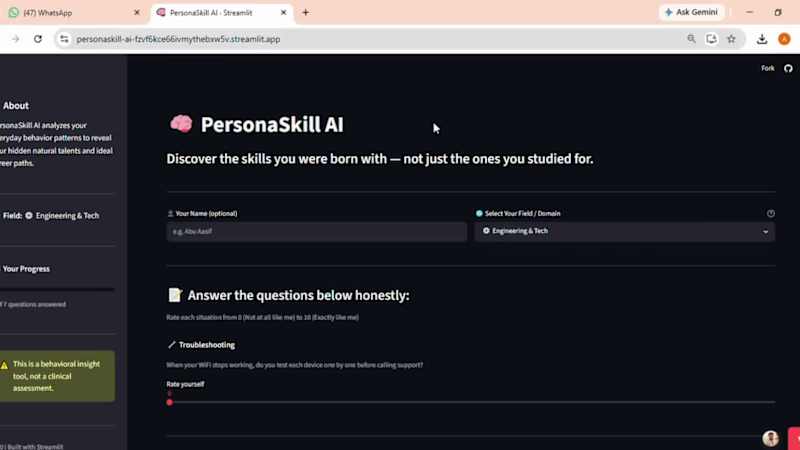

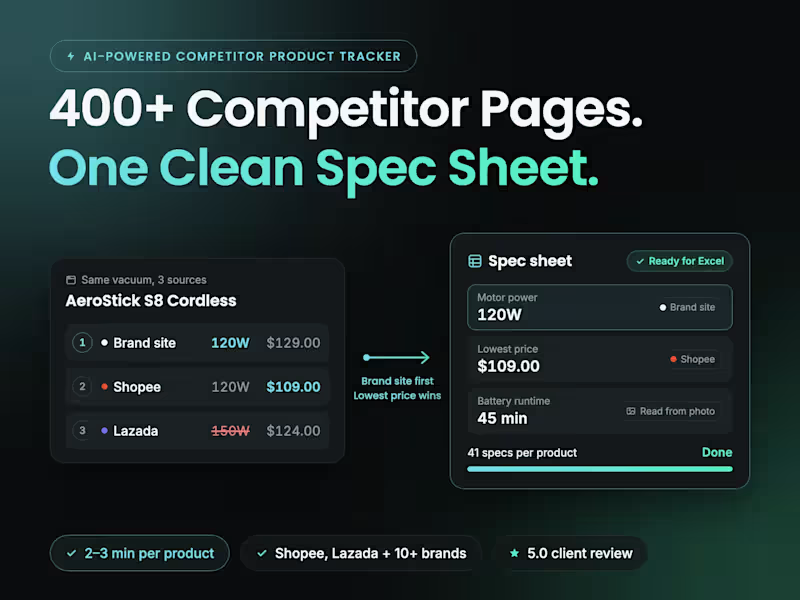
AI Automation Engineer | n8n, Make, Python & Web Scraping

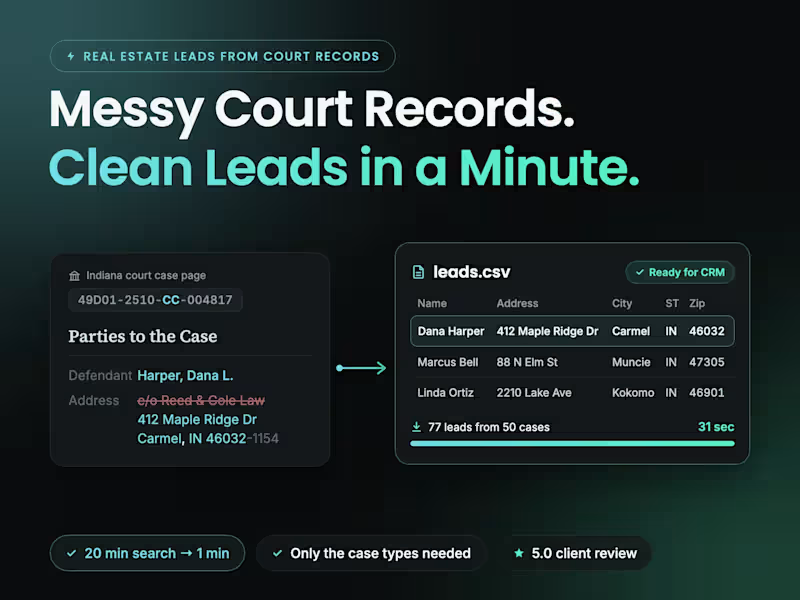
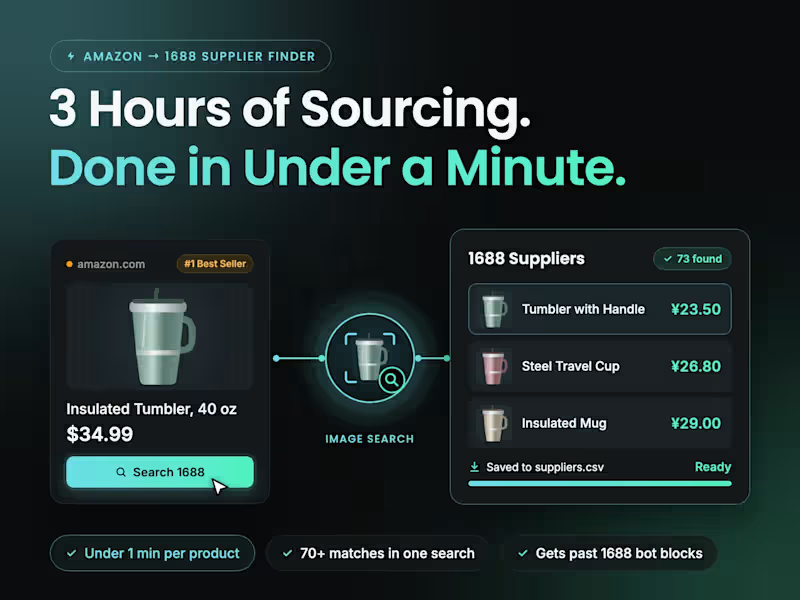

AI Engineer with roots in 3D and a focus on security.
New to Contra
AI Engineer with roots in 3D and a focus on security.
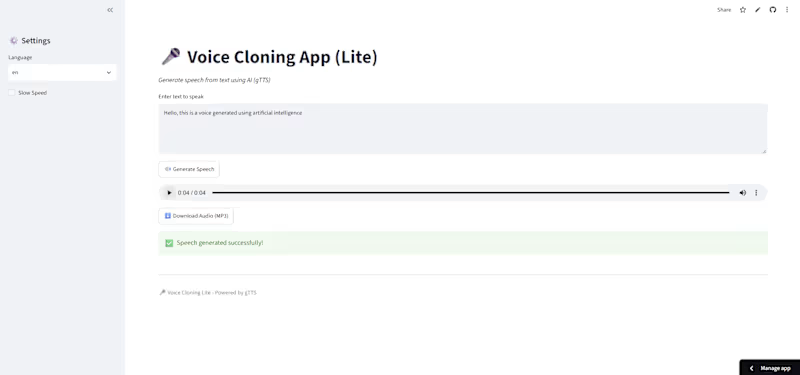
Voice Cloning Lite: Lightweight Text-to-Speech Web App
Built a lightweight, zero-cost text-to-speech application that converts text into downloadable audio across 60+ languages. Designed as a practical, free alternative to premium voice synthesis APIs—prioritizing accessibility and zero cloud costs over premium voice realism.
Engineering Decisions & Trade-offs:
Free-Tier Architecture: Integrated Google Text-to-Speech (gTTS) to eliminate API costs and ensure the app remains permanently free to use. This comes with a trade-off: voice output is functional and clear, but slightly robotic compared to premium paid alternatives (e.g., ElevenLabs, Coqui XTTS).
Multi-Language Support: Enabled text-to-speech across 60+ languages with adjustable speed control.
Audio Export: Implemented MP3 generation and download functionality, allowing users to save synthesized audio directly from the browser.
Production Deployment: Deployed on Streamlit Cloud with graceful error handling for text length limits and network issues.
Tech Stack: Python, Streamlit, gTTS, HTML/CSS.
0
39
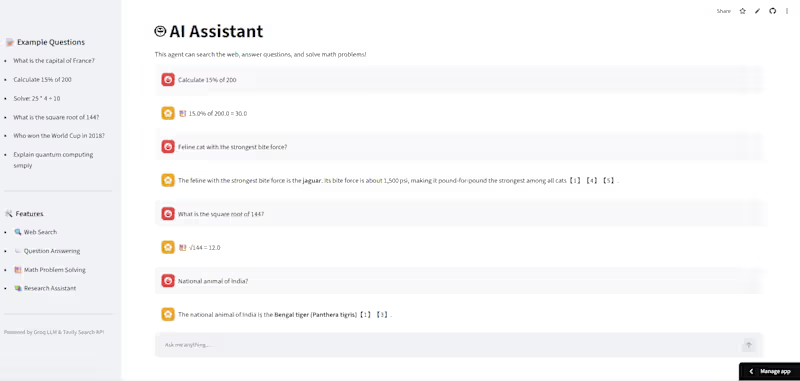
AI Assistant: Agentic Web Search & Math Solver
Built an intelligent AI agent that autonomously decides which tool to use—web search or a calculator—based on the user's query. Unlike a standard chatbot, this system uses agentic reasoning to route questions to the appropriate backend.
Engineering Challenges Solved:
Agentic Decision-Making: Implemented LangChain to give the LLM the ability to reason about user intent and select between a real-time web search tool (Tavily) and a secure mathematical expression evaluator.
Real-Time Information Retrieval: Integrated the Tavily Search API to fetch live, up-to-date answers for questions about current events and general knowledge.
Secure Math Evaluation: Built a sandboxed expression parser to safely evaluate mathematical queries without risking code injection, supporting complex calculations.
Tool-Calling Architecture: Designed a modular pipeline that allows the agent to chain multiple tools together when needed for complex queries.
Tech Stack: Python, LangChain, Groq API (Llama 3.1), Tavily Search API, Streamlit.
0
86

AI Art Generator (Full-Stack Next.js Application)
Built and deployed a production-ready web application that generates images from text prompts using distributed GPU networks and multiple AI models.
Engineering Challenges Solved:
Distributed AI Networks: Integrated the AI Horde API to offload generation to a global volunteer GPU network, eliminating cloud GPU hosting costs while maintaining high availability.
Multi-Provider Architecture: Designed a modular provider system supporting Stable Diffusion 1.5, SDXL, and Flux models, allowing users to switch between models seamlessly.
Async Job Handling: Implemented robust asynchronous polling to handle queued jobs, status updates, and graceful degradation during peak network load.
Production Deployment: Built with Next.js 14 (App Router) and TypeScript, deployed on Vercel with CI/CD pipelines.
Tech Stack: Next.js 14, TypeScript, Tailwind CSS, AI Horde API, Replicate API.
0
70
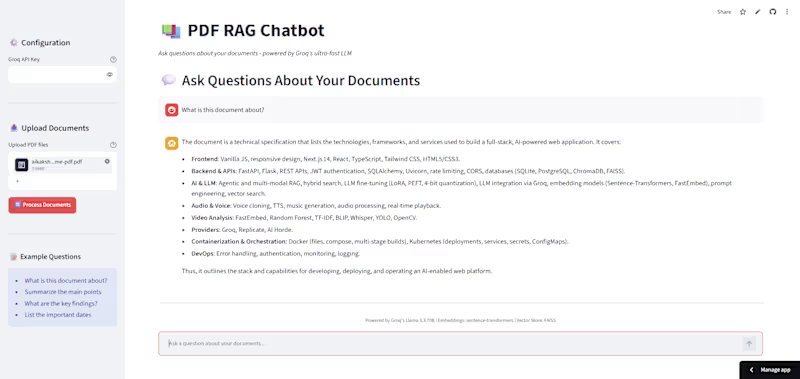
PDF RAG Chatbot: Intelligent Document Q&A System
Built a production-ready Retrieval-Augmented Generation (RAG) system that allows users to upload PDF documents and ask complex questions, receiving accurate, context-aware answers instantly.
Engineering Challenges Solved:
Context Retrieval: Implemented a hybrid search system combining BM25 (keyword) and Vector Embeddings (semantic) using ChromaDB to ensure highly relevant document chunks are retrieved before passing them to the LLM.
LLM Integration: Connected the retrieval pipeline to Groq's Llama 3.1 API, achieving sub-second inference times while maintaining high answer relevancy.
Document Processing: Engineered a robust pipeline using pdfplumber to extract text from multi-page PDFs, with chunking and embedding strategies optimized for retrieval accuracy.
Tech Stack: Python, Flask, ChromaDB, Groq API (Llama 3.1), Sentence-Transformers, pdfplumber.
0
86

PYTHON DEVELOPER | DATA & AUTOMATION SOLUTIONS
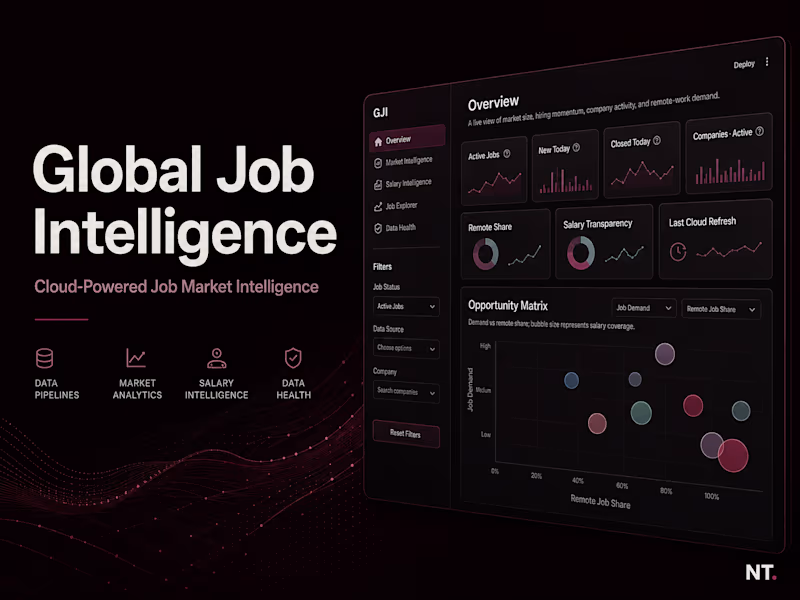
Global Job Intelligence — Updated Version
I designed and built an automated job-market intelligence platform that collects, cleans, normalizes, deduplicates, and analyzes listings from six global sources through daily data pipelines.
The latest version includes:
• Approximately 20,000 job records
• 93 passing automated tests
• 16 standardized job categories
• Improved parent/child category hierarchy
• More accurate normalization and deduplication
• Expanded filters for company, category, seniority, work mode, salary availability, source, and publication date
• Interactive market intelligence and pipeline-health monitoring
• Downloadable CSV and Excel reports
Built with Python, PostgreSQL, Pandas, Streamlit, Plotly, APIs, Playwright, and GitHub Actions.
This project demonstrates how I transform fragmented web data into reliable, searchable, and decision-ready business intelligence.
Live Dashboard:
https://global-job-intelligence.streamlit.app/
GitHub:
https://github.com/niisa0/global-job-intelligence
Portfolio:
https://niisa0.github.io/
0
43
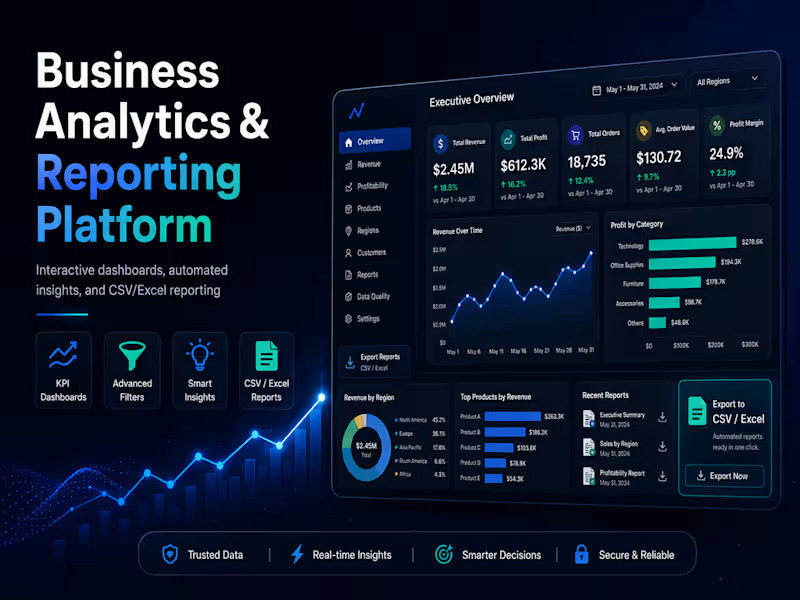
Built a full Business Analytics & Reporting Platform designed to transform raw sales data into decision-ready insights.
The platform covers the complete analytics workflow — from data cleaning and KPI calculation to interactive filtering, profitability analysis, automated business insights, and downloadable CSV/Excel reporting.
The project is deployed as a live Streamlit web application, allowing users to interact with filters, explore business performance, and generate reports directly in the browser.
Key features include dynamic KPI tracking, revenue and profit trend analysis, product/category/regional performance breakdowns, data quality monitoring, and multi-sheet Excel reports with Executive Summary, KPIs, Product Performance, Regional Analysis, and Filtered Data.
Built with Python, Pandas, Streamlit, Plotly, and OpenPyXL using a modular project structure focused on maintainability and real-world reporting workflows.
Live Demo: https://business-analytics-platform.streamlit.app/
(https://business-analytics-platform.streamlit.app/)GitHub: https://github.com/niisa0/business-analytics-platform
1
299
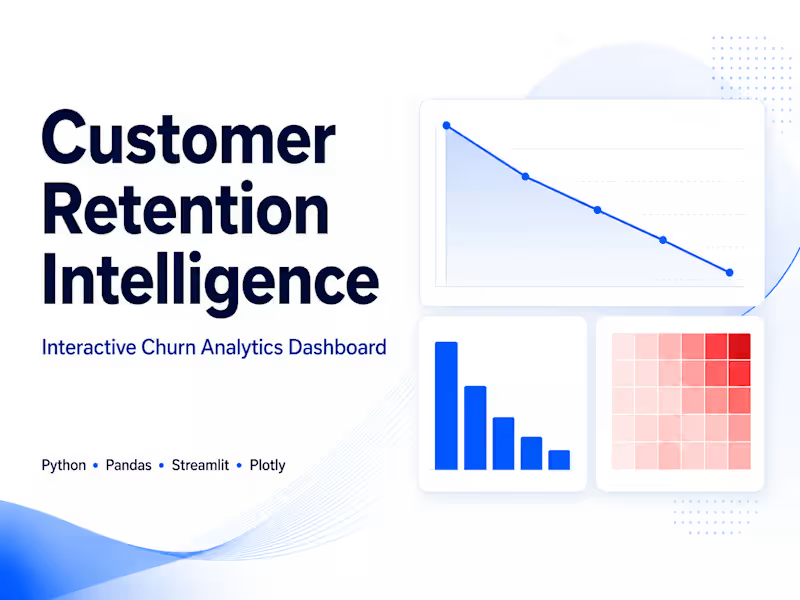
Customer Retention Intelligence is a deployed interactive analytics application built to turn 7,043 telecom customer records into actionable retention insights.
I designed the project as a modular data product rather than a static dashboard. It combines customer data preparation with dynamic segmentation, a tenure × contract churn risk matrix, churn-driver exploration, priority segment analysis, reported churn reasons, financial exposure metrics, and filtered CSV/Excel exports.
The analysis surfaced a clear contract pattern: observed churn was 45.8% among Month-to-Month customers, compared with 10.7% for One Year and 2.5% for Two Year contracts. These results are presented as observed associations rather than causal claims.
The codebase separates data processing, analytics, visualization, and export logic for maintainability. The application was built with Python, Pandas, Streamlit, Plotly, and openpyxl and deployed as a live Streamlit application.
Live Demo: https://nisa-retention-intelligence.streamlit.app/
Source Code: https://github.com/niisa0/customer-retention-intelligence
0
189
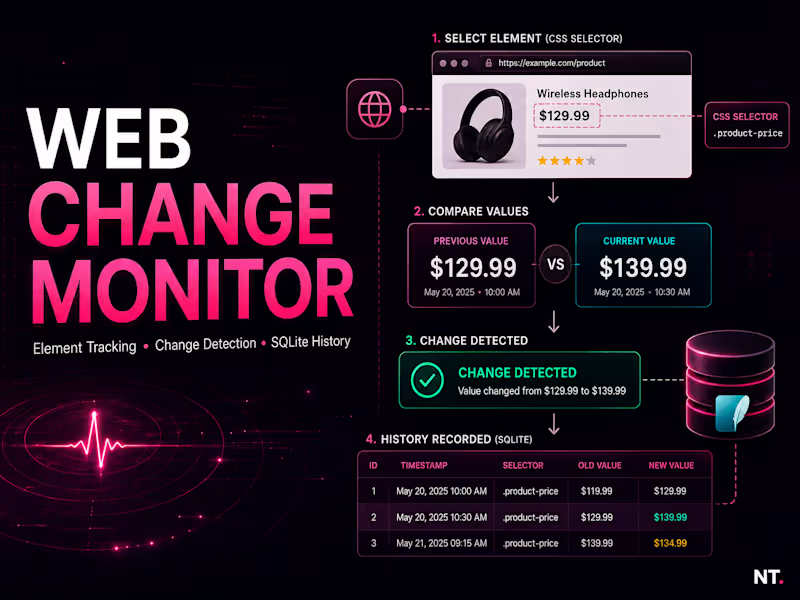
I’ve expanded my Web Change Monitor project with Playwright support, enabling it to monitor selected content on both static and JavaScript-rendered websites.
The application uses Requests and Beautiful Soup for static pages, while Playwright handles content that appears only after JavaScript runs.
Users can provide a page URL and CSS selector to monitor specific information such as prices, stock availability, product details, or announcements.
Key capabilities:
• URL and CSS selector validation
• Static and JavaScript-rendered page support
• SQLite storage for monitored pages and latest values
• Comparison of current and previous results
• Timestamped change history with old and new values
• Error handling and activity logging
The system can be adapted for price tracking, stock monitoring, competitor research, and other website-monitoring workflows.
Built with Python, Requests, Beautiful Soup, Playwright, SQLite, and Logging.
GitHub: https://github.com/niisa0/web-change-monitor
(https://github.com/niisa0/web-change-monitor)Portfolio: https://niisa0.github.io/
#Python #Playwright #WebAutomation #WebScraping #SQLite
0
71

AI Expert |AI Agent| AI RAG | LangChain | LangGraph | CrewAI
AI Expert |AI Agent| AI RAG | LangChain | LangGraph | CrewAI


I made a tutorial for an AI agent where I built an AI-powered blockchain analytics platform (https://www.youtube.com/watch?v=ceRZWLkxEbU) built with CrewAI that analyzes crypto wallets across Ethereum, Polygon, BSC, Arbitrum, and Base.
Uses 4 specialized agents - Portfolio Analyst, Transaction Specialist, Investment Strategist, and Intelligence Synthesizer - working sequentially to process on-chain data via Zapper API.
Delivers good reports with portfolio composition, risk assessment, behavioral patterns, and investment recommendations through CLI and Streamlit interfaces with real-time tracking and downloadable outputs.
Try it out: https://onchain-ai-agent.onrender.com/
Github code: https://github.com/Emarhnuel/Onchain-AI-agent
1
119

Marketing Data Specialist bridging marketing & data science
Marketing Data Specialist bridging marketing & data science


