

Microsoft 365 & Azure Solutions Architect
- $5k+
- Earned
- 2x
- Hired
- 5.0
- Rating
- 16
- Followers
Microsoft 365 & Azure Solutions Architect


Cloud Expert: AWS, GCP, Migration & Optimization
- $25k+
- Earned
- 10x
- Hired
- 5.0
- Rating
- 33
- Followers
Cloud Expert: AWS, GCP, Migration & Optimization


View more →

Cloud Security Engineer · AWS, Azure & M365


Fusion UX Doctor is an AI-powered webpage auditor built entirely in Fusion by Builder.io (http://Builder.io). Paste any URL and instantly get a complete UX, Accessibility, and Performance analysis, followed by AI-generated layout improvements built as real Fusion components.
This project creatively uses Fusion’s visual canvas to turn audits into an interactive experience with animated cards, a clean Before/After comparison, and on-canvas component regeneration. The innovation lies in how AI doesn’t just evaluate a design, it rebuilds it directly in Fusion, proving what’s possible when design, code, and intelligence come together.
Live Project: https://b5b76db448604e6099a747c1f7beab26-main.projects.builder.my/
(https://b5b76db448604e6099a747c1f7beab26-main.projects.builder.my/)#builderchallenge #builtwithfusion
21
456

Product Infrastructure Partner | Fast, Detailed, Reliable
- 1x
- Hired
- 5.0
- Rating
- 15
- Followers
Product Infrastructure Partner | Fast, Detailed, Reliable



Cloud network engineer/architect
Cloud network engineer/architect


View more →

AI Security & DevSecOps Engineer | Cloud Automation
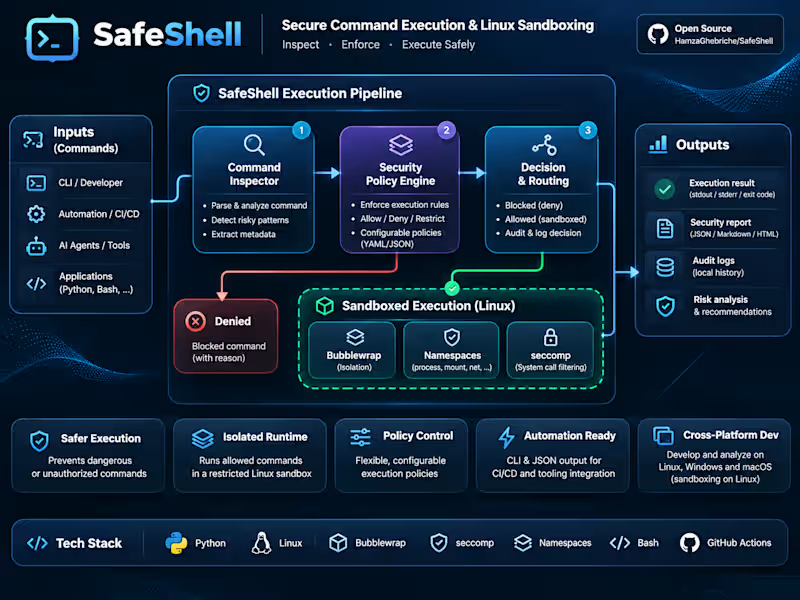
SafeShell | Secure Command Execution & Linux Sandboxing (https://github.com/HamzaGhebriche/SafeShell)
SafeShell is an open-source Python security tool I developed to inspect potentially dangerous shell commands, enforce execution policies, and run permitted commands within a restricted Linux sandbox.
The project focuses on improving command execution safety in development environments, automation workflows, and security-sensitive applications.
🔐 Key Features
1. Command Security Analysis
Inspects shell commands before execution.
Identifies potentially dangerous command patterns.
Generates structured findings and risk information.
Supports deterministic command analysis without executing the submitted command.
2. Secure Linux Sandboxing
Uses Bubblewrap and Linux security controls to restrict command execution.
Implements Linux namespaces and seccomp-based restrictions.
Reduces access to host resources through controlled filesystem and runtime configurations.
Refuses protected execution when required security mechanisms are unavailable.
3. Security Policies & Access Control
Enforces configurable offline execution policies.
Supports explicit authorization for permitted operations.
Prevents approvals from overriding hard security restrictions.
Provides structured execution decisions and status information.
4. Security Automation & Auditing
Offers a Python command-line interface.
Supports JSON output for integration with automation workflows.
Records local execution metadata for review.
Provides timeout and output-size controls.
5. Cross-Platform Development
Supports command inspection and policy management on Linux, Windows, and macOS.
Provides protected execution on supported Linux environments.
Includes automated validation through CI pipelines.
Technologies: Python, Linux, Bubblewrap, seccomp, Linux Namespaces, Bash, GitHub Actions, JSON, Security Automation.
My Role: Independent Developer & Security Engineer.
Project Type: Open-source security tool.
Current Status: Experimental alpha release (v0.1.0-alpha).
SafeShell has undergone automated testing but has not received an independent security audit. It is not intended to serve as a production-grade security boundary.
0
27
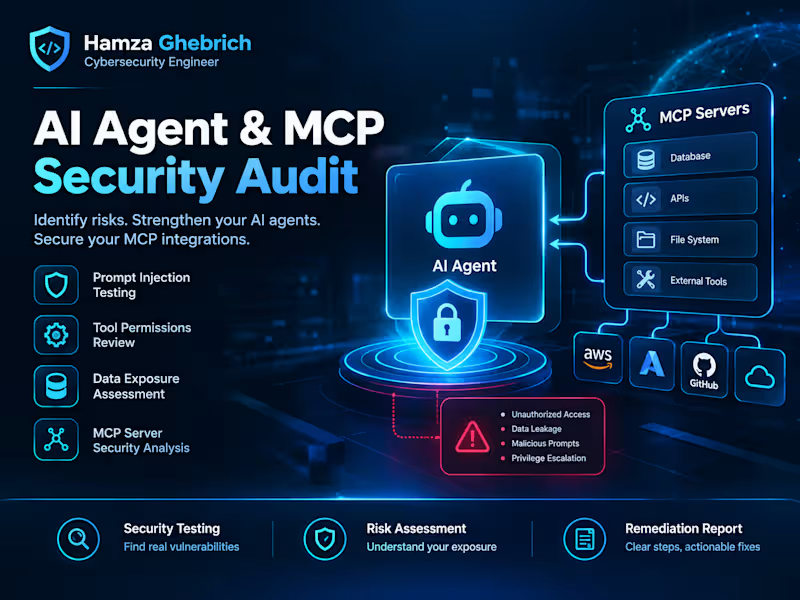
MCP Security Auditor | AI Agent & MCP Server Security (https://github.com/HamzaGhebriche/mcp-security-auditor)
MCP Security Auditor is an open-source security analysis tool I developed to help engineers identify security risks in Model Context Protocol (MCP) servers and AI-agent integrations.
As AI agents increasingly connect to external tools, APIs, and sensitive data, securing these integrations becomes essential.
I designed and developed MCP Security Auditor to automate security configuration reviews, identify potentially dangerous implementation patterns, and generate actionable security reports.
Key Features:
🔐 MCP Security Analysis
Detects risky authentication and authorization configurations.
Identifies potentially unsafe tool permissions and execution patterns.
Reviews filesystem access and security boundaries.
🤖 AI Agent Security
Analyzes security configurations used in MCP integrations.
Identifies potentially insecure connections between AI agents and external tools.
Supports security reviews of AI-powered applications.
⚙️ Automated Security Auditing
Static analysis of Python code and configuration files.
Automated security findings with severity classifications.
Security reports in JSON, HTML, Markdown, and SARIF formats.
Configurable security policies and risk scoring.
🚀 DevSecOps Integration
Supports automated security checks in development workflows.
Helps developers identify security issues earlier.
Provides actionable findings to support remediation.
Technologies: Python, MCP, Static Application Security Testing, Security Automation, GitHub Actions, JSON, YAML.
Business Value: Helps development teams review MCP integrations, identify risky configurations, and introduce repeatable security checks into their development processes.
My Role: Independent Developer & Security Engineer.
Project Type: Open-source cybersecurity tool.
0
35
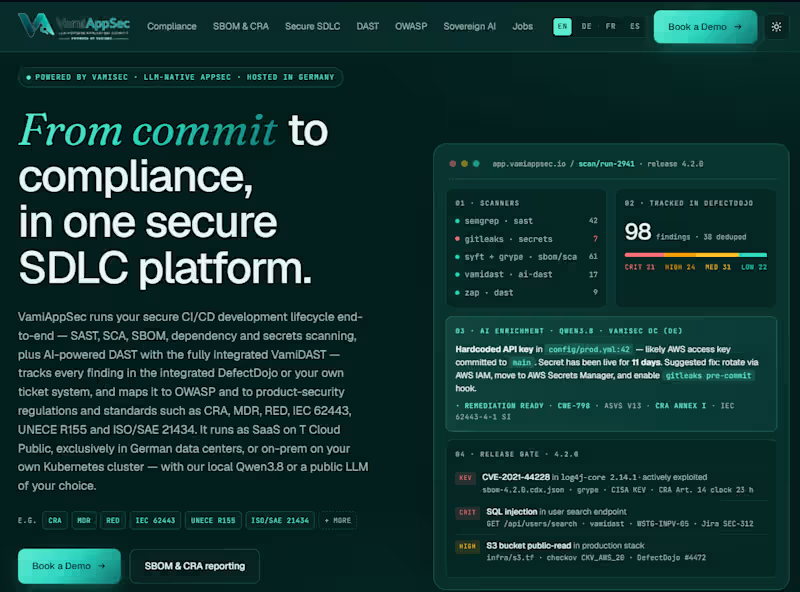
VamiAppSec | AI-Powered Application Security Platform (https://vamiappsec.com/#top)
VamiAppSec is an AI-assisted application security platform developed during my professional experience at VamiSec GmbH.
I contributed to integrating automated security analysis into development workflows, combining multiple security scanning technologies with AI-assisted vulnerability analysis.
My contributions included:
• Integrating SAST, SCA, and secrets detection tools.
• Automating security scanning through CI/CD pipelines.
• Implementing Infrastructure-as-Code security checks.
• Supporting SBOM generation and dependency analysis.
• Developing security findings aggregation and reporting workflows.
• Integrating AI-assisted vulnerability triage and remediation guidance.
Technologies: Python, GitHub Actions, Semgrep, Gitleaks, Checkov, Syft, Grype, LLMs, DevSecOps.
This experience strengthened my expertise in application security engineering, security automation, and AI-assisted DevSecOps.
0
45
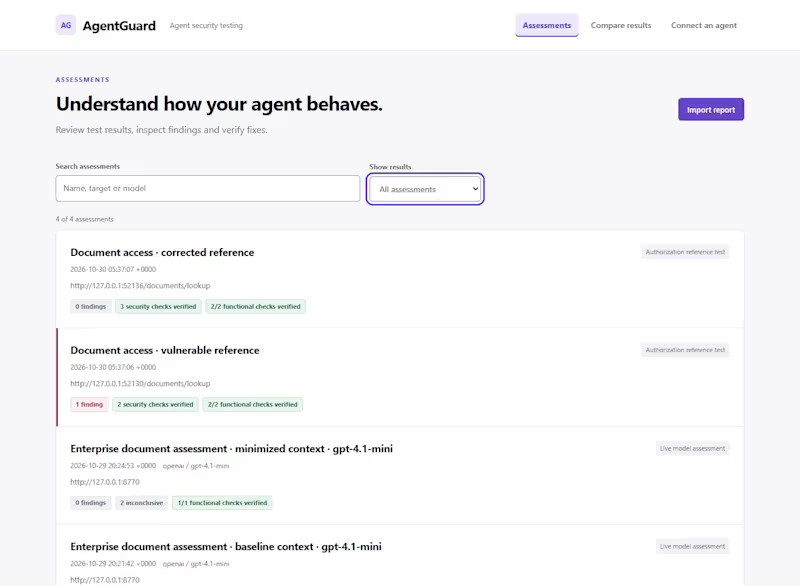
AI Agent Security Testing & Assessment | AgentGuard (https://github.com/HamzaGhebriche/AgentGuard)
AgentGuard is an open-source AI agent security testing tool designed to help developers assess the security of AI-powered applications and agentic systems.
I developed AgentGuard to support structured security assessments of authorized AI-agent endpoints, identify security weaknesses, and verify whether implemented fixes address the observed issues.
Key capabilities include:
• AI-agent endpoint security assessments.
• Testing of authorization and access-control behavior.
• Security findings with supporting evidence.
• Comparison of vulnerable and corrected application behavior.
• Local dashboard for reviewing and exporting security reports.
• Automated security testing using Python.
The project helps development teams understand security risks in their AI applications and validate specific security improvements.
Technologies: Python, AI Agent Security, LLM Security, API Security, Security Automation.
Project: AgentGuard — Open Source Security Tool.
0
54


Expert cloud & platform consultant building AI platforms
Expert cloud & platform consultant building AI platforms

Architected an enterprise Kubernetes platform on Azure AKS for a fintech company running 40+ microservices. Traffic enters through Application Gateway with WAF v2 policies and Azure Firewall before reaching the AKS cluster inside a hub-spoke VNet. ArgoCD manages all deployments through GitOps with automatic drift detection and self-healing. ACR stores container images built by Azure DevOps Pipelines with integrated vulnerability scanning. Workloads connect to Cosmos DB, PostgreSQL Flexible Server, and Redis Cache through private endpoints. Azure ML handles fraud detection model inference called directly from within cluster pods. Entra ID with Managed Identities provides passwordless auth across all services.
0
107

Designed and deployed a multi-account AWS landing zone using Control Tower and Organizations for a healthcare SaaS company handling PHI data. The architecture separates management, security, network, and workload accounts with dedicated IAM boundaries. Traffic routes through CloudFront and WAF into a Transit Gateway hub before reaching production VPCs running ECS Fargate workloads. Security Hub aggregates findings from GuardDuty, Inspector, and AWS Config across all accounts. CloudTrail feeds into EventBridge for real-time alerting through SNS. All encryption managed through a centralized KMS account. Infrastructure provisioned entirely with Terraform and Terragrunt modules. Achieved SOC 2 Type II and HIPAA compliance within 90 days.
0
117

I built a production-ready serverless LLM API on GCP designed for low cost, strong security, and fast inference. Requests flow through CDN, load balancing, WAF, and API management before hitting a Cloud Run FastAPI service that handles prompts, session history, caching, and model routing. The system switches between Gemini 2.5 Pro for deep reasoning and Gemini Flash for fast responses, with RAG support using Vector Search over 768-dim embeddings. Data is stored in Firestore, cached in Redis, and logged to BigQuery. Everything is secured with VPC Service Controls, Workload Identity, KMS, Secret Manager, and DLP. CI/CD is fully automated with Terraform and Cloud Build using canary rollouts and auto-rollback on SLO violations. At around 50K requests per day, the platform runs at about $1K/month and scales to zero when idle.
0
118

Here's how I'd build a scalable ticketing backend with Supabase & Stripe.
The backend is where everything lives or breaks. Supabase handles auth and Row Level Security out of the box, Postgres enforces ticket inventory and access at the database level, and Stripe Checkout processes payments with webhooks that keep everything in sync. Capacity limits, discount logic, and user access all of it stay consistent when real traffic hits. Built to scale without needing a full rewrite six months down the road.
0
105

CISO Services: Bridging Tech & Business Needs
CISO Services: Bridging Tech & Business Needs



View more →