
Built Oracle AI, a custom AI architecture and engineering partner, not just another agency selling generic wrappers.
We design and build tailored AI systems to solve real, complex business bottlenecks. Turning fragmented operational problems into production-ready architecture:
Custom AI System Architecture — end-to-end design of scalable AI pipelines, data flows, and infrastructure built specifically for your exact business problem
Autonomous Agent Orchestration — designing agentic systems where specialized models collaborate, execute multi-step workflows, and solve actual tasks
Enterprise Integration & Data Pipelines — connecting cutting-edge AI models directly into your existing codebase, databases, and operational tools
Problem-First Solution Engineering — we don't start with "what model should we use?"; we start with the core problem and engineer the exact system needed to solve it
Production-Ready Security & Reliability — building robust, secure, and compliant architectures ready for real-world traffic, not just flashy prototypes
The point isn't "we can generate cool text with AI." It's that we architect, build, and deploy the underlying intelligence your company needs to solve actual complex operational challenges.
Check it out: oracleai.se (http://oracleai.se)
2
4
370
I implemented an automated transaction reconciliation system using Python, designed to match platform transactions with bank records, developed as part of a larger Admin Portal for financial operations.
What this system supports:
• Automated matching of bank & platform transactions
• Keyword-based and rule-driven reconciliation logic
• Batch processing for large transaction datasets
• Configurable matching rules per account or merchant
• Clear linking between matched records for auditing
• Scheduled reconciliation via cron jobs running on Render
• Designed to integrate with existing APIs and databases
This project focused heavily on:
✨ Reducing manual reconciliation time within the Admin Portal
⚡ Performance-focused processing for large datasets
🧠 Clear, maintainable Python logic developed iteratively using Cursor
3
349


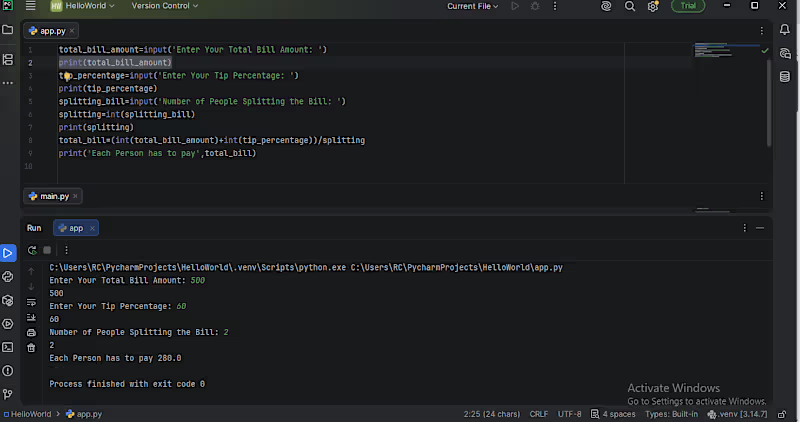
Automated Financial Logic & Enterprise Calculation Engines
The Problem Solved: Eliminates costly revenue leakages and human billing mistakes caused by error-prone manual spreadsheets and rigid legacy systems.
The Solution: Custom, bulletproof algorithmic engines that instantly automate multi-variable calculations, transaction splitting, and backend commercial arithmetic with zero error margins.
Business Impact: Accelerates billing cycles, guarantees 100% calculation compliance, and secures transactional data integrity across your entire business.
Universal Scale: Built with clean, modular logic that integrates seamlessly into your SaaS platforms, e-commerce checkouts, internal CRMs, or enterprise tools.
Want to bulletproof your business math and billing flows? Message me here on Contra with your specific parameters, and let’s engineer a high-performance calculation engine tailored to your stack.
1
161

Python Chatbot Using Cosine Similarity
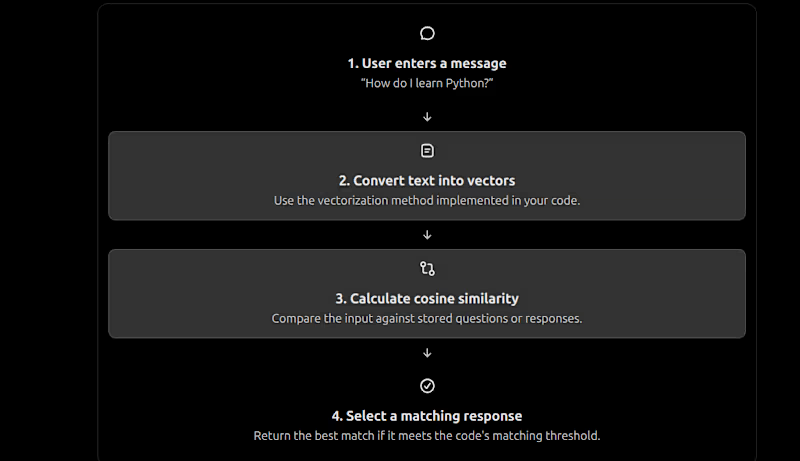
I built a Python-based chatbot that uses cosine similarity to compare text and identify the closest matching response.
The project explores text similarity, vector-based comparison, and conversational interaction, demonstrating how mathematical techniques can be applied to build a simple chatbot.
Key Features
Text similarity matching: Uses cosine similarity to compare text representations.
Response selection: Identifies the closest matching candidate based on similarity scores.
Python development: Implements the chatbot's matching logic using Python.
Applied mathematics: Uses vector similarity to compare text representations.
Technical Approach
Cosine similarity measures the angle between two vectors to estimate how closely they align. When combined with an appropriate text vectorization method, it can help a chatbot match user messages with relevant stored responses.
Technologies
Python · Natural Language Processing (NLP) · Cosine Similarity
Project Source
View the project on GitHub (https://github.com/ak-Machine-Learning/Chatbot)
0
72
Why am I building a quantitative trading system?
Because I don't want trading to depend on spending hours staring at charts, making repetitive decisions manually, missing opportunities, or letting emotions and inconsistency affect execution.
For retail and independent traders, the difficult part isn't just finding a strategy.
It's knowing whether the strategy actually works, why it works, and why it fails.
That's what I'm trying to solve with my Quantitative Systems Platform.
Recently, I found a major bottleneck in my research.
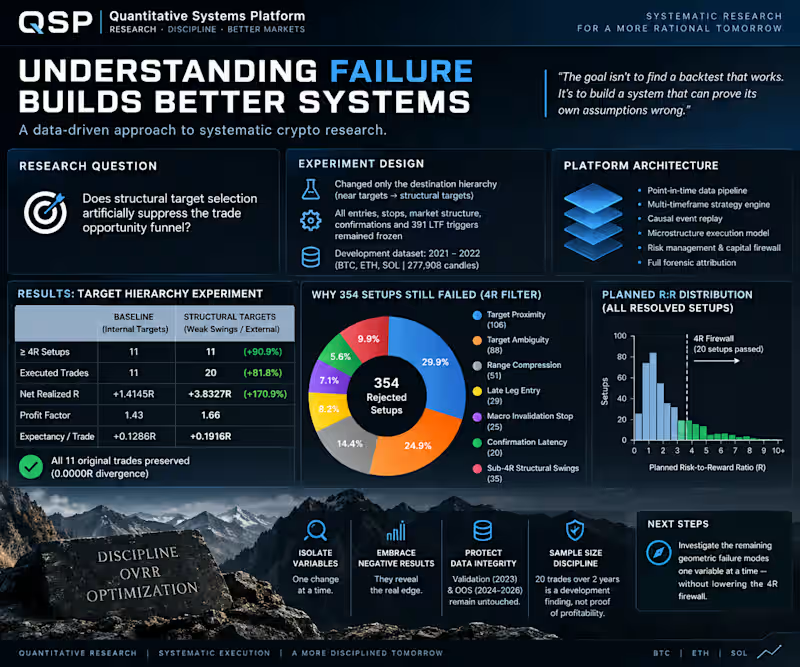
Out of 387 target-resolved setups, only 11 met my ≥4R requirement.
Instead of lowering the requirement to create more trades, I asked:
Was the system choosing the wrong structural target?
I ran a controlled experiment where I changed only the target-selection hierarchy. Entries, stops, market structure, confirmations and the 391 LTF-confirmed triggers stayed frozen.
On the 2021–2022 development dataset:
≥4R setups: 11 → 21
Executed trades: 11 → 20
Net realized: +1.4145R → +3.8327R
Profit Factor: 1.43 → 1.66
All 11 original trades were preserved with 0.0000R divergence.
But the most important part wasn't the improvement.
I investigated the 354 setups that still failed the 4R firewall.
They revealed multiple failure modes:
target proximity, compressed ranges, late entries, wide structural stops, confirmation latency, target ambiguity — and 35 structurally healthy-looking setups that still fell between 1.5R and 3.9R.
So the answer isn't simply:
“Lower 4R.”
The real research problem is understanding the interaction between entry geometry, available expansion, structural risk, confirmation timing and destination selection.
That's why I'm building this platform.
Not to create another black-box trading bot.
I want a system that can tell me:
Why did this trade qualify?
Why did another fail?
Which assumption caused it?
Can I isolate that assumption?
Can I reproduce the result?
Does it survive unseen data?
The long-term objective is straightforward:
Less manual trading. Less inconsistency. More systematic research. More reproducible execution. And eventually, if the evidence earns it, automation.
This experiment is still a development finding, not proof of profitability or production readiness. Validation and out-of-sample data remain protected.
The next step is to investigate the remaining failure modes one variable at a time.
I'm not trying to build a system that only proves itself right.
I'm building one capable of proving itself wrong.
🔗 Project: Quantitative Systems Platform — GitHub (https://github.com/Quantitative-Systems/crypto-platform?utm_source=chatgpt.com)
#QuantitativeFinance #QuantitativeResearch #SystematicTrading #AlgorithmicTrading #TradingSystems #Python #FinTech #RiskManagement #Crypto
1
268
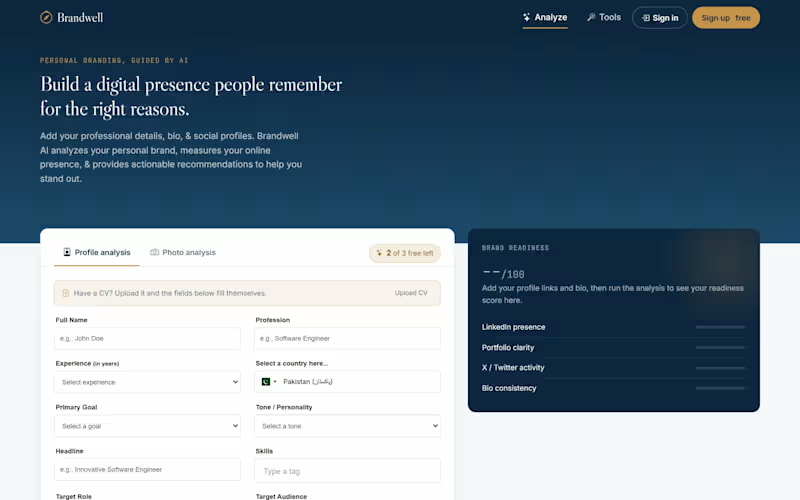
🚀 I'm building Brandwell, an AI personal-branding coach for developers, freelancers and job seekers (currently in development).
It scores your profiles across 10 platforms, then fixes them: the new AI Rewrite Studio took a generic headline from 20 to 95/100, and Job Match shows your honest fit for any role.
Under the hood, pages now load in ~30 ms instead of 2 s, credentials are encrypted, and it's load-tested with 30 users at once.
Next up: weekly progress emails and PDF reports. I'd love your feedback!
#AI (https://www.linkedin.com/search/results/all/?keywords=%23ai&origin=HASH_TAG_FROM_FEED) #PersonalBranding (https://www.linkedin.com/search/results/all/?keywords=%23personalbranding&origin=HASH_TAG_FROM_FEED) #BuildInPublic (https://www.linkedin.com/search/results/all/?keywords=%23buildinpublic&origin=HASH_TAG_FROM_FEED) #PHP (https://www.linkedin.com/search/results/all/?keywords=%23php&origin=HASH_TAG_FROM_FEED)
0
31
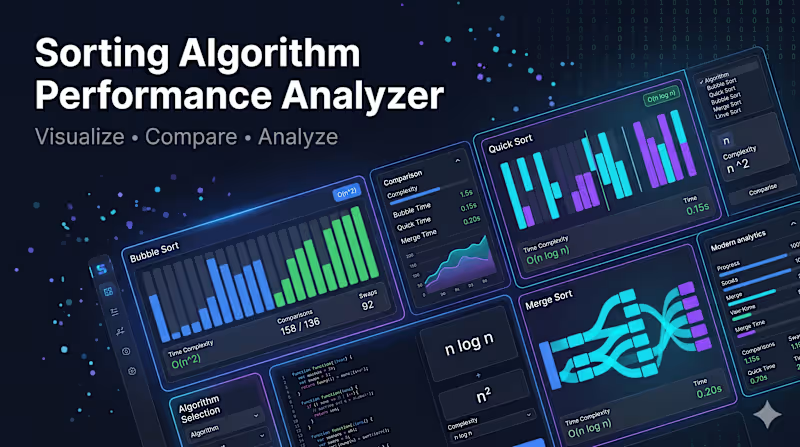
Sorting Algorithm Performance Analyzer
Web-based visualization tool that demonstrates how different sorting algorithms work and compares their execution performance in real time.
Built entirely using HTML, CSS, and JavaScript, the project provides interactive animations, speed analysis, and algorithm comparisons to help users understand sorting concepts visually and practically.
The platform includes real-time visualization for popular algorithms like Bubble Sort, Merge Sort, Quick Sort, Selection Sort, and Insertion Sort with dynamic array generation and performance tracking.
0
41

Authored and designed a foundational guide to help founders define their brand identity, positioning, and internal clarity before scaling. Broke down complex strategy into practical frameworks covering voice, visuals, audience, and experience. Used as a tool to align teams and support cohesive decision-making.
0
45
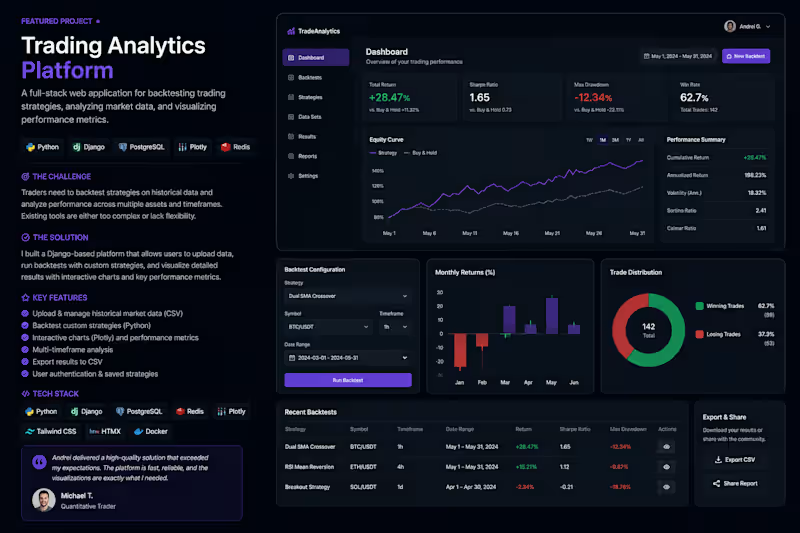
Trading Analytics Platform is a Python-based web application for backtesting trading strategies, analyzing historical market data, and visualizing performance metrics. The platform enables traders to compare strategies, generate reports, and optimize trading performance through interactive dashboards.
0
48