Ghada AL's Work | ContraWork by Ghada AL
Ghada AL

Ghada AL

The AI/Techno Logic Designer | PostgreSQL & DSS Architect

New to Contra

Ghada is ready for their next project!

Cover image for Applied Data Science Capstone
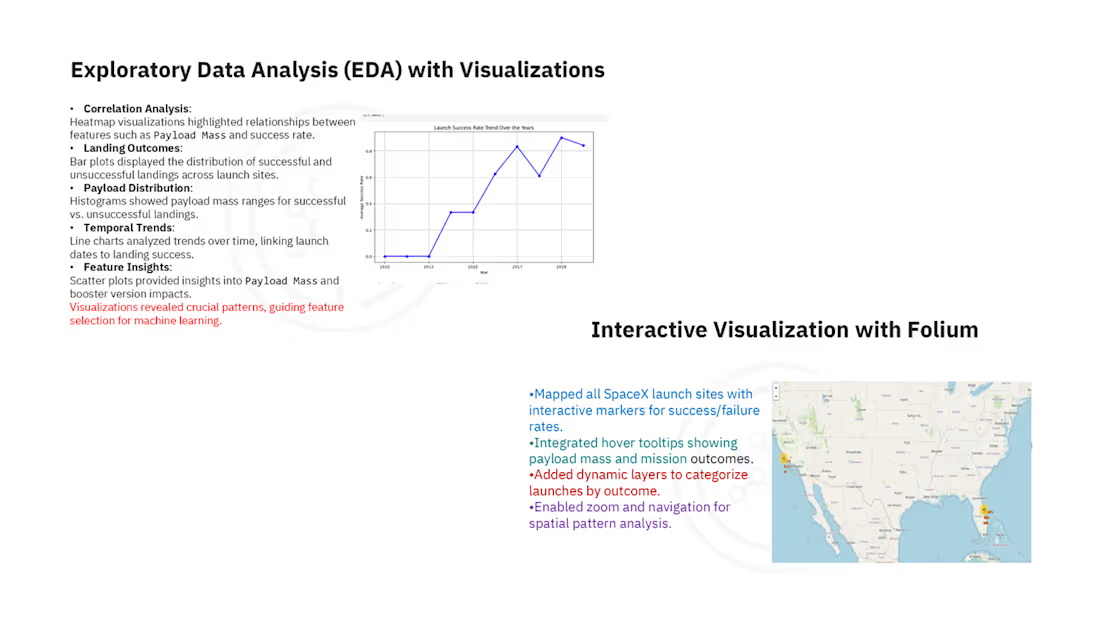
Applied Data Science Capstone
0
11
Cover image for Retry Storm & Duplicate Actions — Decision Boundary Case Des...
Retry Storm & Duplicate Actions — Decision Boundary Case Description This case documents how uncontrolled retry behavior turns temporary uncertainty into duplicated actions, overload, and irreversible side effects. I analyze: Retry decision points Ownership gaps between user and system Missing escalation boundaries Idempotency failures Deliverables focus on: Clear retry constraints Decision flow clarification Safe stop conditions instead of endless repetition This work is fully asynchronous and documented as decision logic, not implementation. https://medium.com/@algoroalgorithm/retry-storms-when-try-again-becomes-a-system-failure-a537d147ee46
1
34
Cover image for I’m currently documenting real-world decision
I’m currently documenting real-world decision failures in multi-actor systems. This case explores handoff failure — when responsibility shifts between actors without explicit ownership transfer. The result is not a technical bug, but operational confusion that surfaces later. I focus on clarifying these hidden decision boundaries before they turn into costly failures. https://medium.com/@algoroalgorithm/when-responsibility-moves-but-no-one-owns-the-decision-296e8eb19f7b
0
19
Cover image for While working on a project, I encountered one of the most fr...
While working on a project, I encountered one of the most fragile moments in system design: when control shifts from the system to a third party. After user confirmation, the café may accept, reject, or remain silent. A reliable system does not assume cooperation or wait indefinitely. It defines clear time boundaries and treats silence as a state. Designing for uncertainty is where real system thinking begins.
1
38
Cover image for Order Confirmation and Cancellation Logic While working on a...
Order Confirmation and Cancellation Logic While working on a project, I realized that the most critical moment in any system is not data entry — but decision-making. At the order confirmation stage, the system has valid data but no confirmed user intent. Proceeding without confirmation is a flaw. Waiting indefinitely is a bigger one. A well-designed system never assumes intent. It asks clearly, waits responsibly, and exits safely. This is the essence of applied computer science. Logic always comes before code.
0
20
Cover image for When a system keeps saying “yes” A user asks for something s...
When a system keeps saying “yes” A user asks for something slightly outside scope. The system adapts. Another request stretches the boundary a bit more. The system adapts again. Nothing breaks immediately. No alerts. No visible failure. But internally, the system is no longer executing rules — it is negotiating its identity. When flexibility becomes confusion At some point: roles overlap, expectations diverge, and different users receive different “truths”. The system is no longer enforcing a shared reality. It is responding case by case. This is where trust erodes — quietly. Not because the system refused, but because it never learned how to say no.
0
14
Cover image for What Happens After a Request Is Confirmed? Most systems focu...
What Happens After a Request Is Confirmed? Most systems focus heavily on getting a request confirmed. Buttons are clear. Flows are optimized. The confirmation moment feels like success. But in practice, this is where many problems quietly begin. Once a request is confirmed, the system often keeps “thinking” on behalf of everyone involved: It proceeds automatically. It makes assumptions. It optimizes for speed, not clarity. At this point, an important question is rarely made explicit: What is allowed to change after confirmation — and what is not?
0
15