AI Agent Orchestrator ProjectsAI Agent Orchestrator ProjectsOFFICIAL SUBMISSION — ECHOES OF TEMPLE LANE
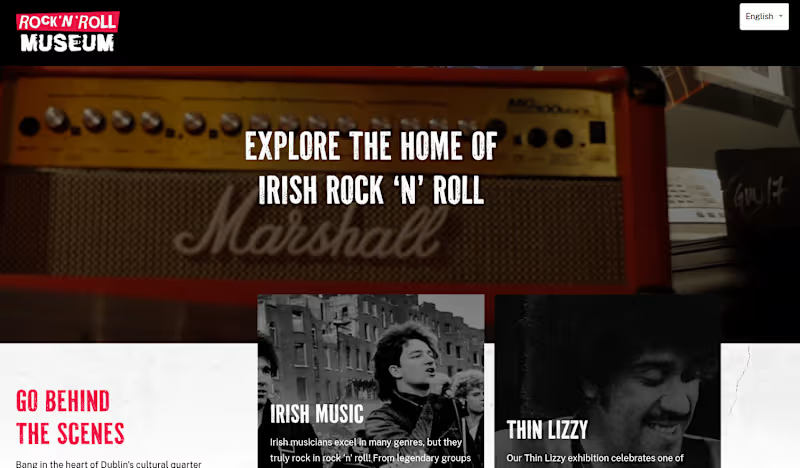
For the Base44 x Contra #GiveItAGlow Challenge, I chose a real Dublin business that has been part of my life since 2018: Temple Lane Studios and the Irish Rock ’n’ Roll Museum Experience.
This was not a random business choice.
Temple Lane has been my place to rehearse, reset, disconnect from everything else, and play proper fat rock ’n’ roll with the band.
BEFORE
The museum already had a strong identity and an established website for presenting its history, exhibitions, tours and visitor information.
The opportunity was not to replace that foundation, but to explore an entirely new digital layer: one that could translate the atmosphere, memories and emotional character of the physical building into an experience people could enter.
AFTER
I built Echoes of Temple Lane — a live, publicly accessible Base44 experience designed as a cinematic digital exhibition.
Visitors move through atmospheric memory rooms, recovered photographs, archival records, rehearsal spaces, personal performance moments and historical fragments.
The journey includes the Room of Celebration, the Room of Punk, interactive archive elements and a final narrative sequence called The Last Echo.
This is not a static redesign.
It is an experience built around motion, sound, discovery and memory.
AUTOMATION
Visitors can submit their own Temple Lane memory through the exhibition.
The memory_scribe AI agent helps shape each contribution into a guestbook-ready draft. The caretaker agent supports the exhibition experience, while the Caretaker Memory Digest workflow runs every three hours, gathers new visitor memories, prepares a moderated report and emails the guestbook digest for review.
The workflow has been tested end-to-end with a real submission, and the attached dashboard proof shows the completed automation run.
BUSINESS VALUE
The system creates the foundation for a moderated, community-generated archive while reducing the manual work required to collect, organize and review visitor stories.
The walkthrough video focuses on the immersive visitor experience. The attached screenshots document the complete transformation:
— the original online presence
— the finished Base44 experience
— the AI agents
— the scheduled automation
— the successful workflow run
— my genuine connection to Temple Lane Studios since 2018
Live experience:
https://temple-lane-studios.base44.app
Original website:
https://irishrocknrollmuseum.com/
(https://irishrocknrollmuseum.com/)LinkedIn post:
https://www.linkedin.com/posts/bobvasic_giveitaglow-giveitaglow-base44-ugcPost-7482178973616119808-rd78
(https://www.linkedin.com/posts/bobvasic_giveitaglow-giveitaglow-base44-ugcPost-7482178973616119808-rd78/?utm_source=social_share_send&utm_medium=member_desktop_web&rcm=ACoAAAWbOcYBym9kgZZll4IyyFfT9tR-b1MMg5U)X post:
https://x.com/RaptorLabsX/status/2076413890817400843?s=20
Built independently with @Base44 for the #GiveItAGlow Challenge.
From a traditional museum website to a living digital archive.
#Base44 #Contra #TempleLane #IrishRockNRollMuseum #Dublin #DigitalMuseum #InteractiveDesign #Automation #AI #BuildInPublic One year ago, we took a leap into the unknown.
Not because it was easy. Starting over never is. There are always doubts, risks, and countless reasons to stay where you are.
But curiosity has a way of winning.
@Bob Vasic and I have known each other since high school, sitting in the last row of the classroom. A year ago, that friendship became @RaptorLabs Agency.
Today, we're building AI-native systems, products, and the company we always wanted to work for.
Cheers to my best friend, co-founder, and the best CTO I could ask for.
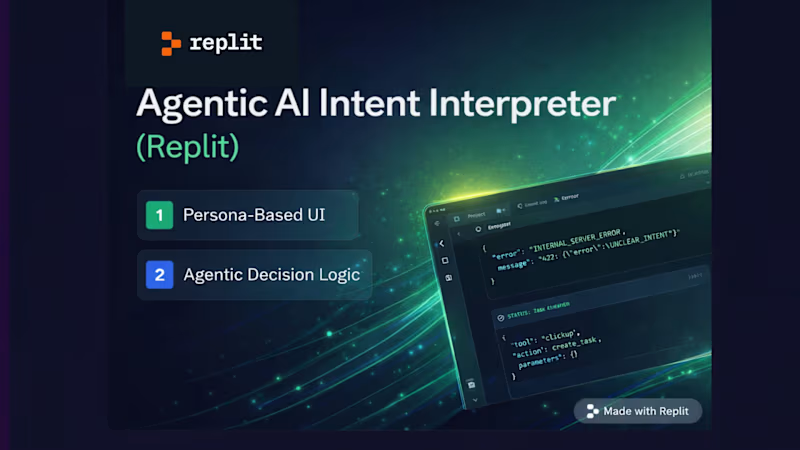
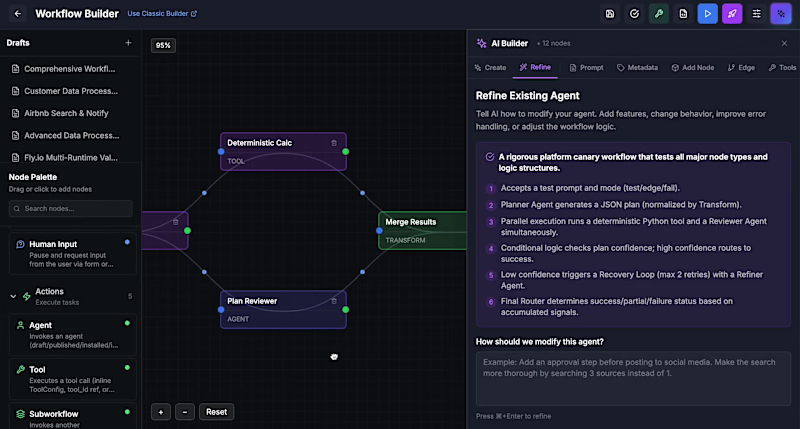
Here's to the first year—and everything we're building next. AI Builder + Agent Studio is a system for designing, testing, and deploying AI agents and autonomous workflows as structured, production-ready graphs, not fragile prompts.
At the core is Agent Studio, where workflows are defined as explicit graphs made up of agents, tools, conditionals, loops, routers, and outputs.
The AI Builder sits on top of this system and generates complete workflows automatically. Instead of writing code or wiring nodes manually, users describe the goal—and the AI Builder constructs a valid workflow graph.
Every workflow can be tested using a test harness, ensuring agents execute correctly before deployment.
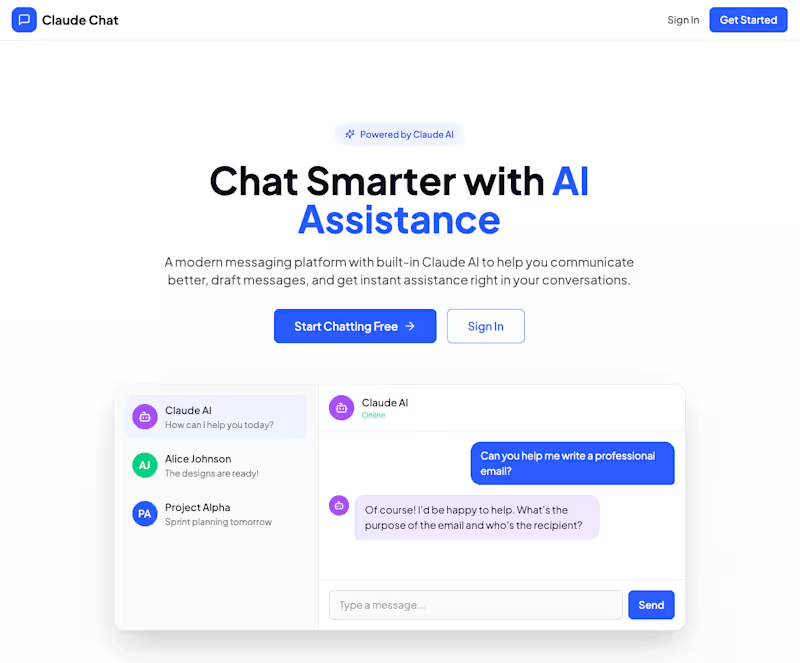
This project demonstrates how AI agents can be treated like real software systems—versioned, validated, and orchestrated—instead of one-off prompt chains. Claude Chat Assistant
A modern real-time chat messaging application with integrated Claude AI assistance. Built with Next.js 15, React 19, Supabase, and Tailwind CSS.
Features:
Claude AI Integration - Chat with Claude AI for instant assistance with writing, coding, brainstorming, and more
Private & Group Chats - Create one-on-one conversations or group chats for team collaboration
Real-time Messaging - Messages appear instantly with Supabase real-time subscriptions
Rich Media Support - Send images, files, and emojis in your conversations
Read Receipts - See when your messages have been read
Message Actions - Reply to, edit, or delete messages
User Presence - See who's online, away, or offline
Dark Mode - Toggle between light and dark themes
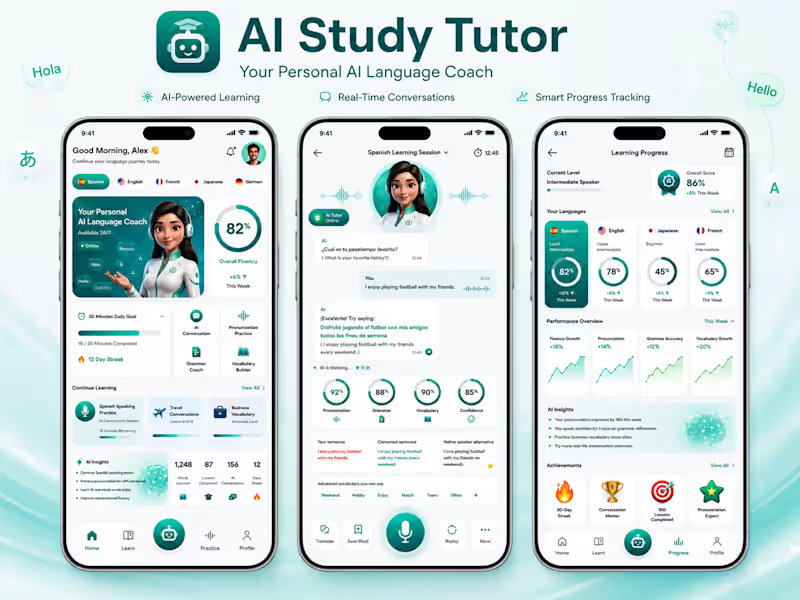
Responsive Design - Works beautifully on desktop and mobile devices AI Agent Tutor Mobile App
An AI personal tutor mobile application designed for learners of all ages, from students to professionals. The app provides personalized guidance, explanations, skill development, and interactive learning across multiple subjects and topics.
Key Features:
> AI tutor conversations for learning any topic
> Personalized learning paths based on user goals and skill level
> Support for academics, professional skills, coding, languages, and general knowledge
> AI explanations, summaries, and concept breakdowns
> Practice exercises, quizzes, and knowledge improvement tools
> Voice and text-based learning interactions
> Learning history and progress tracking
> Adaptive AI responses based on user behavior
Key Contributions:
-- Developed a cross-platform mobile learning experience
-- Integrated AI/LLM technology for real-time tutoring interactions
-- Implemented secure authentication and data management
-- Optimized performance and user experience across devices
Outcome:
Created an AI learning companion that enables users of all ages to learn, improve skills, and access personalized education anytime through a mobile-first experience. AI Operations Agent: RAG-Powered Retail Intelligence & Task Automation
This project was built for large-scale restaurant groups and multi-unit retail operators who manage high volumes of data across dozens or hundreds of locations. Specifically designed for Regional Managers and Operations Directors, the system serves as an enterprise-grade "Digital Consultant" that bridges the gap between fragmented POS/inventory data and daily on-the-ground execution. By transforming millions of rows of restaurant performance metrics into high-priority tasks, it provides a centralized platform for leadership to monitor KPIs, approve AI-suggested corrective actions, and ensure operational consistency across their entire portfolio.
1. What We Built
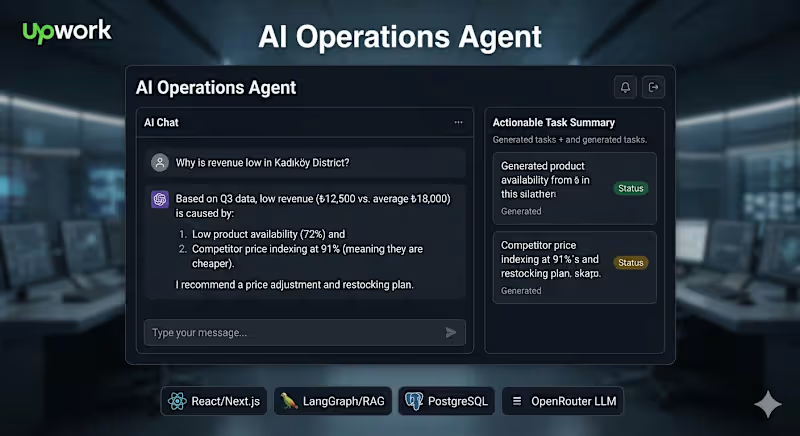
We developed a production-ready Autonomous AI Operations Agent designed to bridge the gap between complex retail data analysis and daily execution. The system acts as a digital consultant for regional managers, transforming raw KPIs into actionable tasks.
Analytical AI Chat: A free-form conversational interface where users can query performance data (e.g., "Show me the top 5 worst profitable stores in Istanbul for the last 3 months").
Task Management Dashboard: A structured workflow where AI-suggested actions are automatically logged for manager approval or rejection.
Automated Action Logic: The agent uses an "Action Suggestion Map" to identify specific defects (like low audit scores or high food waste) and suggest precise corrective measures.
Persistent Memory: Includes both short-term memory for the current chat session and long-term RAG memory to maintain context over time.
2. How We Built It (The Stack)
The system was engineered for scalability and reliability using a modern, containerized stack:AI Orchestration: LangGraph was used to manage complex, multi-turn reasoning and agentic workflows.
Frontend: React/Next.js 14 for a responsive, real-time user interface.
Backend & Data: Node.js paired with a PostgreSQL database capable of handling 1M+ records.
LLM Access: Integrated via OpenRouter to allow for flexible model selection and switching.
Infrastructure: Fully Dockerized to ensure consistent deployment across environments.
3. Challenges We Faced
As the system scaled from prototype to processing millions of records, we encountered several critical engineering hurdles:
Response Latency: The initial monolithic prompt architecture led to response times exceeding 60 seconds, far slower than the required "ChatGPT-like" speed.
Prompt Verbosity & Errors: Complex questions involving multiple variables caused the LLM to lose focus, leading to "reasoning errors" and incorrect SQL generation.
Hallucination Risks: In multi-branch queries, the model occasionally fabricated data points, particularly around manager hours and performance metrics.
Context Switching Bugs: The agent sometimes struggled to "let go" of a previous topic, continuing to reference an old store when the user had asked about a new city.
4. How We Solved It
We re-engineered the core pipeline to transition from a single, heavy agent into a Modular Multi-Step Architecture:
75% Latency Reduction: By decomposing the main logic into smaller, task-specific nodes, we dropped processing time from 60s down to 15s.
Task Decomposition & Specialized Models: We stopped using a "one-size-fits-all" model. Instead, we implemented a router that uses lighter, specialized models for SQL generation and action identification, and flagship models only for final reasoning.
Granular SQL Generation: Breaking the metadata analysis into narrow sub-steps eliminated SQL hallucinations. The model now only "sees" the specific schema needed for the current sub-task, ensuring 100% accuracy.
10-Point Testing Protocol: We implemented a rigorous QA protocol that specifically verified bug fixes for context switching, task duplication, and chart coverage before final delivery.