
Kelvin Desman
Mind of an engineer and the heart of an entrepreneur.
- $50k+
- Earned
- 1x
- Hired
- 15
- Followers


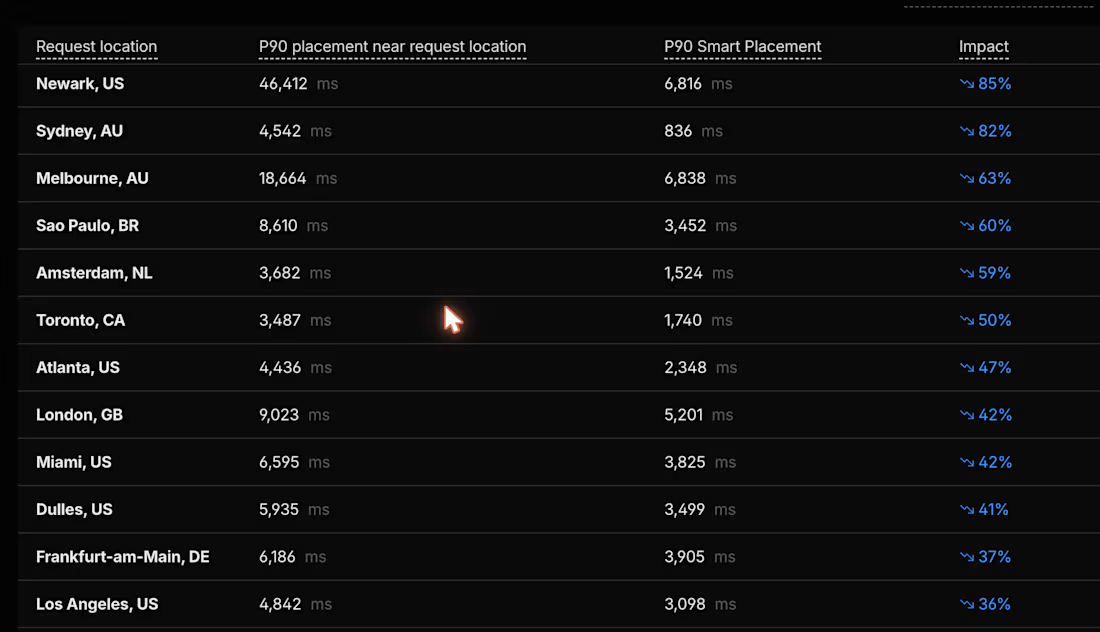
The LokerDollar.com web up to 85% faster in some cities — by moving our code farther from users.
Sounds backwards. Here's why it worked.
1. The edge promise is seductive: run your code in 300+ cities, and it's milliseconds from every user. Newark, Sydney, São Paulo — all local.
2. Your code doesn't work alone. It talks to a database. And that database lives in one place. A single page render can mean 6+ sequential trips to it.
3. Put your compute "at the edge," and each of those trips crosses an ocean and comes back. The edge didn't remove the distance. It multiplied it. That's how a Sydney request quietly turned into seconds of pure waiting.
The fix was one line of config Cloudflare smart placement stopped stop pinning our code next to the user, and run it next to the database instead. One long trip to reach compute, then all the DB chatter is local and nearly free.
The result, measured on our own traffic (P90 — the slowest 1 in 10 requests):
• Newark ↓ 85%
• Sydney ↓ 82%
• Melbourne ↓ 63%
• São Paulo ↓ 60%
and …12 cities faster overall
The lesson I'm taking with me:
Latency isn't about distance to the user. It's the number of long trips on the critical path. Put compute where it talks the most — for data-heavy apps, that's your database, not the edge.
#WebPerformance #EdgeComputing #Cloudflare #BuildInPublic #SoftwareEngineering
1
1
137

Excited to share that Lokerdollar has been accepted into the Cloudflare for Startups program. Grateful for the chance to build something impactful.
But the bigger story is what we're building.
The world of recruiting and hiring is changing fast. In Indonesia alone, millions of people are losing their jobs — economic headwinds, the tech winter, and more. The core problem is a widening gap between industry and talent.
That's why we're building an AI career operating system — an AI that acts as a trusted second brain for landing jobs, improving careers, and handling the manual work. Our platform curates jobs based on your interests and expertise, identifies which roles actually increase your chance of getting hired, and automatically fills out applications so you don't burn hours on paperwork and follow-ups.
We're also building trust into the system. Sometimes AI screening flags too aggressively and rejects good candidates before a human ever reviews them. Our system catches this — because AI shouldn't be rejecting people. It should be helping them.
We're starting in Indonesia, but the opportunity extends far beyond a single country. South Korea, Taiwan, Germany, Italy, the United Kingdom, and the United States are all facing aging populations and shrinking workforces — and they need new ways to connect with talent.
Cloudflare has been instrumental in helping us move from concept to a working product in operation. But our vision is much larger than a curated remote job board. We believe every job seeker should have an AI hiring copilot, get continuous improvement between interviews, and that every company should have greater visibility into how they hire.
The future of hiring isn't about replacing humans. It's about giving job seekers superpowers.
If you're a job seeker, a recruiter, a fellow startup builder, an investor, or someone passionate about the future of hiring and recruitment — I'd love to connect.
#FutureOfWork #CloudflareForStartups #BuildInPublic #CareerTech #StartupIndonesia
1
1
180

I didn't believe the TypeScript 7 speed claims. So I benchmarked it on my own production app — not a toy repo.
1,358 source files. 260K+ lines. The live codebase behind lokerdollar.com (http://lokerdollar.com).
One change: tsc → tsgo (TS7, rewritten in Go). Same tsconfig, same tree, --noEmit.
Cold type-check: 77.1s → 11.6s. 6.6× faster. −85% wall-clock.
Then the part most "10× faster" posts skip — I checked whether it still catches bugs. Seeded 4 classic type errors. Byte-identical diagnostics: same codes, same line and column. The speed isn't bought by missing errors.
But I'm not putting it in your CI yet — and here's the honest reason:
— It's a release candidate
— The native binary drops the JS typescript API, so typescript-eslint type-aware rules, ts-morph, ts-node and ts-jest break
— Custom transformers and incremental builds are still maturing
My call: run it now as a fast local / pre-PR check, and keep tsc as the authoritative CI gate until 7.0 ships stable. You get a 6.6× tighter local loop with zero risk to the pipeline.
The ~$190/year in saved runner minutes is rounding error. The real return is nobody waiting on a turtle.
#TypeScript #DevTools #WebDev
1
1
122
For every feature I shipped with an AI agent, I shipped more than two fixes.
1,000+ PRs. 84 days. Solo. The throughput was real — but 360 of those PRs were fixes against 150 features. That ratio is the part nobody puts in their recap post.
The core problem: the agent is a 20× author, not a 20× reviewer. I had no leverage on verification — just guards built from past failures, useless against anything new.
What I'd change: second agent for adversarial review only, and changes small enough that being wrong is cheap.
Agentic engineering doesn't remove the hard part. It moves it.
1
129