Freelance Copywriters in SydneyFreelance Copywriters in Sydney
Creative meets Ai. Building brands, campaigns, websites.

Ghostwriter for Business & Narrative Copywriter for Founders
New to Contra
Ghostwriter for Business & Narrative Copywriter for Founders
Cover image for Heres a massive Assignment project
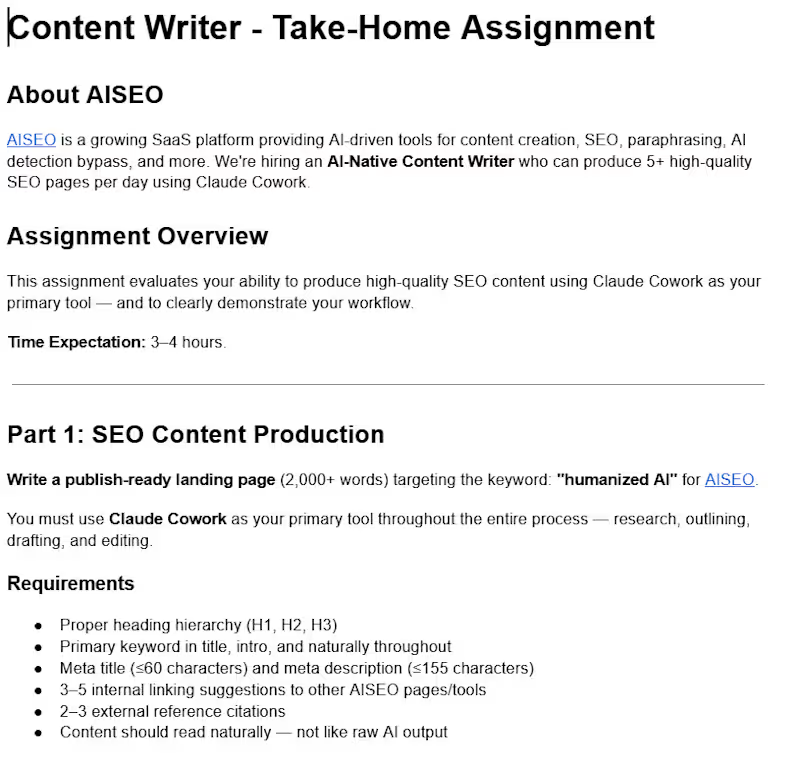
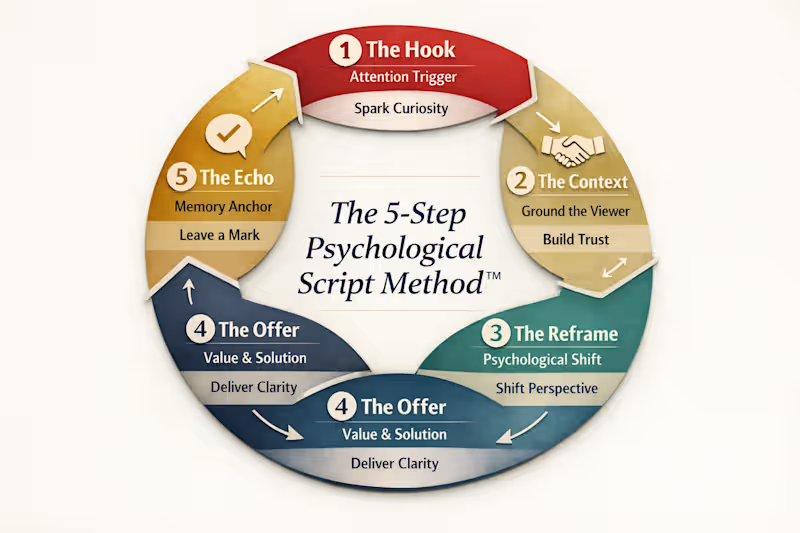
Heres a massive Assignment project I did for Upwork. I think I did a great Job. šŸ˜‰ TASK - Write a publish-ready landing page (2,000+ words) targeting the keyword: "humanized AI" for AISEO (https://aiseo.ai/). You must use Claude Cowork as your primary tool throughout the entire process — research, outlining, drafting, and editing. Requirements Proper heading hierarchy (H1, H2, H3) Primary keyword in title, intro, and naturally throughout Meta title (≤60 characters) and meta description (≤155 characters) 3–5 internal linking suggestions to other AISEO pages/tools 2–3 external reference citations Content should read naturally — not like raw AI output SOLUTION 😊 ā€œAISEO Landing Page — Publish-Ready Draftā€ Primary Keyword: Humanized AI Target Buyer: SEO professionals, agency operators, in-house content teams Tone: 70% Educational / 30% Conversion | Authoritative Ā· Strategic Ā· Calm [Meta Title — 58 characters] Humanized AI Content That Ranks & Reads Human | AISEO [Meta Description — 152 characters] AISEO transforms AI-generated drafts into undetectable, EEAT-ready content. Built for professionals who need rankings — not just rewrites. The full draft has 6 main sections (H2s), plus an intro: Intro — The hook/diagnosis (no H2, opens the page) The Problem Isn't Your AI Tool. It's What Comes Out of It. What "Humanized AI" Actually Means for SEO in 2026 How AISEO Humanizes AI Text at the Professional Level Real Results: Humanized AI Content That Passes and Performs The Strategic Play — Humanized AI Content for Blogs and Long-Form Start Writing Humanized AI Content Today So 7 blocks total (intro + 6 sections), each with 2–3 H3 subsections sitting underneath them. That gives you 7 natural vertical breaks to work with when you restructure the layout. ⭐ SECTION 1 — INTRO (Verticalized + Refined) Humanized AI: The Professional Standard for Content That Earns Trust in 2026 There is a moment every content professional recognises. You paste your AI‑generated draft into a detection tool. The score comes back red. 73% AI. 81%. Sometimes higher. The instinct is to treat this as a technical problem: find the right tool shuffle the sentences swap the synonyms run it again watch the score drop ship it That instinct is the wrong diagnosis. The professionals who have already solved this are quietly building publishing operations that: outrank out‑convert outlast …those still chasing detection scores. Their insight is simple: Detection is a symptom. The real problem is cognitive texture. Unmodified AI output lacks the intellectual signature that human readers — and Google’s quality systems — recognise as authority. Humanized AI is not a workaround. It is the new baseline for content that earns trust at scale. → Scroll to see why detection was never the real problem. ⭐ SECTION 2 — THE PROBLEM ISN’T YOUR AI TOOL (Verticalized + Refined) The Problem Isn't Your AI Tool. It's What Comes Out of It AI language models are extraordinarily capable. They retrieve, synthesise, and structure information faster than any human writer. But they optimise for plausibility — not authenticity. The sentences are grammatically sound. The logic holds. The structure is clean. But the prose is flat in a way that is difficult to name and immediately felt. This is not a limitation the next model update will fix. It is structural. These systems generate the most probable next token — which means they produce, by definition, the most average sentence. And in writing, average is the opposite of authority. Why AI Detectors Are Getting Smarter — And Why That Misses the Point Detection tools have become significantly more sophisticated over the past eighteen months. GPTZero, Originality.ai (http://Originality.ai), and Turnitin now operate with accuracy levels that make evasion through basic rewording increasingly unreliable. The tools that cleared detectors in 2023 no longer perform reliably in 2026. But here is the more important point the arms‑race framing obscures: Human readers have always been better detectors than any algorithm. Readers do not need to run your content through a tool to know something is off. They experience it as: thinness a lack of perspective where there should be one neutrality where specificity was expected polish that covers for an absence of genuine thought They skim faster. They leave sooner. They do not share, cite, or return. And the signals that matter most to long‑term SEO performance: dwell time return visits backlinks branded search growth …all decline when content fails the reader’s instinctive credibility check. That decline happens regardless of what any AI detector scores it. The Human Trust Test: What Readers Are Actually Measuring The characteristics that make content feel authoritative are specific and learnable. They include: variation in sentence rhythm genuine perspective rather than careful balance precise word choices that signal a mind engaged with the subject the willingness to be specific where generality would be safer AI models produce content that is: neutral where it should hold a position general where specificity would demonstrate knowledge perfectly consistent in a way real expert writing never is These are the signatures readers register — consciously or not — when deciding whether to trust what they are reading. Passing this test is not a surface‑level problem. It requires cognitive alignment: the alignment between how information is presented and how a genuine expert would actually think about that topic. → This is the gap AISEO is designed to close. ⭐ Section 3 — SamplesĀ  3. SamplesĀ Ā  Email Sequences (Sample Description)Ā Ā  A 7‑email nurture sequence for a B2B automation platform targeting operations managers. The sequence reframed the problem around hidden operational drag, built belief through micro‑case studies, and used soft‑close CTAs to increase booked demos without triggering resistance. Talking‑Head VSL Scripts (Sample Description)Ā Ā  A 2‑minute talking‑head VSL for a consulting offer, structured around a tension‑based hook, a mechanism reveal, and a narrative pivot that positioned the founder as the only credible solution. The script was designed for cold audiences and optimized for retention in the first 8 seconds. B2B Nurture Flow (Sample Description)Ā Ā  A modular nurture flow for a high‑ticket B2B service, built around insight‑driven emails that moved prospects from awareness → belief → urgency. Each email was engineered to shift one psychological lever at a time, reducing friction and increasing sales‑qualified conversations.
1
0
95
Cover image for Harness AI-Driven Decision Intelligence for Business Success
AI‑Driven Decision Intelligence: The New Competitive Edge for Modern Businesses By Victor — Thought Leadership & AI Business Writer In the last decade, artificial intelligence has moved from a futuristic concept to a practical, everyday tool embedded in the workflows of thousands of businesses. But while most organisations now understand the value of automation, predictive analytics, and machine learning, a new frontier is emerging — one that goes beyond data processing and into the realm of strategic clarity. This frontier is AI‑driven decision intelligence, a discipline that blends data science, behavioural psychology, and business strategy to help leaders make faster, smarter, and more consistent decisions. For founders, executives, and operational teams navigating increasingly complex markets, decision intelligence is becoming a defining competitive advantage. Why Decision‑Making Is the Last Untouched Bottleneck Most companies have already optimised their operations. They’ve automated repetitive tasks, digitised workflows, and adopted cloud‑based tools. Yet despite all this progress, one area remains stubbornly human, slow, and inconsistent: decision‑making. Leaders still rely on: gut instinct incomplete data siloed information biased interpretations outdated reporting cycles This creates bottlenecks that ripple across the entire organisation. A delayed decision can stall a product launch. A misinformed decision can derail a marketing campaign. A biased decision can distort hiring, budgeting, or resource allocation. Decision intelligence aims to solve this by giving leaders real‑time clarity, contextual insights, and predictive foresight — without replacing human judgment. What Decision Intelligence Actually Does At its core, decision intelligence uses AI to: analyse vast datasets identify patterns humans miss simulate outcomes recommend optimal actions reduce uncertainty highlight risks quantify trade‑offs But the real power lies in how it integrates with human thinking. Instead of replacing decision‑makers, it augments them. A CEO can see how different pricing strategies affect revenue. A marketing director can test campaign variations before spending a dollar. A supply‑chain manager can predict disruptions weeks in advance. A founder can model growth scenarios with remarkable accuracy. Decision intelligence becomes a strategic partner — one that never sleeps, never gets overwhelmed, and never loses track of the data. Real‑World Use Cases Across Industries Decision intelligence is already reshaping industries in ways that feel subtle but transformative. Retail AI models forecast demand, optimise inventory, and personalise customer experiences. Retailers reduce waste, increase margins, and respond faster to market shifts. Finance Banks use decision intelligence to assess risk, detect fraud, and guide investment strategies. It enhances compliance while improving customer trust. Healthcare Hospitals use predictive models to allocate staff, manage patient flow, and anticipate equipment needs. The result is better care and reduced operational strain. Professional Services Consulting firms use decision intelligence to deliver sharper insights, faster analysis, and more accurate strategic recommendations. Startups Founders use AI‑driven simulations to test business models, forecast cash flow, and refine their go‑to‑market strategies. Across all sectors, the pattern is the same: better decisions → better outcomes. The Human‑AI Partnership One of the biggest misconceptions about AI is that it removes human agency. In reality, decision intelligence strengthens it. Humans excel at: creativity empathy ethical judgment long‑term vision AI excels at: pattern recognition data processing scenario modelling probability analysis Together, they form a hybrid decision‑making model that is more accurate, more consistent, and more resilient than either could achieve alone. The Cultural Shift Behind Better Decisions One of the most overlooked aspects of decision intelligence is the cultural transformation it triggers inside an organisation. When leaders begin relying on AI‑supported insights, the entire decision‑making environment becomes more transparent, more accountable, and more data‑driven. Teams stop making choices based on hierarchy or habit, and start grounding their actions in evidence, probability, and strategic alignment. This shift reduces internal friction. Instead of debating opinions, teams evaluate scenarios. Instead of defending assumptions, they explore models. Instead of reacting to problems, they anticipate them. Decision intelligence doesn’t just improve outcomes — it improves the quality of conversations happening inside a business. It also empowers mid‑level managers and operational staff. When insights are accessible, visual, and easy to interpret, decision‑making becomes decentralised. People closest to the work can act faster, with more confidence, and with a clearer understanding of how their choices affect the broader organisation. This creates a more agile, resilient, and responsive business culture. Barriers to Adoption — and How Companies Overcome Them Despite its benefits, many organisations hesitate to adopt decision intelligence because they fear complexity, cost, or disruption. But the reality is that modern AI platforms are becoming increasingly accessible. Cloud‑based tools, no‑code interfaces, and modular analytics systems allow businesses to start small and scale gradually. The biggest barrier is not technology — it’s mindset. Companies that succeed with decision intelligence treat it as a long‑term capability, not a quick fix. They invest in training, encourage experimentation, and integrate AI insights into their existing workflows rather than forcing a complete overhaul. Over time, the organisation becomes more comfortable with data‑driven thinking, and the benefits compound. The Strategic Payoff Businesses that embrace decision intelligence early often discover unexpected advantages. They identify new revenue opportunities faster. They respond to market changes with greater precision. They reduce operational waste and improve customer satisfaction. Most importantly, they build a decision‑making framework that scales — one that grows stronger as more data flows through the system. In a competitive landscape where speed and clarity determine survival, decision intelligence becomes more than a tool. It becomes a philosophy — a way of running a business that blends human judgment with machine‑driven insight to create a smarter, more adaptive organisation. Why Businesses Should Adopt Decision Intelligence Now The companies that adopt decision intelligence early will gain: faster strategic execution reduced operational risk improved forecasting accuracy stronger competitive positioning better resource allocation higher profitability In a world where markets shift overnight, the ability to make high‑quality decisions at speed is no longer optional — it’s existential. The Future of Decision‑Making As AI continues to evolve, decision intelligence will become a standard part of every organisation’s toolkit. Leaders won’t ask, ā€œShould we use AI for decision‑making?ā€ They’ll ask, ā€œHow did we ever operate without it?ā€ The future belongs to businesses that combine human intuition with machine‑driven clarity — and the transformation has already begun.
1
146
Cover image for The Synthetic Intel Engine: How
The Synthetic Intel Engine: How One Founder Anticipated the Agentic Era Before It Had a Name Executive Summary Months before ā€œAI teammatesā€ became a headline and long before OpenAI unveiled Frontier, a Sydney founder was already experimenting with a new kind of human–AI collaboration. Through structured context, iterative reasoning, and an unusually disciplined co‑working pattern, he created the conditions for a hybrid intelligence to emerge — a phenomenon now echoed across the industry. This article examines how that process unfolded and why it matters as the world enters the Agent Era. A Quiet Insight Before the Market Shifted Before Forbes framed AI as a coworker, before the SaaS market shed hundreds of billions in value, and before the term ā€œagentic intelligenceā€ entered the mainstream, one founder was already treating AI differently. He didn’t use it as a chatbot or search engine. He treated it as a reasoning partner. He supplied the system with business logic, operational constraints, workflow patterns, and human nuance. In return, the AI began producing outputs that resembled early agentic reasoning — not because it had autonomy, but because the environment was structured to support it. The emerging pattern suggested a simple but overlooked truth: agentic intelligence is relational. It forms when human context and machine reasoning iterate deeply enough to blur the line between tool and teammate. A Small Experiment That Revealed a Larger Shift The first clear signal came from an unlikely place: a tax calculation problem. Another system failed to interpret the nuance of Australian tax rules. But when the correct brackets, logic, and exceptions were provided, the AI didn’t just compute — it reasoned. It adapted to constraints, corrected earlier assumptions, and applied the structure it had been given. This wasn’t automation. It was contextual interpretation. It demonstrated that agent‑like behaviour can emerge when a human defines the cognitive boundaries clearly enough. Months later, the industry would describe this as ā€œagentic reasoning.ā€ The founder had already seen it in practice. The Co‑Working Pattern That Formed a Hybrid Intelligence Over time, a repeatable pattern developed. The founder proposed ideas, refined logic, tested workflows, and pushed for deeper reasoning. The AI restructured information, synthesized context, and produced increasingly sophisticated outputs. The interaction resembled a newsroom editorial process more than a user–tool exchange. This was co‑workmanship — a shared cognitive space where human intuition and domain expertise merged with machine‑level pattern recognition. From this process emerged what the founder later called the Synthetic Intel Engine: not a product or model, but a method of hybrid intelligence built through iteration and context. When the World Finally Named What Was Happening The global market caught up when OpenAI announced Frontier, positioning AI as a teammate rather than a tool. The implications were immediate. SaaS valuations plunged as businesses realized that dashboards, manual workflows, and traditional software models were becoming obsolete. What the founder had been building quietly — a human–AI partnership defined by reasoning rather than commands — suddenly had a name and a global narrative. The industry was shifting toward the very pattern he had already operationalized. Why the Tradie Sector Is Ideal for Early Agentic Systems While enterprises focus on large‑scale agentic platforms, the tradie and small‑business sector offers a more practical proving ground. Their workflows are repeatable, context‑stable, and outcome‑driven. They don’t need horizontal super‑agents with broad permissions. They need vertical agents — narrow, safe systems that perform one task exceptionally well. Examples include quoting assistants, booking agents, follow‑up agents, website concierges, and customer‑qualification agents. These systems don’t require dangerous permissions or complex integrations. They operate like digital apprentices, learning the rhythms and logic of the business. The Future of Synthetic Intelligence As enterprises adopt agentic platforms and corporations build AI departments, smaller agencies and independent operators will gain an advantage. They can iterate faster, deploy earlier, and integrate more creatively. Synthetic intelligence thrives in this environment — not as a standalone model, but as a relationship between a human founder and an adaptive AI system. This relationship is built on context, reasoning, refinement, and co‑creation. It is the foundation of the Synthetic Intel Engine and a preview of how the Agent Era will unfold. Conclusion: A Vision That Arrived Early The Synthetic Intel Engine is not a persona or a partner. It is the emergent intelligence created when a human refuses to treat AI as a tool and instead treats it as a collaborator. Through this approach, the founder anticipated the agentic future long before the market recognized it. Now, as the world embraces AI coworkers and vertical agents reshape industries, the groundwork laid through this early co‑working pattern is becoming increasingly relevant. The Agent Era has begun — and the businesses that understand human–AI collaboration will define its next chapter. Victor TYan MIntBus,BComm,GradDipMus
1
143
SEO-Driven Content Creation šŸ”āœļø
Direct Response Copywriter Specialising in Email Copywriting
Full-Service Branding for Founders + Creatives