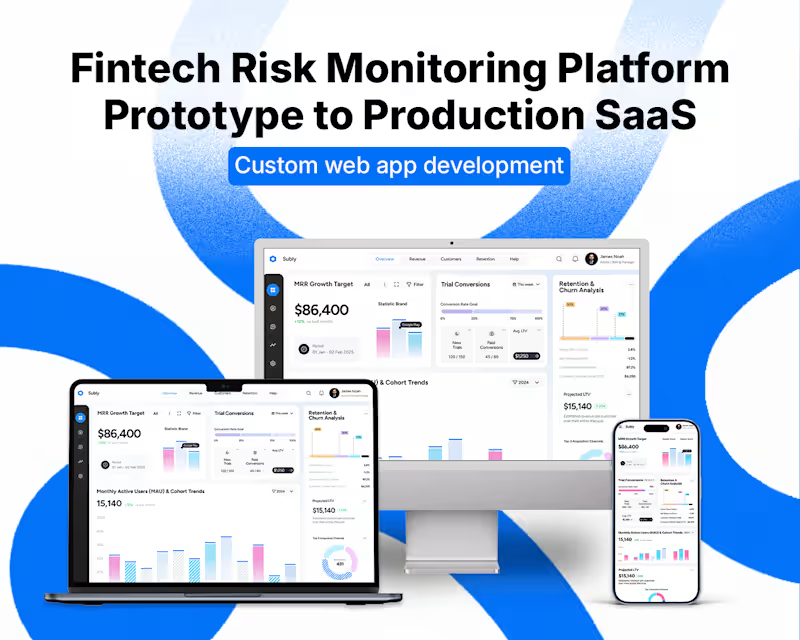
Projects using TypeScript in SindhProjects using TypeScript in SindhKovaRisk: When the Interface Knew More Than the System
──────────────────────────────────────────
The Expert in the Room
Compliance officers don't struggle to understand risk. They struggle to act on it fast enough.
The team behind KovaRisk understood this precisely. They had spent years inside financial institutions watching the same dysfunction repeat: alerts buried in spreadsheets, investigations tracked in email threads, audit trails reconstructed after the fact. They knew
what the interface needed to feel like because they'd lived with the one that didn't.
So they built it. Fast. Exactly as they'd imagined it.
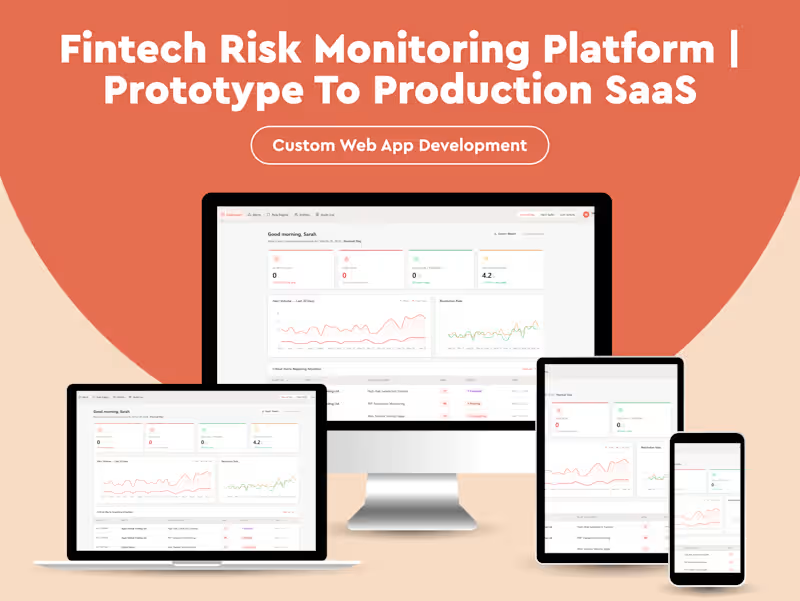
What emerged was sharp: a risk monitoring dashboard with filterable alert feeds, entity profiles with 12-month risk trajectories, a rule engine with toggle controls, and an audit log that felt immutable. The scenario switcher let compliance teams stress-test
different alert load states. The side panel made investigations feel contained and intentional.
It looked like a system that had survived production.
It hadn't been asked to yet.
──────────────────────────────────────────
What Existed Was a Strong Interface - Not a System
Every alert in KovaRisk was generated at startup. Every risk score was computed by a random seed function. Every status change - Investigating, Resolved, Escalated - lived in component state. Every timeline event was appended to an in-memory array. Every rule toggle
disappeared on refresh.
The audit log recorded nothing. The export downloaded a snapshot of what React was holding at that moment. The entity risk history was a curve drawn from a formula, not a record.
The logic was there. But it had nowhere to live.
A compliance officer investigating a high-risk wire transfer would open the side panel, read the plain-English rule explanation, mark the alert as Investigating, add an internal note - and lose every one of those actions the moment they refreshed the browser. No
colleague could see what they'd done. No regulator could verify it had happened.
In financial compliance, that's not a UX problem. It's a liability.
The prototype validated the workflow brilliantly. It exposed exactly how a compliance team would move through their day. But three things were missing: a source of truth, a coordination layer, and a trail that could be audited under pressure.
──────────────────────────────────────────
They Didn't Need More Features - They Needed a System Behind the Interface
The team came with a clear idea and a working prototype. What they needed was the architecture that made the prototype a product - the layer that turned interface actions into durable facts.
Not a rebuild. A foundation.
──────────────────────────────────────────
The Layer That Made It Dependable
Data Models: Giving State a Home
The first thing to reconstruct was where the data should actually live.
KovaRisk's frontend implied a clear schema - alerts, entities, rules, audit events - but none of it persisted. The production system needed a PostgreSQL core with five primary entities:
• Alert — with foreign keys to Entity, Rule, Transaction, and a JSONB timeline column for ordered event history
• Entity — with risk tier, jurisdiction metadata, and a one-to-many relationship to RiskScore snapshots
• Rule — with active/disabled state, trigger thresholds, false-positive tracking, and a versioning mechanism so changes to rules didn't retroactively alter historical alerts
• AuditEvent — append-only, with actor ID, action type, target reference, and a server-generated timestamp that clients cannot modify
• InternalNote — owned by an alert, with authorship and a soft-delete flag to preserve compliance integrity
Every status change, note, escalation, and flag the UI handled ephemerally became a write to this schema.
The Alert Generation Engine: Replacing the Seed Function
In the prototype, 85 alerts appeared because a loop ran 85 times at startup.
In production, alerts are the output of a Transaction Monitoring Service - a background process that runs continuously against incoming transaction streams.
This service:
• Evaluates each transaction against every active Rule definition
• Computes a risk score using rule weights, entity risk tier, jurisdiction flags, and behavioral baselines
• Creates an Alert record only when a threshold is breached
• Emits an event to a notification queue for high-risk triggers
The rule engine the UI let users toggle wasn't decorative. Each rule mapped to an evaluation function in the monitoring service. Disabling a rule didn't just grey out a card - it removed it from the active evaluation set. Re-enabling it didn't retroactively generate
alerts it would have caught; it resumed from the point of activation. That distinction mattered for regulatory defensibility.
──────────────────────────────────────────
Async Workflows: The Operations the UI Implied But Couldn't Sustain
Several interactions in the prototype implied workflows that couldn't complete synchronously.
Escalation - When an alert was escalated, the UI changed a status badge. In production, escalation triggers a queue job that: notifies the senior compliance officer via a configured channel, creates a case record linking the alert, and starts a response SLA timer.
The UI reflects the outcome - it doesn't produce it.
Scheduled Screening - The Sanctions Screening Match rule in the prototype was static. In production, it's a nightly job that re-screens all active entities against updated OFAC, EU, and UN sanctions lists - generating new alerts if a previously clean entity now
appears. The results feed back into the alert pipeline.
Report Export - The dashboard's Export Report button downloaded a text file of whatever React was holding in memory. In production, report generation is an async job: the user requests the report, the job runs server-side against the live database, and a download
link is returned when ready. The content is a verifiable, timestamped record - not a UI snapshot.
──────────────────────────────────────────
The Audit Log: From Feed to Fact
The prototype's audit log was populated by a generateAuditLog function. It looked comprehensive and immutable. It was neither.
Production audit events are written by the API layer on every state-modifying operation - before the response is returned to the client. The table is append-only. No update operations are permitted on AuditEvent records. Timestamps are server-generated in UTC and
stored with full precision. Actor identity comes from the authenticated session, not from a string the client sends.
The audit log the interface displayed was a simulation of accountability. The production version is the accountability.
──────────────────────────────────────────
Tech Stack
1. Frontend: React + Vite, React Router v6, Recharts, React Context + local state, TanStack Query
2. Backend: Node.js + TypeScript, Fastify, Prisma, PostgreSQL, Redis, BullMQ, Passport.js + express-session
3. Infrastructure: AWS ECS / Railway / Render, S3, AWS Secrets Manager / Doppler, Sentry + Datadog, GitHub Actions
4. External Integrations: OFAC / ComplyAdvantage, Refinitiv World-Check, SendGrid / SMTP, Webhooks
──────────────────────────────────────────
From Interface to System
The prototype answered the right questions. It proved the workflow was sound, the information hierarchy was correct, and the alert investigation pattern worked the way compliance officers needed it to.
What it couldn't answer was: what happens when two investigators open the same alert simultaneously? What happens when a rule change needs to take effect immediately across 200 pending alerts? What happens when a regulator asks for every action taken on a specific
entity over the past 18 months?
Those questions don't live in the interface. They live in the system.
KovaRisk's interface was always strong. What it needed was the architecture to make it real - persistent, coordinated, auditable, and defensible under scrutiny.
The logic existed from the beginning. We gave it somewhere to live.
Building a Dreamy Kawaii E-Commerce Store with Squish Physics & Ambient Soundscapes ☁️🧸
Hey Contra community! 👋
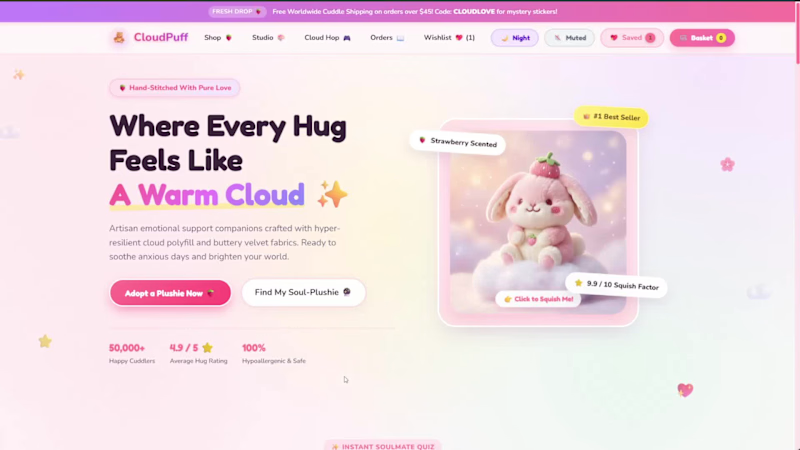
I’ve been designing and developing CloudPuff, an interactive, joy-first e-commerce experience for plushie lovers. Instead of another cookie-cutter shop, I wanted every interaction to feel tactile, cozy, and playful.
What I’ve built so far:
Interactive Squish Physics: Spring animations, squeeze physics, and tactile micro-interactions on hover and click.
Custom Plushie Studio (/customizer): Real-time workshop to build custom plushies (fur tone, scent selection, embroidered collar tags).
Web Audio Soundscapes: Built-in soothing ambient lullaby chime, squish FX, and audio feedback.
In-Page Real-World Size Guide: Visual comparison against everyday objects (coffee mug, 13" laptop, sleeping house cat, pillows).
Adoption Registry & Live Tracker: Official printable birth certificates and a simulated live cuddle courier radar.
Day & Twilight Night Mode: Custom dual-palette design system built purely in Vanilla CSS & Next.js.
Looking for your feedback:
Do you prefer the dreamy pastel cotton candy aesthetic or the deep twilight glassmorphism?
What’s missing? If you were adopting a plushie buddy, what delight feature or micro-interaction would make you say "take my money"?
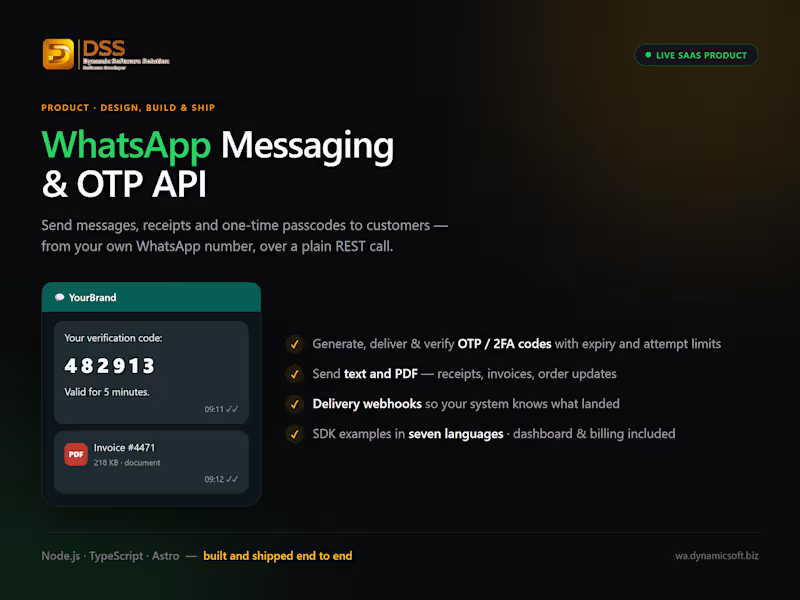
Drop your thoughts or suggestions below. I’d really appreciate your critique! 👇✨ A messaging API that lets businesses send WhatsApp messages and documents
from their own number, programmatically.
The problem it solves: a small business wants to send order confirmations,
receipts and invoices on WhatsApp — where their customers actually are —
but the enterprise options are heavy, slow to get approved, and priced for
companies far larger than them.
So I built the alternative. One REST endpoint to send a message, another to
attach a PDF, and delivery webhooks so your system knows what landed. OTP
codes with expiry and attempt limits for login and 2FA. SDK examples in
seven languages, a dashboard to manage it, and a subscription that starts
at $19/month.
I designed, built and shipped the whole thing — API, dashboard, billing,
docs and marketing site. Node.js and TypeScript on the backend, Astro for
the site. NicheHunter — Figma to Next.js Landing Page
Overview
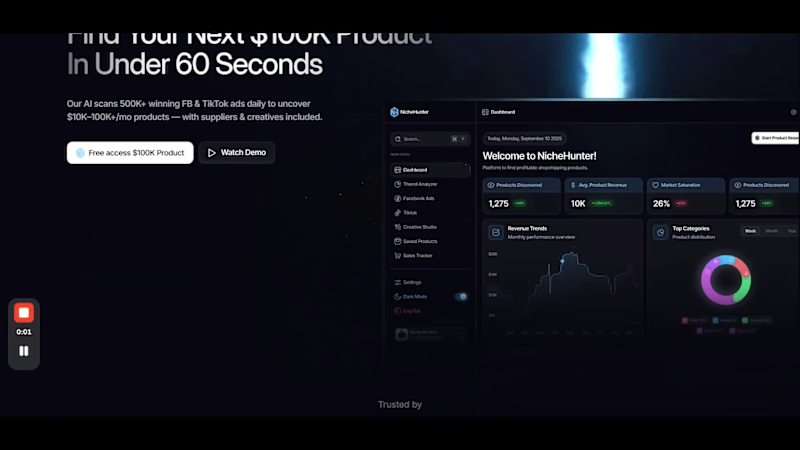
NicheHunter is an AI-powered product research platform for dropshippers and e-commerce marketers, scanning 500K+ Facebook and TikTok ads daily to surface winning products before they saturate the market. My task was to convert the Figma design into a fully functional Next.js landing page, building the front end from scratch.
My Role & Contributions
✅ Built a brand-new Next.js application from the ground up based on the provided Figma design
✅ Used ShadCN UI to implement clean, accessible, and consistent UI components (pricing cards, feature sections, FAQ accordion, etc.)
✅ Implemented an interactive testimonials carousel using React-Slick
✅ Set up authentication flow with NextAuth for user sign-up/login/reset
✅ Handled form validation using Zod and React Hook Form for the trial sign-up and lead capture flows
✅ Built out key sections: hero with product dashboard preview, feature highlights, social proof/testimonials, pricing tiers (Starter, Professional, Enterprise), and FAQ
✅ Ensured responsive design and smooth UX across all sections
Tech Stack
Next.js · ShadCN UI · NextAuth · Zod · React Hook Form · React-Slick
Outcome
A polished, conversion-focused landing page with a complete sign-up and authentication flow — translating the original design 1:1 into a fast, responsive, production-ready Next.js build.
Live Preview: https://niche-hunter.vercel.app/ KovaRisk: Turning a Risk Monitoring Prototype Into a Production-Ready Fintech Platform
From Interactive Compliance Dashboard to Persistent Risk Intelligence System
KovaRisk started with a clear goal: give compliance teams a centralized way to monitor financial risk, investigate alerts, manage rules, and maintain reliable audit records.
The original prototype already had a strong product foundation. It included:
Risk and alert monitoring dashboards
Filterable alert feeds
Entity-level risk profiles
Historical risk trends
Configurable monitoring rules
Investigation workflows
Audit activity
Scenario-based testing
The interface effectively demonstrated how a compliance team could interact with the product.
The challenge was that most of the underlying functionality was still simulated.
The Gap Between the Prototype and Production
The frontend represented a complete risk-management workflow, but much of its state existed only inside the browser.
Alerts were generated when the application started. Risk scores were simulated. Status changes were stored in component state, and audit events existed only in memory.
Refreshing the application could erase an investigation update, internal note, or rule configuration.
For a financial compliance platform, persistence isn't simply a technical requirement. Investigations, decisions, and user actions need to remain traceable and verifiable.
The next phase was therefore focused on building the system behind the interface.
Building the Production Foundation
Structured Data Architecture
We translated the prototype's workflows into a persistent relational data model using PostgreSQL.
The architecture introduced dedicated entities for:
Alerts
Financial entities
Monitoring rules
Risk-score history
Audit events
Internal investigation notes
Transactions
Relationships between these entities allowed actions performed through the interface to become durable records rather than temporary frontend state.
Rule versioning was also introduced so historical alerts could remain associated with the conditions that existed when they were generated.
Real-Time Alert Generation
The prototype initially generated a predefined set of alerts.
We replaced this behavior with a transaction-monitoring architecture capable of evaluating incoming transactions against active compliance rules.
The system could:
Evaluate transactions against configured rules
Calculate risk scores
Consider entity and jurisdiction risk
Identify threshold breaches
Create persistent alert records
Trigger notifications for high-risk events
Rule controls in the dashboard became connected to the actual monitoring engine.
Disabling a rule affected future evaluations rather than simply changing the appearance of a UI component.
Asynchronous Compliance Workflows
Several actions required more than a simple frontend state change.
We introduced background processing for operational workflows such as:
Alert Escalation
Escalating an alert could initiate notifications, create a corresponding case, and begin tracking the response timeline.
Scheduled Screening
Entities could be periodically screened against external sanctions data, with newly identified matches feeding back into the alert workflow.
Report Generation
Instead of exporting whatever happened to be loaded in the browser, reports were generated server-side from the current database state and made available once processing completed.
This created a more reliable separation between the user interface and the underlying business operations.
Building a Reliable Audit Trail
One of the most important parts of KovaRisk was transforming the audit interface from a simulated activity feed into a persistent record of system events.
Audit events were generated at the API layer whenever important state changes occurred.
Each event captured:
Authenticated user
Action performed
Target entity
Event type
Server-generated timestamp
Relevant activity context
The audit records were designed to be append-only, preventing normal application workflows from modifying historical events.
This gave compliance teams a much more dependable record of how alerts and investigations progressed.
Technology Stack
Frontend: React, Vite, React Router, Recharts, TanStack Query
Backend: Node.js, TypeScript, Fastify, Prisma
Database & Processing: PostgreSQL, Redis, BullMQ
Authentication: Passport.js, Express Session
Infrastructure: AWS ECS, Railway / Render, Amazon S3
Security & Monitoring: AWS Secrets Manager, Doppler, Sentry, Datadog
Integrations: OFAC / ComplyAdvantage, Refinitiv World-Check, SendGrid / SMTP, Webhooks
The Result
KovaRisk evolved from an interactive compliance prototype into a structured fintech risk-monitoring platform.
The interface remained focused on the workflows compliance teams needed, while the underlying architecture introduced:
Persistent data
Automated alert generation
Configurable rule processing
Background workflows
External screening integrations
Reliable report generation
Role-aware system operations
Persistent audit records
The key transformation wasn't adding more screens.
It was connecting every important interaction in the interface to a dependable backend process.
The prototype demonstrated how compliance teams should work. The production architecture made those workflows persistent, automated, and operationally reliable.