Freelancers using GitHub in OdesaFreelancers using GitHub in Odesa
Experienced Game Developer: Turning Ideas into Games
Designer Who Ships: Websites & MVPs with Backend, AI-Built
59
Followers
Designer Who Ships: Websites & MVPs with Backend, AI-Built
Cover image for TYKHO Care — sensory-friendly haircuts
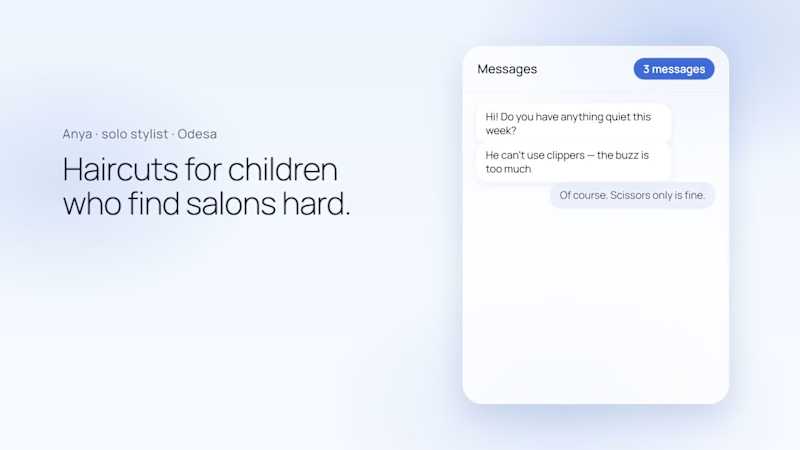
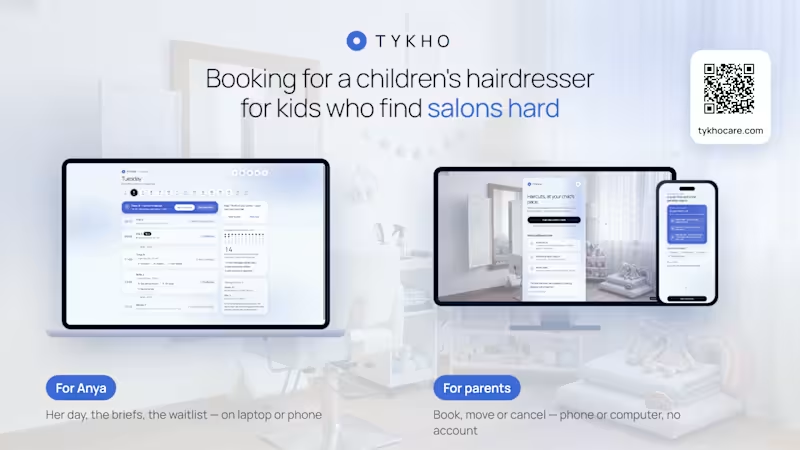
TYKHO Care — sensory-friendly haircuts for children · Odesa, Ukraine TYKHO turns a parent's worried "can we come to you?" into the right kind of visit at the right time — booked, prepared and refilled on cancellation, without a single scheduling message for the stylist. The client:* Anna "Anya" Kovalynska, a solo children's hairdresser in Odesa. One chair, one child at a time — a quiet studio in Arcadia plus home visits along Fontanka Road and in Tairova. Many of her clients are children who find salons hard: the buzz of clippers, mirrors, waiting rooms, being touched. Quirks I designed for: - quiet hours only on Tue/Wed mornings - high-support visits need a 15-min buffer - some children need a 20-min Meet & Greet first - home visits are grouped by district - "tough morning" cancellations burn the rare quiet slots - parents re-explain their child's triggers every time - Anya can't answer the phone mid-cut For parents (no account, no app store): - 5 calm questions → the gentlest kind of visit, with the reasons - only the times that fit their child - instant confirmation and a "what will happen" story to show the child - reminder with one-tap confirm, move or cancel - none of the times fit? Join the waitlist and get an offer by email For Anya (installable owner app): - her whole day on one screen - a brief for every child built from the parent's answers - reminders and a one-tap nudge - cancellations offered automatically to the best-fit family on the waitlist, held 2 hours, then passed on - a day off asks the affected families to pick a new time — nothing is cancelled - book for a family by phone with the same 5 questions - a note after each visit that the next visit starts from - Outbox of every email sent for her · services, prices and hours · QR poster for the studio mirror · light and dark theme Under the hood: Lovable Cloud — server-validated slots with no double booking at the database level, row-level security, scheduled jobs for reminders and offer expiry, transactional email via Resend on its own domain, two PWAs. Removed from Anya's day: scheduling DMs · repeated care questions · manual reminders · chasing cancellations and the waitlist · calling every family on a sick day · preparing each child from memory. One demo week: 14 bookings confirmed without a message · ~3 h of messages saved (estimate) · 2 cancelled slots refilled automatically · 0 care questions repeated. Note: TYKHO Care, Anna Kovalynska and the families are fictional; the studio photo is AI-generated. Links: Site: https://tykhocare.com Lovable project https://lovable.dev/projects/58de9f8c-5ea0-4edf-a27a-102cca33a46f?magic_link=mc_cfcac9a5-e941-4d3d-897e-1fb1a4a3eb8d Demo video: файл «01 Demo video» Bonus: «02 What got easier for Anya», «03 How I built it» Post: https://lnkd.in/p/ddNythxk https://x.com/trusovanaty/status/2105627540081492293?s=20 For Test: 1. Be a parent (no login). Open https://tykhocare.com on your phone → "Start the comfort check" → answer for a made-up child → pick one of the times → enter your real email. You'll get the confirmation email with a "Manage visit" link (reschedule / cancel in one tap). None of the times fit? Tap "Join the waitlist". 2 · Be Anya (owner). https://tykhocare.com/owner/login — email: usertestanya@gmail.com (mailto:usertestanya@gmail.com) · password: Anya0508. Your booking is already in her day with a brief built from your answers. The envelope icon (Outbox) shows every email the system sent. "…" → Services & hours: prices, hours, a day off. "…" → Studio QR poster. 3 · Try the waitlist. Cancel your visit from the email ("Manage visit") → if the freed time fits a family on the waitlist, Anya's Outbox shows the "A quiet time just opened" offer that went to them — no call from Anya needed. Tip: both sides install as separate apps (TYKHO / TYKHO Owner) — Chrome ⋮ → Install app, or Safari → Share → Add to Home Screen. Demo data resets every night. While signed in as Anya, you can also restore it yourself: "…" → Reset demo data.
5
10
940
Cover image for TOTEM — FLORA Museum Challenge
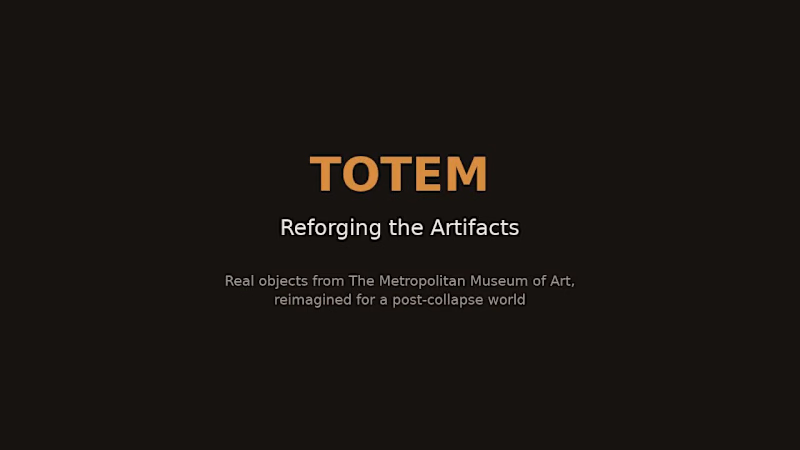
TOTEM — FLORA Museum Challenge submission The Challenge: take one real, public-domain object from The Metropolitan Museum of Art's collection and reimagine it into a new world, using FLORA. The Story In a world after collapse, a new civilization is born from the remnants of the old. But this is not a story of abandonment or forgetting. It is a story of transformation: how memory survives by changing form. The film shows objects transforming into metal. The form remains the same — monumental, permanent, enduring. In this transformation lies the film's deepest meaning. The Primary Artifact: Raven Rattle The heart of TOTEM is a 19th-century rattle by the Xaadas (Haida) people, from Masset, Haida Gwaii. The Met describes it directly: "This raven rattle depicts a perched bird with wings outstretched toward its front — an unusual representation of the raven on a rattle, more typical of the way it would be depicted on a memorial (or totem) pole." This wasn't simply a musical object. A rattle like this was carried by a chief during ceremonial dances as a mark of rank, spiritual power, ritual performance, and the transmission of knowledge. The rattle was an instrument of authority — a voice that commanded attention and carried meaning between generations. What the Raven Symbolizes For the Haida, Raven isn't just a myth character — it's one of the two clan divisions their entire society was built on: Raven and Eagle, inherited through the mother's line. To be Raven is to carry a specific role, a specific responsibility in the social order. But Raven's significance reaches far beyond one people. Across the Pacific Northwest, Raven keeps reappearing in the same role: a creator and trickster figure, the one who changes the established order and brings a new world into being. Even in Norse mythology, Odin's ravens Huginn and Muninn represent Thought and Memory — the keepers of knowledge that fly across the world and return. Almost everywhere it shows up, Raven carries the same charge: intelligence, transformation, the thing that adapts and endures. Why Raven Leads This World In TOTEM, these meanings converge. The raven becomes the central keeper of memory in a world that has lost its history. The rattle — an instrument of ceremony and rank — becomes a medallion with a single burning eye: the emblem of a civilization built not by forgetting the past, but by carrying it forward in a harder form. The raven survives not by remaining unchanged, but by changing form. Wood becomes metal. A ceremonial object becomes an idol. A symbol of one tradition becomes the foundation of a new civilization. These people have not abandoned their ancestors' knowledge. They have transformed it into something that will endure. All six artifacts used in TOTEM Primary artifact: Rattle (Raven) — Xaadas (Haida), 19th century — wood, pebbles, polychrome https://www.metmuseum.org/art/collection/search/501263 Supporting artifacts, used as visual texture to enrich the world: Totem Pole Model — Tlingit, 1820–40 — wood https://www.metmuseum.org/art/collection/search/319073 Totem Pole Model — Haida, 1875–85 — wood, pigment https://www.metmuseum.org/art/collection/search/319081 Totem Pole Model — Charles Edenshaw, ca. 1890 — argillite https://www.metmuseum.org/art/collection/search/319092 The full story of the totem poles — how they encode lineage, rank and memory, and what they become in TOTEM: https://contra.com/community/S5brMMr9-totem-the-gate-bonus-piece Ceremonial Board (Malu) — Sawos people, 19th century — wood https://www.metmuseum.org/art/collection/search/311159 The full story of the ceremonial board — the threshold between the visible and the invisible: https://contra.com/community/4VyUOTHR-totem-the-throne-bonus-piece Grere'o (Shield) — Solomon Islands, early to mid-19th century — fiber, shell, nut paste https://www.metmuseum.org/art/collection/search/310073 Four different original materials — wood, stone, shell, and fiber — all reforged into one material in TOTEM- metal. What the Film Reveals TOTEM shows that memory is not fragile — it is resilient. It survives not by being preserved untouched, but by being transformed. The objects that once held ceremonial meaning for one people become the symbols of power for another. The wisdom encoded in their forms — their balance, their proportions, their spiritual weight — is not lost. It is reborn in a new material, carrying the same essential truth. A civilization that remembers is stronger than one that starts from nothing. Silhouette preserved. Material is not. 🔊 Watch with sound. Half of this world lives in the audio — the film reads differently without it. FLORA project: https://app.flora.ai/join-project/dd0f3ef8-da87-4ca9-aa23-1ebe54a56d65 #floramuseumchallenge #flora #metmuseum #generativedesign
11
766
Cover image for TOTEM — The Gate (bonus
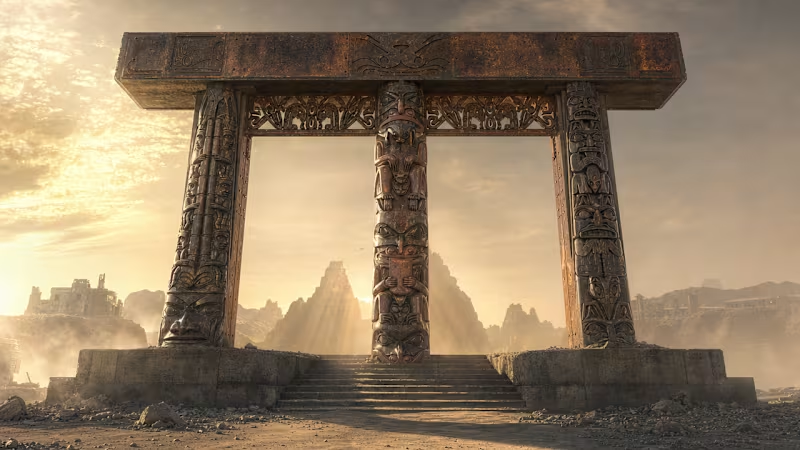
TOTEM — The Gate (bonus piece — my main entry is here 👇) Main submission TOTEM: https://contra.com/community/Y6nZXmUy-totem-flora-museum-challenge-submission — that's the one to upvote for the challenge. This piece is a side visual from the same project TOTEM. Traditionally, welcome poles stood at the edge of a Northwest Coast village to greet visitors, and every totem pole carried a clan's lineage and history in its carved figures — a record of memory, not an idol. In TOTEM, three separate pole models — Tlingit (1820–40, wood), Haida (1875–85, wood, pigment), and one carved in argillite around 1890 by Charles Edenshaw — are reimagined not as three separate standing poles, but fused into a single arch at the shrine's threshold, keeping that same essence: they carry clan memory and greet whoever arrives. One gate instead of three poles, reforged in metal instead of wood and stone. The Met's own records don't specify what each carved figure on these three poles depicts, so the imagery in TOTEM's version is my own extrapolation — grounded in the real, documented purpose of welcome poles and clan-crest carving, not a literal reading of these specific figures. Model poles like these first appeared in the Pacific Northwest in the 1860s, once full-sized totem poles were no longer being carved at the same scale — smaller versions became the way carvers, including Edenshaw, kept the same imagery and tradition alive for the next generation. In the post-collapse world of TOTEM, that same tradition is deliberately amplified: several poles are merged into a single arch, scaled up to a monumental size, and carved in a far more durable material — metal instead of wood and stone — so that it reminds everyone who passes through of the history of the lineage it carries. Totem Pole Model — Tlingit, 1820–40 — wood https://www.metmuseum.org/art/collection/search/319073 Totem Pole Model — Haida, 1875–85 — wood, pigment https://www.metmuseum.org/art/collection/search/319081 Totem Pole Model — Charles Edenshaw, ca. 1890 — argillite (carved stone) https://www.metmuseum.org/art/collection/search/319092 FLORA project: https://app.flora.ai/join-project/dd0f3ef8-da87-4ca9-aa23-1ebe54a56d65 👉 Full story TOTEM: https://contra.com/community/Y6nZXmUy-totem-flora-museum-challenge-submission #floramuseumchallenge #flora #metmuseum #generativedesign #FLORAMuseum
7
9
880
Web & AI & Framer & Kajabi & React & Claude Code & Figma
$5k+
Earned
3x
Hired
5.0
Rating
27
Followers
Web & AI & Framer & Kajabi & React & Claude Code & Figma
AI Engineer & Full-Stack Developer | Custom Internal Tools

2x
Hired
5.0
Rating
3
Followers
AI Engineer & Full-Stack Developer | Custom Internal Tools