Production Planning System for Chilean Moss Producer

Andrii Petrusenko


The Problem
A Chilean sphagnum-moss producer was running their entire production schedule in Excel. The spreadsheet was manually maintained, error-prone, and constantly out of date.
The real-world consequences:
Shortfalls discovered too late — missed shipping dates put client relationships at risk
No visibility into machine load — operators were switching formats 3+ times per day, wasting time on unnecessary setups
No central production log — daily output was tracked on paper, then reconciled manually
Re-planning took hours — any change to an order meant rebuilding the spreadsheet by hand
The Solution
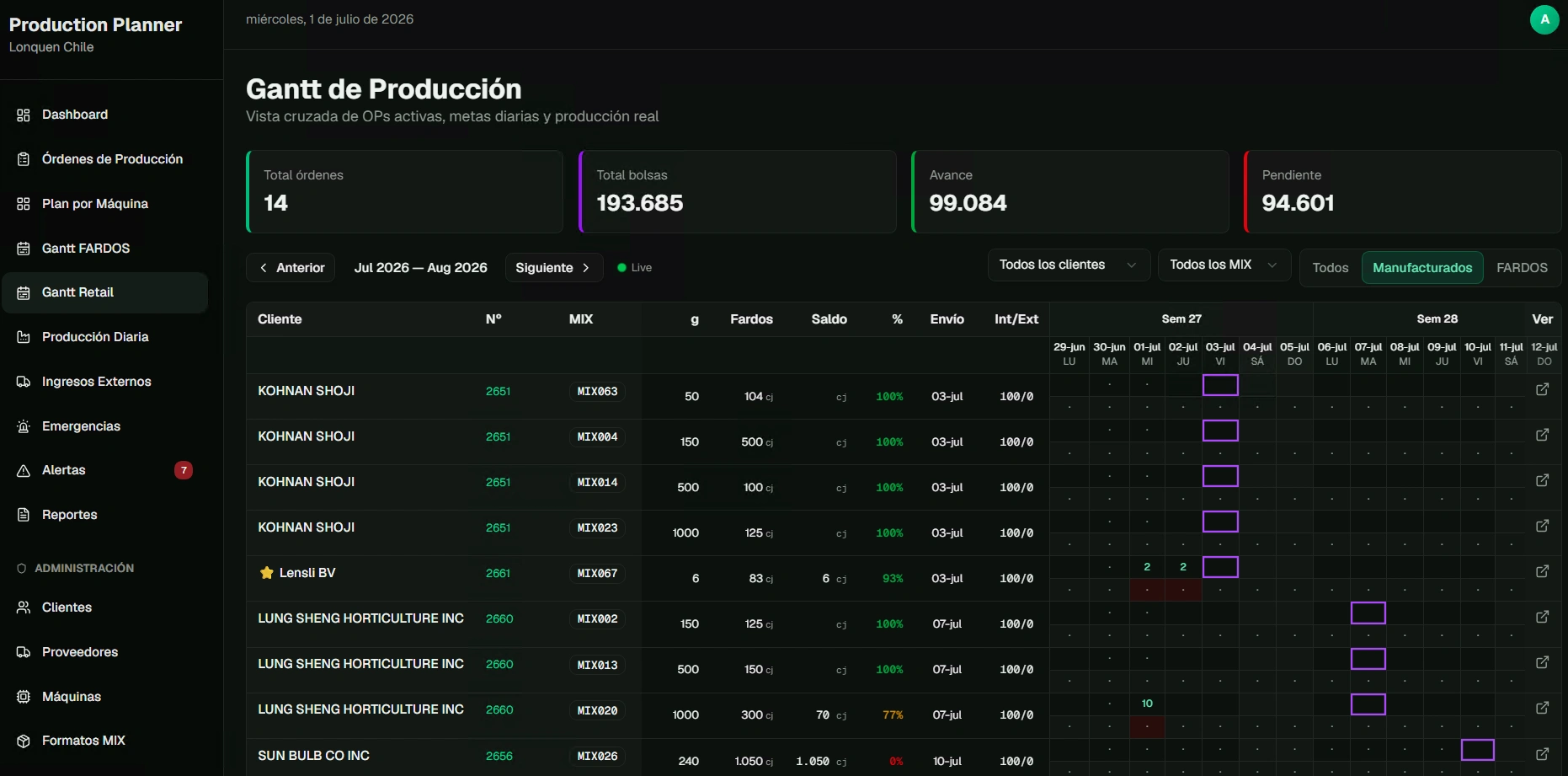
I built an internal production-planning system that auto-assigns each production order to a machine based on format and MIX type, then front-loads a capacity-aware daily schedule.
Key features:
Auto-scheduler with front-loading — replaces manual Excel planning entirely
Format-grouping rules — groups same-format orders on each machine, reducing daily setups from 2-3 down to 1
Live Gantt view — real-time visualization of the full production timeline
Per-machine load view — instant visibility into what each machine is running and when
Shortfall alerts — flags gaps between production capacity and shipping deadlines before they become problems
Daily production logging — operators log output directly in the system, replacing paper-based tracking
Automatic recalculation — every change triggers an instant re-plan (previously hours of manual rework)
Admin panel — user management, configuration, and system settings
Row-Level Security — Supabase RLS ensures each user sees only what they should
Results
Handles ~50 active production orders simultaneously across 6-8 machines and 20+ active clients
Format-grouping rule cut machine setups from 2-3 per day to 1
Re-planning that took hours in Excel now happens automatically on every change
Live Gantt + shortfall alerts catch shipping risks days earlier than the old process
The client adopted the system as their primary planning tool, invited a second team member from the planning department, and production orders are running the full lifecycle: pending → completed → dispatched.
Note: Some outcomes are qualitative — formal before/after metrics weren't tracked. The clearest signal is adoption: the team is using it daily and has expanded access.
Timeline
~3 months of active development (late May to late July), with gradual releases based on client feedback.
Production Planning Dashboard
Like this project
Posted Aug 3, 2026