Freelancers using Framer in MödlingFreelancers using Framer in Mödling
Award winning Webdesigner who loves Framer
$5k+
Earned
5x
Hired
5.0
Rating
34
Followers
Award winning Webdesigner who loves Framer
Product and Web partner for fast growing startups⚡
5.0
Rating
9
Followers
Product and Web partner for fast growing startups⚡
Art Director, Designer and Framer Developer
10
Followers
Art Director, Designer and Framer Developer
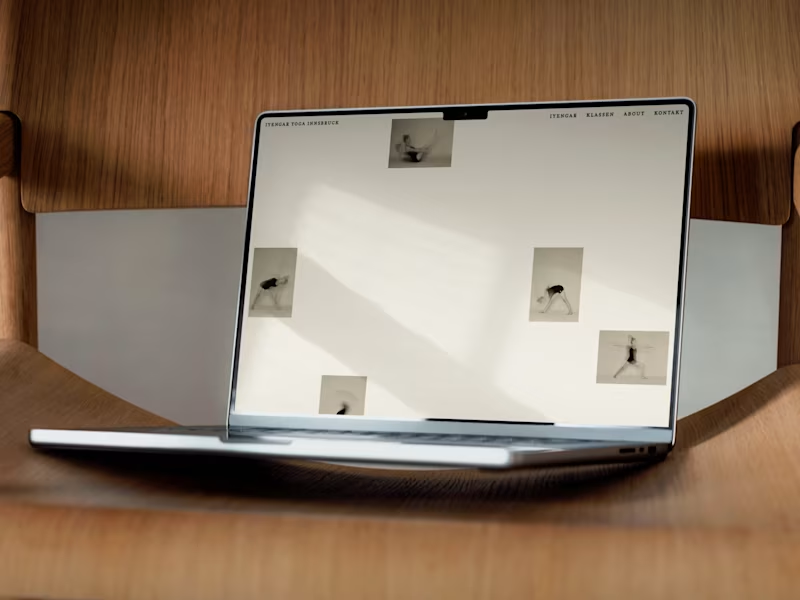
Always pushing the boundaries of Design and Development.
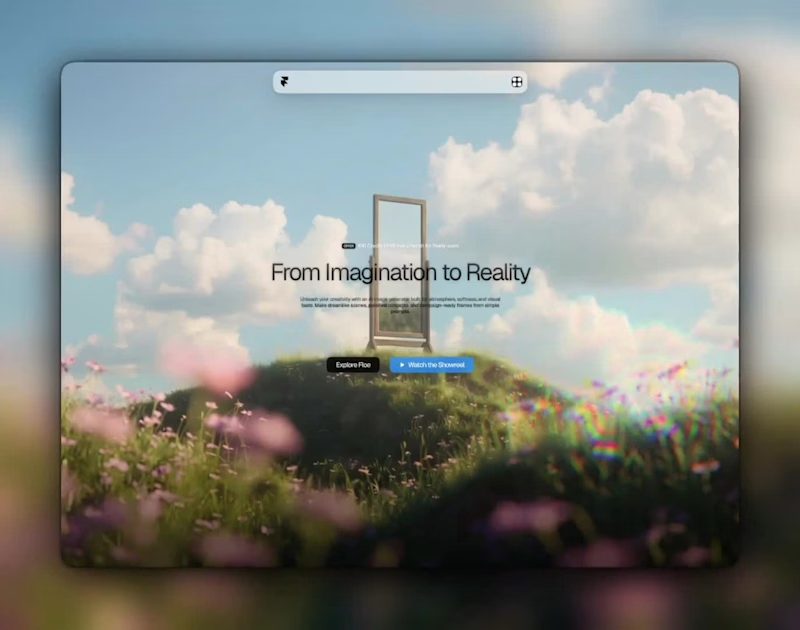
$1k+
Earned
2x
Hired
5.0
Rating
2
Followers
Always pushing the boundaries of Design and Development.
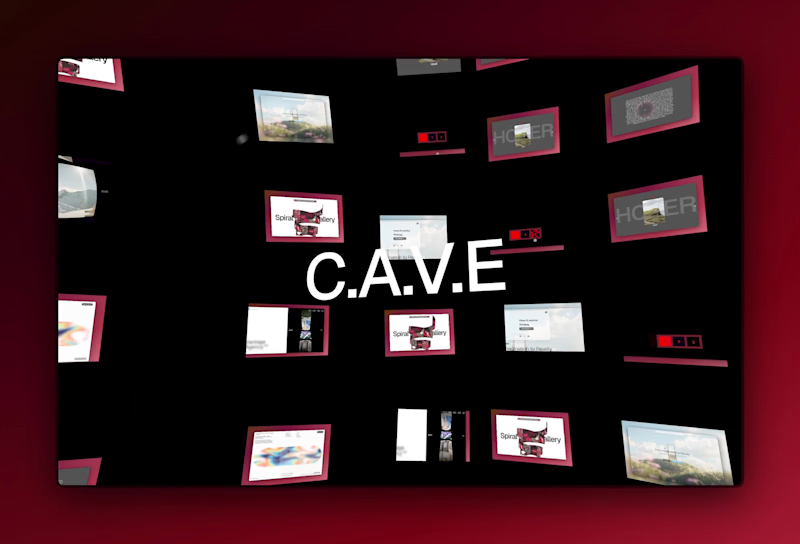
Cover image for CAVE — Curved Adaptive Visual
CAVE — Curved Adaptive Visual Environment Overview CAVE is a Three.js-powered Framer component that arranges images or videos into a curved 3D grid that reacts to cursor movement in real time. Built over two days starting April 1, it was designed as a high-impact hero or showreel component for sites that need something more spatial and immersive than a standard media grid. The Challenge The challenge was building a component that could handle both video and image media inside a curved 3D environment while staying configurable enough to work across different layouts and aesthetics. Every tile needed to sit correctly on the curved surface, face the right direction, and respond to cursor input in a way that felt physically coherent rather than just reactive noise. The Approach The curve is calculated mathematically per tile rather than using a pre-built Three.js geometry. Each tile's x and y position drives its z depth through a parabolic function, and its rotation is derived from the slope of that curve at its position. A separate vertical curvature parameter applies an additional curve along the y axis, allowing the grid to bow in two directions independently. Each tile carries randomised parallax and oscillation data assigned at initialisation. When the cursor moves, tiles shift by different amounts based on their individual parallax factor and a random directional offset, creating a layered depth effect rather than a uniform slide. An idle oscillation tied to a per-tile phase offset keeps the grid breathing even when the cursor is still. The camera uses a smoothed lookAt target rather than moving its position, so the perspective shift feels like the viewer turning their head rather than physically moving through the scene. The Build Video tiles use Three.js VideoTexture fed from dynamically created video elements, with autoplay, mute, and loop handled at initialisation. Images use the standard TextureLoader. Both paths share the same tile geometry and material system. Media sources can be uploaded directly or provided as external URLs through the property controls. The overlay header element responds to mouse movement through CSS 3D transforms applied in JavaScript, giving it a tilt effect that stays in sync with the 3D scene behind it. Cleanup on unmount pauses and unloads all video elements, disposes geometries and materials, and removes the renderer DOM node to prevent memory leaks. The Result CAVE is currently in active development. The component is desktop-focused by design, built for use cases where a high-fidelity, immersive media experience takes priority over mobile compatibility.
1
90
Cover image for PRISM — Pointer Reactive Image
PRISM — Pointer Reactive Image Shader Module Overview PRISM is a WebGL-powered Framer component that applies real-time cursor-reactive shader effects to any image. It ships with four distinct effects: Ripple, Liquid, Chromatic, and Pixel, all driven by a single fragment shader and fully configurable from the Framer properties panel. The Challenge The goal was to build a cursor-reactive image shader that felt genuinely alive without the overhead of a full 3D library. Unlike SIG which required Three.js for spatial geometry, PRISM only needed 2D shader work, so the challenge was implementing four visually distinct effects cleanly, keeping the component lightweight, and handling edge cases like static rendering, WebGL unavailability, and aspect ratio correction gracefully. The Approach The core architectural decision was implementing all four effects inside a single fragment shader using a mode uniform as a branch selector. Rather than compiling separate shader programs per effect, one program handles everything: one compile, one link, one draw call regardless of which effect is active. Switching effects at runtime is a uniform update, not a program swap. Each effect is built differently at the shader level. Ripple uses a sine wave with exponential distance damping from the pointer. Liquid uses Fractal Brownian Motion, layering four octaves of value noise into an organic flow field that warps the UV coordinates. Chromatic splits the RGB channels and samples them at offset positions to simulate lens aberration, combined with a lens bulge distortion. Pixel quantises UV coordinates into a grid and softens the tile edges based on pointer influence. Aspect ratio is handled inside the shader through a custom coverUv function that replicates CSS object-fit: cover mathematically, ensuring the image fills the frame correctly regardless of component dimensions. The Build Rather than Three.js, PRISM uses raw WebGL1 directly via the canvas context. Pointer position and hover state are smoothed with a lerp in the JavaScript render loop before being passed to the shader as uniforms, keeping the GLSL clean and the animation feel controllable. The component uses Framer's useIsStaticRenderer hook to render a plain img tag during static rendering, and falls back to the same img if WebGL is unavailable, so the component never breaks regardless of environment. Cleanup on unmount deletes the texture, buffer, program, and both shaders explicitly, preventing GPU memory leaks. The Result PRISM is currently pending Framer marketplace approval. The build established a lightweight pattern for WebGL shader components in Framer that sits alongside Three.js-based components where full 3D is not needed, giving the component suite a broader range of tools to work with.
1
110
Cover image for 3M Productions — Brand Identity
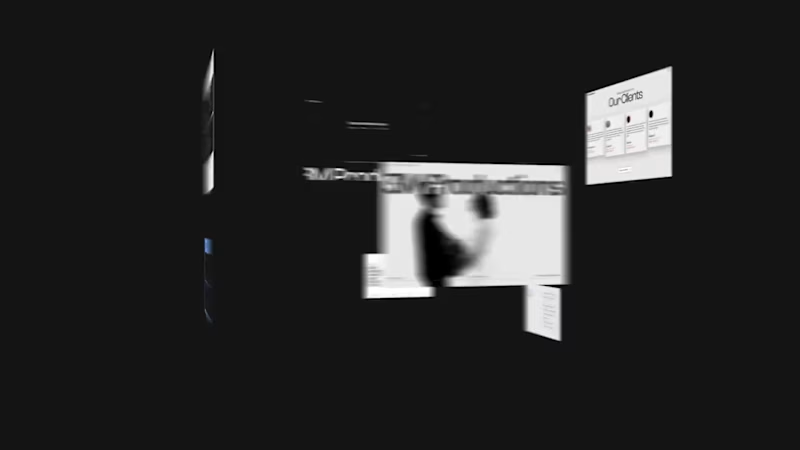
3M Productions — Brand Identity & Web Design Overview 3M Productions is a UK-based creative collective bringing together three specialists: a photographer, videographer, and DJ. The project brief was to shape a unified visual identity and web presence that could reflect the collective's combined offering and establish a clearer, more distinctive position within the events space. The Challenge The core challenge was communicating the value of three separate creative disciplines working together as one. Without a cohesive brand, the collective risked appearing fragmented, three individual services rather than a unified offering. The identity needed to feel memorable and easy to understand, while still giving each discipline enough room to retain its own relevance and energy. The Approach The project treated the brand as a connected system rather than a list of services. By defining a stronger narrative around the meaning behind 3M, memories, moments, and music, the brand could occupy a distinctive space between individual event vendors and full-scale event production, giving it a flexible and differentiated value proposition. The visual identity was built around a direction that feels contemporary, creative, and versatile enough to support different content types, while maintaining enough structure to create consistency across the website and future brand materials. The Build The website was built in Framer and designed to introduce the collective clearly, explain the three-part offering, and guide visitors through the value of the collaboration without confusion. A visually focused presentation combined with straightforward structure helped the brand feel credible, intentional, and ready for client-facing growth. The Result The project delivered a cohesive visual and digital foundation that gave 3M Productions a stronger position within the events and creative services space. By unifying photography, videography, and music under a single brand story, the work helped define a more memorable and differentiated offering, positioning the collective as more than the sum of its parts.
1
108
Cover image for Dylan Donaldson — Portfolio Website
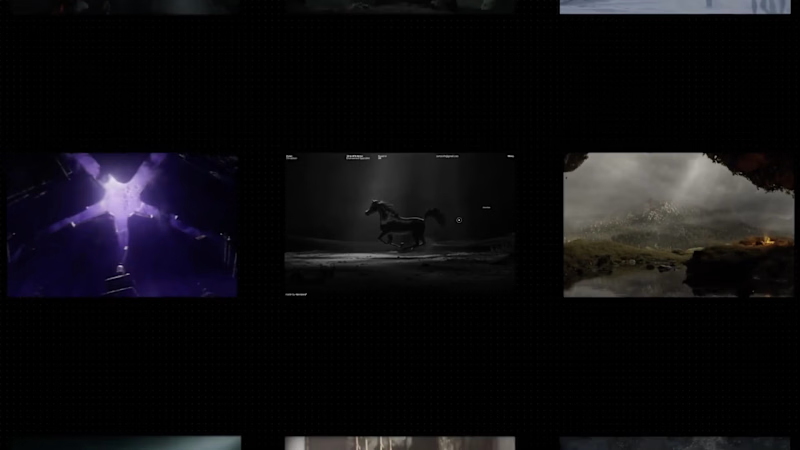
Dylan Donaldson — Portfolio Website (Prototype) Overview This project was developed for Dylan Donaldson, a UK-based 3D and VFX artist, as a portfolio website shaped around his visual work and creative identity. It also marked a significant milestone on our end; becoming our first Framer project during the transition away from Webflow into a new way of designing and building for the web. The Challenge The brief called for a website that could support Dylan's work without competing with it. The experience needed to feel visually considered and aligned with his creative practice, while remaining simple, structured, and easy to navigate. At the same time, the project had to function as a strong first step into a new platform and workflow, making it both a client collaboration and an internal turning point. The Approach The approach centered on creating a clean, intentional environment where the work could remain the focal point. Layout, pacing, and presentation were handled with care so the final experience could feel both expressive and professional without over-designing the frame around the content. The visual direction was developed to give the portfolio enough character to feel distinct while maintaining enough restraint to let the work speak for itself. The goal was a digital setting that felt cohesive, modern, and appropriate for a high-level creative practice. The Build Built entirely in Framer, this project served as a hands-on transition from Webflow — an opportunity to explore a new build process while staying grounded in clarity and usability. What made it especially memorable was the collaborative dynamic throughout. The process felt open and thoughtful, with a strong sense of trust on both sides that made it easier to shape the work with confidence. The Result The outcome was a portfolio website that presented Dylan's work through a clear and considered digital experience. Beyond the deliverable itself, the project became a meaningful early collaboration and an important milestone in establishing Framer as the foundation for all future work, both creatively and technically.
1
115
Web Designer & No-code Developer
$1k+
Earned
1x
Hired
5.0
Rating
1
Followers
Web Designer & No-code Developer
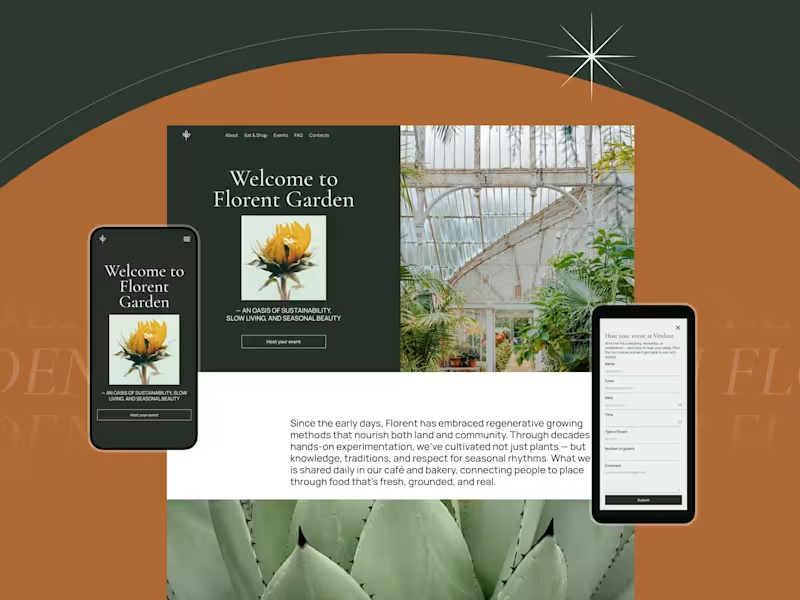
Framer websites that turn visitors into customers
1x
Hired
1
Followers
Framer websites that turn visitors into customers