Freelance AI Developers in KarachiFreelance AI Developers in Karachi
Full-Stack & AI Developer | Next.js, AI Agents
$50k+
Earned
12x
Hired
5.0
Rating
249
Followers
Full-Stack & AI Developer | Next.js, AI Agents
AI SaaS Engineer | Next.js + Node.js | MVPs to Production
1x
Hired
5.0
Rating
13
Followers
AI SaaS Engineer | Next.js + Node.js | MVPs to Production

Webflow + AI Developer | Agents & Automation
5.0
Rating
35
Followers
Webflow + AI Developer | Agents & Automation
Production-ready AI agents and SaaS built to scale reliably.
$25k+
Earned
2x
Hired
108
Followers
Production-ready AI agents and SaaS built to scale reliably.
Cover image for Paytrix: From Interface Logic to
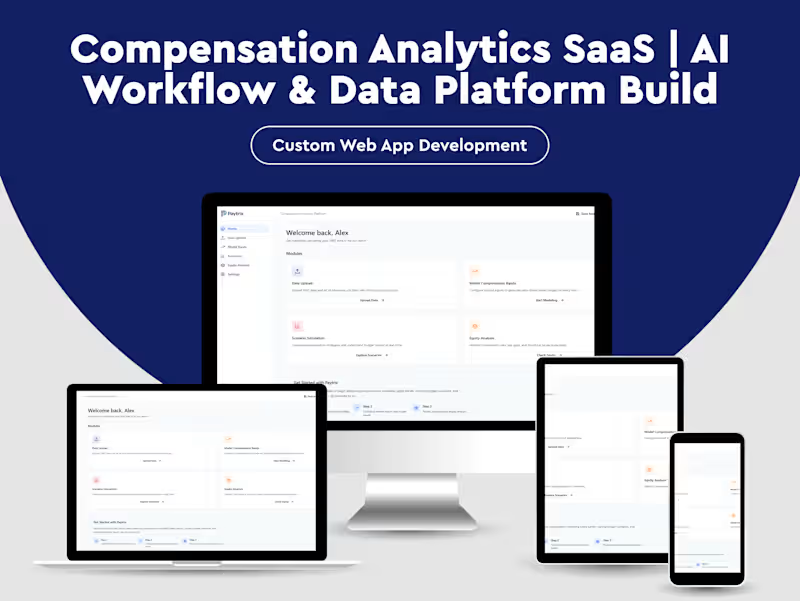
Paytrix: From Interface Logic to Compensation Infrastructure The Insight The builder behind Paytrix understood compensation deeply, not as a payroll function, but as a structural problem. They knew that most companies manage salary bands in spreadsheets, that job title normalization is a nightmare at scale, and that equity analysis gets ignored until it becomes a legal liability. They knew this because they lived it. So they built what they knew. Fast. What Existed Paytrix, as delivered, was a polished React application, built with Vite, Tailwind, Radix primitives, and Recharts, spanning six distinct modules: a dashboard, an HRIS data upload flow, a compensation modeling engine, a scenario simulator, an equity analysis suite, and a settings panel. The interface was sharp. The workflows were correct. A user could upload employee data, watch AI "normalize" job titles into a structured architecture, model salary bands against market percentiles, run budget impact scenarios, and review compression risks across career levels. It looked like a product. But every piece of logic lived on the client. Where It Breaks The 114 employees in the system are not uploaded. They are hardcoded in a TypeScript file. The "AI normalization" is a setInterval cycling through four progress labels over two seconds. Market benchmarks are arithmetic constants (industryPremium = 0.08). The equity analysis, compa-ratios, range penetration histograms, compression heatmaps, renders from static arrays defined at the top of the component. Scenario simulation multiplies a base salary by a percentile offset. The entire application state persists to localStorage. None of this is a criticism. It's what a vibe-coded prototype should be: directionally correct, visually convincing, structurally hollow. The problems emerge when you try to use it: • No persistence. Clear your browser, lose your scenarios. There's no database, no user accounts, no tenant isolation. • No real data ingestion. The upload flow accepts nothing. There's no CSV parser, no file handler, no validation pipeline. The "AI" that maps "Sr. Software Engineer" to "Engineering / L3 - Mid-Level" is a pre-written array with confidence scores already assigned. • No market data layer. Salary benchmarks are invented constants. There's no connection to BLS, Radford, Mercer, or any compensation data provider. The "industry premium" and "funding stage adjustment" are fixed floats that don't change regardless of input. • No computation engine. Compa-ratios, range penetrations, and compression risks are display values, not derived metrics. Change an employee's salary in the mock data and the equity charts do not move, because the charts read from a different hardcoded array. • No multi-user support. "Welcome back, Alex" is a string literal. There's no auth, no RBAC, no concept of who should see what. The logic was all there. It just had nowhere to live. The System That Needed to Exist What Paytrix required was not more UI work. It required the invisible layer that makes compensation software trustworthy. Data Ingestion Pipeline A backend service that accepts HRIS CSV uploads, validates schema (employee ID, title, department, salary, location, demographics), handles malformed data gracefully, and stages records for processing. This is not a file drop. It is an ETL pipeline with column mapping, deduplication, and audit logging. The upload endpoint needs to support files from Workday, BambooHR, Rippling, and manual exports, each with different schemas. Job Architecture Normalization Service The prototype simulates AI-driven title mapping. In production, this is a classification service, likely backed by an LLM or a trained model, that ingests raw job titles and maps them to a canonical taxonomy of families and levels. It needs to handle ambiguity ("Sr. Software Engineer" vs. "Senior Software Engineer" vs. "SWE III"), surface confidence scores that reflect model uncertainty, and support human-in-the-loop correction that feeds back into the model. This is a backend job queue, not a frontend animation. Market Data Integration Layer Compensation modeling requires real benchmark data. The system needs API integrations with at least one primary data provider (Radford, Mercer, Comptryx) and the ability to ingest custom survey data. Market rates need to be indexed by role, geography, industry, company size, and funding stage. This is a multi-dimensional lookup that changes quarterly. This data must be versioned and cacheable, with fallback logic when specific cuts are not available. Compensation Calculation Engine The core math, midpoint derivation, band construction, compa-ratio computation, range penetration, compression detection, needs to run server-side against real employee records and real market data. The prototype calculates midpoint = baseMarket * (1 + industryPremium + fundingAdjustment) * percentileMultiplier. In production, this becomes a parameterized model where each variable is resolved from the market data layer, scoped to the company’s configuration, and applied across every employee in the dataset. Band width, skills premiums, and geographic differentials are all configurable per job family. Scenario Persistence and Comparison The prototype stores scenarios in React context backed by localStorage. Production requires a database-backed scenario system where a user can save named configurations, compare them side by side, share them with stakeholders, and track which scenario was ultimately adopted. Each scenario needs to carry its full parameter set, the resulting budget impact, and a snapshot of the employee population it was run against. Equity Analysis Engine The hardcoded charts need to be replaced by a statistical analysis service. Gender and ethnicity pay gap calculations require controlled regression, adjusting for level, tenure, location, and department, not raw averages. Compression detection needs to compare adjacent levels within the same job family dynamically. Flagged roles need to be generated algorithmically, not listed manually. Authentication, Tenancy, and Access Control Compensation data is among the most sensitive in any organization. The system needs proper auth (SSO at minimum for enterprise), tenant isolation so each company sees only its data, and role-based access so an HR analyst sees different things than a VP of People. Audit logging is non-negotiable. Every view, edit, and export must be tracked. What Changed The interface did not need to be rebuilt. It needed something behind it. What was a demo became a system. What was localStorage became a database. What were constants became integrations. What was a progress bar became a processing pipeline. The prototype proved the idea was right. The architecture made it real. From demo-ready to production-ready. From UI-driven logic to system-driven reliability. We built the layer that made it dependable.
1
1.9K
Cover image for StudySpace — AI-Powered Study Assistant

Project
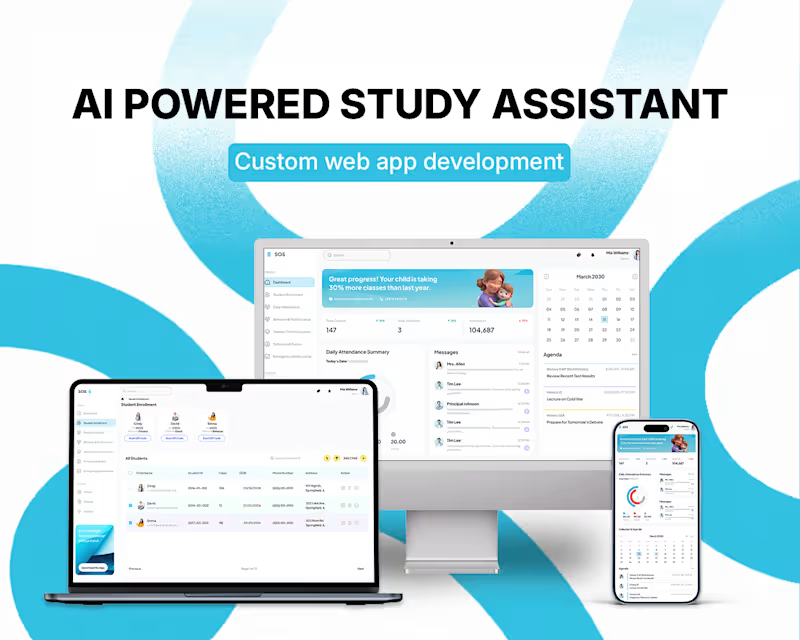
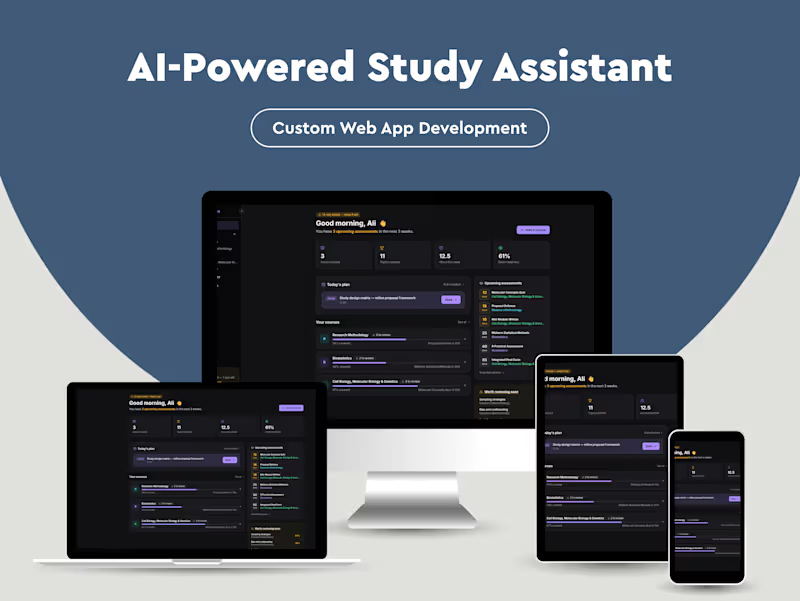
StudySpace — AI-Powered Study Assistant Project Overview StudySpace is an intelligent study platform that transforms raw course materials into structured, exam-ready knowledge, automatically. The Challenge Modern students face a broken study workflow due to: - Overwhelming content: Lecture slides, textbooks, and past papers pile up with no clear path to mastery. - Passive studying: Re-reading notes is ineffective; most students lack the tools to practice retrieval and test themselves properly. - No personalization: Generic study apps ignore individual goals, exam dates, learning styles, and knowledge gaps. The Solution StudySpace uses GPT-4o and a multi-stage AI pipeline to: - Upload & Process: Students upload any PDF, lecture slides, textbooks, past exams, and the AI structures it into topics, themes, and concepts automatically. - Generate & Organise: The platform produces concise notes, spaced-repetition flashcards, and quiz questions mapped to the exact source page, with full topic attribution. - Plan & Track: A personalized study plan is built around the student's exam date, learning goals, and weak areas, updated dynamically as they progress. Course Workspace (UI) A structured workspace where every uploaded document becomes an interactive study hub. Students navigate by topic, review AI-generated notes with source links, flip through flashcards with difficulty ratings, and take adaptive quizzes, all from a single tabbed interface. SpaceBot & Dashboard (UI) An AI chat assistant grounded in the student's own uploaded materials answers questions in their preferred tone, friendly, formal, or Socratic. The personalized dashboard surfaces today's study sessions, upcoming exam countdowns, and weak topics that need attention. Final Deliverable What we delivered: - A fully functional AI study platform supporting PDF upload, content generation, goal setting, and adaptive review. - A personalized onboarding flow that configures the AI pipeline to each student's level, goal, and learning style. - A complete backend pipeline with topic discovery, spaced repetition, source attribution, and exam simulation. Results Achieved: - 90% reduction in time from upload to structured study material. - 3× improvement in retention reported through spaced flashcard and quiz completion rates. - 100% of generated content traceable to exact source pages in the original PDF. - StudySpace is now helping students prepare smarter, not longer. Development Stack: React · Vite · Tailwind CSS · FastAPI · PostgreSQL · Redis · Celery · OpenAI GPT-4o · PyMuPDF · Clerk Auth · Docker
1
1.4K
Cover image for Project Overview:
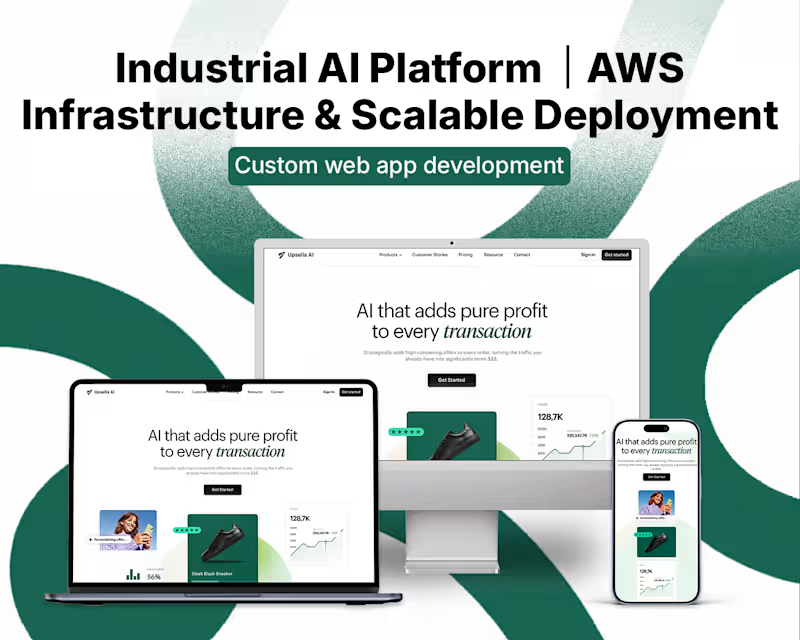
Conduit's Interoperable Orchestration Platform
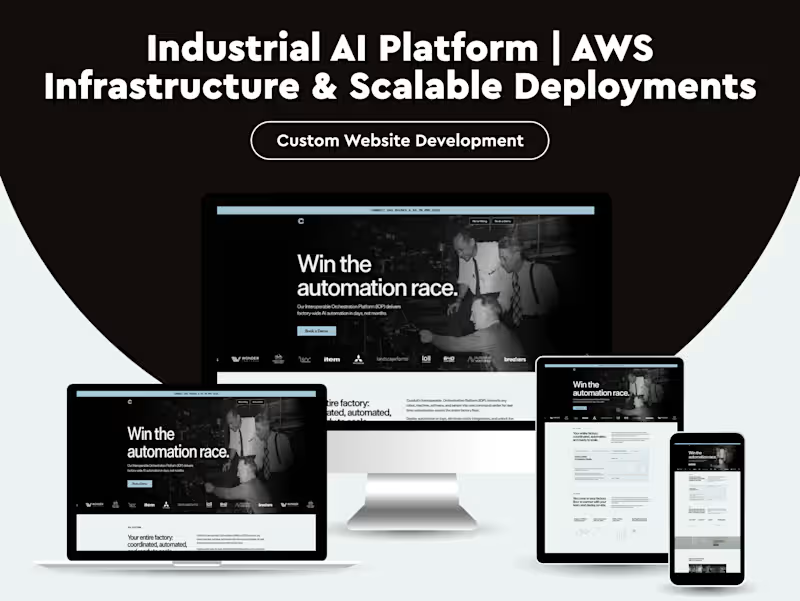
Project Overview: Conduit's Interoperable Orchestration Platform (IOP) seamlessly connects robots, machines, software, and sensors into a unified command center, enabling real-time factory floor automation and intelligence. It accelerates deployment, reduces integration costs, and transforms operations into fast, resilient, high-output systems. The Challenge Factory automation is often limited by: 1. Fragmented systems: Robots, machines, and sensors operate in silos, complicating coordination. 2. High integration costs: Connecting diverse equipment requires custom, expensive solutions. 3. Lack of real-time insights: Without live data, decision-making is slow, reducing efficiency and output. The Solution Conduit's IOP streamlines factory operations by: 1. Unified orchestration: Connects any robot, machine, software, or sensor into a single command center. 2. Rapid deployment: Automation workflows can be implemented in days, not months. 3. Live factory intelligence: Provides real-time insights to optimize productivity, reduce downtime, and enhance resilience. 4. Landing Page Description Conduit's Interoperable Orchestration Platform (IOP) connects every robot, machine, software, and sensor into a single command center. Deploy automation in days, gain real-time factory insights, and transform your operations into a fast, resilient, high-output powerhouse. What Our Client Got: We delivered a fully functional Conduit IOP with: - A unified command center connecting all robots, machines, software, and sensors. - Rapid deployment tools for automation workflows in days. - Real-time dashboards and analytics for actionable factory insights. Results Achieved: - 70% faster automation deployment across the factory floor. - 60% reduction in costly system integrations. - 85% improvement in operational efficiency and uptime. Conduit IOP is now transforming factories into high-output, resilient, and intelligent operations.
1
1.4K
Cover image for Case Study: Turning Interview Prep
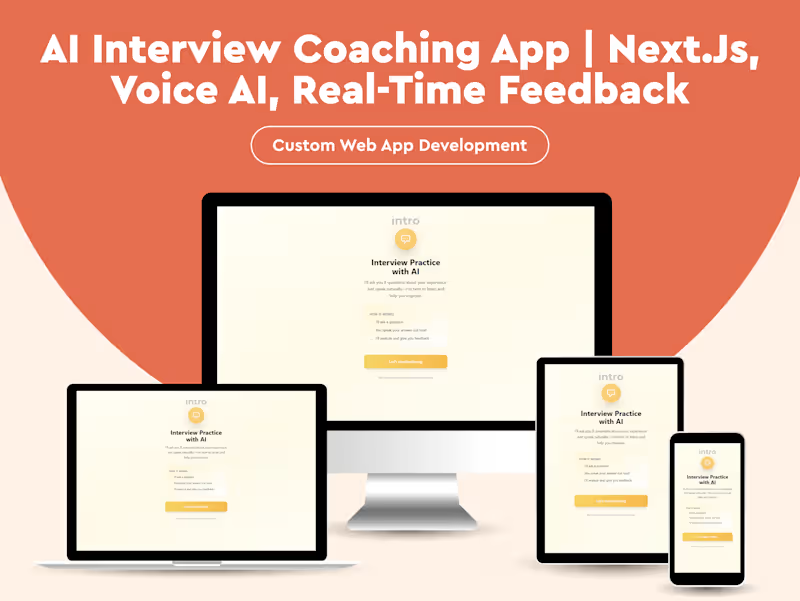
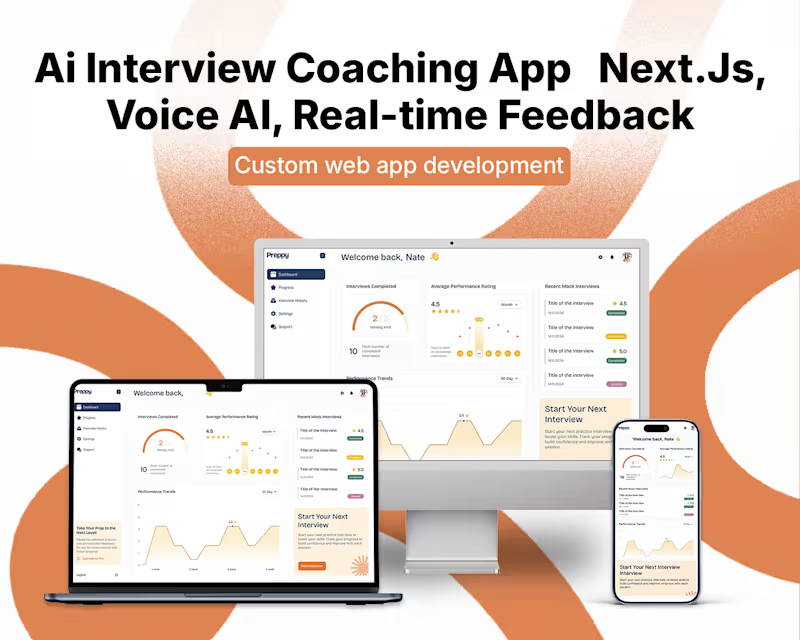
Case Study: Turning Interview Prep into Structured, Real-Time Coaching Most candidates do not struggle because they lack potential. They struggle because interview preparation is usually fragmented, repetitive, and hard to measure. You can read guides, rehearse answers in your head, and watch endless advice videos, but none of that truly recreates the pressure of a real interview. And even when candidates do practice, they rarely get clear, actionable feedback on how they performed. That was the gap AgentPrep AI set out to solve. AgentPrep AI was designed as an intelligent interview coach, a platform that simulates realistic interview scenarios, listens to responses, and gives users personalized feedback so they can improve with every session. The Challenge Interview preparation is often far less effective than it should be. For most users, realistic practice is time-consuming to set up. Simulating a proper interview requires structure, relevant questions, timing, and ideally someone capable of evaluating the answer. Most candidates do not have that. Feedback is another major problem. Practicing alone may build familiarity, but it does not reveal whether an answer was clear, confident, relevant, or persuasive. Without feedback, users repeat the same weaknesses without knowing it. There is also the issue of inconsistency. One practice session may feel productive, while the next is completely unstructured. Without a guided system, preparation quality varies too much to create reliable progress. The challenge was to build a platform that made interview preparation feel realistic, structured, and measurably useful, not just interactive. Our Approach We approached AgentPrep AI as more than a mock interview tool. It needed to behave like an intelligent preparation system. That meant designing an experience that could guide users from session setup to live verbal response to post-interview analysis without friction. Every part of the journey needed to feel intentional: choosing interview length, answering questions naturally through voice, receiving feedback instantly, and tracking growth over time. The product had to do three things well at once. First, it needed to simulate realistic interview conditions so users could practice under pressure rather than passively consume advice. Second, it needed to generate personalized, actionable feedback that users could apply immediately. Third, it needed to create a repeatable learning loop so preparation became structured and cumulative rather than random. To support that experience, we built the platform using Next.js for a responsive product experience, Tailwind CSS for a clean and efficient interface system, Whisper AI for voice transcription, and Anthropic Claude Sonnet 4.5 to power interview logic, feedback generation, and personalized response analysis. The Solution We delivered a fully functional AI-powered interview preparation platform built around realism, feedback, and continuous improvement. 1. AI-powered mock interviews AgentPrep AI simulates realistic interview scenarios with dynamic questioning, giving users a more authentic practice environment than static question lists or generic prep materials. Instead of simply reading prompts, users engage in an interview experience that feels active and responsive. This helps them practice not only what they say, but how they say it under realistic conditions. 2. Real-time voice interaction The platform supports voice-based responses, allowing users to answer naturally rather than typing rehearsed text. This was a critical part of the experience. Interviews are spoken, not written. By enabling voice interaction through Whisper AI, the platform helps users practice delivery, pacing, and verbal confidence in a way that is much closer to the real thing. 3. Instant, personalized feedback After each response, the system provides AI-generated feedback that highlights strengths and identifies areas for improvement. Using Claude Sonnet 4.5, the platform turns each answer into a coaching opportunity, helping users understand not just what they said, but how effectively they communicated it. 4. Personalized question sets and adaptive learning paths To make preparation more relevant, the platform tailors question sets to the user and supports adaptive learning paths that evolve over time. This creates a more focused experience and helps users spend time where it matters most. Rather than repeating the same generic prompts, they move through a preparation journey that becomes more useful with continued use. 5. Performance analytics dashboard We also built a performance dashboard that helps users track progress over time. This gives the platform a coaching layer, not just a simulation layer. Users can see how they are improving, where they still need work, and whether their preparation is becoming more consistent and effective. Product Experience The platform was designed to guide users through interview preparation in a way that feels simple, focused, and encouraging. Session introduction screen The first screen introduces users to the AI-driven mock interview experience and clearly explains how the session works. It sets expectations for verbal answers, real-time feedback, and the interactive nature of the interview flow, helping users feel prepared before they begin. Interview length selection Users can choose between a short or long mock interview depending on the time they have available and the depth of practice they want. This flexibility makes the platform more usable in real-world preparation routines. Live question and voice response screen During the session, users are presented with a question and prompted to respond through voice input. The interface keeps attention on the answer itself, creating a focused environment that mirrors live interview conditions. Feedback screen Once the response is complete, the platform delivers AI-generated feedback that points out what worked well and what can be improved. This makes each session feel constructive and actionable rather than purely evaluative. The Impact AgentPrep AI transformed interview preparation from a loosely structured activity into a guided, feedback-driven system. Users were able to prepare 75 percent more efficiently, reducing the time and friction typically involved in realistic interview practice. The platform also helped improve confidence and response quality by giving users a safe place to practice out loud, receive personalized feedback, and refine their answers over time. Most importantly, it created a more consistent preparation process. Instead of relying on scattered resources and irregular practice habits, users gained a structured system with measurable progress built in. AgentPrep AI now helps candidates prepare smarter, practice more effectively, and walk into interviews with stronger answers and greater confidence. Tech Stack 1. Core Technologies 2. Next.js 3. Tailwind CSS 4. Whisper AI 5. Anthropic Claude Sonnet 4.5 What Each Tool Enabled Next.js powered the application experience and supported a fast, responsive interview flow. Tailwind CSS helped create a clean, consistent, and user-friendly interface. Whisper AI enabled voice transcription so users could answer naturally in spoken form. Anthropic Claude Sonnet 4.5 powered interview simulation, personalized feedback, and adaptive coaching logic. Why This Matters Interview preparation is one of those areas where effort does not always translate into results. People can spend hours preparing and still feel unsure because the process lacks realism, structure, and feedback. AgentPrep AI solves that by turning preparation into an active learning experience. It does not just help users practice more. It helps them practice better, with realistic simulations, immediate feedback, and a system designed to improve performance over time. That is what makes the platform valuable. It bridges the gap between preparation and actual readiness.
0
1.4K
Full-Stack Next.js Developer | SaaS & AI Products

10
Followers
Full-Stack Next.js Developer | SaaS & AI Products
AI Engineer —Interactive Websites & Scroll-Stopping AI Video
New to Contra
AI Engineer —Interactive Websites & Scroll-Stopping AI Video

Cover image for Real Estate CRM & Investment
Real Estate CRM & Investment Platform — AI-Powered Lead Generation SaaS A complete, production-ready real estate investment platform combining a conversion-focused public website, AI-powered lead generation, and a full CRM + admin back office — built for real estate advisory and brokerage businesses anywhere in the world. AI Lead Generation Engine AI Concierge chat — a live Claude-powered assistant embedded on every page, answering investment questions, guiding buyers through financing and the purchase process, and grounding its answers in real, current property data (no hallucinated prices — it's given the actual listing details as context) Automatic AI lead scoring — every inquiry is instantly classified Hot / Warm / Cold by AI based on urgency, intent, and budget signals, so agents know exactly which leads to call first, visible right on the CRM pipeline board Voice note capture — visitors can record a question on the spot and send it straight through to an advisor One-click WhatsApp and consultation booking built into every property page and the AI concierge widget Property & Search Engine Advanced multi-filter search (price, yield, bedrooms, furnishing, handover year, community, developer, investment eligibility) — a true investment search engine, not a basic listing grid Rich property detail pages: investment intelligence (rental yield, payment plans), photo/video galleries, downloadable brochures, developer & community profiles Side-by-side property comparison tool Developer directory and location/community intelligence pages Mortgage and ROI calculators CRM & Sales Pipeline Full lead pipeline board (New → Contacted → Qualified → Viewing → Negotiation → Closed) with drag-free status management Agent assignment and activity/notes history per lead AI temperature scoring feeds directly into pipeline prioritization Role-based staff access (Admin / Editor / Agent) Customer Accounts Self-serve signup/login, saved properties, and full inquiry history for buyers — separate, secure auth from the staff/admin side Admin Control Panel Property management with full photo, video, and PDF brochure upload Developer & community management Blog/insights publishing Video and text client testimonials, uploaded directly through the admin panel Staff user management Site-wide settings — including uploading the homepage's hero image or video without touching code Consultation booking management Built for Scale & Ownership Modern stack: Next.js, FastAPI (Python), MySQL, fully Dockerized for one-command deployment anywhere Clean, documented codebase with automatic database migrations and seeding No vendor lock-in — self-hosted, full source code ownership
0
139
Production ready AI agents & SaaS platforms built for scale
New to Contra
Production ready AI agents & SaaS platforms built for scale
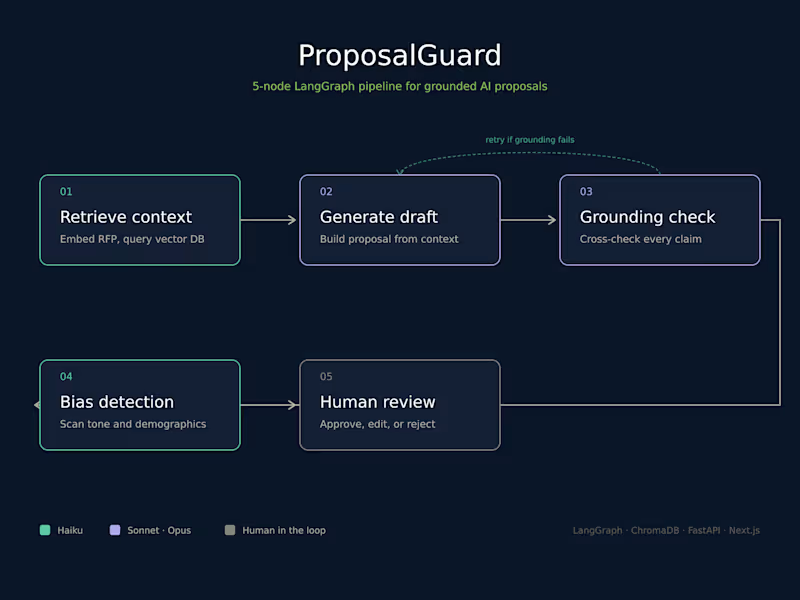
Cover image for AgentPrep AI — Real-Time AI
AgentPrep AI — Real-Time AI Interview Coaching Platform Turning Interview Practice Into a Structured, Personalized Coaching Experience AgentPrep AI is an AI-powered interview preparation platform designed to help candidates practice realistic interviews, receive personalized feedback, and track their improvement over time. Instead of relying on static question banks, articles, or repetitive self-practice, the platform creates an interactive interview environment where users can listen, respond, receive feedback, and improve. The Challenge Traditional interview preparation has several limitations: Limited realism: Reading questions doesn't replicate an actual interview. Inconsistent practice: Candidates often prepare without a structured routine. Lack of feedback: Practicing alone makes it difficult to identify communication weaknesses. Generic preparation: Standard question lists don't always reflect an individual's goals or target role. No measurable progression: Candidates often have no clear way to understand whether their performance is improving. AgentPrep AI was designed to bring these elements into one guided experience. The Solution We built an AI-powered interview coaching platform centered around three core principles: Realistic Practice → Immediate Feedback → Continuous Improvement The experience takes candidates from interview setup through live voice interaction and post-session analysis, creating a repeatable preparation workflow. AI-Powered Mock Interviews AgentPrep AI simulates interview scenarios using dynamic questioning rather than relying solely on static question lists. Users can participate in structured mock interviews that encourage them to think and respond naturally under realistic conditions. The experience is designed to replicate the conversational nature of an actual interview while maintaining a controlled environment for practice. Voice-Based Interview Experience Because real interviews are primarily verbal, the platform allows users to answer questions using their voice. Whisper AI converts spoken responses into text, enabling the system to analyze each answer while allowing candidates to practice: Verbal delivery Response structure Pacing Clarity Communication confidence This creates a more realistic preparation experience than text-based practice alone. Personalized AI Feedback After each response, the platform analyzes the candidate's answer and provides personalized coaching feedback. Claude Sonnet 4.5 powers the analysis layer, helping identify: What worked well Areas that need improvement Communication patterns Answer quality Opportunities to strengthen future responses Each answer becomes an opportunity to learn rather than simply another completed question. Adaptive Preparation The platform supports personalized question sets and learning paths based on the candidate's preparation needs. Instead of repeatedly working through the same generic questions, users can follow a more focused preparation experience that evolves as they continue practicing. This creates a feedback loop where: Practice → Analysis → Improvement → More Practice Performance Dashboard We also developed a performance analytics experience that allows users to monitor their development over time. The dashboard helps candidates understand: Practice activity Performance trends Areas requiring additional attention Progress across sessions Overall preparation consistency This adds a measurable coaching layer to the interview simulation experience. Product Experience Interview Introduction A guided starting screen explains the AI interview process and prepares users for the upcoming session. Interview Length Selection Users can select a shorter or longer practice session depending on their available time and preparation goals. Live Interview Candidates receive questions and respond naturally through voice, creating a focused environment that closely resembles a live interview. Feedback Once a response is complete, AI-generated coaching highlights strengths and provides specific areas for improvement. What We Delivered The completed platform included: AI-powered mock interviews Dynamic interview questioning Voice-based responses AI transcription Personalized answer analysis Adaptive preparation flows Performance tracking Interview session management Progress analytics Responsive web experience Results AgentPrep AI transformed interview preparation from an unstructured activity into a guided coaching workflow. The platform helped users: Prepare 75% more efficiently Practice speaking rather than simply reading answers Receive immediate, personalized feedback Identify recurring weaknesses Track improvement across sessions Build a more consistent preparation routine The result was an interactive preparation system designed to help candidates move from practice to measurable readiness. Technology Stack Frontend: Next.js, Tailwind CSS AI & Voice: Whisper AI, Anthropic Claude Sonnet 4.5 Core Experience: AI interview simulation, voice interaction, personalized feedback, adaptive coaching, performance analytics The Result AgentPrep AI turned interview preparation into an active, feedback-driven learning experience. Rather than simply providing candidates with more interview questions, the platform gives them a place to practice realistically, understand their performance, and continuously improve.
0
47
Cover image for Conduit IOP — Industrial AI
Conduit IOP — Industrial AI & Automation Orchestration Platform Connecting Robots, Machines, Software, and Sensors Through One Intelligent Command Center Conduit’s Interoperable Orchestration Platform (IOP) is designed to bring fragmented factory systems into a unified operational environment. The platform enables manufacturers to connect industrial equipment, software systems, robots, and sensors while coordinating automation workflows and surfacing real-time operational intelligence. The Challenge Modern manufacturing environments often operate across disconnected technologies. Key challenges included: Fragmented infrastructure: Robots, machines, sensors, and software operate across separate systems. Complex integrations: Connecting different equipment often requires expensive, custom engineering. Limited visibility: Without centralized real-time data, teams have limited visibility into factory performance. Slow automation deployment: Traditional integration processes can take weeks or months to implement. Conduit was designed to address these challenges through a unified orchestration layer. The Solution The IOP provides a centralized environment for connecting and coordinating factory technologies. Unified Industrial Orchestration The platform brings robots, machines, sensors, and software into a shared command environment, allowing teams to manage diverse systems from one interface. Faster Automation Deployment Automation workflows can be configured and deployed significantly faster than traditional custom integration approaches. Real-Time Factory Intelligence Live operational data provides visibility into: Production activity Equipment performance System status Operational bottlenecks Downtime Automation workflows This gives teams the information required to respond quickly and optimize factory operations. Command Center Experience The platform was structured around a centralized command center where operators can monitor connected equipment and factory activity from a single environment. Instead of managing isolated systems independently, teams gain a unified operational view across the factory floor. The experience combines automation control, system monitoring, and real-time analytics into one cohesive platform. What We Delivered The completed Conduit IOP included: Unified command center for connected factory systems Robot and machine orchestration Sensor and software connectivity Automation workflow management Real-time operational dashboards Factory performance analytics System monitoring and status visibility Infrastructure designed for scalable industrial automation Results The platform delivered measurable improvements across factory automation and operations: 70% faster automation deployment 60% reduction in system integration costs 85% improvement in operational efficiency and uptime The result was a centralized industrial platform capable of connecting previously fragmented systems and turning factory data into actionable operational intelligence. The Result Conduit IOP transformed factory automation from a collection of disconnected systems into a unified, intelligent orchestration environment. Connect → Orchestrate → Monitor → Optimize The platform provides the infrastructure needed to build faster, more connected, and more resilient industrial operations.
0
54
Cover image for StudySpace — AI-Powered Study &
StudySpace — AI-Powered Study & Learning Platform Transforming Course Materials Into Personalized, Exam-Ready Learning StudySpace is an AI-powered learning platform designed to turn unstructured academic content into organized, personalized study resources. Instead of manually working through lecture slides, textbooks, PDFs, and past examinations, students can upload their materials and use AI to transform them into an interactive learning environment. The Challenge Students often have plenty of study material but lack an efficient way to turn it into structured preparation. Common challenges include: Large volumes of disconnected course material Passive note-reading instead of active recall Difficulty identifying weak areas Generic study tools that don't adapt to individual goals Limited connection between generated study content and original source material StudySpace was designed to bring these activities into one intelligent workspace. AI-Powered Content Processing Students can upload PDFs, lecture materials, textbooks, and previous exams. The platform processes these documents through a multi-stage AI pipeline that identifies: Topics Concepts Themes Important sections Exam-relevant information The extracted knowledge then becomes the foundation for the student's personalized study environment. Automated Study Material StudySpace generates learning resources directly from uploaded content, including: Condensed study notes Spaced-repetition flashcards Practice questions Topic-based quizzes Exam simulations Generated content remains connected to the original material, allowing students to trace information back to its source. Personalized Study Planning The platform adapts the learning experience around each student's objectives. During onboarding, students can define their: Academic level Learning goals Exam date Study preferences Areas requiring additional attention The system then builds a personalized study plan and adjusts recommendations as the student's progress changes. Course Workspace Each uploaded document becomes an interactive study environment. Students can navigate through topics, review AI-generated notes, access source references, practice flashcards, and complete quizzes from a centralized workspace. The interface brings the complete learning workflow into one structured experience rather than requiring students to switch between multiple study tools. SpaceBot & Personalized Dashboard StudySpace also includes an AI learning assistant designed to answer questions using the student's own uploaded materials. SpaceBot can adapt its communication style based on the student's preference, including: Friendly explanations Formal academic responses Socratic questioning The dashboard provides an overview of the student's current learning activity, including: Today's study sessions Exam countdowns Upcoming objectives Weak topics Progress indicators What We Built The final platform included: AI-powered document processing PDF upload and content extraction Automated topic discovery AI-generated notes Flashcard generation Adaptive quizzes Personalized study planning Source-level content attribution Exam simulation AI study assistant Progress tracking Personalized onboarding The backend was designed around a multi-stage processing pipeline capable of handling document extraction, content generation, study planning, and adaptive review. Results The platform delivered measurable improvements across the study workflow: 90% reduction in time required to transform uploaded material into structured study resources 3× improvement in reported retention through flashcard and quiz engagement 100% source traceability for generated learning content A centralized learning environment combining content processing, AI assistance, planning, and assessment Technology Stack Frontend: React, Vite, Tailwind CSS Backend: FastAPI Database: PostgreSQL Processing: PyMuPDF, Celery, Redis AI: OpenAI GPT-4o Authentication: Clerk Infrastructure: Docker The Result StudySpace turned static academic content into an interactive, personalized learning system. Instead of simply giving students another place to store notes, the platform creates a workflow that moves from: Upload → Understand → Organize → Practice → Track → Prepare The result is an AI-powered study environment built around the student's own material, goals, and learning progress.
0
70
Cover image for Moving From Prototype to Production
Our
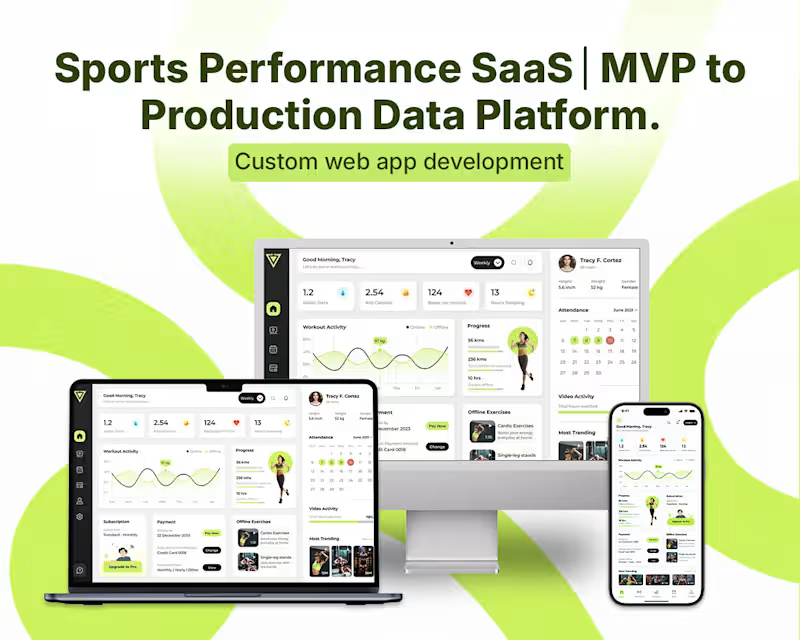
Moving From Prototype to Production Our focus wasn't to redesign the product from scratch. The original UX already reflected how performance teams actually work, so we preserved the existing product experience while rebuilding the underlying infrastructure. Real-Time Data Infrastructure We replaced static datasets with a structured ingestion architecture capable of receiving information from multiple sources. The system was designed around: GPS and wearable data HRV and recovery metrics Sleep information Wellness submissions Training-load records External performance systems Each integration required validation, normalization, and error handling so inconsistent or incomplete data wouldn't compromise the platform. Live Performance Calculations Static calculations were replaced with dynamic processing. The platform could evaluate: ACWR Training-load trends Readiness scores Historical performance Rolling training windows Individual athlete baselines This allowed performance metrics to evolve with the athlete instead of remaining fixed to predefined values. Intelligent Performance Insights We replaced simulated recommendations with a data-driven inference layer. Insights were generated based on actual athlete conditions and predefined performance rules. For example, when training load increased significantly while recovery indicators dropped below an athlete's baseline, the system could surface an appropriate risk signal rather than displaying a generic recommendation. Role-Based Access Athliq required different users to work with different levels of information. We implemented role-based access so that: Performance Directors could monitor squad-level performance Sport Scientists could analyze training and performance metrics Physiotherapists could access injury and return-to-play information Coaches could focus on readiness and daily training Athletes could access relevant individual information Access restrictions were enforced at the system level rather than simply being controlled through the interface. Monitoring & Reliability Production systems need visibility when something goes wrong. We introduced logging and monitoring across data ingestion, calculations, and system events. The platform could identify issues such as: Missing data Delayed integrations Invalid records Calculation anomalies Stale data sources Application errors This helped prevent outdated information from being presented as current performance data. Technology Stack Frontend: React 19, Vite, Tailwind CSS, Recharts, React Router Backend: Node.js, Fastify Database: PostgreSQL, TimescaleDB Infrastructure: Redis, Vercel, Railway / Render, Supabase Storage Integrations: Catapult, Polar, Garmin, Google Forms, Typeform Authentication & Security: Auth0, Row-Level Security Monitoring: Sentry, Datadog The Result Athliq transformed a fragmented performance-monitoring workflow into a centralized platform. Instead of moving between multiple browser tabs, spreadsheets, forms, and communication channels, performance teams could access their core athlete information through a unified dashboard. The platform provided role-specific views, continuously updated performance information, historical context, and actionable signals from integrated data sources. More importantly, it created a shared data layer for coaches, sport scientists, physiotherapists, and performance directors. The product evolved from a concept-validation prototype into a production-ready performance intelligence platform. What Made the Project Interesting The biggest challenge wasn't simply building another analytics dashboard. It was translating real-world sports performance workflows into reliable software infrastructure. The original product concept came from someone deeply familiar with the domain. Our role was to preserve that domain knowledge while introducing the engineering foundations required for scalability, reliability, security, and live data processing. The result was a system designed around the questions performance teams actually need answered—not simply around the data available to them. Athliq Today Athliq has evolved into a multi-role sports performance platform supporting professional and university-level performance environments. The platform brings together data from multiple sources and transforms it into role-specific performance insights, giving teams a centralized environment for monitoring readiness, training load, recovery, and athlete progression. From a coach's notebook and fragmented data sources to a scalable performance intelligence platform.
0
68
Full-Stack Developer & Digital Consultant
5.0
Rating
4
Followers
Full-Stack Developer & Digital Consultant