
ML AI | Backend | Computer Vision | GenAI | LLM Agents
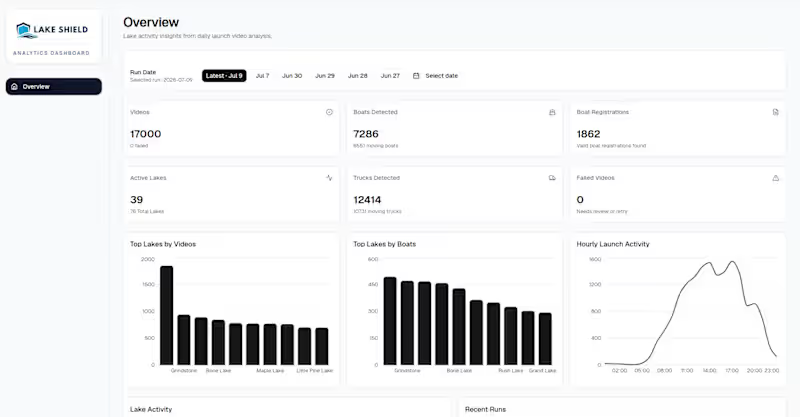
LakeShield - AI-Powered Video Monitoring and Vessel Intelligence Platform
I led the development of LakeShield as the Senior AI/ML Engineer and Lead Developer, taking the platform from initial research and experimentation to a scalable production system.
My responsibilities included:
🔹 Designing the end-to-end AI and video-processing architecture
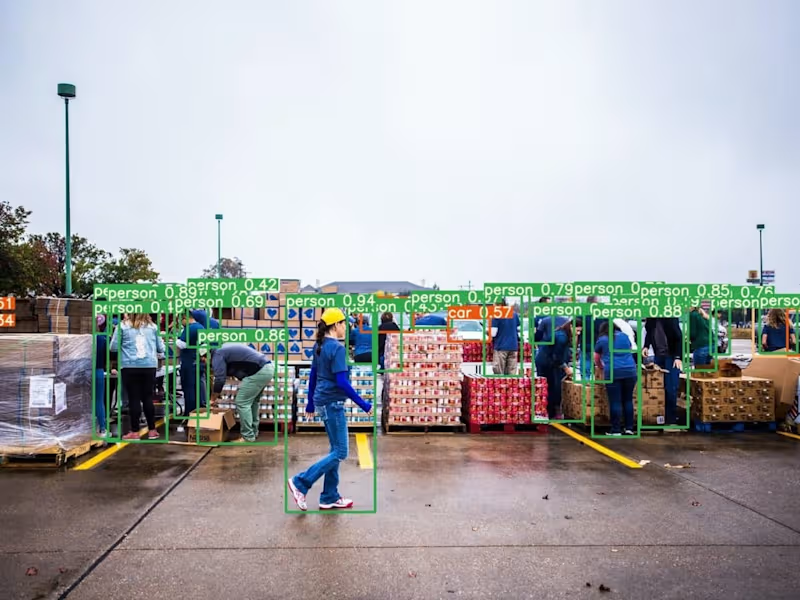
🔹 Building YOLO-based boat and vehicle detection pipelines
🔹 Developing object tracking and movement-analysis workflows
🔹 Implementing OCR for extracting boat registration information
🔹 Creating scalable pipelines for processing thousands of surveillance videos
🔹 Developing FastAPI backend services and automated data workflows
🔹 Building a Next.js analytics dashboard integrated with Supabase
🔹 Deploying and operating the AI pipeline on cloud GPU infrastructure
🔹 Optimizing model accuracy, inference speed, infrastructure costs, and reliability
🔹 Managing production monitoring, troubleshooting, maintenance, and continuous improvements
The platform transforms raw surveillance footage into structured operational insights, enabling automated vessel monitoring, vehicle activity analysis, registration extraction, and reporting.
This project involved complete technical ownership across Computer Vision, AI/ML, backend development, cloud infrastructure, data engineering, MLOps, and production operations.
#ComputerVision #VideoAnalytics #ArtificialIntelligence #ObjectDetection #OCR #MLOps #FastAPI #NextJS #Supabase #CloudEngineering
2
257

Shelfr - AI-Powered Retail Shelf Intelligence Platform
I led the development of Shelfr as the Senior Computer Vision Engineer and Lead Developer, taking the platform from the initial idea and system architecture through development, deployment, and production operations.
My work included:
🔹 Designing the complete computer vision and backend architecture
🔹 Building product detection, shelf analysis, OCR, and image-processing pipelines
🔹 Developing APIs and scalable data-processing workflows
🔹 Deploying and managing production systems on GCP cloud servers
🔹 Optimizing model accuracy, processing speed, and infrastructure performance
🔹 Managing production monitoring, reliability, troubleshooting, and ongoing improvements
🔹 Leading technical decisions across AI, backend, cloud infrastructure, and DevOps
The platform converts real-world retail shelf images into structured product and shelf-level insights, helping automate retail auditing, product visibility analysis, and inventory workflows.
#ComputerVision #RetailAI #LeadDeveloper #AIEngineering #GCP #MLOps #Python #CloudEngineering
2
245


Generative AI Developer
Generative AI Developer
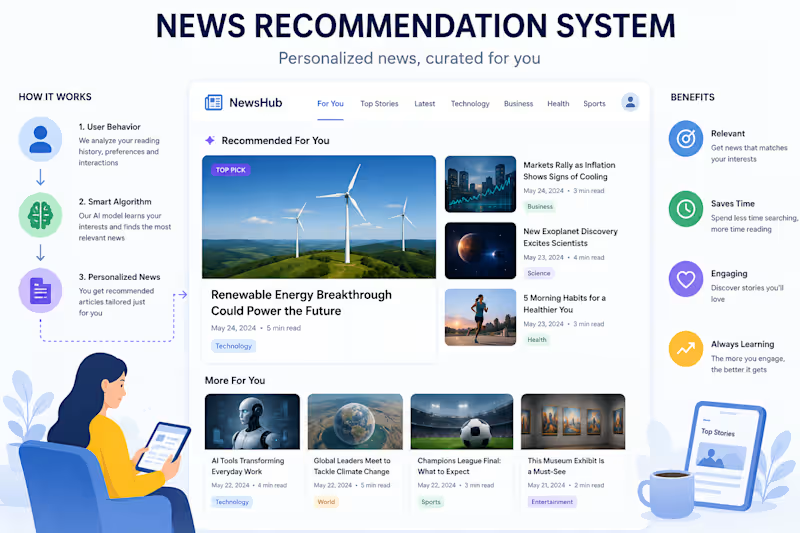
Engineered a personalized news recommendation system leveraging the Microsoft MIND dataset to deliver highly relevant, user-centric content at scale. The solution models user engagement patterns through collaborative filtering techniques to predict and surface articles aligned with individual reading behavior. It encompasses a complete machine learning pipeline, including data preprocessing, model training, evaluation, and performance validation using click-through-based metrics on real-world interaction data.
0
48
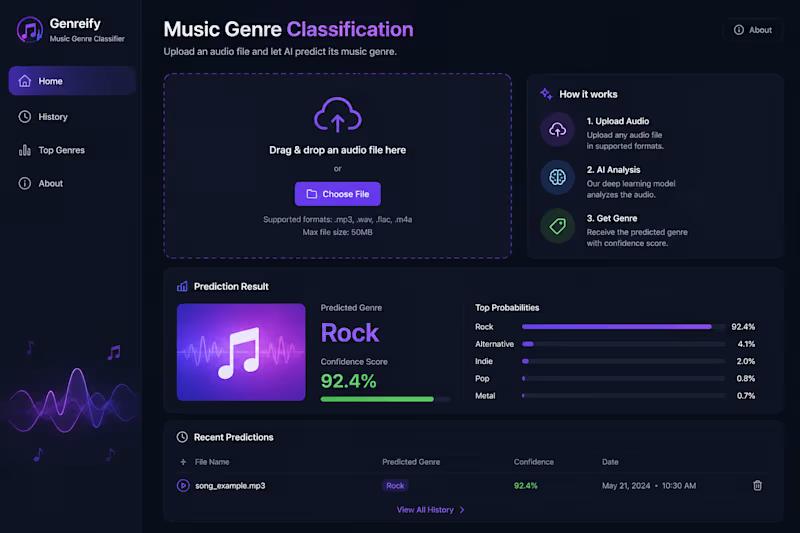
This Music Genre Classification System features a modern, AI-powered dashboard designed to classify music genres from uploaded audio files. The interface provides a seamless user experience with a drag-and-drop audio upload section, real-time prediction results, confidence score visualization, and probability distribution across multiple genres.
The dashboard follows a clean dark-theme design with vibrant purple accents, making it visually appealing while maintaining usability. Users can upload audio files in various formats, view the predicted genre instantly, and analyze model confidence through interactive charts and progress bars. Additional features such as prediction history and workflow guidance enhance transparency and user engagement.
Overall, the frontend effectively combines machine learning functionality, intuitive user interaction, and modern UI/UX principles to create a professional music genre classification platform suitable for academic projects, research demonstrations, and production-ready AI applications.
0
51
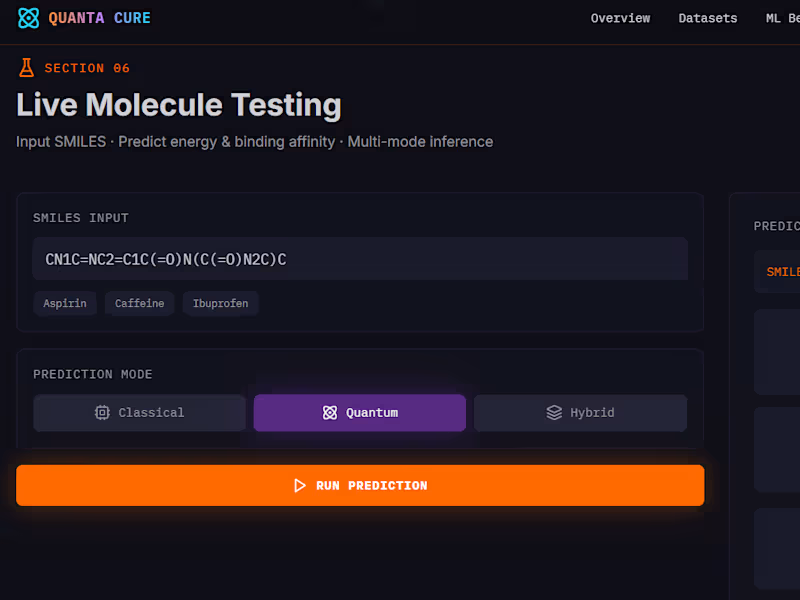
Drug discovery usually takes 10 to 15 years, our service proposes a way to lower the time and the cost by an estimated ten years, by simulating drug molecule behaviour with protein, docking, to give researchers a tool to speed up clinical trials by instead relying on simualtions
0
73
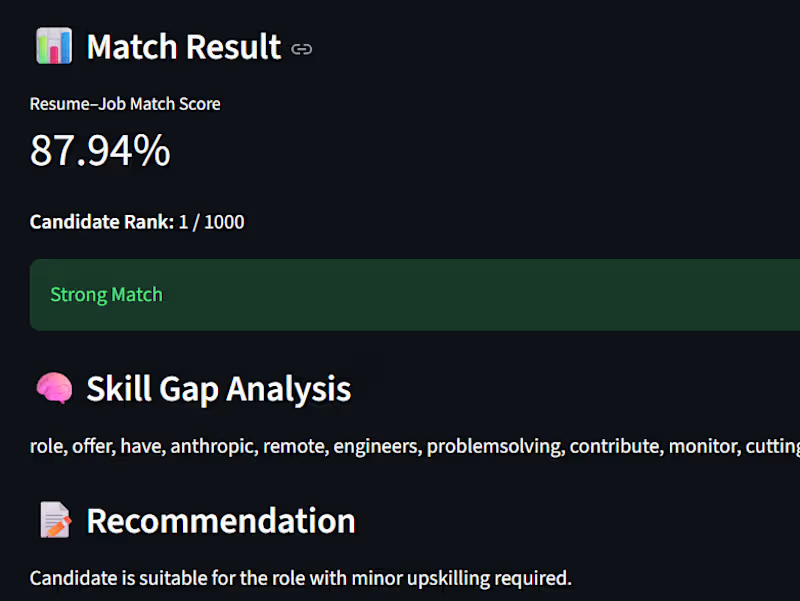
AI-Powered Resume Screening System
Tired of manually sifting through hundreds of resumes? This intelligent screening system does the heavy lifting — automatically parsing resumes, extracting key skills, and semantically matching candidates to job descriptions in seconds.
🧠 How It Works
The system uses advanced Natural Language Processing (NLP) to deeply understand both resumes and job descriptions — going far beyond simple keyword matching. It calculates semantic similarity using cosine similarity, meaning it understands context, not just words.
⚙️ Key Features
📄 Smart Resume Parsing — Automatically extracts skills, experience, and qualifications from any resume format
🔍 Semantic Job Matching — Matches candidates to roles based on meaning, not just keywords
🏆 Candidate Ranking — Instantly ranks applicants by relevance score
📊 Match Scoring — Clear percentage-based compatibility scores for every candidate
🕳️ Skill Gap Analysis — Identifies exactly what skills a candidate is missing for a role
🚀 Streamlit Dashboard — Clean, interactive UI deployable in one click
🛠️ Tech Stack
Python · NLP · Scikit-learn · Cosine Similarity · Streamlit · SpaCy / NLTK
💼 Perfect For
HR teams, recruitment agencies, startups, and any business drowning in job applications — this tool cuts screening time by up to 80%.
📈 Results It Delivers
✅ Faster hiring decisions
✅ Bias-reduced candidate evaluation
✅ Clear, data-backed shortlisting
✅ Scalable to thousands of resumes
0
64

AI Developer & ML Engineer: Top-notch Expertise
AI Developer & ML Engineer: Top-notch Expertise

AI Developer Data Analyst and ML Expert
AI Developer Data Analyst and ML Expert

Data Scientist | Data Analyst | ML Engineer
Data Scientist | Data Analyst | ML Engineer


Top Rated Plus Freelancer & Top 1% Talent
- $5k+
- Earned
- 2x
- Hired
- 5.0
- Rating
- 18
- Followers
Top Rated Plus Freelancer & Top 1% Talent


Where Founder Vision Is Engineered into Agentic AI Products.
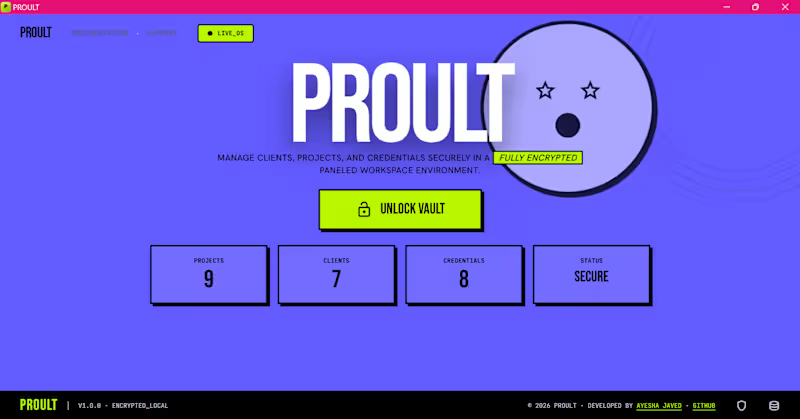
I wish I had it months ago.
(Launching Proult - Desktop App)
I spent 20 minutes looking for a Stripe credential.
I checked my notes.
My browser bookmarks.
Old chats.
Random text files.
Not because I forgot it.
Because I couldn't remember where I had saved it.
That's when I realized the most dangerous phrase in a developer's workflow isn't:
"I forgot."
It's:
"I've saved it somewhere."
As freelancers, students, developers, and builders, we constantly juggle multiple projects simultaneously.
And each project comes with its own ecosystem of information:
• Client details
• Credentials and passwords
• API keys and secrets
• Domains and hosting accounts
• GitHub repositories
• Deployment links
• Meeting notes
• Project requirements
• Time logs and deadlines
The problem isn't that we don't save this information.
The problem is that we save it everywhere.
-A Notepad file for credentials.
-A spreadsheet for clients.
-A project management tool for tasks.
-Bookmarks for links.
-Chat messages for "important" details.
And before long, finding information takes more time than using it.
After one too many "I know I saved this somewhere" moments,
I decided to build something for myself.
A single place where every project has its own secure workspace.
Not just for storing passwords, but for managing everything related to that project: clients, credentials, API keys, notes, services, links, statuses, and time tracking.
That's how "𝐏𝐫𝐨𝐮𝐥𝐭" started.
So over the last few days, I've been building Proult,
A local-first desktop application designed to keep everything related to a project in one place.
-AES-encrypted credentials, API keys, and secrets
-Project and client management
-Built-in time tracking
-Organization through project domains (Freelance, Personal, Organization, University)
-Global search across projects, clients, credentials, and services
-Full import/export support so your data always remains yours
-Pinned projects, tags, notes, deployment links, and service management
-Local-first architecture; no cloud dependency, everything stays under your control
Still polishing it, but building it has already improved my own workflow significantly.
Turns out, the best developer tools are often the ones built to solve your own frustrations first.
1
532
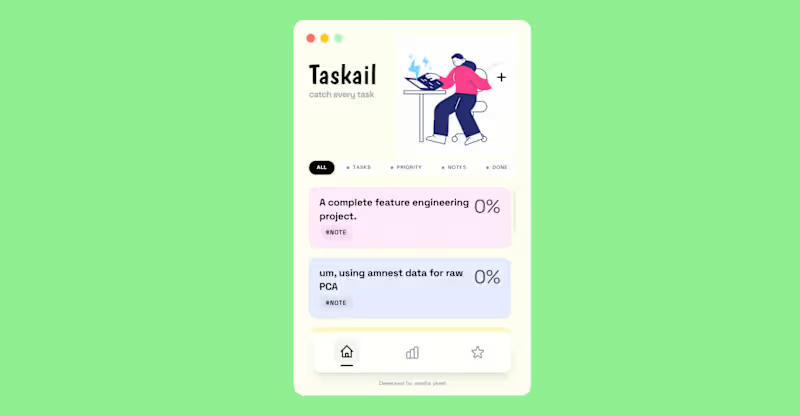


Clean Syntax. Scalable Intelligence
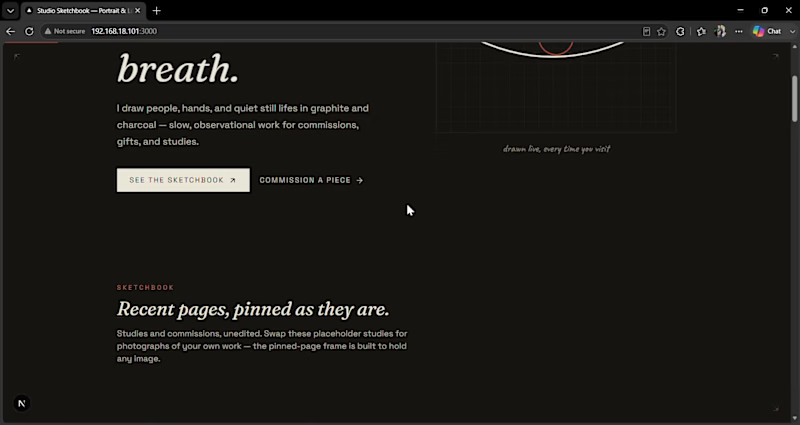
A dark-studio, sketchbook-themed portfolio for a portrait/line artist. Same stack as the AI-engineer portfolio: Next.js (App Router), Tailwind, Framer Motion, lucide-react, react-icons, and a working nodemailer contact form. The big thing is the AI , image to 3d model generator, which uses a tencent cloud API Stable Diffusion model to generate 3D models from 2D images. The models are then exported to GLTF format and displayed in the portfolio using Three.js.
0
24
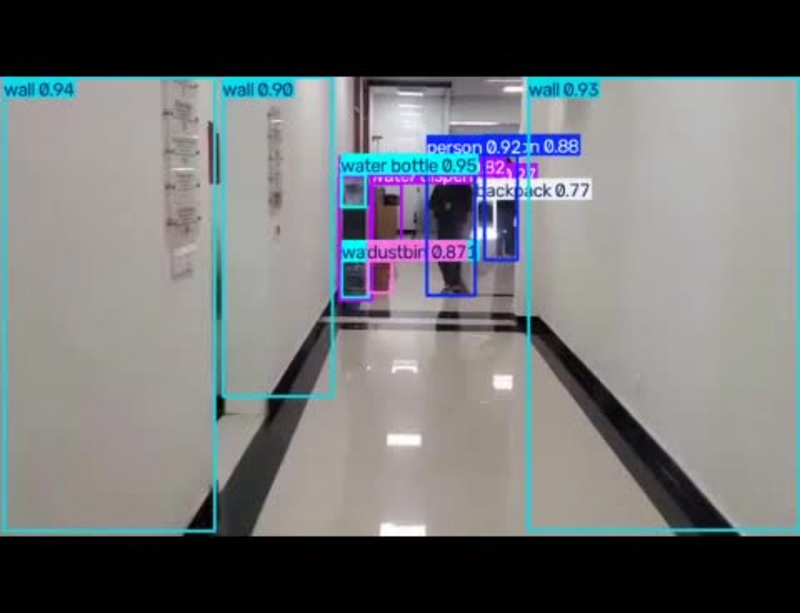
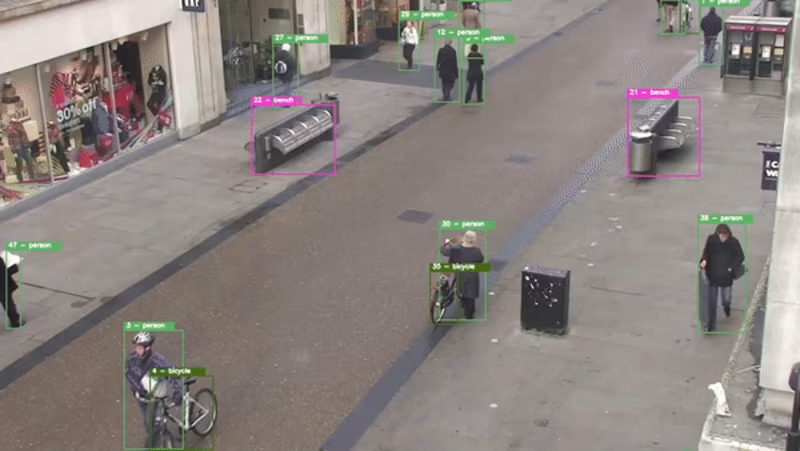
The system is built upon a dual-model hybrid architecture, balancing inference speed with spatial accuracy. The pipeline is heavily optimized to run on local hardware accelerators.
1. Object Detection (YOLOv8) Standardized on Ultralytics YOLOv8 for realtime bounding box generation. Fine-tuned to recognize critical indoor obstacles (doors, benches, people, structural barriers) while maintaining high FPS on edge hardware.
2. Metric Depth Estimation Utilizes Depth Anything V2 (Metric Indoor Small). Unlike relative depth models, this Vision Transformer (ViT) architecture outputs exact physical distances in meters, crucial for accurate collision calculations.
3. Edge Quantization (FP16) To preserve metric distance accuracy, the pipeline avoids INT8 quantization. Models are converted using FP16 (16-bit float) via ONNX/TFLite formats, doubling inference speed without degrading depth measurements.
4. Custom Python Pipeline A unified OpenCV-based tracking and inference loop. It manages frame buffering, selectively triggers the heavier depth model at optimized frame intervals, and computes the Collision Envelope mathematics.
0
27
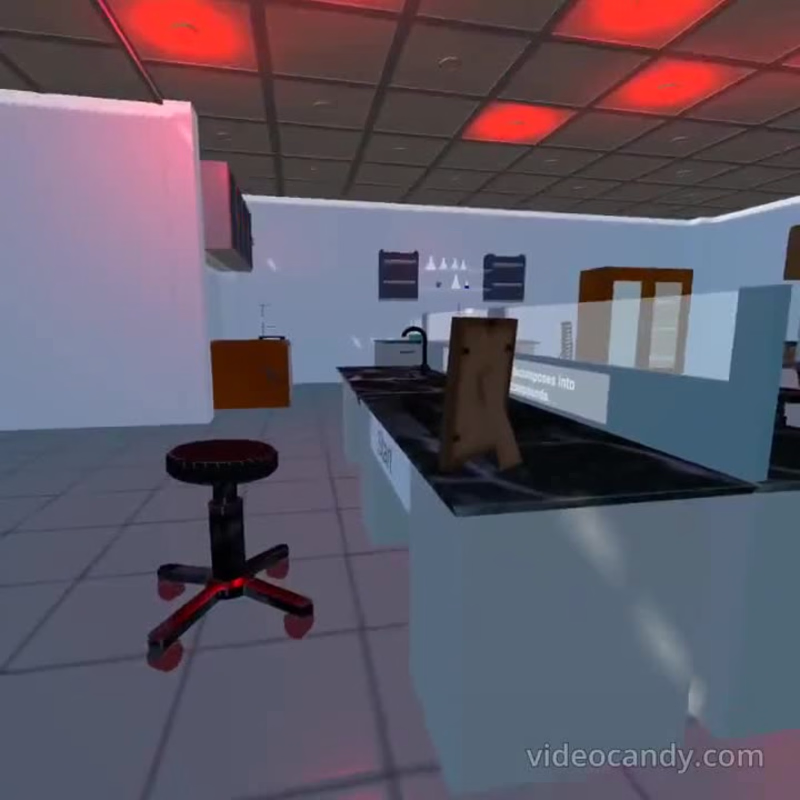
mmersive virtual reality chemistry lab for Meta Quest 2 that enables safe experimental practice and interactive XR simulations of laboratory procedures.
0
21
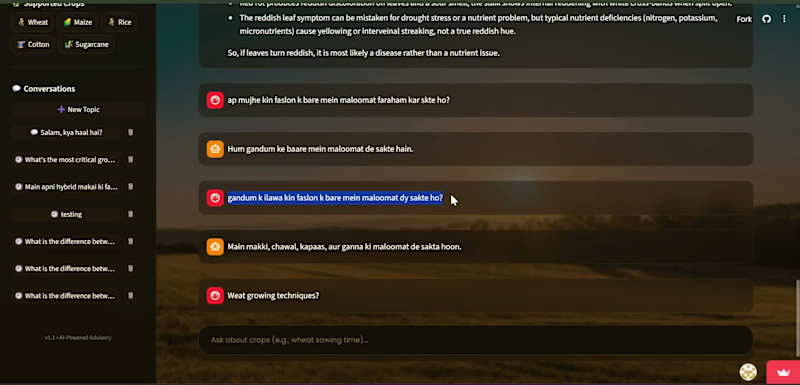
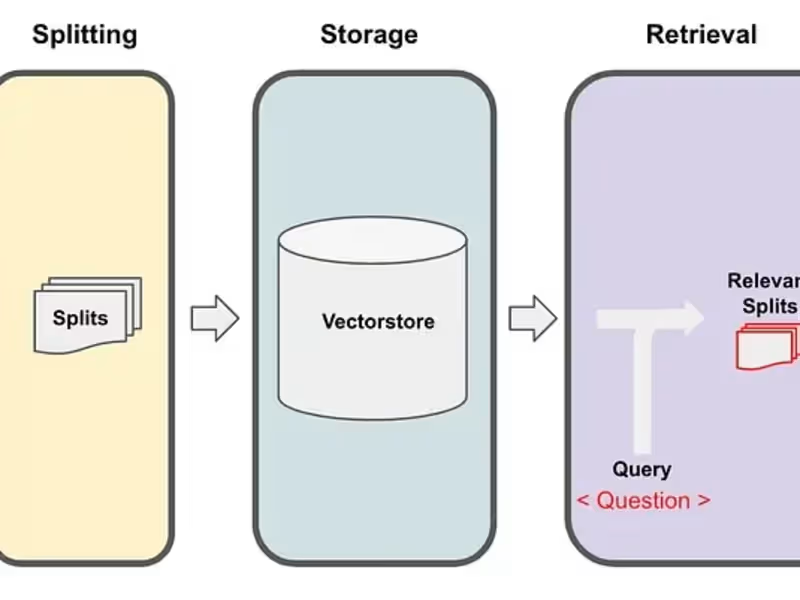
Intelligent Q&A assistant for farmers, powered by retrieval-augmented generation.
Curated 100+ agricultural documents and generated 1,000+ semantic knowledge chunks
Embedded using Sentence Transformers and indexed in ChromaDB for vector retrieval
Integrated Groq-hosted Llama models for accurate, context-grounded responses
Built and deployed a publicly accessible Streamlit application
Optimized retrieval through chunk-size tuning and prompt engineering
Validated retrieval and response quality against a curated test question set
0
33