The network for creativity
Join 1.25M professional creatives like you
Connect with clients, get discovered, and run your business 100% commission-free
Creatives on Contra have earned over $150M and we are just getting started
Back to feedPost

THE KEEPER OF WHAT REMAINS
I started with Mask (Buk, Krar, or Kara), a Torres Strait Islander ceremonial mask from probably Mabuiag Island, dating to the mid–late 19th century. Made from materials including turtleshell, wood, cassowary feathers, fiber, resin, shell, and paint, the mask is associated with ceremonial traditions and is surmounted by a bird.
That bird became my point of departure.
I imagined it coming alive and carrying the mask through time.
Rather than placing the mask in a single new environment, I built a continuous journey through different works from The Met's collection—moving through sculpture, ancient fresco, historic interiors, Renaissance architecture, landscapes, nineteenth-century painting, Impressionism, Pointillism, photography, and Romantic painting.
The bird and mask remain together throughout.
They don't change into something else.
The world changes around them.
The architecture changes.
The landscape changes.
The light changes.
The atmosphere changes.
The visual language changes.
But the bird continues flying, carrying the same mask from one world into another.
That continuity is the heart of the piece.
I wanted the journey to feel less like looking at a sequence of artworks and more like passing through centuries of art history in a single uninterrupted movement.
The bird stays near the center as the environments transform around it. Each transition is a continuation of its flight rather than a reset, so the viewer is always following the same traveler.
The mask becomes the constant.
It is carried from one period to the next, through radically different spaces and ways of seeing, until the journey eventually reaches the present.
The bird emerges into a museum and approaches Edgar Degas's The Little Fourteen-Year-Old Dancer.
It does not transform.
It does not disappear.
It simply releases the mask.
The mask comes to rest on the Little Dancer.
That final moment is the reason for the entire journey.
For me, the piece became a meditation on how history survives time.
We move through different eras.
The way we see changes.
The environments around us change.
Art changes.
But some things are carried forward.
The bird is the journey.
The mask is what remains.
ORIGINAL MUSEUM PIECE
Mask (Buk, Krar, or Kara)
Torres Strait Islander, probably Mabuiag Island
Mid–late 19th century
The Metropolitan Museum of Art
https://www.metmuseum.org/art/collection/search/311950
FINAL DESTINATION
The Little Fourteen-Year-Old Dancer — Edgar Degas
Modeled c. 1878–81
The Metropolitan Museum of Art
https://www.metmuseum.org/art/collection/search/196439
PUBLIC FLORA CANVAS
https://app.flora.ai/join-project/71bb6232-69ae-44cf-989d-21b45ef5e015
ARTWORKS / WORLDS REFERENCES
Antonio Canova — Perseus with the Head of Medusa
Cubiculum from the Villa of P. Fannius Synistor at Boscoreale
Bedroom from the Palazzo Sagredo, Venice
Worsham-Rockefeller Dressing Room
Platter, follower of Bernard Palissy
Boiserie from the Hôtel de Cabris, Grasse
Patio from the Castle of Vélez Blanco
Albert Bierstadt — The Rocky Mountains, Lander's Peak
Winslow Homer — The Veteran in a New Field
Thomas Eakins — Max Schmitt in a Single Scull
William Merritt Chase — At the Seaside
George Caleb Bingham — Fur Traders Descending the Missouri
Martin Johnson Heade — Approaching Thunder Storm
Vincent van Gogh — Wheatfield with Cypresses
Georges Seurat — A Sunday on La Grande Jatte study/version
Gustave Le Gray — The Great Wave, Sète
J. M. W. Turner — Whalers / The Whale Ship

The network for creativity
Join 1.25M professional creatives like you
Connect with clients, get discovered, and run your business 100% commission-free
Creatives on Contra have earned over $150M and we are just getting started
Trending
retrofuturism
Share your favorite designs from the past exploring the distant future. Or your own take on the aesthetic 🚀
halftone
Dots. Texture. Grain. Let's see your designs using the halftone technique.

Midjourney
Creatives are showing off what they're making with Midjourney.
colorgrade
Video editors sound off: How do you enhance the mood of your video in color grading?
Related posts

This is my 2nd Submission
Check my 1st submission at this link:
https://on.contra.com/CbjhLm
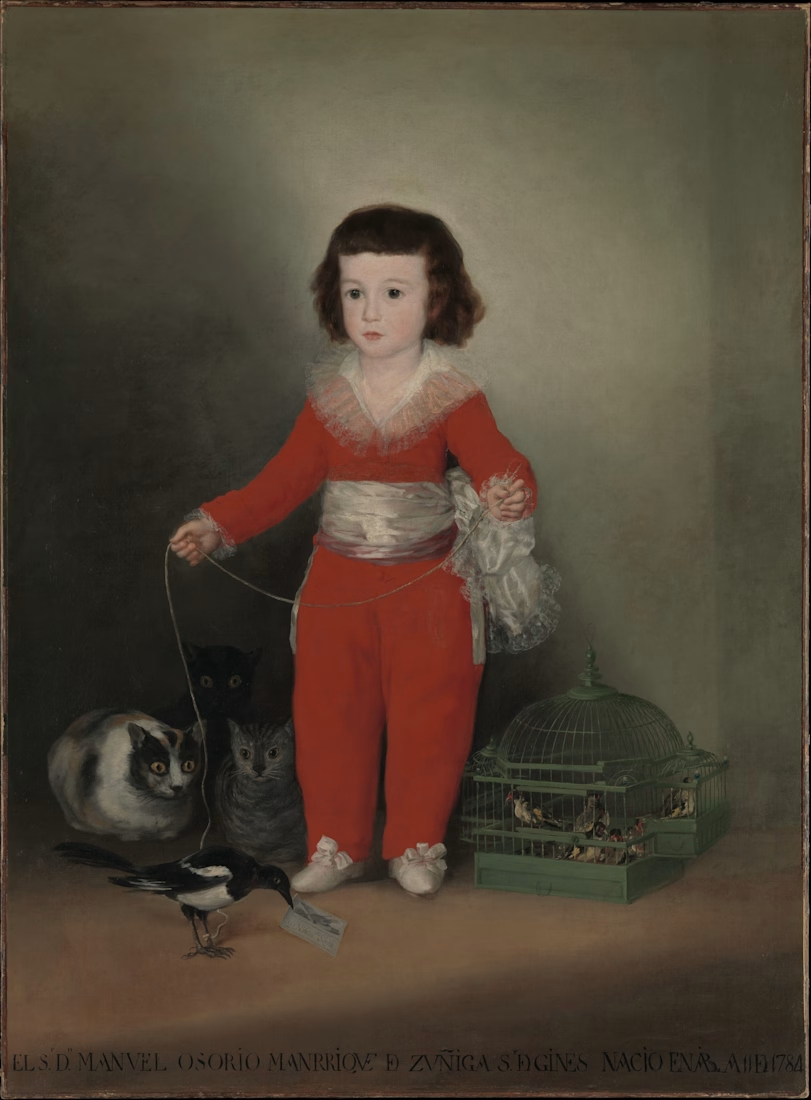
Inspired by: Manuel Osorio Manrique de Zúñiga, Francisco Goya, 1787–88, from The Met's open archive.
Link to Original Art: https://www.metmuseum.org/art/collection/search/436545
I liked this painting because of the boy at its center, Manuel, dressed in a striking red suit, holding a magpie on a string while three cats watch him from the shadows. Even as a child's portrait, it felt tense, like something was about to happen. It looked like a moment frozen right before a story unfolds.
What I made: I turned Manuel into a toy doll, kept his red suit, his pose, his face, everything the same, just changed what he is. In my video, a father buys the doll from a toy shop and gives it to his little daughter, and they walk out together. I chose a girl instead of a boy on purpose, it felt like giving Manuel a second life completely outside the world he was painted into, away from the cats, the cage, the tension, just a toy being loved.
How I made it: I downloaded the painting image from The Met's open archive, then imported it into FLORA, connected the picture to a text prompt node, then connected both the picture and text prompt node to the video node I also made an element Doll, and selected the Seedance 2.5 model with a 30 second clip. I kept the workflow as simple as possible.
Why I made this: I wanted to take Manuel out of the painting and out of the museum, and give him an actual childhood, even 230+ years later. I think his portrait still holds so much presence that it deserves to live on, just now as something a child can actually hold and love, not just look at.
Instagram post link:
https://www.instagram.com/p/Dc8SwEJMwP3/
Twitter(X) post link: https://x.com/AhmadSauleh/status/2096539462402466095?s=20

Awwwww so sweeet, ideaaa!!!

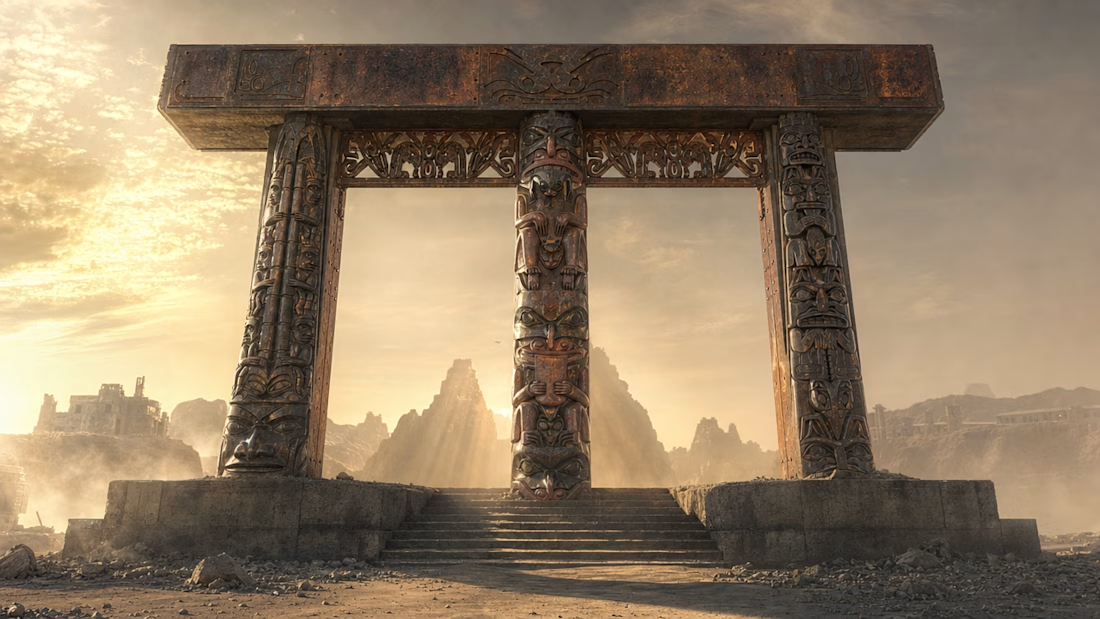
TOTEM — The Gate (bonus piece — my main entry is here 👇)
Main submission TOTEM: https://contra.com/community/Y6nZXmUy-totem-flora-museum-challenge-submission — that's the one to upvote for the challenge.
This piece is a side visual from the same project TOTEM.
Traditionally, welcome poles stood at the edge of a Northwest Coast village to greet visitors, and every totem pole carried a clan's lineage and history in its carved figures — a record of memory, not an idol.
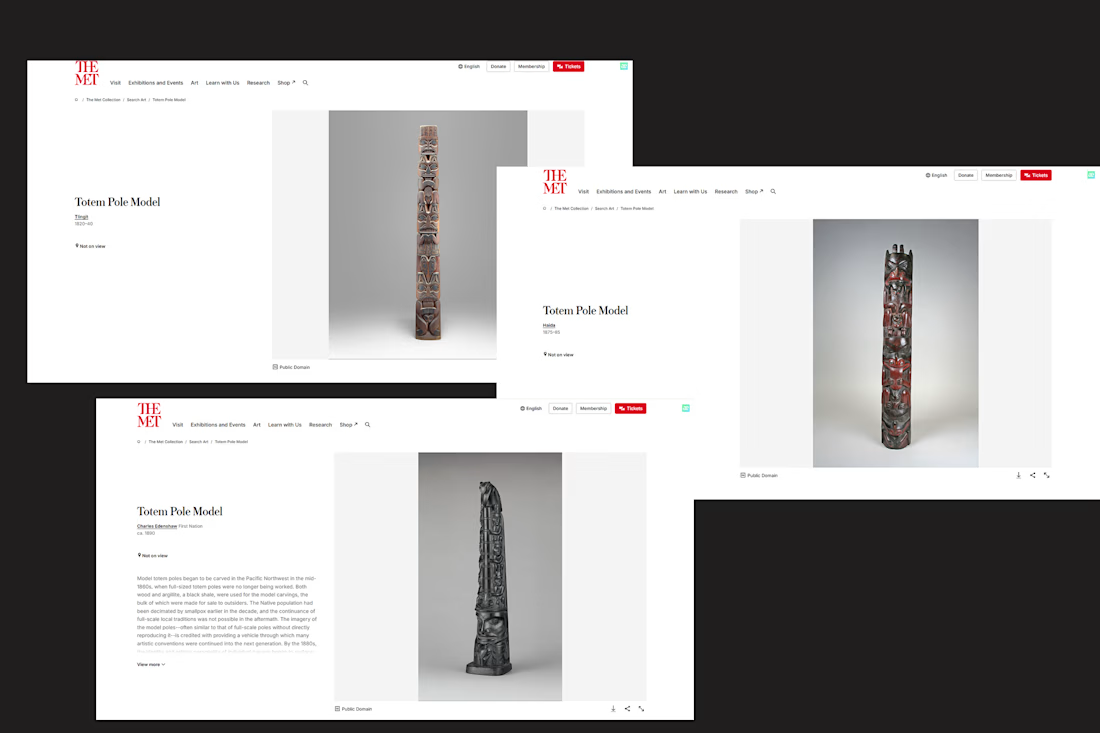
In TOTEM, three separate pole models — Tlingit (1820–40, wood), Haida (1875–85, wood, pigment), and one carved in argillite around 1890 by Charles Edenshaw — are reimagined not as three separate standing poles, but fused into a single arch at the shrine's threshold, keeping that same essence: they carry clan memory and greet whoever arrives.
One gate instead of three poles, reforged in metal instead of wood and stone.
The Met's own records don't specify what each carved figure on these three poles depicts, so the imagery in TOTEM's version is my own extrapolation — grounded in the real, documented purpose of welcome poles and clan-crest carving, not a literal reading of these specific figures.
Model poles like these first appeared in the Pacific Northwest in the 1860s, once full-sized totem poles were no longer being carved at the same scale — smaller versions became the way carvers, including Edenshaw, kept the same imagery and tradition alive for the next generation. In the post-collapse world of TOTEM, that same tradition is deliberately amplified: several poles are merged into a single arch, scaled up to a monumental size, and carved in a far more durable material — metal instead of wood and stone — so that it reminds everyone who passes through of the history of the lineage it carries.
Totem Pole Model — Tlingit, 1820–40 — wood
https://www.metmuseum.org/art/collection/search/319073
Totem Pole Model — Haida, 1875–85 — wood, pigment
https://www.metmuseum.org/art/collection/search/319081
Totem Pole Model — Charles Edenshaw, ca. 1890 — argillite (carved stone)
https://www.metmuseum.org/art/collection/search/319092
👉 Full story TOTEM: https://contra.com/community/Y6nZXmUy-totem-flora-museum-challenge-submission
#floramuseumchallenge #flora #metmuseum #generativedesign #FLORAMuseum

Perfect!

She sat by the window, waiting for someone who promised to return.
Years passed. The city changed. The lights outside changed.
But she kept waiting.
Eventually, she left the window and went looking for him herself.
What she found was the truth she had been waiting years to learn.
He was gone.:
She left one final letter behind and walked away.
Decades later, the building disappeared. The street changed. Everyone who knew their story was gone.
But the moment survived.
I found Portrait of a Woman before a Window, attributed to William Henry Brown, and that mystery inspired me to imagine the story that might have existed beyond the frame.
This is The Last Light — a story about waiting, loss, and how art can preserve a moment long after the people who lived it are gone.
Original inspiration: The Met — Portrait of a Woman before a Window

Mind boggling..🔥🔥🔥