
Uduak Eti
I help health brands write content anyone can understand.


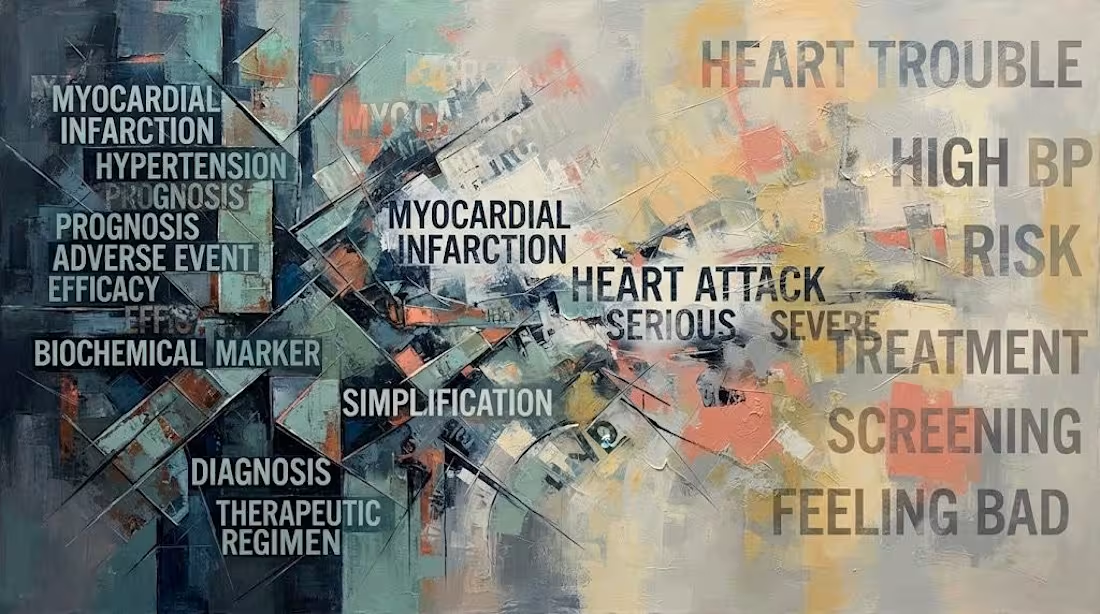
𝐖𝐡𝐞𝐧 𝐌𝐚𝐤𝐢𝐧𝐠 𝐇𝐞𝐚𝐥𝐭𝐡 𝐈𝐧𝐟𝐨𝐫𝐦𝐚𝐭𝐢𝐨𝐧 𝐒𝐢𝐦𝐩𝐥𝐞 𝐌𝐚𝐤𝐞𝐬 𝐈𝐭 𝐋𝐞𝐬𝐬 𝐀𝐜𝐜𝐮𝐫𝐚𝐭𝐞
In this article, I looked at a problem in health communication that's easy to miss: simpler doesn't always mean better.
Good health writing isn't about deleting every hard word. It's about knowing what you can simplify, what needs to stay, and how to explain it without losing accuracy.
That's how I approach health writing: researching the issue, looking beyond the obvious problem, and turning complex information into something clear, accurate, and useful to the intended audience.
Link to the article. (https://www.linkedin.com/pulse/when-making-health-information-simple-makes-less-accurate-uduak-eti-hbxif)
Health communicators are often advised to make information simple, and that counsel is right. But what if some health information becomes misleading precisely because we simplified it too much?
Let's agree that medical terms can be confusing for patients who are anxiously searching online for answers. However, people should not need medical degrees to understand information about their health.
Still, there's a serious problem we don't talk about enough. Sometimes, making health information simpler can make it less accurate.
This is not because simplicity is bad. It happens when information is simplified poorly.
Some words carry more meaning than we realise, and careless simplification can distort meaning or create misinformation.
Take, for example, the words 'serious' and 'severe'. In our conversations every day, these words can sound interchangeable. But in a medical context, replacing one with the other may change what the information communicates. In adverse event reporting, 'severe' describes how intense a symptom or event is, while 'serious' describes the clinical consequences for the patient, such as hospitalisation, disability, or death.
Many medical terms are used because they have specific meanings in clinical, research, or regulatory settings. So the problem is not that health information contains difficult words. The issue is not knowing which difficult words to replace and which technical terms to keep. Replacing a technical term can make a sentence easier to read, but it can also change or weaken its meaning.
𝐖𝐡𝐲 𝐝𝐨𝐞𝐬 𝐭𝐡𝐢𝐬 𝐡𝐚𝐩𝐩𝐞𝐧?
Part of the reason is straightforward: simpler information is often easier for people to understand, remember, and act on. Health communicators want their intended audience to understand the key message. Too much information can be overwhelming. Patients may have different levels of knowledge and health literacy, and they may be stressed, ill, short on time, or not familiar with medical terms. They may also be dealing with uncertainty.
In those situations, health communicators may reduce the number of ideas and focus on the main points that the audience needs to know.
Technical terms can be a barrier for people who do not know medical language or have limited access to healthcare or medical support. Health communicators help reduce these barriers by making information more accessible. They consider differences in literacy, language, age, disability, and social background.
The format itself also plays a role. A poster, text message, or social media post cannot contain a full research paper. Writers may also have strict word or character limits to work with. When information has to be shared in different languages, translation adds more choices to make. And in a health emergency, there is often not much time to create clear messages that people can quickly understand and act on.
Also, what an organisation wants to achieve affects what they say. For example, a health campaign might focus on telling people what to do rather than explaining every detail about the issue.
Health communicators have to choose what information the audience needs right away and what can be shared later. That makes health communication more than a writing exercise: it is a process of selection.
When we decide what to leave out, how do we know we haven't left out something that changes the meaning?
𝐖𝐡𝐚𝐭 𝐝𝐨𝐞𝐬 𝐭𝐡𝐞 𝐞𝐯𝐢𝐝𝐞𝐧𝐜𝐞 𝐫𝐞𝐯𝐞𝐚𝐥?
Research shows two things that are both true: medical jargon confuses patients, but we still need precise technical terms to keep information safe and accurate. It also shows that using simple, everyday words helps people who are not experts to understand and act on health advice. That's why the WHO recommends plain language.
If you simplify too much, though, you can lose important details, change the meaning, and make it harder for people to make informed decisions.
So good health communication needs to be clear and interesting, but still accurate.
The aim is not to make it as simple as possible. It is to make it as easy to understand as possible without changing what it actually means.
𝐖𝐡𝐚𝐭 𝐬𝐡𝐨𝐮𝐥𝐝 𝐰𝐞 𝐝𝐨 𝐝𝐢𝐟𝐟𝐞𝐫𝐞𝐧𝐭𝐥𝐲?
How do we actually do that?
Keep the medical term, but add a translation. For example, 'Myocardial infarction (heart attack).'
Keep the numbers, the doses, the warnings, but give context to understand them.
Use short sentences, clear headings, and examples.
Have a subject matter expert review that the main actions and warnings are still correct. This could be a clinician, pharmacist, or other specialist.
Test the information with people from the intended audience to see if they understand what it means and what they need to do.
When writing, ask yourself, 'Could I use another word for this without changing its meaning?'
If you can, use a simple word.
If you can’t, keep the technical term and explain it.
𝐍𝐨𝐭 𝐚𝐥𝐥 𝐜𝐨𝐦𝐩𝐥𝐞𝐱𝐢𝐭𝐲 𝐜𝐨𝐦𝐞𝐬 𝐟𝐫𝐨𝐦 𝐰𝐨𝐫𝐝𝐬
Sometimes health information is hard because of the words we use. But often it's hard because the science itself is uncertain.
Scientific findings are often a work in progress as science continues to evolve. A treatment may help some people, but not everyone. This is because health advice often focuses on chances, not guarantees. And what works for one group might not work for another.
A screening test can detect disease early, but it can also give false-positive or false-negative results. It may also find something that would never have caused harm.
Good communication also depends on the audience. What they need to know, their cultural background, and how they will use the information matter too.
If we remove those differences just because they feel 'too complicated', we have not made the information clearer. We have only changed what we are actually saying.
Our job is not to remove complexity. It is to help people understand the parts of it that matter.
𝐒𝐨𝐮𝐫𝐜𝐞𝐬
World Health Organization. Use Plain Language. Communicating for Health. https://www.who.int/about/communications/understandable/plain-language
World Health Organization. WHO Strategic Communications Framework for Effective Communications. https://www.who.int/docs/default-source/documents/communicating-for-health/communication-framework.pdf
Centers for Disease Control and Prevention. Develop & Test Materials. Health Literacy. https://www.cdc.gov/health-literacy/php/develop-materials/develop-test-materials.html
International Council for Harmonisation. E2A: Clinical Safety Data Management: Definitions and Standards for Expedited Reporting. European Medicines Agency. https://database.ich.org/sites/default/files/E2A_Guideline.pdf
1
39

𝐂𝐥𝐞𝐚𝐫 𝐄𝐧𝐨𝐮𝐠𝐡 𝐭𝐨 𝐑𝐞𝐚𝐝, 𝐍𝐨𝐭 𝐂𝐥𝐞𝐚𝐫 𝐄𝐧𝐨𝐮𝐠𝐡 𝐭𝐨 𝐀𝐜𝐭
This article looks at why plain language alone isn't always enough to make health information clear and useful, and how we can help people really understand it by testing with intended audiences, being specific about what to do, using examples that fit their culture, and checking understanding with teach-back.
This piece shows how I take complex health research and turn it into clear, practical content that helps readers understand what health information means and what to do with it.
Link to the article. (https://www.linkedin.com/pulse/clear-enough-read-act-uduak-eti-bcule)
People don’t always struggle with health information and services because they can’t read. Health information can be medically accurate and easy enough to read, yet still fail to help people understand what it means or what they should do.
We often talk about health literacy as though it is simply about communication between doctors and their patients or about medical writers developing written materials in plain language.
Health literacy begins in early childhood, long before a child can read or write. Children develop it through interactions with caregivers, family members, schools, and communities.
It involves the ability to find, understand, evaluate, and use health information and services to make informed health-related decisions and take appropriate action for ourselves and others.
People can misunderstand health information even when it's written in plain, simple language because understanding depends on more than just simple words and short sentences.
𝐅𝐚𝐜𝐭𝐨𝐫𝐬 𝐓𝐡𝐚𝐭 𝐀𝐟𝐟𝐞𝐜𝐭 𝐇𝐨𝐰 𝐖𝐞 𝐔𝐧𝐝𝐞𝐫𝐬𝐭𝐚𝐧𝐝
Plain language can reduce misunderstanding, but it doesn't put an end to it. It can make it easier to understand risks, recognise misinformation, and respond to warnings about severe weather or environmental hazards.
Several factors can affect how someone understands and uses a health message.
A person’s health literacy skills can affect how easily they find, understand, and act on information. However, understanding does not depend on individuals alone. Healthcare organisations also shape whether people can understand and act.
Different cultures hold different beliefs about sickness, risk, and treatment, and these beliefs can affect how people understand health information.
A reader may struggle to understand a health message when they are unfamiliar with the language, when there is a translation error, or when vague wording is used.
Medical terms and instructions can also confuse a patient, even when the information uses clear and simple words.
Information about dosage should specify the amount to take and when to take it.
Numbers can be especially tricky to understand. People may interpret a ‘50% increase in risk’ very differently from ‘risk rises from 2 in 1,000 to 3 in 1,000,’ even though both describe the same relative change. The second example makes the actual difference easier to see.
Pain, fear, stress, time pressure, and information overload can affect attention, memory, and decision-making.
These factors show why plain language is important, but not always enough.
𝐃𝐨𝐧'𝐭 𝐀𝐬𝐬𝐮𝐦𝐞: 𝐂𝐡𝐞𝐜𝐤 𝐔𝐧𝐝𝐞𝐫𝐬𝐭𝐚𝐧𝐝𝐢𝐧𝐠
For health communication to be effective, professionals and writers should combine plain language with practical ways of checking understanding.
Be specific about what you want people to do. Instead of saying ‘Take twice daily’, say ‘Take one tablet in the morning and one in the evening’, when that schedule is appropriate for the medicine. Explain symptoms, side effects, and warning signs using simple examples.
It is also important to use the language your intended audience prefers and understands, along with culturally relevant examples.
Before you publish, test your written materials with members of the intended audience. Ask them what they think the message is about, what they will do next, and which parts remain unclear.
Teach-back is a way to check whether the information was understood. It tests whether the explanation was clear; it is not a test of the patient. Ask the person to explain, in their own words, what they understand and what they will do.
For example:
‘I want to be sure my explanation was clear. Can you please tell me how you will take this medication when you get home?’
𝐂𝐨𝐧𝐜𝐥𝐮𝐬𝐢𝐨𝐧
Plain language is a good starting point, but clear words do not always guarantee clear understanding.
We should not assume that people understand us simply because we have explained something clearly. A better test is whether they understood what we meant, know what to do next, and can act on it.
𝐒𝐨𝐮𝐫𝐜𝐞𝐬
World Health Organization (WHO). Low health literacy is costing health (2025). https://www.who.int/publications/i/item/B09619
Centers for Disease Control and Prevention (CDC). Plain Language Materials & Resources. https://www.cdc.gov/health-literacy/php/develop-materials/plain-language.html
Swedish Agency for Health Technology Assessment and Assessment of Social Services (SBU). Interventions to Promote Health Literacy in Children, Adolescents, and Supporting Adults (2025). https://www.sbu.se/en/publications/sbu-kartlagger/interventions-to-promote-health-literacy-in-children-adolescents-and-supporting-adults/
NIH/PMC. Health promotion through reading in the first thousand days (2025). https://pmc.ncbi.nlm.nih.gov/articles/PMC12716577/
2
242

𝐖𝐡𝐞𝐧 𝐌𝐚𝐥𝐚𝐫𝐢𝐚 𝐀𝐟𝐟𝐞𝐜𝐭𝐬 𝐭𝐡𝐞 𝐁𝐫𝐚𝐢𝐧: 𝐖𝐡𝐲 𝐂𝐞𝐫𝐞𝐛𝐫𝐚𝐥 𝐌𝐚𝐥𝐚𝐫𝐢𝐚 𝐂𝐚𝐧 𝐋𝐨𝐨𝐤 𝐋𝐢𝐤𝐞 ‘𝐌𝐚𝐝𝐧𝐞𝐬𝐬’
A public health article explaining how cerebral malaria attacks the brain and why it can turn life-threatening. I broke down the science behind the condition, from how it develops to symptoms like confusion, seizures, and loss of consciousness, and explained it in plain language that a general reader could follow without losing what makes it credible.
This piece shows my ability to translate complex medical research into clear language without losing the science.
Link to the article. (https://drive.google.com/file/d/1JpqugZqCngM6AIbQH9Oh-YhrupnthcbZ/view?usp=drivesdk)
𝐖𝐡𝐞𝐧 𝐌𝐚𝐥𝐚𝐫𝐢𝐚 𝐈𝐬 𝐌𝐨𝐫𝐞 𝐓𝐡𝐚𝐧 𝐚 𝐅𝐞𝐯𝐞𝐫
Is it malaria, typhoid, or something else? Confusion can be a medical emergency.
When malaria is severe, it can go beyond fever and chills and affect the brain. This can cause dramatic changes in behaviour, consciousness, and thinking that may look frightening or confusing to an untrained observer, and could be mistaken for madness.
This condition is called cerebral malaria.
𝐖𝐡𝐚𝐭 𝐈𝐬 𝐂𝐞𝐫𝐞𝐛𝐫𝐚𝐥 𝐌𝐚𝐥𝐚𝐫𝐢𝐚?
Cerebral malaria is a very serious form of malaria that affects the brain. It is caused by 𝑃𝑙𝑎𝑠𝑚𝑜𝑑𝑖𝑢𝑚 𝑓𝑎𝑙𝑐𝑖𝑝𝑎𝑟𝑢𝑚, the deadliest malaria parasite. This parasite is responsible for most severe malaria and malaria deaths.
And yes, it is caused by the same parasite that causes malaria.
But this isn't just a case of someone having a high fever and feeling weak.
Cerebral malaria can cause a person to become confused, act very differently from normal, have seizures, or even lose consciousness and fall into a coma.
The WHO defines cerebral malaria as an unarousable coma that persists even after other temporary causes, such as low blood sugar or the temporary effects of a recent seizure, have been corrected.
In simpler terms, the person's brain has been affected so severely that they become completely unresponsive. They cannot be woken up by normal stimulation, such as loud sounds or shaking.
That is what makes cerebral malaria so dangerous.
𝐖𝐡𝐲 𝐂𝐚𝐧 𝐈𝐭 𝐂𝐡𝐚𝐧𝐠𝐞 𝐇𝐨𝐰 𝐒𝐨𝐦𝐞𝐨𝐧𝐞 𝐁𝐞𝐡𝐚𝐯𝐞𝐬?
So, how can malaria make someone confused, behave strangely, or even become unconscious?
Remember, 𝑃𝑙𝑎𝑠𝑚𝑜𝑑𝑖𝑢𝑚 𝑓𝑎𝑙𝑐𝑖𝑝𝑎𝑟𝑢𝑚 is a parasite that lives in red blood cells. The parasites do not go directly into the brain tissue. Instead, as the infection becomes severe, these infected cells stick to the walls of the tiny blood vessels in the brain and get trapped there.
This blocks blood flow and reduces oxygen to the brain. It causes inflammation, swelling, and changes that can damage brain function.
Chemicals in the brain get out of balance.
All this causes the brain to function poorly. And when the brain is not functioning well, the effects can be dramatic.
𝐀 𝐩𝐞𝐫𝐬𝐨𝐧 𝐦𝐚𝐲:
• Become confused or disoriented.
• See or hear things that are not there (hallucinations).
• Act aggressively, violently, or very strangely.
• Have seizures and then be very drowsy or agitated.
• Talk in a way that does not make sense.
So, what may look like a sudden change in someone's personality or behaviour may actually be a sign that their brain is in serious trouble.
𝐖𝐡𝐲 𝐈𝐭 𝐂𝐚𝐧 𝐁𝐞 𝐌𝐢𝐬𝐭𝐚𝐤𝐞𝐧 𝐟𝐨𝐫 ‘𝐌𝐚𝐝𝐧𝐞𝐬𝐬’
In many communities, especially where mental health literacy is limited, these sudden changes can look like the person is having a mental health crisis. Others may think it is typhoid or even that the person is possessed by spirits.
But cerebral malaria can cause some of these same outward signs.
The important difference is that these changes can be caused by a severe infection affecting the brain. They do not automatically mean that the person has a mental illness.
This is why it is dangerous to make assumptions based only on what you can see.
Many people may not recognise that these symptoms require urgent medical attention. If the behaviour is mistaken for a mental health problem, typhoid, or something supernatural, the person may not receive the medical treatment they urgently need.
Don't dismiss the behaviour as ‘madness’. It could be the brain signalling that something is seriously wrong.
𝐖𝐡𝐚𝐭 𝐒𝐡𝐨𝐮𝐥𝐝 𝐘𝐨𝐮 𝐃𝐨?
If a person with suspected or confirmed malaria becomes confused, unusually sleepy, very weak, unconscious, has seizures, or has trouble breathing, treat it as an emergency.
𝐖𝐡𝐚𝐭 𝐭𝐨 𝐝𝐨:
• Don't wait to see if they get better.
• Take them to the nearest hospital immediately for urgent medical assessment and treatment.
• Don't assume it is only a mental health problem, typhoid, or something supernatural.
• Don't try to manage severe symptoms at home.
• Don't restrain the person unless it is necessary to prevent immediate injury. A sudden change in behaviour should not be assumed to be purely psychiatric without urgent medical assessment.
• If a seizure happens, move nearby objects away to prevent injury. Do not put anything in the person's mouth, and do not force food or drink.
Most importantly, get medical help quickly.
𝐖𝐡𝐲 𝐅𝐚𝐬𝐭 𝐓𝐫𝐞𝐚𝐭𝐦𝐞𝐧𝐭 𝐌𝐚𝐭𝐭𝐞𝐫𝐬
Cerebral malaria is an important public health problem because it can be life-threatening and can leave lasting effects, especially in children.
Surviving is not always the end of the story.
Even when a person survives cerebral malaria, some may have long-term problems, such as:
• Trouble concentrating, learning, or remembering.
• Behavioural changes, mood problems, or lasting mental health effects.
• Difficulty at school or at work.
Children who survive cerebral malaria may be particularly affected, and some may need follow-up care for learning and behaviour problems.
This is why recognising the warning signs early and getting medical care quickly can save lives and help reduce the risk of long-term brain damage.
𝐓𝐡𝐞 𝐓𝐚𝐤𝐞𝐚𝐰𝐚𝐲
Malaria is more than a fever. When it becomes severe, it can be life-threatening.
And while children are particularly affected by severe malaria, adults can also become seriously ill, including travellers visiting malaria-endemic regions and pregnant women.
When we recognise sudden changes in behaviour, we shouldn't delay urgent medical care. Cerebral malaria needs immediate antimalarial treatment and supportive care in the hospital.
This is also why continued investment in malaria prevention, including treated mosquito nets, indoor spraying, and malaria vaccines, matters, alongside early diagnosis and rapid treatment.
Sometimes, what looks like a change in behaviour is actually a medical emergency.
𝐒𝐨𝐮𝐫𝐜𝐞𝐬
[World Health Organization (WHO) – Malaria] (https://www.who.int/news-room/fact-sheets/detail/malaria)
[WHO Guidelines for Malaria] (https://www.who.int/publications/i/item/guidelines-for-malaria)
[Neuropsychiatric Profile in Malaria: An Overview] (https://pmc.ncbi.nlm.nih.gov/articles/PMC5020222/)
[Cerebral Malaria and Neuronal Implications of Plasmodium falciparum Infection: From Mechanisms to Advanced Models](https://pmc.ncbi.nlm.nih.gov/articles/PMC9798991/)
[Human cerebral malaria and the blood-brain barrier](https://pubmed.ncbi.nlm.nih.gov/16616145/)
1
291

𝐁𝐞𝐟𝐨𝐫𝐞 𝐘𝐨𝐮 𝐂𝐚𝐥𝐥 𝐈𝐭 𝐀𝐭𝐭𝐞𝐧𝐭𝐢𝐨𝐧-𝐒𝐞𝐞𝐤𝐢𝐧𝐠, 𝐀𝐬𝐤 𝐖𝐡𝐚𝐭 𝐭𝐡𝐞 𝐏𝐞𝐫𝐬𝐨𝐧 𝐈𝐬 𝐓𝐫𝐲𝐢𝐧𝐠 𝐭𝐨 𝐂𝐨𝐦𝐦𝐮𝐧𝐢𝐜𝐚𝐭𝐞
A public health article exploring how suicidal distress can be misunderstood as attention-seeking, and how we can learn to recognise when someone is struggling and respond with more care.
This piece reflects my ability to communicate sensitive health issues by combining storytelling, evidence, and practical guidance in a way that is human, clear, and easy to understand, while helping readers think differently about how they respond to people in distress.
Link to the article. (https://www.linkedin.com/pulse/before-you-call-attention-seeking-ask-what-person-trying-uduak-eti-qgxve?utm_source=share&utm_medium=member_ios&utm_campaign=share_via)
I've lost count of the number of people I've seen joke about suicidal thoughts or even past attempts, as though suicide were something to laugh about or a game people needed to play.
One of those times, a friend told me a disturbing story about himself. He laughed as he told it, as though it were nothing. He had joked about being tired of life. But what he described afterwards was not a joke. He had gone out alone late at night to an isolated road, hoping something would happen that would end his life. When nothing did, he returned home. The following night, he tried again. He returned home disappointed. And when he told me about it, he laughed it off as though he were recounting an unfortunate incident rather than telling me how close he had come to dying.
I remember the laughter.
Not because it made the story less disturbing, but because it made me think about how easily distress can be disguised, dismissed, or misunderstood. What unsettled me most was the excitement with which he recounted it, as though attempting to end his life were an achievement.
And that stayed with me.
We are often more comfortable judging the behaviour than asking what might be behind it. Sometimes we call someone dramatic because they keep saying they cannot cope or that they are tired of living. It’s easy to say they’re too sensitive when the same issue keeps bothering them again and again. But maybe they are just trying to communicate something we don’t understand.
We get frustrated when they keep calling and texting repeatedly, and then withdraw when we ask what's wrong. We tell them they are overreacting when they say they need to be left alone. It irritates us when they post something concerning and delete it shortly afterward. At times, we even mute their stories or statuses because we don't want to be disturbed. Eventually, we stop responding because we have decided they are looking for attention.
What if attention is exactly what they are asking for?
Distress does not always arrive in a way that is convenient for us to recognise. Sometimes it's loud; it's the same thought on repeat; it looks like anger, pulling away, or suddenly needing to be close to someone. And sometimes you can’t even name it. You just know something inside feels too heavy to carry.
That doesn’t mean every unusual behaviour is a sign someone is suicidal. But when someone’s words or behaviour show they’re struggling, and we dismiss them just because their pain makes us uncomfortable, we might miss the moment when they most need someone to listen.
You cannot always see psychological distress from the outside. A person can laugh with you, work, socialise, make plans, carry on with their day, and appear perfectly fine while struggling with thoughts they have told no one about. Some may even be the person everyone describes as cheerful.
That is part of what makes suicidal distress so difficult to recognise. We often expect someone who is struggling to look broken and sad, but when they don't, we assume nothing serious is happening.
A person can be functioning and still be struggling.
Saying ‘I am fine’ when asked how you are is almost a default answer everyone gives. Sometimes people respond that way because they don’t have words for what’s going on inside. Or because making a joke about it hurts less than saying it straight.
That does not mean every cheerful person is secretly suicidal, or that every joke about death is a warning sign. It means we should be careful about assuming that distress always looks the way we expect it to. Sometimes, the person who looks fine is simply the person who has mastered the art of looking fine.
If we cannot always recognise distress by appearance, we need to pay closer attention to what people say and do instead of dismissing them.
If you’re in that place right now, I hear you.
You constantly battle with the voice in your head. You struggle with an urge that can feel impossible to resist. You smile at others, but somehow inside, you are tormented and exhausted from holding it together.
You don’t feel the love around you.
Everyone else seems to be moving towards something, while you feel empty.
And every day, the weight gets heavier.
You do not have to wait until it gets worse. Please tell someone. A close friend, a family member, a doctor, or a crisis line in your country. You do not have to carry this alone. And it's okay not to have the right words to ask for help. Just speak.
So what happens when we dismiss the way someone asks for help because we don't like how they ask for it?
They may withdraw because they don't feel heard, seen, or understood. And when someone is already struggling with suicidal thoughts, being dismissed can make it harder to seek help.
According to the WHO, more than 720,000 people die by suicide every year, and suicide is the third leading cause of death among 15–29-year-olds globally. Many suicides happen impulsively during moments of crisis.
Yet suicide is preventable.
That is why, when someone's words or behaviour concern you, don't beat around the bush. Ask directly:
‘Are you thinking about suicide?’
It feels scary to ask. But asking does not give them the idea. In fact, talking openly often helps. It can ease the pressure and show them someone is really listening.
Give them your full attention without judgement. Acknowledge their pain. Avoid arguing or minimising what they are experiencing.
Maybe we need to change the question.
This year's World Suicide Prevention Day theme is ‘Changing the Narrative on Suicide’, with the call to action: ‘Start the Conversation.’ WHO's message is not simply about talking more. It is about challenging the myths, stigma, and misunderstandings that can stop people from speaking or seeking help.
Perhaps that change can begin with something simple: rethinking how we speak to people, and how fast we dismiss them.
Before we call someone dramatic, difficult, or attention-seeking, we can pause and ask what might be underneath it.
Because sometimes, attention is not the problem.
Sometimes, being noticed is the first step towards being heard.
And sometimes, the question that matters most is not:
‘Why are they seeking so much attention?’
It is:
‘What are they trying to communicate?’
6
706