The network for creativity
Join 1.25M professional creatives like you
Connect with clients, get discovered, and run your business 100% commission-free
Creatives on Contra have earned over $150M and we are just getting started
Back to feedPost

𝐖𝐡𝐞𝐧 𝐌𝐚𝐤𝐢𝐧𝐠 𝐇𝐞𝐚𝐥𝐭𝐡 𝐈𝐧𝐟𝐨𝐫𝐦𝐚𝐭𝐢𝐨𝐧 𝐒𝐢𝐦𝐩𝐥𝐞 𝐌𝐚𝐤𝐞𝐬 𝐈𝐭 𝐋𝐞𝐬𝐬 𝐀𝐜𝐜𝐮𝐫𝐚𝐭𝐞
In this article, I looked at a problem in health communication that's easy to miss: simpler doesn't always mean better.
Good health writing isn't about deleting every hard word. It's about knowing what you can simplify, what needs to stay, and how to explain it without losing accuracy.
That's how I approach health writing: researching the issue, looking beyond the obvious problem, and turning complex information into something clear, accurate, and useful to the intended audience.
Health communicators are often advised to make information simple, and that counsel is right. But what if some health information becomes misleading precisely because we simplified it too much?
Let's agree that medical terms can be confusing for patients who are anxiously searching online for answers. However, people should not need medical degrees to understand information about their health.
Still, there's a serious problem we don't talk about enough. Sometimes, making health information simpler can make it less accurate.
This is not because simplicity is bad. It happens when information is simplified poorly.
Some words carry more meaning than we realise, and careless simplification can distort meaning or create misinformation.
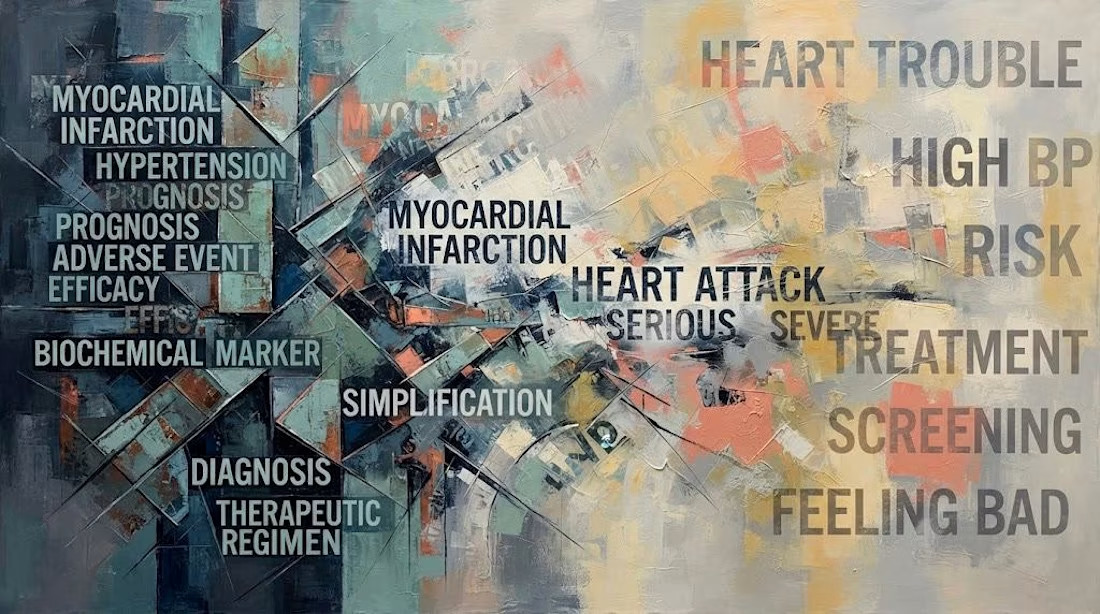
Take, for example, the words 'serious' and 'severe'. In our conversations every day, these words can sound interchangeable. But in a medical context, replacing one with the other may change what the information communicates. In adverse event reporting, 'severe' describes how intense a symptom or event is, while 'serious' describes the clinical consequences for the patient, such as hospitalisation, disability, or death.
Many medical terms are used because they have specific meanings in clinical, research, or regulatory settings. So the problem is not that health information contains difficult words. The issue is not knowing which difficult words to replace and which technical terms to keep. Replacing a technical term can make a sentence easier to read, but it can also change or weaken its meaning.
𝐖𝐡𝐲 𝐝𝐨𝐞𝐬 𝐭𝐡𝐢𝐬 𝐡𝐚𝐩𝐩𝐞𝐧?
Part of the reason is straightforward: simpler information is often easier for people to understand, remember, and act on. Health communicators want their intended audience to understand the key message. Too much information can be overwhelming. Patients may have different levels of knowledge and health literacy, and they may be stressed, ill, short on time, or not familiar with medical terms. They may also be dealing with uncertainty.
In those situations, health communicators may reduce the number of ideas and focus on the main points that the audience needs to know.
Technical terms can be a barrier for people who do not know medical language or have limited access to healthcare or medical support. Health communicators help reduce these barriers by making information more accessible. They consider differences in literacy, language, age, disability, and social background.
The format itself also plays a role. A poster, text message, or social media post cannot contain a full research paper. Writers may also have strict word or character limits to work with. When information has to be shared in different languages, translation adds more choices to make. And in a health emergency, there is often not much time to create clear messages that people can quickly understand and act on.
Also, what an organisation wants to achieve affects what they say. For example, a health campaign might focus on telling people what to do rather than explaining every detail about the issue.
Health communicators have to choose what information the audience needs right away and what can be shared later. That makes health communication more than a writing exercise: it is a process of selection.
When we decide what to leave out, how do we know we haven't left out something that changes the meaning?
𝐖𝐡𝐚𝐭 𝐝𝐨𝐞𝐬 𝐭𝐡𝐞 𝐞𝐯𝐢𝐝𝐞𝐧𝐜𝐞 𝐫𝐞𝐯𝐞𝐚𝐥?
Research shows two things that are both true: medical jargon confuses patients, but we still need precise technical terms to keep information safe and accurate. It also shows that using simple, everyday words helps people who are not experts to understand and act on health advice. That's why the WHO recommends plain language.
If you simplify too much, though, you can lose important details, change the meaning, and make it harder for people to make informed decisions.
So good health communication needs to be clear and interesting, but still accurate.
The aim is not to make it as simple as possible. It is to make it as easy to understand as possible without changing what it actually means.
𝐖𝐡𝐚𝐭 𝐬𝐡𝐨𝐮𝐥𝐝 𝐰𝐞 𝐝𝐨 𝐝𝐢𝐟𝐟𝐞𝐫𝐞𝐧𝐭𝐥𝐲?
How do we actually do that?
Keep the medical term, but add a translation. For example, 'Myocardial infarction (heart attack).'
Keep the numbers, the doses, the warnings, but give context to understand them.
Use short sentences, clear headings, and examples.
Have a subject matter expert review that the main actions and warnings are still correct. This could be a clinician, pharmacist, or other specialist.
Test the information with people from the intended audience to see if they understand what it means and what they need to do.
When writing, ask yourself, 'Could I use another word for this without changing its meaning?'
If you can, use a simple word.
If you can’t, keep the technical term and explain it.
𝐍𝐨𝐭 𝐚𝐥𝐥 𝐜𝐨𝐦𝐩𝐥𝐞𝐱𝐢𝐭𝐲 𝐜𝐨𝐦𝐞𝐬 𝐟𝐫𝐨𝐦 𝐰𝐨𝐫𝐝𝐬
Sometimes health information is hard because of the words we use. But often it's hard because the science itself is uncertain.
Scientific findings are often a work in progress as science continues to evolve. A treatment may help some people, but not everyone. This is because health advice often focuses on chances, not guarantees. And what works for one group might not work for another.
A screening test can detect disease early, but it can also give false-positive or false-negative results. It may also find something that would never have caused harm.
Good communication also depends on the audience. What they need to know, their cultural background, and how they will use the information matter too.
If we remove those differences just because they feel 'too complicated', we have not made the information clearer. We have only changed what we are actually saying.
Our job is not to remove complexity. It is to help people understand the parts of it that matter.
𝐒𝐨𝐮𝐫𝐜𝐞𝐬
World Health Organization. Use Plain Language. Communicating for Health. https://www.who.int/about/communications/understandable/plain-language
World Health Organization. WHO Strategic Communications Framework for Effective Communications. https://www.who.int/docs/default-source/documents/communicating-for-health/communication-framework.pdf
Centers for Disease Control and Prevention. Develop & Test Materials. Health Literacy. https://www.cdc.gov/health-literacy/php/develop-materials/develop-test-materials.html
International Council for Harmonisation. E2A: Clinical Safety Data Management: Definitions and Standards for Expedited Reporting. European Medicines Agency. https://database.ich.org/sites/default/files/E2A_Guideline.pdf


The network for creativity
Join 1.25M professional creatives like you
Connect with clients, get discovered, and run your business 100% commission-free
Creatives on Contra have earned over $150M and we are just getting started





Related posts




Looks great !


Upgoating this..... Converting complex healthtech Figma components into a seamless, high-trust Webflow build is no easy feat—really smooth execution!

𝑪𝒐𝒈𝒏𝒊𝒙 - 𝑨𝑰 𝑬𝒅𝒖𝒄𝒂𝒕𝒊𝒐𝒏 𝑳𝒂𝒏𝒅𝒊𝒏𝒈 𝑷𝒂𝒈𝒆


