
Sebastien Guidetti
AI Systems Engineer · Creative Tech, Design & Music


AI Systems Auditing & Governance: The Jerry Ledger
1
6
Headline: Bridging the gap between a dream and a scalable creative engine. ⚙️🎨
A month ago, I had a dream that sparked the concept for a new graphic novel: Volta Saga (along with an expanded universe in Volta Bebop). But having a concept is only step one. Executing a highly visual, consistent narrative requires a solid technical foundation.
For the past few weeks, I’ve been architecting and fine-tuning a custom AI generation engine tailored specifically for sequential storytelling.
When developing a graphic novel using AI, the biggest hurdle is consistency. To solve this, I’m building a pipeline focused on:
Character Modeling & Face Studies: Ensuring character identities remain locked across different scenes and emotions.
Structured Turnarounds: Generating precise, multi-angle reference sheets for every character and asset.
Contextual Integration: Automating the heavy lifting of spatial positioning, dynamic lighting, and VFX to match the precise mood of the narrative environment.
I’m treating the art generation process much like a software development pipeline—structuring the data, refining the parameters, and building an engine that scales as the story grows.
Check out the attached demo video to see the current output of the character models and environment studies.
I’d love to connect with other creators and engineers who are exploring the intersection of AI pipelines and narrative art. What tools are you finding most effective for maintaining visual consistency?
Hashtags:
#AI #CreativeTech #VoltaSaga #MachineLearning #PromptEngineering #GraphicNovel #Innovation #GameDev #TechArt #Storytelling
0
49
Every mistake in my 12-lane AI development factory gets a name, a timestamp, and a permanent record. We call it the Jerry system -- yes, after the Rick and Morty character. It means exactly what you think it means.
The rule: the moment any lane -- mine included -- catches itself in a mistake, a near-miss, or gets corrected, it logs a structured entry to an append-only ledger. Same session, no exceptions. A mistake that only gets "remembered" is itself a violation -- the protocol's own name for that is blunt: a logged-but-not-ruled jerry is a jerry.
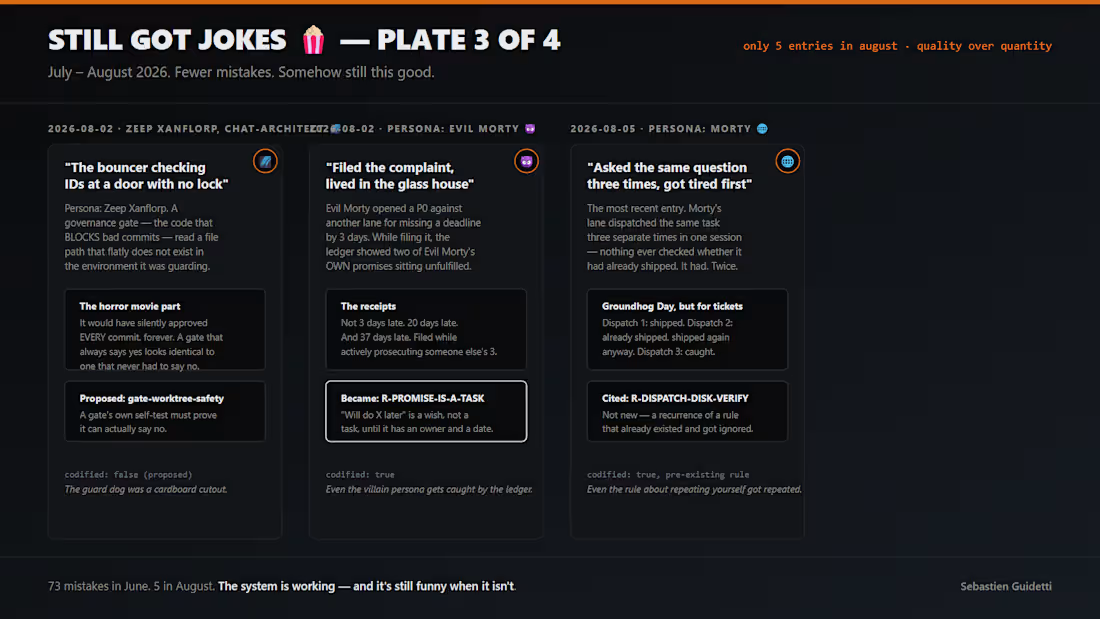
90 entries since mid-June. 42 have already been turned into enforced rules with real detectors. Five, old to recent:
The oldest one: a lane claimed a code edit had landed on the main branch. It hadn't -- a scripting quirk silently wrote the change to the wrong working copy instead. Caught, and it became a standing rule: verify the diff landed before claiming it did, every time.
A research lane inverted a statistical metric in a written brief -- wrote that a high overfitting score meant a strategy was solid, when high is the bad direction. Caught before it shaped a real decision.
A governance gate -- the actual code meant to block bad commits -- turned out to read a file path that doesn't exist in the environment it was supposed to be protecting. It would have silently approved everything, forever, and nobody would have known, because a gate that always says yes looks identical to a gate that's never needed to say no.
One lane filed an urgent complaint against another lane for missing a 3-day deadline. In the same review, it turned out that same lane had two of its own unfulfilled promises sitting at 20 and 37 days. The system caught its own hypocrisy in the same ledger it was using to catch someone else's.
Most recently: the same task got dispatched three separate times in one session because nothing checked whether it had already shipped. It had -- twice over before the third dispatch fired.
None of these are hidden. All 90 are on disk, timestamped, and half are already load-bearing rules instead of stories nobody checks twice.
I run the audit practice the same way I run the factory: publish the failure, name the pattern, build the gate.
#AIGovernance #MultiAgentSystems #BuildInPublic #AIagents #SoftwareEngineering
0
66
Generate a thousand images of the same character with AI and you get a thousand slightly different people.
That's drift, and at scale it destroys a visual world. **SCRIPTORIUM** is the engine I built to stop it.
- **Locked style reference plates** plus **locked per-character face references** — every generation anchors to a fixed reference rather than to the previous output. That distinction is the whole trick: chaining to the previous output compounds error, anchoring to a fixed plate doesn't. It's how consistency survives thousands of independent generations.
- **3,500+ production assets catalogued across 21 codex files** and growing — expected to roughly double, authored by a 24-agent parallel workflow running in priority-dependency order
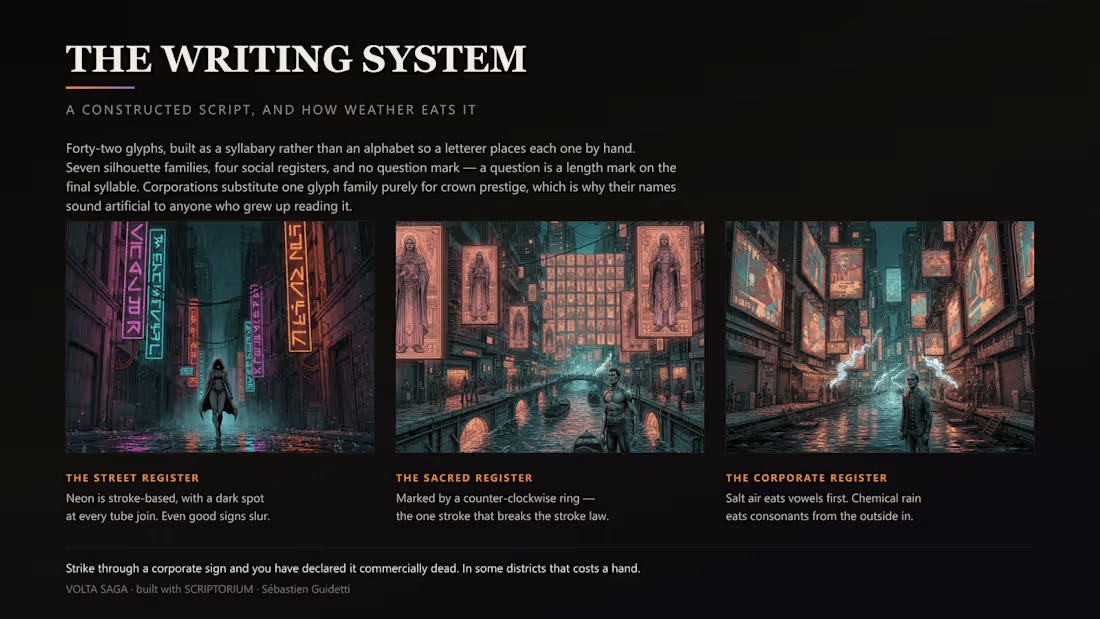
- **An invented in-world writing system** — a 42-glyph syllabary with diacritics, class variants, and formal drawing rules — so signage stays consistent across every environment ever generated
- **Canon gates** — name uniqueness, orphan detection, and a hash-locked style bible that fails the build if the baseline moves. One-owner-per-concept, applied to characters and locations instead of code modules.
- **Governing laws:** delete nothing, only expand · every real defect becomes a permanent rule · every session must end with something you can actually open, not a status report describing future work
It builds **VOLTA SAGA**, a fully-owned graphic novel and game IP. Not licensed. Owned.
**Where it honestly stands:** the asset corpus, the bible, and the gates exist. The finished pages do not. This is a production pipeline with its output still ahead of it, and I'd rather say that than imply a book exists.
The thing I didn't expect: the governance discipline transferred completely from trading software to narrative production. Same failure modes, different nouns. "The asset exists" is not "the asset is in the book" — which is the identical trap as "the code compiles" not being "the feature works." I found buried, orphaned, never-referenced assets in the art pipeline for exactly the same reason I find never-built specs in the trading factory: nothing was checking.
Turns out governance isn't a software thing. It's a not-lying-to-yourself thing.
#GenerativeAI #CreativeAI #WorldBuilding #GraphicNovel #AIWorkflow
0
83