Welcome to Frostmere
The Grand Opening of Frostmere — A World Outside of Time
Frostmere is a world where every era of human history exists at once. A samurai exchanges philosophy with a medieval monk beneath purple wisteria. A valley girl from 1990s California convinces a warrior twice her size to try a pink cocktail, and he hands her a horn of mead. An Egyptian queen and a timeless Archivist meet in a moment of recognition thousands of years in the making.
Full Project Link + Stills/Video + Story: Portfolio - Complete Process (https://contra.com/p/2bmrElRZ-the-grand-opening-of-frostmere-a-world-built-outside-of-time)
Melius project: Melius (https://app.melius.com/projects/c3ac7f69-2ff4-4c7c-a3f4-0b3f75e2df3b/canvas/967012d1-1ecb-4833-be22-8e79d37e1a17)
Walkthrough: Loom Link (https://www.loom.com/share/e7163140b1c1465c889862b78956c675)
Process Highlights
I established the Frostmere world, characters, symbolism and aesthetic before generation began, allowing the agent to build with continuity instead of isolated prompts. The workflow combined multiple node types across image generation, outpainting, animation, audio and editing.
Tools: Keyframes were generated in GPT Image 2 and animated with Seedance 2.0 and Kling. I muted the inconsistent generated clip audio and created a single atmospheric soundtrack for the full piece, ending with The Archivist's final word to the audience: “Come.”
Melius Feedback
What worked: Briefing an agent on a complex fictional world and maintaining continuity across many nodes and hours.
What frustrated: Unpredictable credit costs (120 estimated credits jumping to 5,400), learning that some generations were billed per second, and maintaining stylistic consistency between photorealistic and painterly scenes.
What surprised: Building an entire cinematic world from something that had only existed in my head before this challenge.
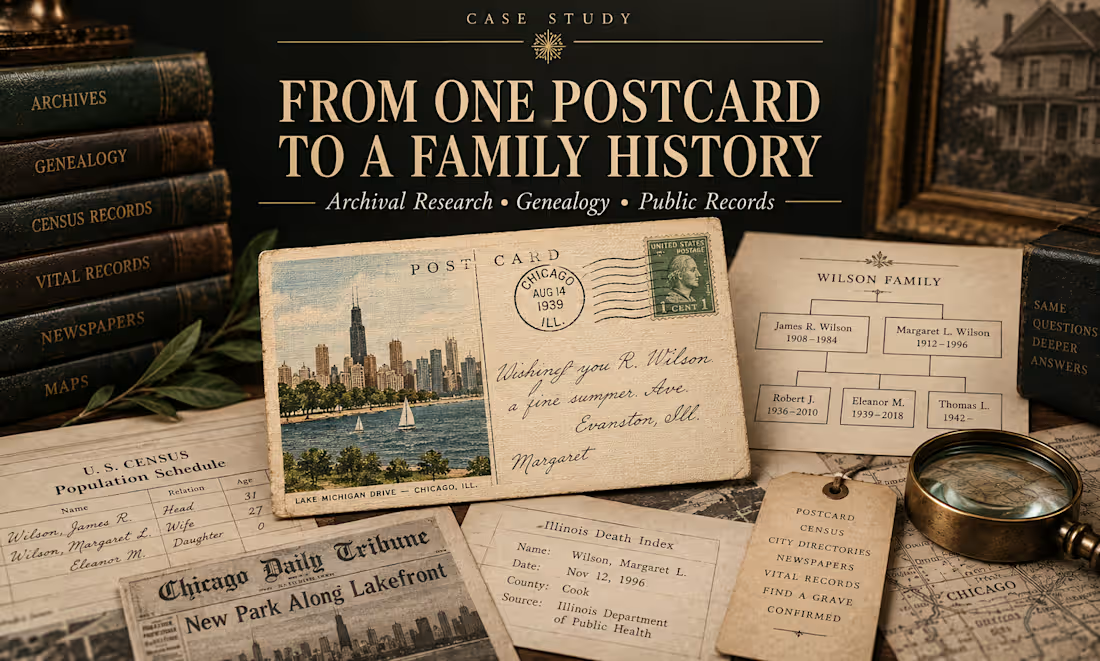
How I Use Obituaries to Build Family Trees
Most people think of obituaries as endings. For me, they're starting points.
When I'm researching a family line, obituaries are one of the most underrated tools available. A single obituary can hand you 10+ names in one read: parents, siblings, children, grandchildren, in-laws, and sometimes even maiden names that would take hours to find any other way.
How I use them:
I start with whatever name I have. Could be a great-grandparent, a maiden name someone half-remembers, or just a last name and a rough location. I search obituary databases (Newspapers.com (http://Newspapers.com), Find A Grave, legacy.com (http://legacy.com), local newspaper archives) and look for matches.
When I find one, I don't just read it. I pull every name mentioned and map the relationships. "Survived by her daughter Jane (Smith) Doe, son-in-law Robert Doe, and grandchildren Michael and Sarah." That one sentence just gave me a maiden name, a married name, a spouse, and two more branches to follow.
I cross-reference those names go into Ancestry, FamilySearch, public records. Each one can lead to another obituary, another set of names, another generation. One obituary can crack open an entire branch of a family tree that was completely stuck.
What to look for:
Maiden names in parentheses (this is gold)
"Preceded in death by" (gives you the generation above)
Church names, lodge memberships, military service (open up whole new record sets)
Locations mentioned (where they lived, where they're buried, where they moved from)
Don't just search for the person you're looking for. Search for their siblings, their parents, their in-laws. Sometimes the obituary you need isn't theirs. It's their brother's, and your person is listed as a survivor.
One good obituary can save you 20 hours of digging.
Designed and developed a branded e-commerce website focused on history-inspired lifestyle products. The goal was to create a cohesive, visually appealing storefront that encourages browsing, conversion and inspiration.