sakshi ranglani
Packaging | Branding | Visual design


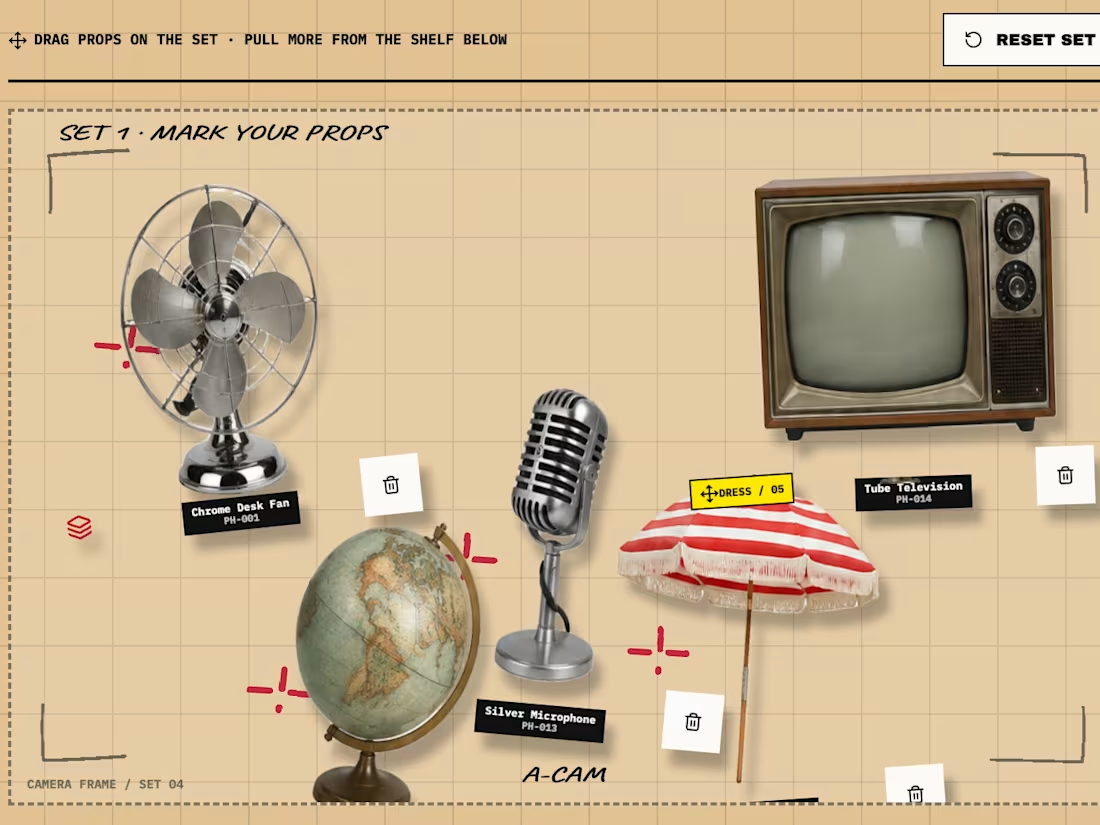
Shipped major upgrades to Prop House // Ledger! 📦✨
Eliminated the worst manual bottlenecks in prop rentals:
1️⃣ Self-Serve Rescheduling — Renters can shift dates directly via their share link with real-time availability checks & instant double-swaps. No back-and-forth calls needed.
2️⃣ One-Click Physical Paperwork — Generates print-ready Pull Sheets & Return Checklists directly from the ledger state for warehouse floor staff.
3️⃣ "Ask for Changes" Stamp — Crew can flag notes or request prop swaps directly on the manifest link without breaking pricing, inventory holds, or rental agreements.
All features live now! Check out the quick demo below 👇
https://contra.com/community/8rvYxpvQ-visual-prop-rental-booking-and-return
#BuildInPublic
2
129
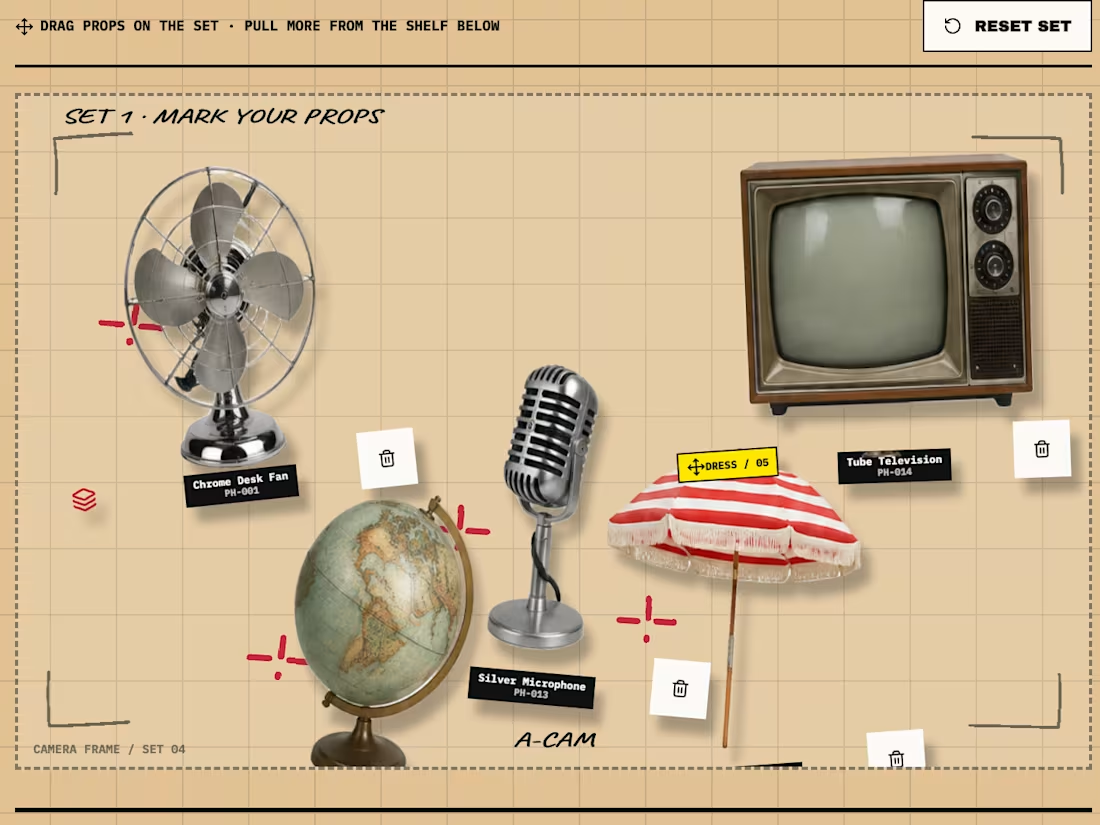
Prop rental is an asset-based appointment business—instead of booking a person's time slot, you are locking down an asset's availability window.
PROP HOUSE // LEDGER turns a prop inquiry into a confirmed, deposit-locked booking without email back-and-forth. It covers both the front door (check availability, swap conflicts, sign off, deposit) and the follow-through (return timers, overdue reminders, auto-resolve).
Built for a solo Detroit prop house (100 objects, 7am to 7pm pulls, 48-hour night-shoot notice) that was losing hours to double-bookings, no-shows and late-return chasing. Ledger swaps conflicts and keeps every return on schedule.
Build the scene. Not a cart.
A prop rental tool for film sets. Art directors plan their props on a visual grid, and owners keep every rental on schedule from one dashboard.
The problem--
A double-booked prop can stall a shoot. Most rental sites work like online shops, with a cart and a long email thread for every change.
What it does--
-Plan on a grid. Drag(or click) cutout props onto the Staging Floor and see rates add up as you go. No login is needed, and your scene saves in your browser.
-Swap conflicts instantly. If a prop is already booked for your dates, Ledger suggests an available archival substitute in the same category. You sign off on a quick waiver and the deposit is locked in.
-Sync across devices. Sign in and your manifest follows you, connected to the owner's records.
-Run the whole rental in one place. The Owner Ledger shows active sets, live return countdowns and late fees. Press [ AUTO-RESOLVE ALL ] to clear collisions and send overdue reminders.
Try it: https://prophouse-ledger.lovable.app/
Everything above works without an account, including Sandbox Mode for the Owner Ledger. Drag-and-drop (or click), rate and deposit math, substitute matching and status changes (ON SET → RETURNED) all persist between sessions.
Demo note: checkout uses a sample deposit slip with an email field for production notices and doesn't charge a real card. [ AUTO-RESOLVE ALL ] records timestamped "reminder sent" stamps in the ledger as a stand-in for dispatch webhooks. "The Mail Reminder" button opens a pre-filled draft that the owner sends from their own email app.
2
3
489
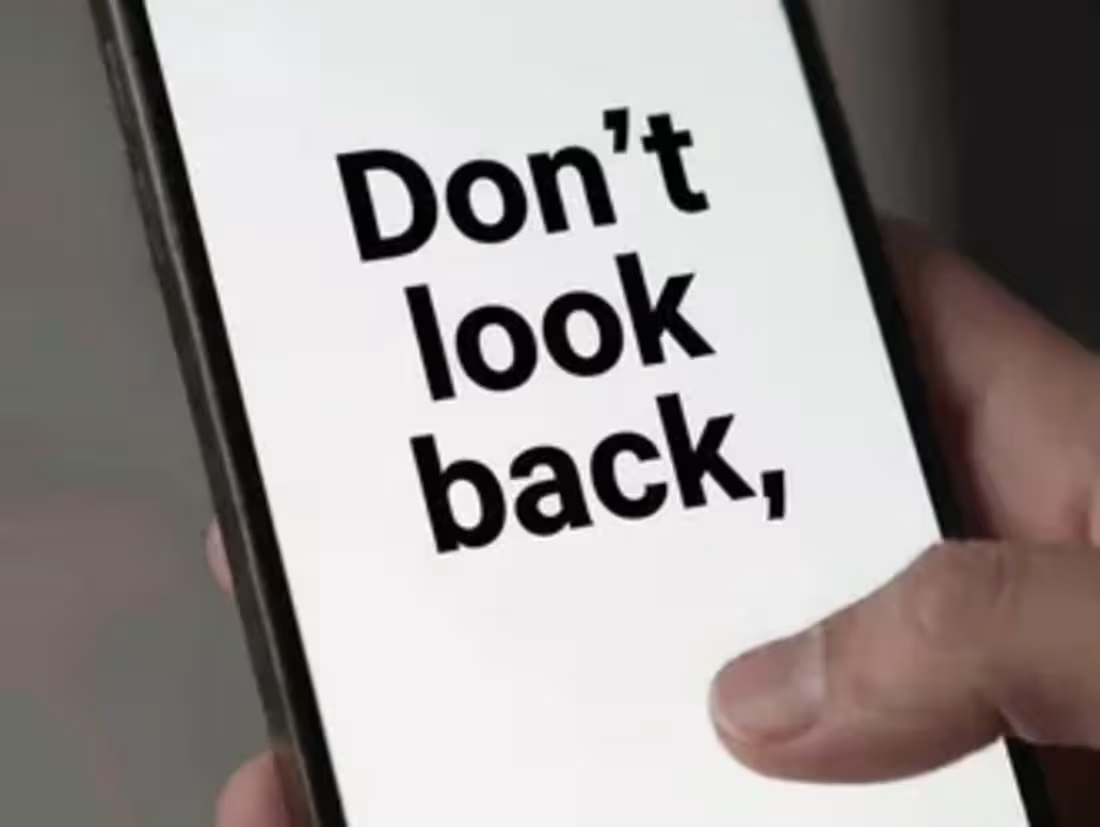
Excited to officially submit my entry for the Cantina Challenge — a psychological horror short titled Mira.
The spark for this project came from a simple, unsettling image that stuck in my head: what if the emotional weight you carry literally detached from you and stayed in the room? I wanted to translate that internal feeling of isolation into a visual reality without relying on heavy dialogue or classic horror tropes.
Project Title: Mira
Core Thesis: "Not looking back doesn't mean you're not still carrying it."
The Concept: Mira is a short psychological thriller pilot that explores the heavy, invisible weight of unresolved emotional trauma. Rather than relying on standard horror tropes, cheap dialogue, or jump-scares, the story relies entirely on grounded visual storytelling, non-verbal shadow choreography, and high-tension environmental audio.
The Protagonist: Mira (https://cantina.com/i/ttej5)
Trapped in a cycle of isolation and avoidance, attempting to project a calm exterior while her internal state deteriorates.
Key Visual Mechanics: A dynamic phone typing interaction where text messages act as a gateway to her internal state, leading up to a chilling moment where her shadow literally detaches from her body — anchored to the living room while she moves forward.
The Climax: A quiet, suffocating sequence where the ambient space collapses into total darkness, leaving her face-to-face with what she's been running from.
Why I Created This: I've always believed that every person carries immense quiet value, but when unaddressed trauma isolates us, we lose sight of our own worth. I wanted to build a character study that honors that internal struggle visually.
This is a blend of: Psychological Thriller + Surreal Character Study + Minimalist Environmental Horror.
Narrative engine: Emotional Isolation --> Unspoken Tension --> Visual Distortion --> Psychological Climax
Where I would take the series next:
Episode 1 is The Room. The engine is one locked apartment, one locked Mira, 10 visual metaphors for grief.
Episode 2 - the shadow that stayed behind now moves when she doesn't.
Creator Studio Feedback:
What worked well - precise low-key lighting, atmospheric sound design, micro-expressions.
Challenge — temporal asset consistency for the brown sofa, and precisely preserving her exact silhouette (hair, shoulder line) through the shadow's turn across frames.
Suggestion — location colour lock + shadow-direction/shape control for finer silhouette fidelity.
Confirmation: Created end-to-end in Cantina. Original work, one submission.
2
6
669
5,000 years of art, waiting to inspire what comes next. 🏺✨
I reimagined ancient public domain antiquities from the Met Archive into "THE MET RESONANCE ORGAN"—an autonomous kinetic runway built on @floraai.
Project Link: https://app.flora.ai/view/js75czfq8an8d7vy4zzb1374xs8dx7m5
The Inspiration: The Met's catalogue lists its medium in two words: "Pottery, sand." — a small bowl of sand buried under an Egyptian temple around 1473 BCE so the building would have something sacred to stand on. In the Nayarit archive, I found its creators: a ceramic pair caught mid-ritual, pouring offerings. I made them pour their own foundation. The Met Resonance Organ is that moment scaled to a monumental circular basin, where the archive builds its own runway.
The Space: The runway floor is that foundation deposit bowl, scaled to a monumental circular basin. Hidden audio transducers beneath the basin generate specific acoustic frequencies, driving the sand into real-time geometric Chladni resonance patterns.
The Performance: That shifting acoustic pattern drives a micro-tension wire grid above, causing standalone avant-garde footwear sculptures — structural silhouettes of an English punch pot, a 1581 pilgrim bottle, a Greek amphora, and Nayarit ceramics — to autonomously pivot and execute a mechanical ballet around a central fracturing amphora.
Video Link: https://app.flora.ai/media/f7665dfa7f
Archive References:
Egyptian Foundation Bowl: https://www.metmuseum.org/art/collection/search/585542
(https://www.metmuseum.org/art/collection/search/585542)Japan Zaō Gongen:
https://www.metmuseum.org/art/collection/search/39707
Greek Terracotta Amphora: https://www.metmuseum.org/art/collection/search/251935
English Punch Pot: https://www.metmuseum.org/art/collection/search/197560
Pilgrim Bottle:
https://www.metmuseum.org/art/collection/search/198707
Nayarit Ceramic Pair: https://www.metmuseum.org/art/collection/search/310604
(https://www.metmuseum.org/art/collection/search/310604)German Shrine:
https://www.metmuseum.org/art/collection/search/193632
#FLORAMuseum #AIArt #FashionDesign #VisualArts #FLORA
1
2
245