Aura Ticketing Platform Development

Peter Ikechukwu


Aura
A production-grade ticketing platform designed to demonstrate correct system design for high-demand event sales. Built on Next.js 16, Prisma ORM, and PostgreSQL, with a four-tier oversell defense that guarantees zero double-bookings even under flash-sale concurrency. Portfolio project — run it locally to kick the tyres, no public demo URL.
Read the case study — for the design, the trade-offs, and what a real flash sale will find.
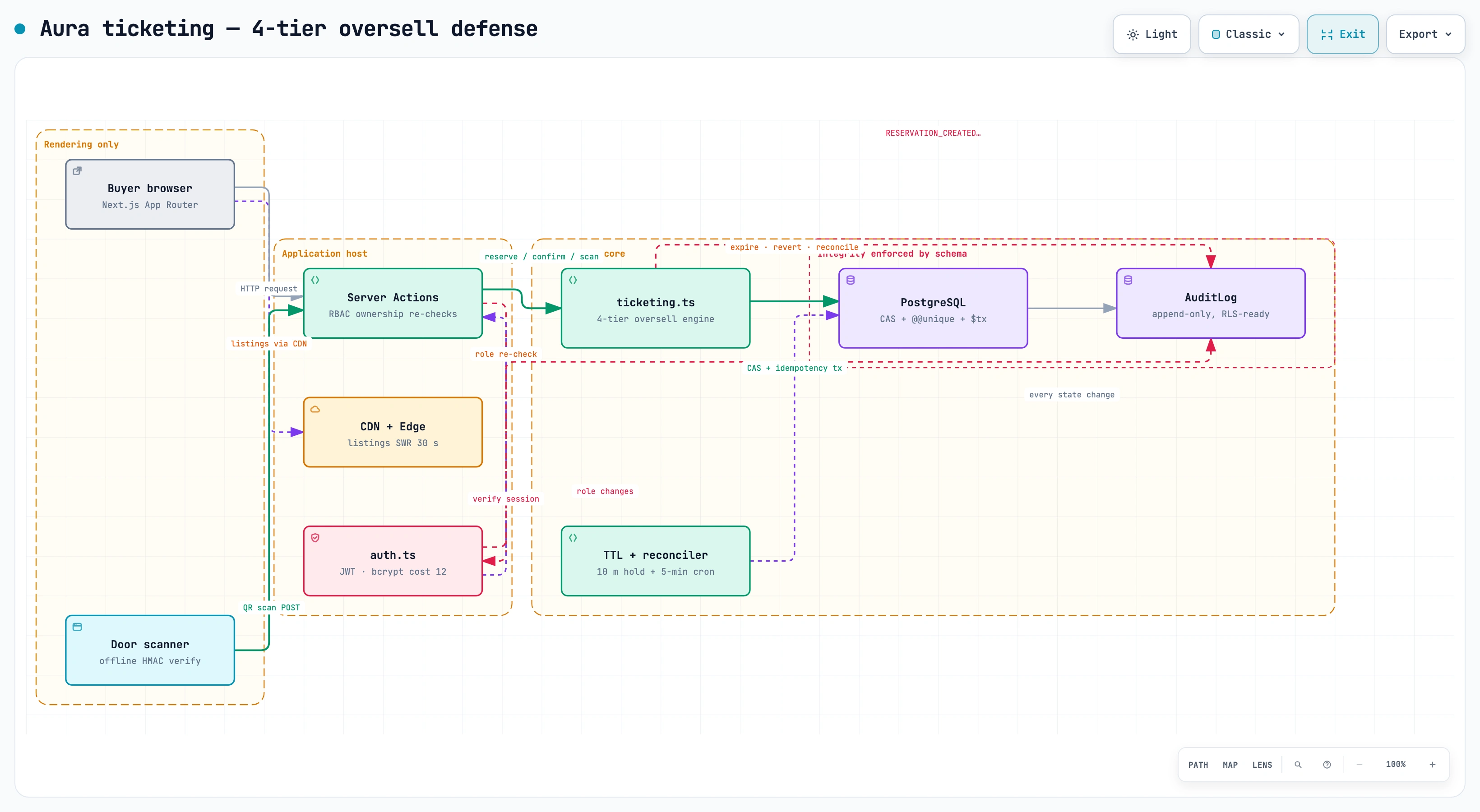
Interactive HTML view and source JSON live in docs/architecture.html and docs/diagrams/architecture.json. The reservation-lifecycle sequence diagram: docs/protocol-sequence.html · PNG · JSON. Rendered with Archify.
What it does
CAS-based atomic capacity writes.
UPDATE ... WHERE ticketsIssuedCount + qty <= capacity inside a single Postgres statement, no SELECT-read-then-write, no SELECT-FOR-UPDATE deadlock window, no overticketing. See ticketing.ts L36-47.Per-request idempotency. UUID
idempotencyKey on every reserve call, backed by Reservation.idempotencyKey UNIQUE — double-clicks, 4G retries and retry storms never double-charge. See schema.prisma L107.Four-tier oversell defense. CAS write + idempotency key +
(userId, eventId, ticketIndex) @@unique on Ticket + background reconciler. Tiers 1 and 2 stop the known races; tier 3 stops refactor bugs; tier 4 heals manual-DB-write drift. See schema.prisma L134.10-minute held seats counted against capacity. A reserved seat decrements availability at CAS-write time, not at confirm;
cleanupExpiredReservations atomically reverts sold count + marks reservation EXPIRED + appends audit log. See ticketing.ts L49-50 and L164-189.Signed JWT QR tickets. Every ticket payload is a HS256 JWT signed by
TICKET_SECRET in qr.ts. Forgery fails offline in the door scanner before any DB lookup; the signature check is cheap and runs in the browser worker.Person-to-person ticket transfers.
TicketTransfer model with unique transferCode, pending/completed/cancelled status, receiver email, expiry window and claim flow. See schema.prisma L137-148 and the transfer + claim routes.RBAC with four strictly increasing roles.
USER, ORGANIZER, ADMIN, SUPER_ADMIN. Every mutating route re-checks the role from the httpOnly session cookie; ORGANIZER-owned resources additionally check organizerId === session.userId. See schema.prisma L14-19.Append-only AuditLog for every state change.
AuditLog rows are created inside the same $transaction as the mutation they record; no UPDATE or DELETE on AuditLog is exposed anywhere in application code. See schema.prisma L150-159.Buyer ↔ organizer messaging threaded per event.
Message model scoped by eventId, with read flags, unread-count endpoint, and per-conversation pages on both dashboard and organizer sides. See schema.prisma L161-173.Organizer QR check-in, offline-capable signature verify first. The scanner component runs
verifyTicketToken locally before POST-ing; the /api/organizer/checkin endpoint re-verifies the signature and re-checks ORGANIZER ownership, then writes Ticket.status = USED + validatedAt + validatedBy. See qr.ts L19-32 and checkin/route.ts.Self-healing capacity reconciler. Runs after every TTL expiry sweep and on a 5-minute cron; sums ACTIVE reservations + ISSUED/USED tickets vs stored
ticketsIssuedCount, writes corrective UPDATE atomically, and appends a CAPACITY_RECONCILED AuditLog row with old/new values and reason. See ticketing.ts L216-266.New-organizer onboarding: deployment-request review workflow + admin approve/reject. Organizer-created events land as
DRAFT with approvedByAdmin = false; the admin dashboard's DeploymentRequests queue lists them with Approve / Reject buttons. Approve flips both flags and publishes; Reject closes the event. Both actions write AuditLog. See deployment-requests.tsx and action/route.ts.Run it locally
Warnings:
Prisma
postinstall runs prisma generate, which reads DATABASE_URL from prisma.config.ts via env("DATABASE_URL") — the variable must exist in the shell that runs npm install, or prisma generate is skipped.Do NOT use SQLite. The database is PostgreSQL-only: CAS relies on Postgres's atomic
UPDATE ... WHERE semantics, AuditLog.metadata is Json type, and the schema's datasource is provider = "postgresql".How it fits together
Which components can write tickets, and when
Component Used What it sees / can write Next.js app (Vercel or self-host Node) Every request Runs server actions; mutates only through
ticketing.ts. Never holds signing material in JS (httpOnly cookie). ticketing.ts (src/services/) Every mutation Only actual writer to Reservation/Ticket/counters. Wraps CAS + idempotency + inserts in one $transaction. PostgreSQL Every reservation / confirm / scan / expire UNIQUE indices are schema-level (idempotencyKey, ticketIndex pairs) — final enforcer, blocks duplicates even if app code is wrong. Writes AuditLog append-only. TTL reconciler (cleanupExpiredReservations → reconcileCapacity) After every expiry sweep + 5-min cron Reverts sold count for expired holds, detects drift, writes CAPACITY_RECONCILED AuditLog. Never issues new tickets. Browser door scanner Every entry Verifies QR ticket signature offline before POST-ing; cannot write directly. Writes only via /api/organizer/checkin with ORGANIZER ownership re-check.Things worth knowing
CAS is not a lock — it's a write-time predicate inside the UPDATE. Two concurrent writers race the same
UPDATE ... WHERE ticketsIssuedCount + qty <= capacity statement; Postgres runs them serially and exactly one of them gets 1 row affected (or 0 if capacity is exhausted). There is no SELECT-FOR-UPDATE deadlock window because there is no separate read — the read is the predicate, inside the write. See ticketing.ts L36-47.Idempotency is not deduplication. The
idempotencyKey UNIQUE protects one buyer retrying the same reserve on flaky 4G: same key = same reservation returned, no new write. It does not protect against a code refactor that calls ticket.create twice inside confirm with different keys. That gap is what Ticket @@unique([userId, eventId, ticketIndex]) catches. Two different mechanisms, two different failure modes. See schema.prisma Ticket @@unique.event.ticketsIssuedCount is authoritative, not a derived COUNT(*), which means drift is possible. A DB admin writing a manual fix, a mid-sale admin action on the event row, or any future code path that issues a ticket without bumping the counter — all of them leave the counter wrong. The reconciler sums the real sources of truth (reservations + tickets), compares, and writes the correct value back with an AuditLog entry recording the delta and reason. It's not a sign of failure; it's the system fixing itself.QR tokens are signed with a separate
TICKET_SECRET from the session's JWT_SECRET. Rotate one and the other is unaffected. Rotate TICKET_SECRET and every old unscanned QR token is immediately invalid. Operational playbook during rotation: sign new tokens with both secrets for an overlap window, verify against both in verifyTicketToken, then drop the old secret once every pending ticket has either been scanned or expired.Deploy it
Step 1 — Postgres. Any managed Postgres works: Supabase, Neon, Fly Postgres, self-hosted. SQLite absolutely does not. See the Run it locally warnings.
Step 2 — env. Copy
.sample.env to .env.local (or your deploy platform's env UI). Fill:DATABASE_URL + DIRECT_URL (from your Postgres provider)JWT_SECRET: generate with openssl rand -hex 32 (256-bit)TICKET_SECRET: generate with openssl rand -hex 32 (256-bit, different from JWT_SECRET)SESSION_COOKIE_NAME: unique per deploy so localhost/staging/prod cookies don't clobber each otherStep 3 — migrate.
npx prisma migrate deploy — NOT migrate dev in production. migrate deploy runs the applied migrations only and never touches the shadow database or the Prisma client.Step 4 — seed. ONLY on first deploy, and only with explicit
ENABLE_SEEDING=true. Never on production after go-live: the seed script is built for local demo data and truncates if enabled.Step 5 — Next.js app. Deploy on Vercel Node runtime (NOT Edge runtime). Prisma client needs a real TCP socket to Postgres; server actions on Vercel Edge cannot open one. RSC + Server Actions work out of the box on Node.
Step 6 — When you get real flash-sale traffic, in this order:
Deploy PgBouncer in front, transaction pool mode.
CDN-cache all event listing reads (stale-while-revalidate ≤ 30s).
SQS FIFO queue per
eventId, with idempotency keys riding the message key.Redis shard counters (last tier, only if you've proved 1–3 aren't enough).
Warnings:
ENABLE_SEEDING: Never enable in production. Demo seeding deletes existing user-facing data or duplicates it.JWT_SECRET / TICKET_SECRET leak: attacker can forge SUPER_ADMIN sessions and forge valid door-entry QR tickets. Rotate immediately, and for QR tokens write a dual-sign overlap playbook before you need it.Edge runtime not supported: Prisma client needs real TCP to Postgres, so server actions on Vercel Edge fail. Use Node.
Cap signups and require organizer approval before any ticket creation runs. The deployment-request (event submission) workflow exists and defaults new organizer events to
approvedByAdmin = false — use it.Run the capacity probe from docs/capacity.md against your Postgres before your first big sale. Managed offerings differ by 3–4× in hot-row TPS.
Status
Working (lint + tsc + build exit 0): CAS-based atomic capacity writes, per-request idempotency with UNIQUE key, four-tier oversell defense, 10-minute held seats with TTL expiry worker and atomic revert, HS256-signed JWT QR tickets verified offline first, person-to-person transfers with transfer codes and claim flow, RBAC across USER / ORGANIZER / ADMIN / SUPER_ADMIN with ownership enforcement, append-only AuditLog on every state change, buyer-organizer messaging threaded per event, organizer QR check-in with signature verify + DB write, self-healing capacity reconciler (TTL sweep + 5-min cron), and admin deployment-request approve/reject workflow for new organizer events.
Measured: 3k–8k writes/s single hot Postgres row baseline with PgBouncer transaction pooling. See docs/capacity.md for the planning numbers and the pgbench probe to run on your real instance.
Not built (documented as the next tiers): FIFO queue per eventId behind PgBouncer, event table sharding by hash, partial refunds, waitlist auto-promotion to held seat, SSO / OAuth login, per-section or per-tier pricing within one event.
Credits
The ticketing core — CAS write, idempotency transaction wrapping, TTL expiry worker with atomic revert, four-tier oversell defense and self-healing capacity reconciler — was written by hand. The UI redesign and pages, auth flow (register / login / httpOnly cookie session), organizer and admin dashboards, check-in scanner, event forms, messaging threads, styling and Tailwind class modernization were written with AI assistance, then reviewed and linted until the problems tab was clean, TypeScript strict was green, and ESLint had zero warnings. Design decisions were written down in docs/decisions/ as Context / Options / Decision / Consequences at the point each was made.
License
MIT — use freely for learning, interviews, or as a starting point for your own event platform. If this repo helped you land a role, I'd love to hear about it.
Like this project
Posted Sep 23, 2026
Developed a ticketing platform with zero double-bookings using Next.js, Prisma, and PostgreSQL.