Social Security Fairness Act Implementation

Richard Eberwein


The U.S. Senate passed the Social Security Fairness Act last week, a bill that would expand the Social Security payouts for millions of public sector workers.
House Resolution 82 passed the upper chamber last Friday night by a vote, with 76 senators voting to approve while 20 voted against. All “nay” votes were cast by Republicans, including Sen. Ron Johnson (R-WI), Sen. Chuck Grassley (R-IA), and future Senate Majority Leader John Thune (R-SD).
Majority Leader Chuck Schumer (D-NY) made it a priority to vote on the bill before the 118th Congress adjourned, and it ended up being the final action the body took before approving the spending bill to keep the government open.
Tonight, the Senate finally corrects a fifty-year mistake by passing the Social Security Fairness Act.
Millions of retired teachers and firefighters and letter carriers and state and local workers have waited decades for this moment.
No longer will public retirees see their…
The Social Security Fairness Act also survived attempts to effectively kill the bill last Friday night. Sens. Rand Paul (R-KY) and Ted Cruz (R-TX) forced votes on amendments to raise the retirement age of Social Security benefits. All four amendment votes failed, but if any of them had been successful, the Social Security Fairness Act would have been forced to return to the House of Representatives, where it likely would have died in the next Congress.
Since the legislation already passed the House of Representatives in November, it will head to President Joe Biden’s desk, who is expected to sign it.
If Biden signs the Act, it will repeal two provisions, enacted in 1983 and 1977 respectively, known as the Windfall Elimination Provision (WEP) and the Government Pension Offset (GPO). Supporters of the bill say these provisions prevent workers and spouses who receive government pensions — like police officers, firefighters, teachers and postal workers — from receiving full Social Security payouts after retirement.
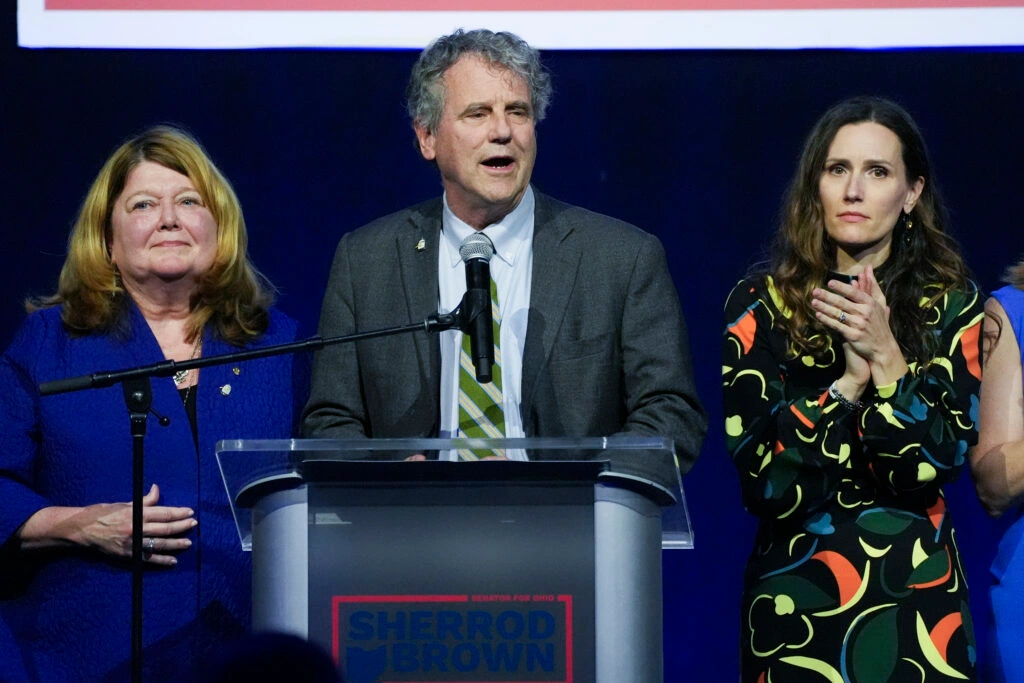
Sen. Sherrod Brown (D-OH), who co-sponsored the Senate version of the Social Security Fairness Act, has advocated for repealing these provisions for years.
Brown recently lost his reelection bid to MAGA-backed Republican Bernie Moreno. Brown gave an emotional farewell speech on the Senate floor last Tuesday, but he hinted that he will run for office again in the future.
Sen. Sherrod Brown (D-OH) gets emotional as he wraps up his farewell speech by thanking his family, including his wife, Connie Schultz.
“To my colleagues, this is my last speech on the Senate floor. But it’s not, I promise you, the last time you’ll hear from me.” pic.twitter.com/bgWuLXgbGB
Brown, who frequently spoke up for strengthening the middle class during his near 50-year career in politics, also addressed the Senate before the chamber took a cloture vote on the bill last Wednesday.
“Social Security is a bedrock of our middle class. You pay into it for 40 quarters, you earned it, it should be there when you retire,” Brown said. “All these workers are asking for is for what they earned.”
Social Security is funded by the employer and employee payroll taxes (6.2% each). It is estimated that in 2033, there will not be enough payroll taxes to cover all payouts to retirees, making the eventual insolvency an issue Congress needs to address.
Experts have estimated that repealing the WEP and GPO provisions will cost $196 billion over the next decade and speed up the insolvency of the Social Security program by six months. This led to some GOP senators criticizing the bill, including Paul and Grassley. Paul also parroted a false GOP narrative that Social Security is “going bankrupt” while speaking for his amendment to raise the Social Security retirement age to 70 years old.
“It speeds the bankruptcy of Social Security. Social Security is due to go bankrupt in 2034. This will speed it up by a year or so. It’s $200 billion added to a program that is already short of money,” Paul told The Hill. “If you’re going to add to its mandate by expanding it, you should pay for it. One of the proposals that’s been out there for a long time is to gradually raise the age of eligibility.”
Increasing the age to receive benefits is not the only way to extend solvency. A bill known as the Social Security Expansion Act, introduced by Sen. Bernie Sanders (I-VT) last year, would extend the solvency of the program by increasing the payroll taxes on wages and income above $250,000. As of 2023, the maximum amount of income subject to Social Security payroll tax is $160,200. Sanders’ bill was read twice in the Committee on Finance but has not been taken up by the Senate.
(1/7) Update: President Biden signed the Social Security Fairness Act into law on Jan. 5, 2025. Millions with state and government pensions are expected to see their Social Security payouts increase while others will receive a lump sum for the benefits they should have gotten in 2024. The Social Security Administration is urging recipients to verify their current mailing addresses and direct deposit information.
Like this project
Posted Jul 6, 2025
The Social Security Fairness Act was signed into law, increasing payouts for public sector retirees.
Likes
0
Views
9
Timeline
Dec 20, 2024 - Dec 23, 2024