Ohio Issue 1 Campaign Against Gerrymandering

Richard Eberwein


After years of Republican gerrymandering in the state of Ohio, voters had the opportunity to end the biased practice by passing a ballot measure called Issue 1. But the measure was rejected after many voters were misled, leaving the maps in the hands of the GOP and setting the stage for another five years of Republican-skewed maps in the Buckeye State.
Although the measure received bipartisan support, favorable polling numbers and significant financial backing, Ohio overwhelmingly voted down the ballot measure by 409,574 votes.
Had it passed, Issue 1 would have implemented a 15-member commission responsible for drawing legislative and congressional maps. This commission would have encompassed five Republicans, five Democrats and five independents.
Under current law, the state legislature, currently a Republican supermajority, draws and approves congressional maps, while a politician commission draws the legislative maps. The state maps require at least two votes of approval from each major political party, but it can brute force maps voted with a simple majority that are only valid for four years. Coincidentally, this came into law after voters passed 2015’s Issue 1, which had bipartisan support, favorable polling numbers and significant financial backing.
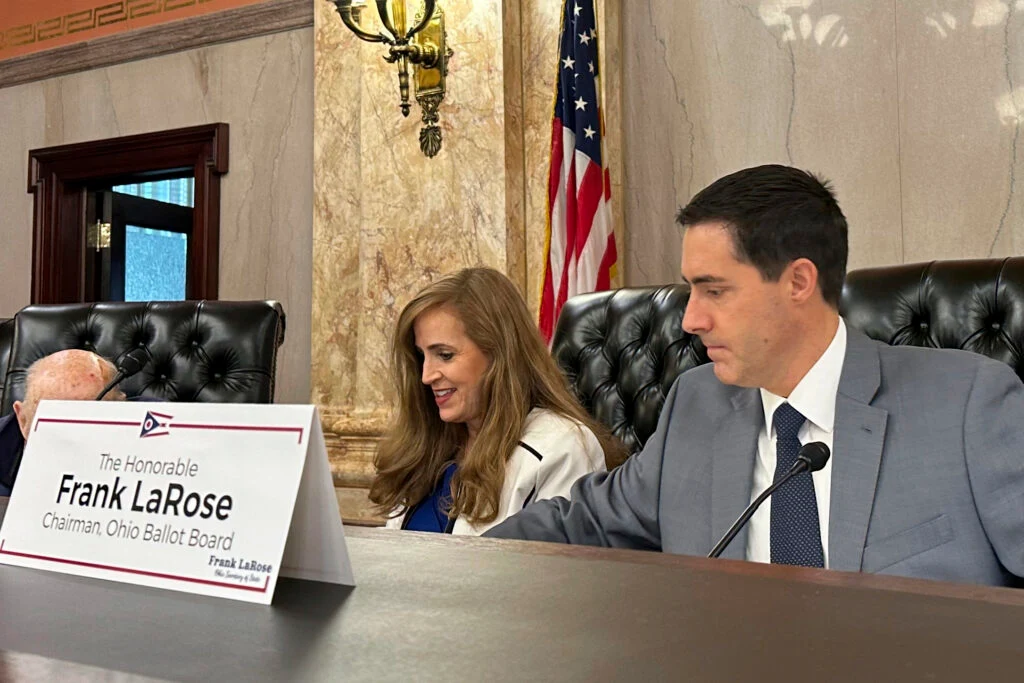
The politician commission includes the Gov. Mike DeWine (R), Secretary of State Frank LaRose (R), State Auditor Keith Faber (R) and individuals appointed by the state legislature. According to former Ohio Democratic Party Chairman David Pepper, the Republicans have had full power over this commission since its inception in 2015, allowing them to keep their legislative majorities through gerrymandering.
“The problem has been that we’ve had the politicians drawing their own districts,” Pepper said. “Through dishonest ballot language and an election where Trump’s margin was too big to overcome, they succeeded in continuing to be able to rig their own districts. And getting them away from the table would have changed their ability to do what they’ve been doing for all these years.”
Despite bipartisan support for Issue 1, the Republican Party routinely engaged in a misinformation campaign, claiming that voting down Issue 1 would end gerrymandering. This is untrue because voting “no” keeps the status quo intact, allowing the GOP (or any ruling party) to continue drawing their own maps.
Former Ohio Supreme Court Justice Maureen O’Connor, a Republican who was appointed to the court by the GOP, has spearheaded the Issue 1 campaign this cycle along with the Citizens Not Politicians organization. While on the bench, she sided with Democrats in voting down five Statehouse maps and two congressional maps as unconstitutional.
After Issue 1 failed, O’Connor said that confusion and misinformation played a large part in the outcome.
“Everybody that voted in this election, I venture to say, thought they were voting to end gerrymandering,” O’Connor reportedly said on election night. “It’s as simple as that.”
The misleading language of the measure was written by LaRose, who has frequently upheld the GOP’s gerrymandering. Although anti-gerrymandering groups took LaRose’s office to court over the deceptive language, LaRose’s version was upheld by the Republican majority on the state Supreme Court.
When asked why Issue 1 failed, Pepper also said that voters were deceived by LaRose’s efforts.
“This is the part that I think is not fair game but an abuse of power, is they wrote ballot language that is not only confusing, but actually said the exact opposite of what is actually did,” Pepper said. “For those voters who wanted to end gerrymandering, which is the majority of Ohioans, if you didn’t know anything about the issue but what you read on election day, you would have voted ‘no’ because it made it look like voting ‘no’ was how you end gerrymandering.”
Since 2011, the Ohio Republicans have drawn heavily biased maps to give themselves majorities in the state legislature. When gerrymandered maps were again drawn by the Republican-led commission in 2020, they were routinely rejected by the state Supreme Court which O’Connor was serving as chief justice on. The commission refused to comply with the Supreme Court’s orders and eventually forced the gerrymandered maps on voters in 2022 with the help of two federal judges appointed by the Trump administration. The Republican supermajorities increased after the 2022 elections, and despite Donald Trump winning the state with 55% of the vote compared to Kamala Harris’ 44%, the state GOP will control 66% of the House (65-34) and 73% of the Senate (24-9).
The Ohio GOP discussed impeaching O’Connor, who was the swing vote attempting to block the gerrymandered maps. She was forced to retire in December 2022 due to constitutional mandate.
Despite repeatedly approving unconstitutional maps and undermining Issue 1, LaRose campaigned on ending gerrymandering when he first sought the Secretary of State’s office in 2018. DeWine also publicly bashed Issue 1 despite his pledges to end gerrymandering. DeWine falsely stated that if Issue 1 passed, Ohio would be under a system that “compels map drawers to produce gerrymandered maps.”
DeWine also floated implementing a redistricting system similar to Iowa’s method, which is regarded as one of the fairest map drawing models in the country. However, DeWine has made no effort to reform redistricting in Ohio and has repeatedly upheld the unfair process through his voting record on the commission.
Ohio Republicans will oversee the redistricting process in 2025, where they are expected to again implement rigged maps despite conducting an anti-gerrymandering campaign this cycle. Pepper said there is a chance voters will be angry when the next maps are implemented, which will likely be in effect from 2026-30.
“So if the same politicians who said ‘vote no to stop gerrymandering’ gerrymander next year, they have the chance to redistrict Congress, yeah I do think that could backfire,” Pepper said.
If another ballot measure is attempted, the earliest it will come is during the 2026 midterm elections, after the new maps are drawn. LaRose, DeWine and Faber will be forced to leave office in 2026 in compliance with Ohio’s term limits, opening the opportunity for a Democratic majority on the politician commission if the body still handles redistricting in the future.
Citizens Not Politicians did not respond to Heartland Signal’s request for comment, and it is unclear if the organization will conduct another ballot measure campaign in 2026. After Issue 1 failed, the 73-year-old O’Connor did not have any immediate plans for district reform.
“No, I don’t think that we’ll be putting forth this kind of effort immediately,” O’Connor said. “We’ll regroup, we’ll think about it, but that hasn’t been discussed.”
The offices of LaRose and DeWine did not respond to Heartland Signal’s requests for comment.
Like this project
Posted Jul 7, 2025
Campaign for Ohio's Issue 1 to end gerrymandering failed.
Likes
0
Views
9
Timeline
Nov 16, 2024 - Nov 19, 2024