Building an All-in-One Team Management SaaS from Scratch

MD Robin Islam


KpiClock — Building an All-in-One Team Management SaaS from Scratch
Building a time-tracking app is hard. Building time tracking, attendance, productivity monitoring, desktop apps, integrations, and a multi-role dashboard — as one product, from scratch, competing with Hubstaff and Time Doctor — is a different order of problem.
That's what I built for KpiClock. I architected and built the entire backend in Laravel; my team built the React and Next.js frontend. Over roughly three months we shipped an MVP now running in beta with real companies using it every day. Here's how it came together.
React + Next.js Frontend
Laravel Backend (built by me)
Multi-role Admin / Lead (Manager) / Employee
Live beta Real companies using it
Scope:
Full SaaS web application, MVP
My role:
Backend architecture + development (lead)
Frontend:
My development team
Timeline:
~3 months to beta
Robin built our entire backend from scratch and helped bring the whole platform to life. We're running our real operations on it in beta right now — time tracking, monitoring, the desktop apps, all of it — and it's held up. He didn't just take orders; he architected it properly so it can scale as we grow. Genuinely felt like having a technical co-founder, not a contractor.
— KpiClock

The brief: replace three tools with one
KpiClock's product promise is aggressive — replace Hubstaff (time tracking), BambooHR (HR), and DocuSign (eSign) with a single affordable platform. That promise only works if the underlying software actually does all of it, reliably, from day one.
So this wasn't an MVP in the "one feature, test the market" sense. To be credible in its category, the first version had to ship a genuinely broad feature set — and each piece had to work well enough that real teams would trust it to run their operations.

Delivered and live in beta:
→ Time tracking — manual and automatic, projects and tasks, billable vs non-billable, offline sync
→ Productivity monitoring — activity tracking, app/URL monitoring, optional screenshots with a blur mode for sensitive work
→ Desktop applications — native apps for Windows, Mac, and Linux, syncing to the web platform
→ Integrations — connections to project tools like ClickUp, Jira, Trello, Asana, and more
→ Multi-role dashboards — distinct, permission-based experiences for Admins, Team Leads / Managers, and Employees
→ Reports & analytics — timesheets, productivity, and attendance, exportable to CSV, Excel, and PDF
→ Admin panel — full management across users, teams, clients, and projects
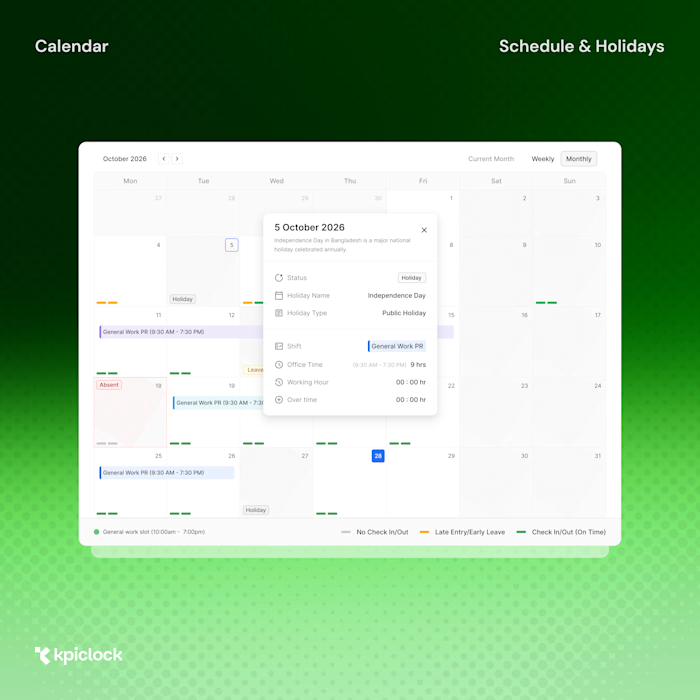
Phase 2 (in progress): Attendence management, leave management, and ESIGN-compliant document signing.

How I built it
I architected the backend in Laravel, chosen for the speed and structure it gives a data-heavy, multi-tenant SaaS with complex permission logic. My team built the frontend in React and Next.js for a fast, modern, responsive dashboard experience. The two connect through a clean API layer that also feeds the desktop apps.
The core architectural decisions were driven by one requirement: this platform manages real work data for multiple companies at once. That demands solid multi-tenancy, strict role-based access, and a data model that stays consistent whether the input comes from the web dashboard or a desktop app on someone's laptop.

Where it got hard
Almost every module had a genuine engineering challenge underneath a simple-looking surface:
→ Desktop apps syncing to the web platform. Building native apps for Windows, Mac, and Linux that track time and activity locally, work offline, and sync reliably back to the web dashboard — without duplicating or losing data — was the hardest single piece. Offline sync is deceptively brutal.
→ Productivity monitoring with screenshot blur. Capturing activity and optional screenshots, then applying a blur mode so teams handling NDA/sensitive data can monitor productivity without exposing confidential content, meant getting both the capture pipeline and the privacy layer right.
→ Time tracking that has to be trustworthy. In this category, if the numbers are ever wrong, the product is dead. Manual + automatic tracking, offline sync, and billable logic all had to reconcile to the exact same truth.
→ Integrations. Each external tool (ClickUp, Jira, Trello, Asana) has its own API and quirks; wiring them into one consistent internal model took real work.
The two things that weren't the hard part — multi-role permissions and the reporting engine — went smoothly precisely because the backend architecture was built for them from the start.


The outcome
KpiClock is live in beta, with the client's own company and two partner companies using it daily to run real operations. That live usage is now driving the roadmap — we're resolving bugs and operational edge cases against real-world data, and building out Phase 2 (leave management and eSign).
What exists today is a broad, working, multi-tenant SaaS platform — built from scratch in about three months — credible enough that real teams trust it to track their work.
Anyone can build one feature. The hard part — the part that makes an all-in-one platform real — is making a dozen of them work together, reliably, from day one.
Like this project
Posted Aug 26, 2026
All-in-one team management SaaS built from scratch; time tracking, monitoring, desktop apps, multi-role dashboards. React/Next.js + Laravel.