Tajreed: Culturally Relevant Asset Library for Arab Creatives

Reem Magdi


Tajreed: Building an Arabic-first Visual Asset Library
Role: Solo Founder, Product Designer, Framer Developer
Stack: Framer, Supabase, n8n, Custom Google Sheets Plugin
The Problem: The quiet friction of imported design
Tajreed was born from a frustrating loop I experienced constantly in Arab-facing design work. Finding high-quality assets was never the issue. The problem was that none of them felt made for us.
Global asset libraries are beautifully polished but deeply rooted in Western environments, lighting, and cultural assumptions. When you design for Cairo, Riyadh, or Dubai using generic assets, you inevitably waste hours cropping, editing, and forcing visuals to feel locally relevant.
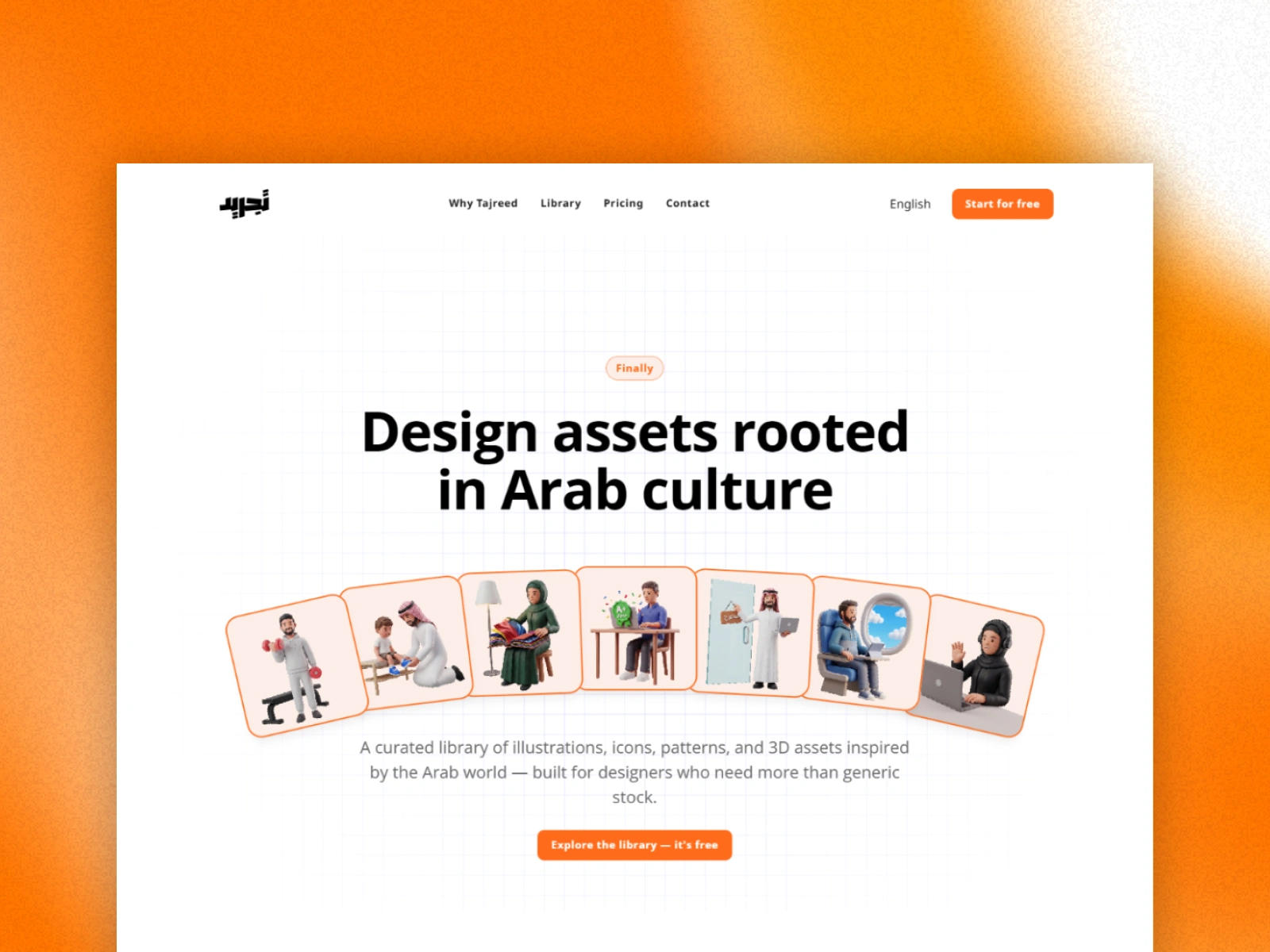
I wanted to eliminate that friction. My goal with Tajreed was to build a gated visual asset library—images, icons, and 3D elements—where cultural relevance was the foundation, not an afterthought.
The Approach: Designing a tool, not a gallery
Most asset platforms are built like endless visual galleries. But a massive collection of files is useless if a user cannot find what they need in under ten seconds.
I made a strict decision early on to treat Tajreed as a search tool. Instead of relying on infinite scroll and flat tags, I engineered the discovery system around how designers actually think. Users can filter by category, by specific country, or by broader cultural regions like the Levant or North Africa. Getting this right required heavy, invisible work mapping out relational metadata and naming conventions so the front-end browsing experience would feel completely effortless.
The Architecture: Decoupling the front end from the logic
Framer is unmatched for speed and visual control, making it the perfect engine for the public marketing layer and the core UX flow. But building a complex, gated filtering system entirely inside a website builder is a recipe for a slow, bloated product.
To solve this, I split the stack. Framer handles the presentation, interaction, and pricing models, while Supabase acts as the heavy-lifting relational database in the background. This split kept the user interface incredibly light while ensuring the search and filtering logic could scale to thousands of assets without lagging.
The Operations Engine: n8n and a custom Framer Plugin
A platform like this usually demands an army of people doing manual data entry. Since I was building this solo, I had to engineer myself out of the content management process.
I set up an automated pipeline using n8n that pulls raw assets from Dropbox and uses AI to generate culturally accurate descriptions. But getting that data seamlessly into the site was another challenge. To bridge the gap, I built a custom Google Sheets sync Framer plugin.
Now, the n8n pipeline pushes the structured AI-generated metadata directly into a Google Sheet, and my custom plugin instantly syncs that sheet with the front end. What could have been hours of repetitive daily uploading is now a completely frictionless background process.
The Trade-off: Ignoring native features to validate faster
While I built complex custom workflows for the backend, I deliberately chose to do things the "hard way" on the front end when it came to translation. Tajreed is fully bilingual, but I opted not to use Framer’s native Localization infrastructure for the MVP.
Instead, I manually duplicated the Arabic and English pages. It was tedious to maintain, but it was a calculated trade-off. I wanted absolute proof that users valued the bilingual support before I invested time and money into configuring perfect localization scaling. I would rather validate an assumption manually than over-engineer a feature nobody wants.
The Takeaway
Tajreed is the clearest reflection of how I build digital products. It is not just a pretty interface. It is a highly specific solution for a neglected audience, backed by deep system design, custom plugin development, and workflow automation. It proves that when you understand both design and code, you can build tools that look simple on the surface but carry massive technical leverage underneath.
Like this project
Posted Jun 19, 2026
Designed Tajreed, a culturally relevant visual asset library for Arab contexts.