Integrating Design Thinking at Integral Care Workshop

Justin Hale


Overview
Project Scope: 1 hour
Project Type: Brainstorming, Teaching
Role: UX Researcher, Presenter, Facilitator
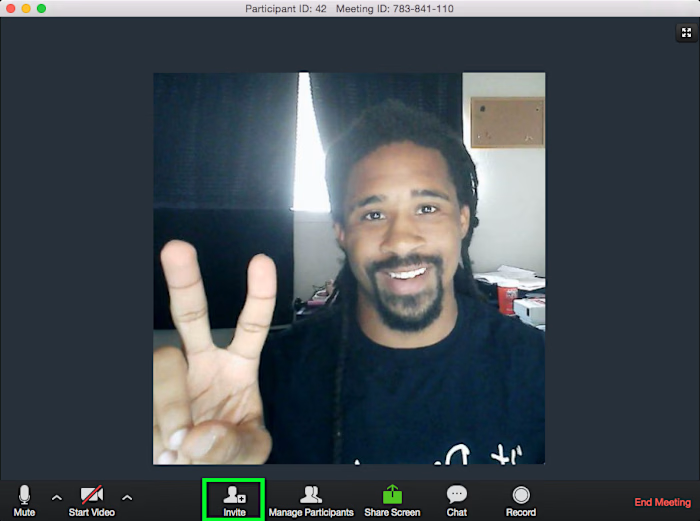
Tools: Miro, Microsoft Teams, Timer
UX Techniques: How Might We (HMW), Rapid Ideation, Effort/Impact Scale
Participants: Integral Staff Communications Division (12 People), including the Chief Strategist (CSO) and Director of Communications.
The inaugural conference, held in November 2000, was the first in Texas and only the third in the United States to focus on the healthcare needs of African Americans. The event was created to confront systemic and cultural biases that have historically limited healthcare access for African Americans.
Hosted by Integral Care, Travis County’s Local Mental Health and Intellectual and Developmental Disability Authority, the conference aims to provide tools and resources to build well-being and create a foundation for physical and mental health, enabling individuals to reach their full potential.
Problems
Staff members were tasked with leading a department meeting on any topic that might benefit or interest the team. While the team was mostly extroverted, this created challenges in brainstorming, as introverts often felt less comfortable speaking up. The extroverts tended to dominate discussions, overshadowing quieter participants.
To address this, I focused on a brainstorming activity that introduced design thinking principles and asynchronous software (Miro) to provide equal participation opportunities.
Solution
Introduce design thinking techniques and tools like Miro to facilitate brainstorming and ideation, ensuring all voices are heard.
My Role
I conceptualized and facilitated the workshop, guiding the team through each phase of the design-thinking process.
Workshop Breakdown
Part 1: Challenge Statement: 7 minutes of Rapid Ideation
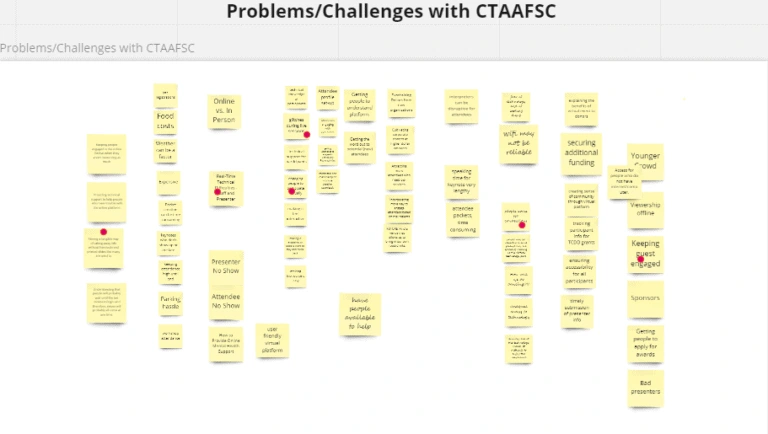
The team brainstormed problems and challenges for the Central Texas African-American Family Support Conference (CTAAFSC), which would be virtual for the first time. Participants used sticky notes to generate as many ideas as possible without discussion.
Outcome:
70 ideas were generated.
Encouraged the team to think from a user experience perspective.
Part 2: Presentation: 10 minutes
– “You have 5 seconds!”
Each participant had 5–10 seconds to present their ideas. This format allowed extroverts to share freely while minimizing pressure on introverts.
Outcome:
Opened the floor for diverse perspectives.
Prevented premature problem-solving.
Part 3: Vote & Organize: 4 minutes
Participants were given two red dots to vote for their favorite ideas. After voting, the top four ideas were organized.
Outcome:
Focused the team on key challenges without discussion.
Part 4: How Might We (HMW): 7 minutes
The team reframed the top challenges into How Might We (HMW) questions to shift the focus from problems to solutions.
Outcome:
Generated actionable questions, e.g., “How might we educate users on the platform?”
Part 5: Back to Ideation & Voting: 7 minutes
Using the HMW questions, the team brainstormed solutions. Each participant had 5–10 seconds to present their ideas, followed by voting.
Outcome:
35 solutions generated.
Part 6: Prioritization: 3 minutes
Solutions were grouped and prioritized using an affinity mapping approach.
Outcome:
Top 5 solutions identified.
Part 7: Effort/Impact Scale: 5 minutes
The team evaluated the top solutions on an effort/impact matrix to determine feasibility and effectiveness.
Outcome:
Clear understanding of viable solutions.
The final step involved creating actionable tasks for the selected solutions.
Outcome:
A live chatbox was implemented, addressing:
Help desk functionality.
FAQs.
Live tutorials.
Project Learnings
Inclusivity in brainstorming: Some of the best solutions came from quieter team members. Providing structured activities ensures everyone’s ideas are heard.
Time management: Design thinking workshops can run over time. Building in buffer time is critical for success.
Like this project
Posted Feb 23, 2026
Led rapid design thinking workshop using Miro for inclusive brainstorming. Guided team through HMW, ideation, and prioritization. Live chatbot deployed.
Likes
0
Views
14
Timeline
Oct 31, 2000 - Ongoing
Clients
Integral Care